
The essence of a nutation drive lies in gyroscopic motion, specifically the rotation of a rigid body about a fixed point. This principle, when applied to mechanical transmission systems, results in compact, high-ratio speed reducers. A prominent configuration utilizes a pair of meshing bevel gears to achieve this motion conversion. This article presents a detailed kinematic analysis of such a nutation drive system employing internal meshing bevel gears.
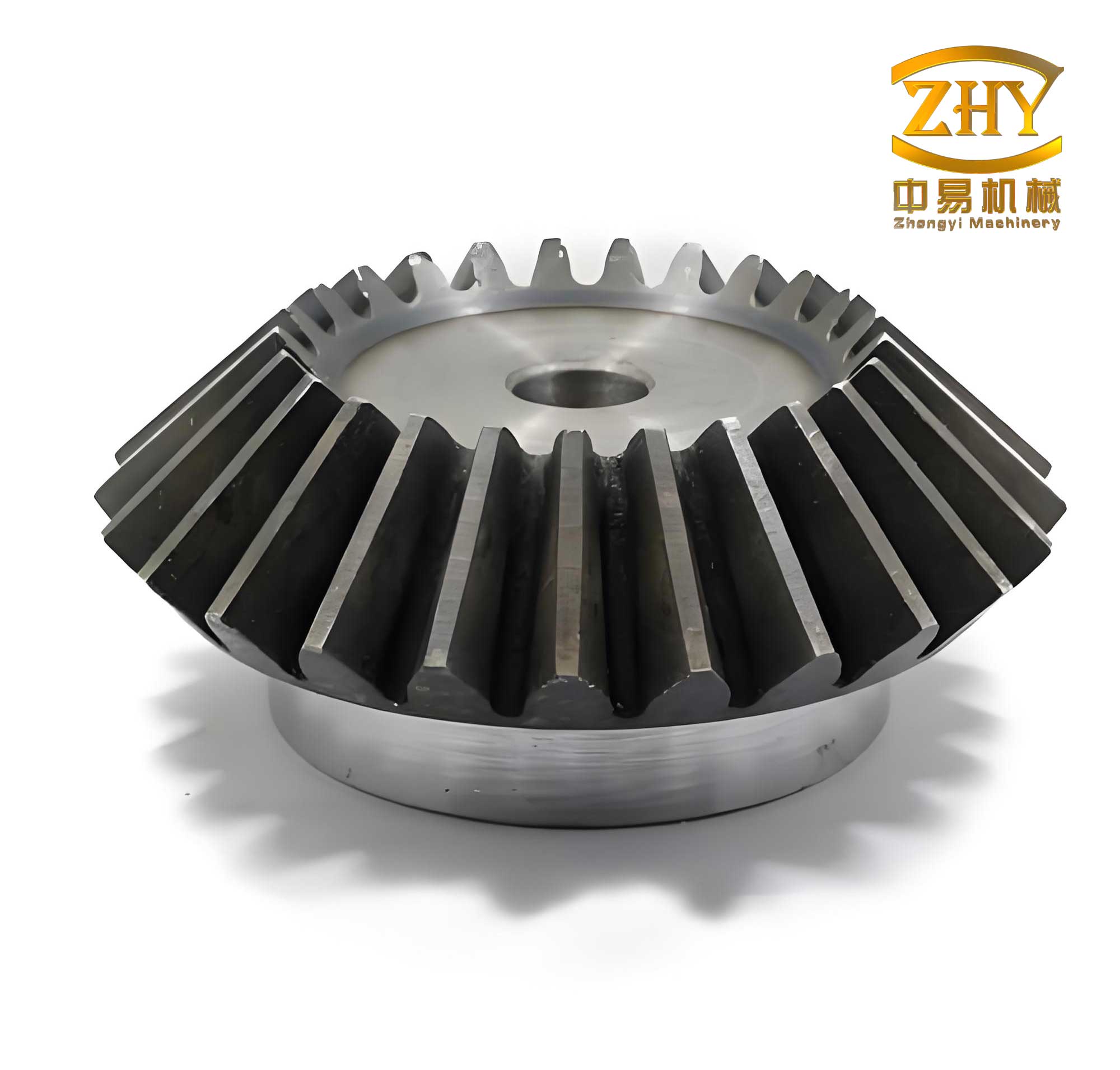
The fundamental mechanism comprises an input shaft, an output shaft aligned coaxially with the input, a wobbling shaft (or crankshaft) mounted at an angle (the nutation angle) to the input axis, and a pair of bevel gears. The outer bevel gear, termed the nutating gear or wobble gear, is connected to the wobbling shaft but prevented from rotating about its own axis by a pin or similar constraint. The inner bevel gear, termed the output gear, is fixed to the output shaft. As the input shaft rotates, it forces the nutating bevel gear to undergo a compound rotational motion about the fixed point where the vertices of the two bevel gears coincide. This motion is then transmitted through the meshing of the bevel gear teeth to the output bevel gear, resulting in a reduced speed and increased torque at the output. The key to analyzing this system is describing the complex motion of the nutating bevel gear.
Kinematics of the Nutating Bevel Gear
The motion of the nutating bevel gear is a classic case of a rigid body rotating about a fixed point. Its orientation and angular velocity in space can be elegantly described using Euler angles. We define two coordinate systems: a fixed frame \( O\text{-}\xi\eta\zeta \) and a body-fixed frame \( O\text{-}xyz \) attached to the nutating bevel gear, with their common origin \( O \) at the fixed point (the common apex of the bevel gears). The three Euler angles are:
- Precession Angle (\(\phi\)): The rotation of the nutating gear’s axis (\(Oz\)) about the fixed vertical axis \(O\zeta\). For a constant input speed \(\omega_H\), we have \(\phi = \omega_H t\).
- Nutation Angle (\(\theta\)): The constant angle between the nutating gear’s axis (\(Oz\)) and the fixed axis (\(O\zeta\)). It is determined by the pitch cone angles of the meshing bevel gears, \(\delta_1\) and \(\delta_2\), typically as \(\theta = \pi – (\delta_1 + \delta_2)\) or a similar relation depending on the internal meshing configuration.
- Spin Angle (\(\psi\)): The rotation of the nutating bevel gear about its own axis (\(Oz\)) relative to the wobbling shaft. If the gear is prevented from free spin, this angle is related to the relative motion. For a constant relative angular velocity \(\omega_1^H\), we have \(\psi = -\omega_1^H t\). The negative sign often indicates direction relative to the chosen positive sense.
The total angular velocity vector \(\boldsymbol{\omega}\) of the nutating bevel gear is the vector sum of the time derivatives of these three rotations:
$$ \boldsymbol{\omega} = \dot{\phi}\, \mathbf{e}_\zeta + \dot{\theta}\, \mathbf{i}_1 + \dot{\psi}\, \mathbf{k} $$
where \(\mathbf{e}_\zeta\) is the unit vector along \(O\zeta\), \(\mathbf{k}\) is the unit vector along \(Oz\), and \(\mathbf{i}_1\) is a unit vector along the line of nodes.
To obtain usable component forms, we project this angular velocity onto both the body-fixed (\(O\text{-}xyz\)) and space-fixed (\(O\text{-}\xi\eta\zeta\)) coordinate systems. Through geometric decomposition of the component vectors, we derive the Euler kinematic equations.
Angular Velocity in the Body-Fixed Frame (\(O\text{-}xyz\))
Expressing \(\boldsymbol{\omega}\) in terms of its components along the moving axes \(x, y, z\) attached to the nutating bevel gear yields:
$$ \begin{align*}
\omega_x &= \dot{\phi} \sin\theta \sin\psi + \dot{\theta} \cos\psi \\
\omega_y &= \dot{\phi} \sin\theta \cos\psi – \dot{\theta} \sin\psi \\
\omega_z &= \dot{\phi} \cos\theta + \dot{\psi}
\end{align*} $$
Substituting the defined relations \(\dot{\phi} = \omega_H\), \(\dot{\theta}=0\) (constant nutation angle), and \(\dot{\psi} = -\omega_1^H\), we get:
$$ \begin{align*}
\omega_x &= \omega_H \sin\theta \sin(\omega_1^H t) \\
\omega_y &= \omega_H \sin\theta \cos(\omega_1^H t) \\
\omega_z &= \omega_H \cos\theta – \omega_1^H
\end{align*} $$
Angular Velocity in the Space-Fixed Frame (\(O\text{-}\xi\eta\zeta\))
Similarly, projecting \(\boldsymbol{\omega}\) onto the fixed axes provides another useful perspective:
$$ \begin{align*}
\omega_\xi &= \dot{\theta} \cos\phi + \dot{\psi} \sin\theta \sin\phi \\
\omega_\eta &= \dot{\theta} \sin\phi – \dot{\psi} \sin\theta \cos\phi \\
\omega_\zeta &= \dot{\phi} + \dot{\psi} \cos\theta
\end{align*} $$
Again, with \(\dot{\phi} = \omega_H\), \(\dot{\theta}=0\), and \(\dot{\psi} = -\omega_1^H\):
$$ \begin{align*}
\omega_\xi &= -\omega_1^H \sin\theta \sin(\omega_H t) \\
\omega_\eta &= \omega_1^H \sin\theta \cos(\omega_H t) \\
\omega_\zeta &= \omega_H – \omega_1^H \cos\theta
\end{align*} $$
The following table summarizes the angular velocity components of the nutating bevel gear in both coordinate systems:
| Coordinate System | X/ξ-component | Y/η-component | Z/ζ-component |
|---|---|---|---|
| Body-Fixed (O-xyz) | $$ \omega_H \sin\theta \sin(\omega_1^H t) $$ | $$ \omega_H \sin\theta \cos(\omega_1^H t) $$ | $$ \omega_H \cos\theta – \omega_1^H $$ |
| Space-Fixed (O-ξηζ) | $$ -\omega_1^H \sin\theta \sin(\omega_H t) $$ | $$ \omega_1^H \sin\theta \cos(\omega_H t) $$ | $$ \omega_H – \omega_1^H \cos\theta $$ |
Relative Motion Velocity at the Bevel Gear Mesh
To analyze the meshing condition between the nutating bevel gear and the fixed-axis output bevel gear, we must determine their relative velocity at potential contact points. This is foundational for applying gear theory, whether using conjugate surface or conjugate curve methodologies. We establish a series of coordinate systems to facilitate this analysis using homogeneous transformation matrices.
- \(S_0(O_0-\xi, \eta, \zeta)\): Fixed in space, with \(O\zeta\) aligned with the output shaft (output bevel gear axis).
- \(S_1(O_1-x_1, y_1, z_1)\): Fixed to the output bevel gear, rotating with it about \(O\zeta\).
- \(S_p(O_p-x_p, y_p, z_p)\): Fixed in space, with \(Oz_p\) initially aligned with the nutating bevel gear’s axis. It provides an intermediate frame for the nutation angle \(\theta\).
- \(S_2(O_2-x_2, y_2, z_2)\): Fixed to the nutating bevel gear, rotating with it.
Let \(\varphi_1\) be the rotation angle of the output bevel gear, with a constant transmission ratio \(i = \omega_1^H / \omega_1 = \phi / \varphi_1\), implying \(\varphi_1 = \phi / i\). The angular velocities are:
$$ \boldsymbol{\omega}_1 = \omega_1 \mathbf{e}_\zeta = (0, 0, \omega_1)^T \quad \text{(in \(S_0\))} $$
$$ \boldsymbol{\omega}_2 = (\omega_\xi, \omega_\eta, \omega_\zeta)^T \quad \text{(in \(S_0\), from Euler equations)} $$
The transformation between coordinate systems is described by \(4 \times 4\) homogeneous matrices, combining rotation and translation. The key transformations are:
| Transformation | Homogeneous Matrix \(M_{ij}\) | Description |
|---|---|---|
| \(S_1 \rightarrow S_0\) | $$ M_{01} = \begin{bmatrix} \cos\varphi_1 & -\sin\varphi_1 & 0 & 0 \\ \sin\varphi_1 & \cos\varphi_1 & 0 & 0 \\ 0 & 0 & 1 & 0 \\ 0 & 0 & 0 & 1 \end{bmatrix} = \begin{bmatrix} \cos(\phi/i) & -\sin(\phi/i) & 0 & 0 \\ \sin(\phi/i) & \cos(\phi/i) & 0 & 0 \\ 0 & 0 & 1 & 0 \\ 0 & 0 & 0 & 1 \end{bmatrix} $$ | Rotation of output gear about ζ-axis. |
| \(S_0 \rightarrow S_p\) | $$ M_{p0} = \begin{bmatrix} 1 & 0 & 0 & 0 \\ 0 & \cos\theta & -\sin\theta & 0 \\ 0 & \sin\theta & \cos\theta & 0 \\ 0 & 0 & 0 & 1 \end{bmatrix} $$ | Fixed rotation by nutation angle θ. |
| \(S_p \rightarrow S_2\) | $$ M_{2p} = \begin{bmatrix} \cos\phi & -\sin\phi & 0 & 0 \\ \sin\phi & \cos\phi & 0 & 0 \\ 0 & 0 & 1 & 0 \\ 0 & 0 & 0 & 1 \end{bmatrix} $$ | Precession rotation of nutating gear. |
| \(S_1 \rightarrow S_2\) | $$ M_{21} = M_{2p} M_{p0} M_{01} $$ | Composite transformation. |
The explicit form of \(M_{21}\) is:
$$ M_{21} = \begin{bmatrix}
\cos\phi \cos(\phi/i) + \sin\phi \sin(\phi/i) \cos\theta & \cos\phi \cos\theta \sin(\phi/i) – \cos(\phi/i) \sin\phi & \sin(\phi/i) \sin\theta & 0 \\
\cos(\phi/i) \cos\theta \sin\phi – \cos\phi \sin(\phi/i) & \cos(\phi/i) \cos\phi \cos\theta + \sin\phi \sin(\phi/i) & \cos\phi \sin\theta & 0 \\
-\sin\phi \sin\theta & -\cos\phi \sin\theta & \cos\theta & 0 \\
0 & 0 & 0 & 1
\end{bmatrix} $$
The relative velocity vector \(\mathbf{v}^{12}\) at a point is fundamental for gear mesh analysis. In the fixed frame \(S_0\), it is given by:
$$ \mathbf{v}^{120} = \boldsymbol{\omega}_1 \times \mathbf{r}^{10} – \boldsymbol{\omega}_2 \times \mathbf{r}^{10} $$
where \(\mathbf{r}^{10}\) is the position vector of the point in \(S_0\). This can be expressed in matrix form using skew-symmetric matrices \(W\) representing the cross product:
$$ \mathbf{v}^{120} = W_1 \mathbf{r}^{10} – W_2 \mathbf{r}^{10} = (W_1 – W_2) \mathbf{r}^{10} $$
Here,
$$ W_1 = \begin{bmatrix} 0 & -\omega_{1\zeta} & \omega_{1\eta} & 0 \\ \omega_{1\zeta} & 0 & -\omega_{1\xi} & 0 \\ -\omega_{1\eta} & \omega_{1\xi} & 0 & 0 \\ 0 & 0 & 0 & 0 \end{bmatrix} = \begin{bmatrix} 0 & -\omega_1 & 0 & 0 \\ \omega_1 & 0 & 0 & 0 \\ 0 & 0 & 0 & 0 \\ 0 & 0 & 0 & 0 \end{bmatrix}, \quad W_2 = \begin{bmatrix} 0 & -\omega_{2\zeta} & \omega_{2\eta} & 0 \\ \omega_{2\zeta} & 0 & -\omega_{2\xi} & 0 \\ -\omega_{2\eta} & \omega_{2\xi} & 0 & 0 \\ 0 & 0 & 0 & 0 \end{bmatrix} $$
with \(\omega_{2\xi}, \omega_{2\eta}, \omega_{2\zeta}\) given by the space-fixed frame Euler equations.
To express this relative velocity in the coordinate system attached to the output bevel gear (\(S_1\)), which is convenient for defining tooth geometry, we apply the inverse coordinate transformation:
$$ \mathbf{v}^{121} = M_{10} \mathbf{v}^{120} = M_{10}(W_1 – W_2) M_{01} \mathbf{r}^{11} = M_{01}^T (W_1 – W_2) M_{01} \mathbf{r}^{11} $$
where \(\mathbf{r}^{11}\) is the position vector of the contact point in the output bevel gear’s frame \(S_1\). The matrix \(M_{01}^T\) is the transpose (and inverse for rotation matrices) of \(M_{01}\). This formulation, \(\mathbf{v}^{121} = M_{01}^T (W_1 – W_2) M_{01} \mathbf{r}^{11}\), provides a clear, computable expression for the relative sliding velocity at any point on the bevel gear tooth surface as a function of the gear rotation angles \(\phi\) and \(\varphi_1 = \phi/i\), the nutation angle \(\theta\), and the angular velocity components. This relative velocity vector is crucial for applying the fundamental gear meshing condition, which states that the relative velocity must lie in the common tangent plane to the mating tooth surfaces at the point of contact, i.e., it must be perpendicular to the common normal vector \(\mathbf{n}\):
$$ \mathbf{n} \cdot \mathbf{v}^{12} = 0 $$
This equation, when combined with the geometry of the chosen tooth profile (e.g., spherical involute for bevel gears), allows for the determination of the contact path and the verification of correct meshing action in the nutating bevel gear drive.
Conclusion
The kinematic analysis of a nutation drive based on internal meshing bevel gears reveals a systematic approach to understanding this compact and high-ratio transmission system. By modeling the nutating bevel gear’s motion as that of a rigid body rotating about a fixed point, its angular velocity can be precisely described using Euler angles and the corresponding kinematic equations. The derivation yields explicit formulas for the angular velocity components in both body-fixed and space-fixed coordinates, which are essential for dynamic analysis. Furthermore, by establishing a coordinate transformation framework based on homogeneous matrices, the relative motion velocity at the meshing interface between the nutating and output bevel gears can be rigorously derived. This relative velocity, expressed in the coordinate frame of the output gear, serves as the foundational input for applying conjugate gear meshing theory—whether using traditional surface-based methods or the emerging curve-based approaches—to analyze contact conditions, tooth geometry, and transmission accuracy. The methodology presented here transforms the abstract, three-dimensional motion of the nutating bevel gear into a structured, analytical framework, simplifying the design and analysis process for these sophisticated mechanical drives. This analysis underscores the unique kinematic advantages offered by bevel gear configurations in nutation drives, paving the way for their optimized use in applications requiring high reduction ratios within confined spaces, such as robotics and aerospace actuation systems.