
In the automotive industry, gear shaving stands as a pivotal finishing process for gear manufacturing, particularly in passenger vehicle transmissions. From my perspective, having been deeply involved in production practices, I recognize that over 90% of gear finishing operations rely on gear shaving due to its efficiency, cost-effectiveness, and ability to enhance gear precision by 1–2 grades, achieving levels 5–7 with surface roughness values of Ra = 1.25–0.32 μm. Moreover, gear shaving facilitates tooth profile modifications and compensates for heat treatment distortions, thereby reducing transmission noise and improving load capacity and service life. Among various methods, radial gear shaving is the most efficient, offering superior surface finish and extended tool life. However, as the final process before heat treatment, the accuracy of gears after gear shaving critically determines final product quality. In practical production, we frequently encounter issues such as tooth surface scratching, tooth profile concavity (often termed “mid-concavity” or “tooth profile hollowing”), S-shaped tooth profiles, and pitch deviations. This article, from a first-person viewpoint, delves into the analysis and countermeasures for tooth profile shape deviations in gear shaving, emphasizing gear shaving principles, root causes, and improvement strategies through optimized parameters and tool grinding techniques.
To understand these deviations, we must first grasp the fundamental principles of gear shaving. Gear shaving operates on the basis of crossed-helical gear engagement, where the gear shaving cutter and workpiece interact with non-parallel axes. At the contact point, the velocity directions differ, causing sliding motion along the tooth flanks. This relative sliding velocity serves as the cutting speed, enabling the removal of thin chips (0.005–0.01 mm thick) through a combination of cutting and挤压. The process involves a gear shaving cutter with helical teeth engaging a workpiece gear at a crossed-axis angle. Consider a gear shaving cutter with a left-hand helix angle $\beta_0$ and a workpiece gear with a right-hand helix angle $\beta_\omega$. The axis crossing angle $\Sigma$ is given by $\Sigma = \beta_0 \pm \beta_\omega$, where the plus sign applies for same-handed helices and the minus sign for opposite-handed ones. At the meshing point P, the circumferential velocities are $V_0$ for the cutter and $V_\omega$ for the workpiece, with normal components $v_{0n}$ and $v_{\omega n}$, and tangential components $v_{0t}$ and $v_{\omega t}$. The normal components must be equal for proper meshing: $v_{0n} = v_{\omega n}$, but the tangential components differ, resulting in relative sliding. The sliding velocity $V_p$, which is the cutting speed in gear shaving, can be expressed as:
$$V_p = v_{\omega t} \pm v_{0t}$$
where the sign depends on helix direction. This leads to the formula for cutting speed in gear shaving:
$$V_p = \frac{\pi d_{a0} n_0 \sin \Sigma}{60,000}$$
Here, $d_{a0}$ is the cutter outer diameter in mm, $n_0$ is the cutter rotational speed in rpm, and $\Sigma$ is the axis crossing angle in degrees. This sliding action, combined with feed pressure, allows the small grooves on the cutter flanks to shave material from the workpiece. Notably, the gear shaving process has a zero clearance angle at the flank, leading to挤压 effects, making it a hybrid of cutting and挤压. Understanding this gear shaving mechanism is crucial for diagnosing profile deviations.
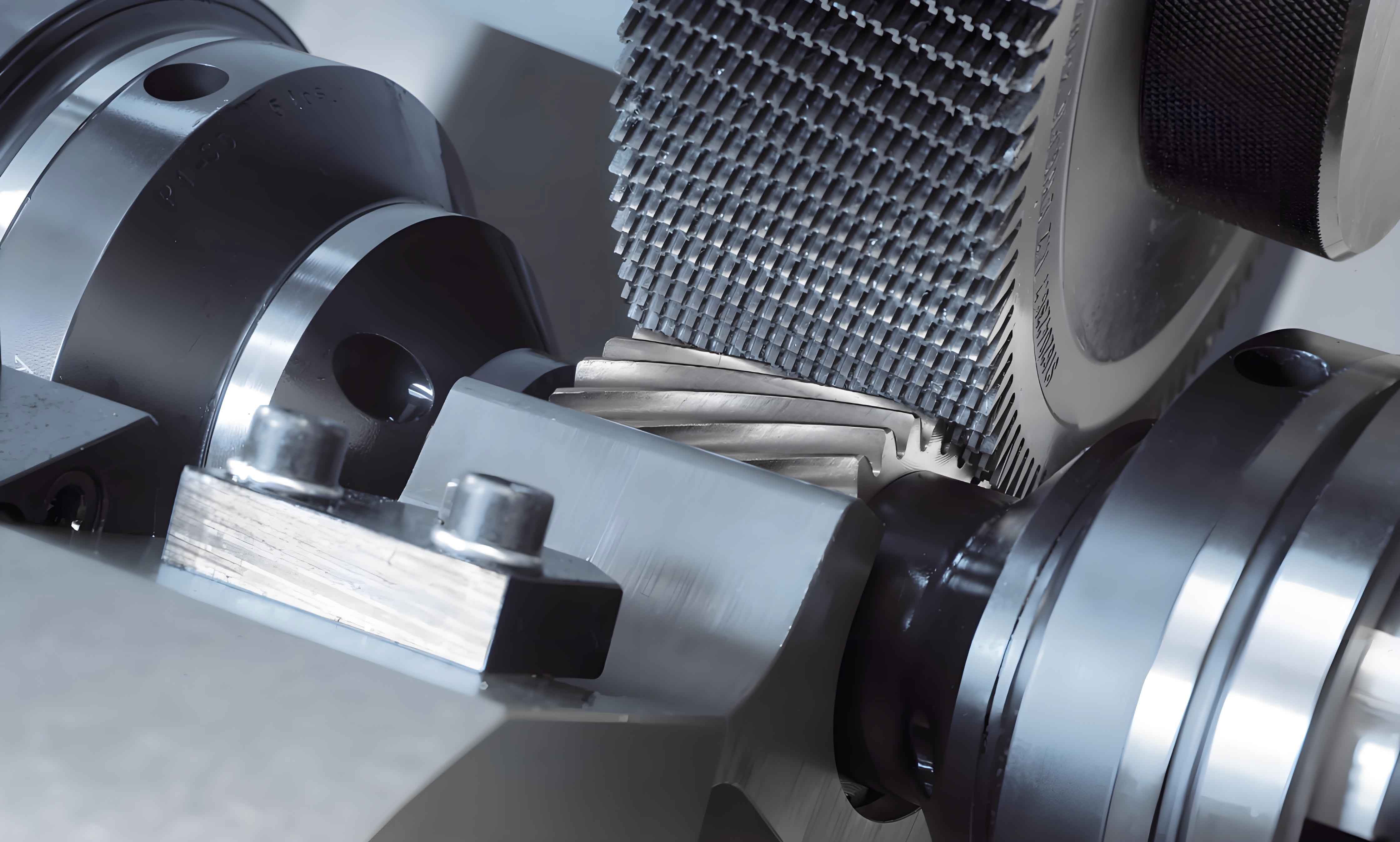
In our production experience, tooth profile shape deviations are common challenges in gear shaving. During the initial debugging of a Gleason-Hurth gear shaving machine for a transmission input shaft reverse gear, we observed significant tooth profile shape errors. The measurement reports revealed three primary issues that led to deviations in profile crowning and shape: asymmetry in left and right flank crowning, pronounced mid-concavity on the left flank, and a distinct S-shape on the right flank. These problems directly impacted gear quality, causing超差 in parameters such as profile form error $f_{f\alpha}$ and crowning $C_\alpha$. To systematically address these, we analyzed each issue from a gear shaving perspective.
First, the asymmetry in crowning between left and right flanks indicated不合理 gear shaving parameters. Since the gear shaving cutter’s left and right flanks were ground identically, the gear shaving process should yield symmetric workpiece profiles. The discrepancy arose from suboptimal gear shaving parameters, necessitating optimization. We focused on adjusting the gear shaving sequence to ensure uniform material removal. Key parameters included the number of reversals, reversal dwell time, feed rates during finishing, cutter speed, and final positioning dwell time. By increasing reversals, extending dwell times, reducing feed and speed during precision stages, and adding a final burnishing phase, we mitigated flank differences. Additionally, we optimized retraction positions to account for elastic recovery of the workpiece under cutting pressure. The table below summarizes the gear shaving parameter adjustments we implemented:
| Parameter | Before Optimization | After Optimization |
|---|---|---|
| Number of Reversals | 1 | 2 |
| Reversal Dwell Time | 0-1 s | 1-2 s |
| Finishing Feed Rate | High | Reduced by 30% |
| Cutter Speed in Finishing | High | Reduced by 20% |
| Final Position Dwell Time | 0 s | 1.5 s |
| Retraction Position | 0.01 mm | 0.005 mm with 1.5 s dwell |
These gear shaving parameter changes ensured that the cutter’s profile was accurately replicated on both flanks, resolving crowning asymmetry. This highlights the importance of精细 tuning in gear shaving operations.
Second, tooth profile mid-concavity, a well-documented issue in gear shaving, results from uneven pressure distribution during engagement, often due to the kinematic nature of crossed-axis meshing. In gear shaving, the contact between cutter and workpiece varies along the tooth height, leading to excessive material removal at the pitch circle region. Traditionally, this is countered by反向修形 of the gear shaving cutter during grinding—i.e., imparting a反向 profile to compensate. However, this approach can introduce S-shaped profiles, especially when the overlap ratio is insufficient. The S-shape, characterized by material deficiency at the tooth root (cutter tip), stems from low overlap ratio in gear shaving. The overlap ratio $\varepsilon$ in gear shaving should ideally be $\geq 1.5$ to ensure at least two teeth are in contact during meshing at the tip and root. When $\varepsilon$ is too low, pressure concentration at the root causes excessive shaving, creating an S-shape. From our analysis, we found that S-shapes consistently appeared as undercutting at the tooth root in measurement reports. To address both mid-concavity and S-shape in gear shaving, we adopted a segmented grinding method for the gear shaving cutter.
Our segmented grinding approach for gear shaving cutters involves dividing the tooth height into two sections based on the S-shape inflection point observed on workpiece reports. Each section is evaluated and ground separately to achieve a compensated profile. The key parameters for adjustment include the overall profile angle $f_{H\alpha}$, crowning $C_\alpha$, and segment-specific crowning $C_{\alpha1}$ and $C_{\alpha2}$. By manipulating these during gear shaving cutter regrinding, we can eliminate mid-concavity and control S-shapes. The process is guided by the following formulas for profile modification in gear shaving:
$$f_{H\alpha} = f_{H\alpha1} + f_{H\alpha2}$$
$$C_\alpha = C_{\alpha1} + C_{\alpha2}$$
where $f_{H\alpha1}$ and $f_{H\alpha2}$ correspond to profile angle components for the two segments, and $C_{\alpha1}$ and $C_{\alpha2}$ are crowning values. During production, as the gear shaving cutter wears and becomes thinner after each regrinding, the cutting conditions change. Therefore, we adjust grinding parameters based on pre-regrinding workpiece reports. The table below outlines our segmented grinding strategy for gear shaving cutters:
| Segment | Parameter | Adjustment Purpose |
|---|---|---|
| Upper (Tip Region) | $f_{H\alpha1}$, $C_{\alpha1}$ | Control mid-concavity and top flank shape |
| Lower (Root Region) | $f_{H\alpha2}$, $C_{\alpha2}$ | Mitigate S-shape and root flank shape |
| Overall | $f_{H\alpha}$, $C_\alpha$ | Ensure total profile and crowning accuracy |
This gear shaving cutter segmentation method allows for precise correction of localized deviations. For instance, if a workpiece report shows an S-shape with undercutting at the root, we increase $C_{\alpha2}$ to add material in that region during gear shaving. Similarly, for mid-concavity, we adjust $f_{H\alpha}$ and $C_{\alpha1}$ to reduce removal at the pitch circle. Through iterative application in gear shaving production, we have successfully resolved both mid-concavity and S-shape issues, achieving stable profile quality.
Furthermore, the role of gear shaving parameters extends beyond symmetry and shape correction. We也必须 consider factors like cutter speed and feed dynamics. The cutting speed $V_p$ in gear shaving, as derived earlier, influences surface finish and tool wear. Optimizing $V_p$ involves balancing $n_0$ and $\Sigma$ for efficient material removal without causing vibrations. In our practice, we use the following relationship to guide speed selection in gear shaving:
$$n_0 = \frac{60,000 V_p}{\pi d_{a0} \sin \Sigma}$$
where $V_p$ is typically set between 20–40 m/min for steel gears. Additionally, the axial feed rate $f_a$ in radial gear shaving affects profile accuracy. We correlate $f_a$ with the number of strokes and reversals to ensure complete coverage. For example, a lower $f_a$ with more reversals enhances precision but reduces productivity. Thus, gear shaving requires a trade-off that we manage through DOE (Design of Experiments).
From a broader perspective, the quality of tooth profiles after gear shaving hinges on two critical factors: the accuracy of the gear shaving cutter’s profile and the effectiveness of the gear shaving program in transferring that profile to the workpiece. Regarding crowning, if the gear shaving cutter’s left and right flank crowning values are similar, the gear shaving program must ensure minimal deviation in replication. Key programmable parameters in gear shaving include cutter rotation direction, speed, number of reversals, reversal positions, dwell times before reversal, and dwell time at the zero position. Slower cutter speeds, two reversals, and extended dwell times generally improve gear shaving outcomes by allowing better material flow and reducing dynamic errors. For gear shaving cutter grinding, especially when addressing S-shapes with segmented grinding, the skill of the operator in setting target parameters is vital. The评价 of grinding results requires understanding of profile graphs and tolerance limits.
In conclusion, based on our accumulated experience in mass production, gear shaving remains a cornerstone of gear finishing, but it demands meticulous attention to detail. The analysis and countermeasures for tooth profile shape deviations in gear shaving revolve around optimizing process parameters and adopting advanced tool grinding techniques. We have demonstrated that through parameter adjustments—such as增加 reversals and dwell times—and segmented gear shaving cutter grinding, issues like crowning asymmetry, mid-concavity, and S-shapes can be effectively mitigated. The formulas and tables provided herein serve as practical guides for gear shaving practitioners. Ultimately, successful gear shaving relies on a synergy between precise cutter geometry and a well-tuned shaving cycle, ensuring that gears meet stringent automotive standards for noise, durability, and performance. As gear shaving technology evolves, continuous improvement in these areas will further enhance its efficacy in modern manufacturing.