
In modern mechanical engineering, the transmission of power and motion relies heavily on gear systems. Among various gear types, helical gears are distinguished by their superior performance characteristics, including smoother operation, reduced noise levels, and higher load-carrying capacity due to a larger contact ratio. These advantages make them the preferred choice in demanding applications such as aerospace, marine propulsion, and heavy industrial machinery. However, the very nature of their operation—involving complex, time-varying contact conditions and significant nonlinearities—poses a substantial challenge for accurate stress analysis. The traditional method for calculating contact stress, based on the classical Hertzian formula, involves simplifying assumptions that treat the gear teeth as contacting cylinders, which can lead to discrepancies from real-world behavior. In my analysis, I employ an integrated simulation approach utilizing Pro/ENGINEER (Pro/E), ADAMS, and ANSYS to dynamically model the meshing process and accurately determine the contact stress distribution on the tooth flanks of helical gears. This methodology allows for a more precise and visual understanding compared to purely analytical methods.
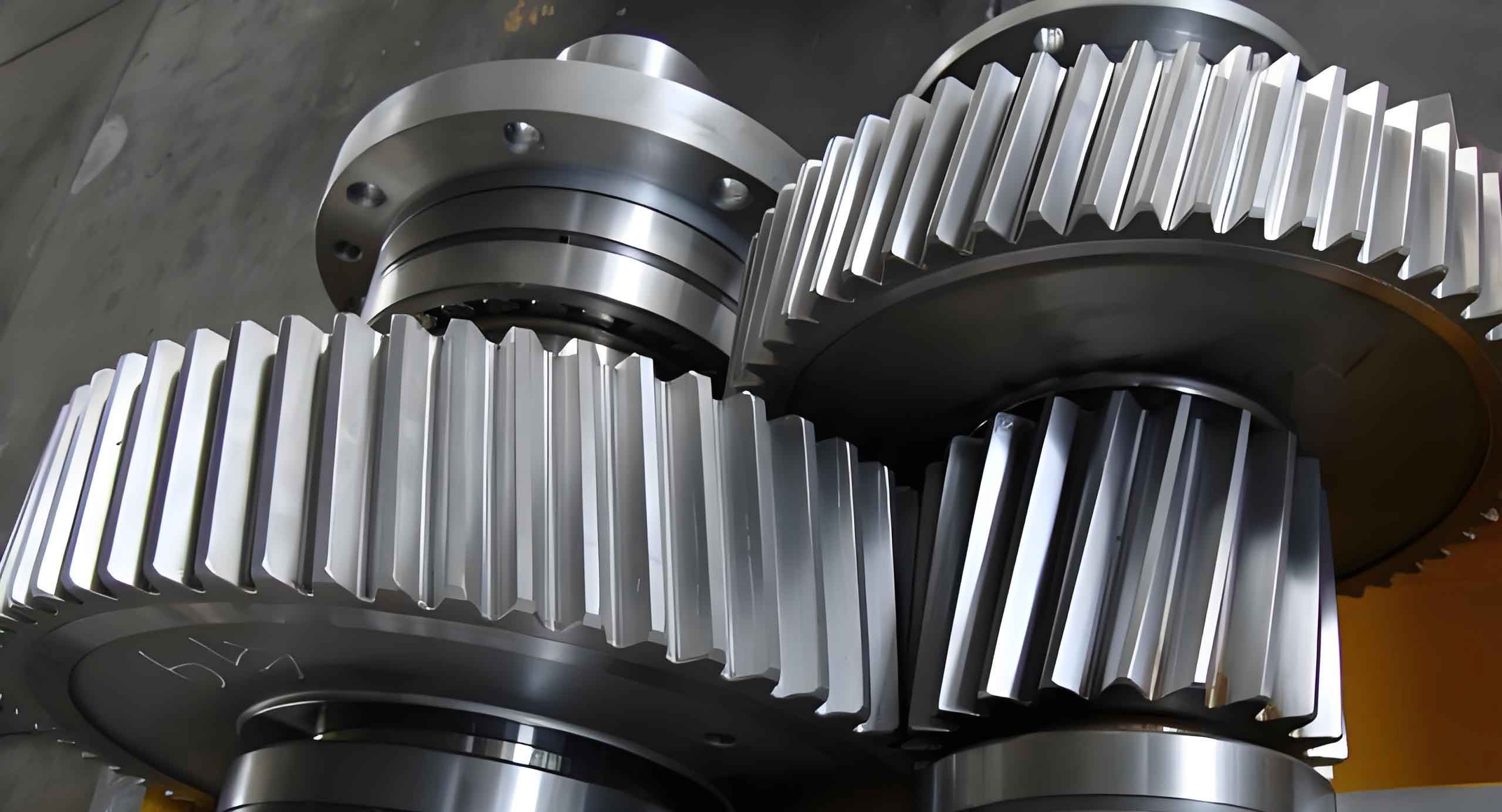
The foundation of any accurate simulation lies in a precise geometric model. I begin the process by creating a three-dimensional parametric model of the helical gears in Pro/E. The model is based on the fundamental mathematical equations governing the geometry: the involute curve for the tooth profile, the trochoid for the root fillet, and the helix for the tooth orientation. This parametric approach ensures dimensional accuracy and facilitates easy modification of key design parameters. For this specific analysis, I model a pair of helical gears with the geometric specifications detailed in Table 1.
| Parameter | Pinion (Gear 1) | Gear (Gear 2) |
|---|---|---|
| Number of Teeth (z) | 21 | 76 |
| Face Width (b) | 30 mm | 25 mm |
| Helix Angle (β) | 25° | |
| Normal Module (mₙ) | 2.25 mm | |
| Normal Pressure Angle (αₙ) | 20° | |
| Operating Pressure Angle (α’) | 24.1° | |
| Material | 20CrMnTi (Case-hardened Steel) | |
| Young’s Modulus (E) | 2.07 x 10⁵ MPa | |
| Poisson’s Ratio (μ) | 0.27 | |
Following the creation of the accurate 3D model, I export it in Parasolid (*.x_t) format and import it into the ADAMS multi-body dynamics software. In ADAMS, I construct a virtual prototype by defining material properties, constraints, and contacts. The pinion and gear shafts are assigned a revolute joint. The gear bodies are fixed to their respective shafts. The most critical interaction, the meshing contact between the teeth of the helical gears, is defined using a contact force algorithm based on an impact function. This requires careful selection of several contact parameters:
- Stiffness (K): Derived from the material properties and geometry of the contacting bodies. For a pair of helical gears, the stiffness coefficient is calculated using:
$$ K = \frac{4}{3} R^{\frac{1}{2}} E^{*} $$
where the equivalent radius \( R \) and the equivalent modulus \( E^{*} \) are given by:
$$ \frac{1}{R} = \frac{1}{R_1} + \frac{1}{R_2} \quad \text{and} \quad \frac{1}{E^{*}} = \frac{1 – \mu_1^2}{E_1} + \frac{1 – \mu_2^2}{E_2} $$
For helical gears, the radius of curvature must be considered in the normal plane. The normal radius of curvature at the pitch point is \( R_n = R_t / \cos \beta_b \), where \( R_t \) is the transverse radius of curvature and \( \beta_b \) is the base helix angle (\( \beta_b = \arctan(\tan \beta \cos \alpha_t) \)). The comprehensive normal radius of curvature is:
$$ R = \frac{R_{n1} R_{n2}}{R_{n1} + R_{n2}} = \frac{u d_1 \cos \alpha_t \tan \alpha’}{2(1+u)\cos \beta_b} $$
Substituting the values from Table 1, the stiffness coefficient \( K \) is computed to be approximately \( 4.25 \times 10^5 \, \text{N/mm}^{3/2} \).
- Force Exponent (e): Set to 1.5.
- Damping (C): Set to 100 N·s/mm.
- Penetration Depth (d): Set to 0.1 mm.
- Friction: A static coefficient of 0.08 and a dynamic coefficient of 0.05 are used, assuming adequate lubrication.
I apply a rotational motion to the pinion shaft using a step function to simulate a realistic start-up: \( \text{STEP}(time, 0, 0, 0.1, 8820) \) in degrees per second. A constant drive torque of \( 2.6 \times 10^5 \, \text{N·mm} \) is applied. I run the dynamic simulation for 1 second with a step size of \( 1 \times 10^{-4} \) seconds. The results provide crucial dynamic load data. The meshing force and input torque plots over time are extracted. After an initial transient period (0-0.2s), the system reaches a steady-state oscillatory condition. The meshing force fluctuates around an average value of approximately 14,057 N, with a peak value of 20,753 N. The theoretical meshing force calculated from the input torque is:
$$ F_n = \frac{2T}{d \cos \beta \cos \alpha_n} = 14,234 \, \text{N} $$
The close agreement (within 2%) between the simulated average force and the theoretical value validates the accuracy of my multi-body dynamics model for the helical gears. This peak load of 20,753 N is identified as the critical loading condition for the subsequent stress analysis.
For the detailed contact stress analysis, I turn to the ANSYS Finite Element Analysis (FEA) software. I import the Pro/E model of the gear pair into ANSYS. To ensure computational efficiency while maintaining accuracy—especially in the contact region—I simplify the model to four pairs of engaging teeth, based on Saint-Venant’s principle. The model is meshed with SOLID185 elements. I use a swept meshing method and apply local mesh refinement in the contact zones and at the tooth roots where high stress gradients are expected. The final FE mesh model is shown below, depicting the refined contact regions.
The contact between the helical gears is defined as a surface-to-surface, rigid-to-flexible contact pair. Since the pinion (driver) typically experiences more severe conditions, its tooth surface is designated as the “target” surface (rigid) using TARGE170 elements, and the gear’s tooth surface is designated as the “contact” surface (flexible) using CONTA174 elements. The Augmented Lagrange method is chosen for the contact algorithm due to its robustness and reduced sensitivity to contact stiffness. The contact stiffness factor (FKN) is set to 1.0, and the maximum allowable penetration (FTOLN) is set to 0.1 after several trial runs to balance accuracy and convergence.
Boundary conditions and loads are applied to replicate the meshing instant captured from the dynamics simulation. All degrees of freedom on the inner bore of the gear (the driven gear) are fully constrained. On the pinion, radial and axial displacements on the inner bore nodes are constrained, allowing only rotation. The peak torque of 460 N·m (from ADAMS simulation) is converted into a tangential force and applied to the nodes on the pinion’s inner bore. The tangential force per node \( F_t \) is calculated as:
$$ F_t = \frac{T}{r \cdot N} $$
where \( T = 460 \times 10^3 \, \text{N·mm} \), \( r = 20 \, \text{mm} \) is the bore radius, and \( N = 1065 \) is the total number of nodes on the bore surface. The constrained and loaded finite element model is now ready for solution.
I execute the nonlinear static analysis in ANSYS. The post-processing results reveal the contact stress distribution on the tooth flanks. The contour plot clearly shows that the contact stress is not uniformly distributed along the face width. The highest stress concentrations appear near the edges of the tooth faces, a phenomenon often associated with misalignment or edge effects. The maximum contact stress on the pinion is found to be 1,132 MPa, while on the gear it is 1,369 MPa. The central region of the tooth contact shows a more uniform and lower stress distribution. Non-engaged teeth show negligible stress, confirming the localized nature of the load.
It is essential to compare this FEA result with the traditional Hertzian theory. The theoretical contact stress \( \sigma_H \) is calculated as:
$$ \sigma_H = Z_E Z_H Z_\beta \sqrt{ \frac{2 K T_1}{b d_1^2} \cdot \frac{u+1}{u} } $$
where:
\( Z_E = 189.8 \sqrt{\text{MPa}} \) (elasticity coefficient),
\( Z_H = 2.28 \) (zone factor),
\( Z_\beta = \sqrt{\cos \beta} = \sqrt{\cos 25^\circ} \),
\( K = 1.2 \) (application factor),
\( T_1 = 2.6 \times 10^5 \, \text{N·mm} \),
\( b = 25 \, \text{mm} \),
\( d_1 = m_t \cdot z_1 / \cos \beta = 52.14 \, \text{mm} \),
\( u = 76/21 = 3.62 \).
Substituting the values yields:
$$ \sigma_H = 189.8 \times 2.28 \times \sqrt{\cos 25^\circ} \times \sqrt{ \frac{2 \times 1.2 \times 2.6 \times 10^5}{25 \times 52.14^2} \times \frac{3.62+1}{3.62} } \approx 1,411 \, \text{MPa} $$
The maximum FEA result of 1,369 MPa differs from the Hertzian calculation by approximately 3%. This close correlation validates the integrated simulation methodology. The minor discrepancy can be attributed to the simplifications inherent in the Hertz formula, which assumes perfect geometry and load distribution, whereas the FEA model accounts for the actual tooth geometry, localized contact, and edge effects. Therefore, the finite element analysis provides a more precise and visually comprehensive insight into the stress state of the helical gears.
This first-person analysis demonstrates a robust and effective workflow for analyzing helical gears. The integration of Pro/E for precise geometric modeling, ADAMS for dynamic load prediction under realistic operating conditions, and ANSYS for detailed nonlinear contact stress analysis forms a powerful virtual prototyping toolchain. The key findings are summarized below:
| Aspect | Method/Software | Key Result/Value | Purpose/Validation |
|---|---|---|---|
| 3D Modeling | Pro/ENGINEER (Parametric) | Accurate geometry of helical gears based on involute, trochoid, and helix equations. | Foundation for all subsequent simulations. |
| Dynamic Simulation | ADAMS (Multi-body Dynamics) | Peak Meshing Force: 20,753 N Average Force: 14,057 N (≈ Theoretical 14,234 N) |
Extracts time-varying operational loads; validates model against theory. |
| Contact Stress Analysis | ANSYS (Finite Element Analysis) | Max Contact Stress (FEA): 1,369 MPa Theoretical (Hertz): 1,411 MPa Error: ~3% |
Provides detailed, visual stress distribution; confirms accuracy of integrated method. |
| Overall Workflow | Pro/E → ADAMS → ANSYS | Seamless data transfer via Parasolid format; dynamic loads used as static FEA boundary conditions. | Enables a more realistic and accurate analysis than standalone analytical or FEA methods. |
The process successfully captures the dynamic behavior and complex contact mechanics of helical gears. The stress distribution pattern, showing higher stresses at the tooth edges, offers direct insight for design improvements, such as optimizing lead crowning to ensure a more uniform pressure distribution across the face width. This methodology extends beyond basic analysis; it provides a foundational platform for advanced studies on the fatigue life, durability, and design optimization of helical gears and complete transmission systems like gearboxes and differentials. By leveraging this integrated simulation approach, engineers can significantly reduce reliance on physical prototypes, accelerate the design cycle, and develop more reliable and efficient gear drives for critical applications.