
Spiral gears, commonly exemplified by helical and hypoid types, are widely utilized in power transmission systems due to their superior performance characteristics. These advantages include high transmission efficiency, smooth and quiet operation, a large contact ratio leading to better load distribution, high load-carrying capacity, compact structure, and minimal power loss during operation. These attributes make spiral gears indispensable in various industrial sectors, particularly within the automotive industry. However, the point-contact nature of spiral gear meshing, combined with sliding motion along the tooth flank, generates significant contact stresses. This often leads to severe surface wear, pitting, and even tooth breakage, imposing stringent requirements on their design, material selection, and operating conditions.
The following analysis delves into a specific case of premature failure in a spiral gear pair, drawing from a real-world application to illustrate common pitfalls and propose systematic improvements. The focus is on the underlying mechanisms of wear and the comprehensive design considerations necessary for reliable spiral gear operation.
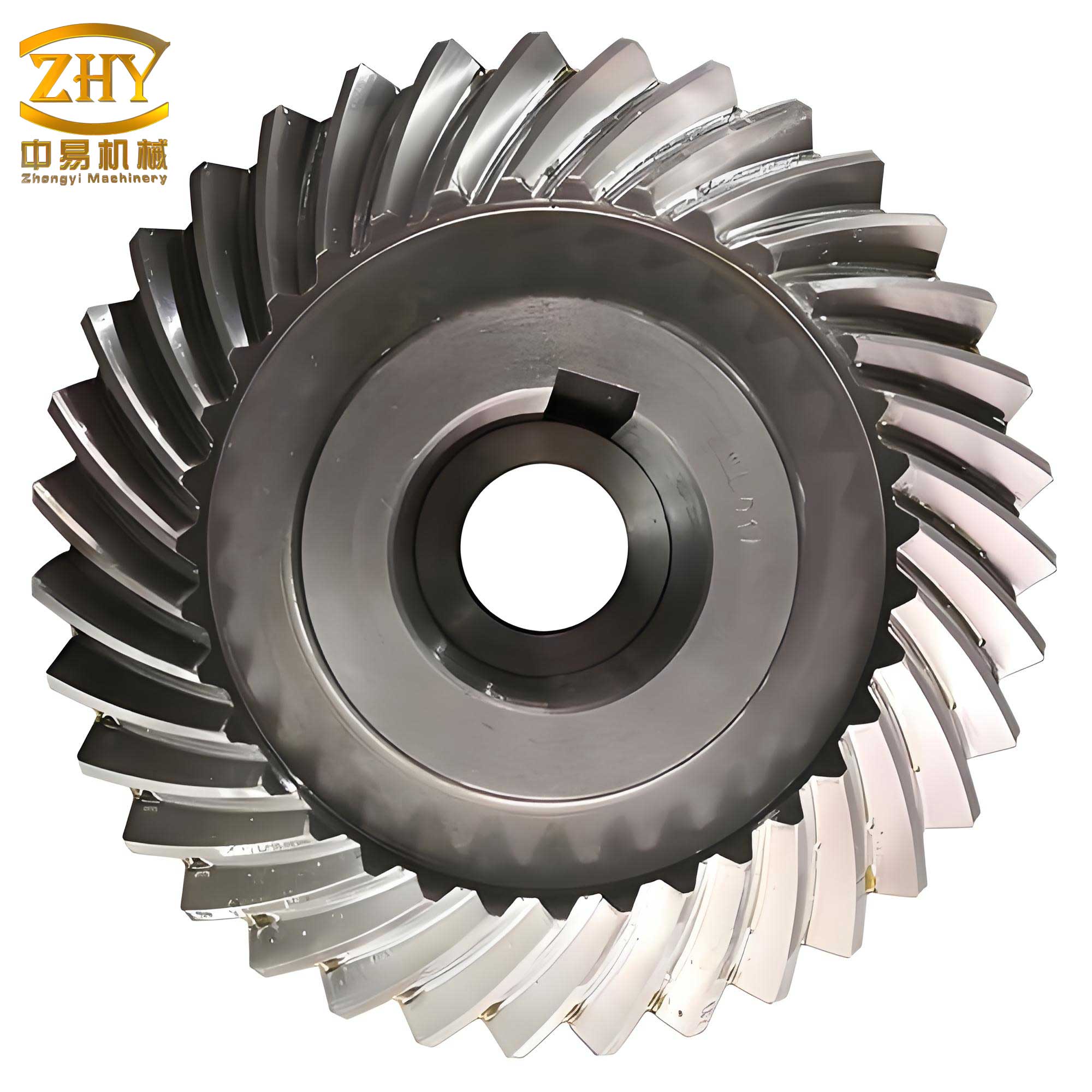
Case Study: Premature Wear in an Engine Spiral Gear Drive
Problem Description
The case originates from a type EQ3126 engine where a pair of spiral gears, used to transmit power from the camshaft to the oil pump drive shaft, exhibited severe early-stage wear. During factory reliability testing, pronounced wear patterns were discovered on the gear teeth after a very short operating period. When installed in a vehicle, the spiral gear drive failed after the vehicle had traveled less than 3,000 km, with nearly half of the tooth height on one gear worn away. This failure directly compromised the oil pump’s function, leading to potential catastrophic engine damage due to oil starvation. Visual inspection revealed that the camshaft gear, made of gray cast iron, suffered extreme scoring and deep grooves along the direction of meshing. In contrast, the oil pump drive shaft gear, manufactured from case-hardened 20Cr steel with a surface hardness of approximately 62 HRC, showed significantly less wear.
Technical Analysis and Root Cause Identification
Measurement of the failed spiral gear pair provided the following parameters:
| Parameter | Symbol | Camshaft Gear (1) | Oil Pump Gear (2) |
|---|---|---|---|
| Normal Module | $m_n$ | 1.58 mm (Non-standard, from DP=16) | |
| Normal Pressure Angle | $\alpha_n$ | 14.5° (Non-standard) | |
| Number of Teeth | $z$ | 13 | 13 |
| Helix Angle | $\beta$ | 60° | 30° |
| Pitch Diameter | $d$ | 41.28 mm | 23.83 mm |
| Center Distance | $a$ | 32.5 mm | |
The oil pump operating conditions were: speed $n = 2300 \text{ rpm}$, outlet pressure $p = 490 \text{ kPa}$, and flow rate $Q = 21 \text{ L/min}$. The resulting torque on the pump shaft is calculated as:
$$ T_2 = \frac{p \cdot Q}{2\pi n} \approx 830 \text{ N·mm} $$
Assuming negligible friction losses, the normal force at the pitch point can be estimated. First, we find the transverse pressure angle $\alpha_t$ and base helix angle $\beta_b$:
$$ \tan\alpha_t = \frac{\tan\alpha_n}{\cos\beta} $$
$$ \sin\beta_b = \sin\beta \cdot \cos\alpha_n $$
For the camshaft gear ($\beta_1 = 60°$):
$$ \alpha_{t1} = \arctan\left(\frac{\tan(14.5°)}{\cos(60°)}\right) \approx 25.1° $$
$$ \beta_{b1} = \arcsin(\sin(60°) \cdot \cos(14.5°)) \approx 58.1° $$
The transmitted torque on the camshaft gear $T_1 = T_2 = 830 \text{ N·mm}$. The normal force $F_n$ is:
$$ F_n = \frac{2 T_1}{d_1 \cos\alpha_{t1} \cos\beta_{b1}} $$
Substituting the values:
$$ F_n = \frac{2 \times 830}{41.28 \times 10^{-3} \times \cos(25.1°) \times \cos(58.1°)} \approx 83 \text{ N} $$
Primary Design Flaws:
- Unbalanced Helix Angle Distribution: Although the gear ratio is 1 ($z_1=z_2$), the helix angles are 60° and 30°. This results in significantly different pitch diameters ($d_1 > d_2$). Geometrically, this configuration resembles a speed-increasing drive from the camshaft to the oil pump shaft. Speed-increasing drives typically have lower mechanical efficiency than reducing drives, meaning the driving gear (camshaft gear) experiences higher reactive forces, increasing its susceptibility to wear.
- Improper Material Pairing: The combination of a soft gray cast iron gear against a hard case-hardened steel gear is fundamentally flawed for a point-contact spiral gear application. The soft material cannot withstand the high contact stresses.
- Excessive Contact Stress: The point contact in spiral gears, especially with a 90° shaft angle, leads to very high Hertzian contact stress, which was the ultimate cause of failure.
Quantitative Stress Analysis
The contact stress between two elastic bodies can be calculated using Hertzian contact theory. For the spiral gear pair, the contact at the pitch point can be modeled as between two ellipsoids. The material properties are:
| Material | Elastic Modulus (E) | Poisson’s Ratio ($\mu$) |
|---|---|---|
| Gray Cast Iron (Gear 1) | $E_1 = 1.4 \times 10^5 \text{ MPa}$ | $\mu_1 = 0.25$ |
| Case-Hardened Steel (Gear 2) | $E_2 = 2.0 \times 10^5 \text{ MPa}$ | $\mu_2 = 0.30$ |
The equivalent modulus $E’$ is given by:
$$ \frac{1}{E’} = \frac{1-\mu_1^2}{E_1} + \frac{1-\mu_2^2}{E_2} $$
$$ \frac{1}{E’} = \frac{1-0.25^2}{1.4 \times 10^5} + \frac{1-0.30^2}{2.0 \times 10^5} $$
$$ E’ \approx 1.54 \times 10^5 \text{ MPa} $$
The principal radii of curvature at the pitch point need to be determined. The radius in the profile direction (normal plane) is:
$$ R_i = \frac{d_i \sin\alpha_{ti}}{2\cos\beta_{bi}} $$
Calculating for both gears:
$$ R_1 = \frac{41.28 \times \sin(25.1°)}{2 \times \cos(58.1°)} \approx 17.4 \text{ mm} $$
$$ R_2 = \frac{23.83 \times \sin(\alpha_{t2})}{2 \times \cos(\beta_{b2})} $$
First, for gear 2: $\alpha_{t2} = \arctan(\tan(14.5°)/\cos(30°)) \approx 16.7°$, $\beta_{b2} = \arcsin(\sin(30°)\cdot\cos(14.5°)) \approx 28.9°$.
$$ R_2 = \frac{23.83 \times \sin(16.7°)}{2 \times \cos(28.9°)} \approx 3.9 \text{ mm} $$
The principal radii in the transverse plane ($R’_i$) are derived from the geometry of the involute helicoid surface and require numerical solution. For the given parameters, approximate values are: $R’_1 \approx 352.5 \text{ mm}$, $R’_2 \approx 211.0 \text{ mm}$.
The effective radius $R_e$ for contact is defined by the relative curvatures:
$$ \frac{1}{R_e} = \frac{1}{R_1} + \frac{1}{R_2} + \frac{1}{R’_1} + \frac{1}{R’_2} $$
$$ \frac{1}{R_e} = \frac{1}{17.4} + \frac{1}{3.9} + \frac{1}{352.5} + \frac{1}{211.0} \approx 0.0575 + 0.2564 + 0.0028 + 0.0047 \approx 0.3214 $$
$$ R_e \approx 3.11 \text{ mm} $$
The maximum Hertzian contact pressure $\sigma_{Hmax}$ for point contact is:
$$ \sigma_{Hmax} = \sqrt[3]{\frac{6 F_n E’^2}{\pi^3 R_e^2}} $$
Substituting the values $F_n = 83 \text{ N}$, $E’ = 1.54 \times 10^5 \text{ MPa}$, and $R_e = 3.11 \text{ mm}$:
$$ \sigma_{Hmax} = \sqrt[3]{\frac{6 \times 83 \times (1.54 \times 10^5)^2}{\pi^3 \times (3.11)^2}} $$
Carefully computing step-by-step: $(1.54 \times 10^5)^2 = 2.3716 \times 10^{10}$. $6 \times 83 \times 2.3716 \times 10^{10} \approx 1.181 \times 10^{13}$. $\pi^3 \approx 31.006$. $(3.11)^2 = 9.6721$. Denominator: $31.006 \times 9.6721 \approx 299.9$. Therefore, the fraction is $1.181 \times 10^{13} / 299.9 \approx 3.939 \times 10^{10}$. The cube root is $\sqrt[3]{3.939 \times 10^{10}} \approx 3406$. However, this result is in $\text{N/m}^2$? Wait, we must maintain consistent units: $F_n$ in N, $E’$ in Pa (N/m²), $R_e$ in m. Let’s convert all to meters: $F_n=83\text{ N}$, $E’=1.54\times10^{11} \text{ Pa}$, $R_e=3.11\times10^{-3} \text{ m}$.
Recalculate: $E’^2 = (1.54\times10^{11})^2 = 2.3716\times10^{22}$. $R_e^2 = (3.11\times10^{-3})^2 = 9.6721\times10^{-6}$. Numerator: $6 * 83 * 2.3716\times10^{22} \approx 1.181\times10^{25}$. Denominator: $\pi^3 * 9.6721\times10^{-6} \approx 31.006 * 9.6721\times10^{-6} \approx 2.999\times10^{-4}$. Fraction: $1.181\times10^{25} / 2.999\times10^{-4} = 3.939\times10^{28}$. $\sqrt[3]{3.939\times10^{28}} = \sqrt[3]{3.939} \times 10^{28/3} \approx 1.58 \times 10^{9.333} = 1.58 \times 10^{9} \times 10^{0.333} \approx 1.58 \times 10^{9} \times 2.154 \approx 3.40 \times 10^9 \text{ Pa}$ = 3400 MPa. This seems extremely high.
Let’s use the standard formula for line contact modified for initial point contact of spiral gears, often expressed as:
$$ \sigma_H = Z_E \sqrt{ \frac{F_n}{b} \cdot \frac{1}{R_e} } $$
Where $Z_E$ is the elasticity factor $\sqrt{\frac{1}{\pi \left( \frac{1-\mu_1^2}{E_1} + \frac{1-\mu_2^2}{E_2} \right)}}$, and $b$ is the face width (12 mm).
$$ Z_E = \sqrt{ \frac{1}{\pi \left( \frac{1-0.25^2}{1.4\times10^5} + \frac{1-0.30^2}{2.0\times10^5} \right) } } = \sqrt{ \frac{1}{\pi \left( \frac{0.9375}{1.4\times10^5} + \frac{0.91}{2.0\times10^5} \right) } } $$
$$ = \sqrt{ \frac{1}{\pi \left( 6.696\times10^{-6} + 4.55\times10^{-6} \right) } } = \sqrt{ \frac{1}{\pi \times 1.1246\times10^{-5} } } \approx \sqrt{ 28320 } \approx 168.3 $$
Now, $\frac{1}{R_e} \approx 0.3214 \text{ mm}^{-1} = 321.4 \text{ m}^{-1}$. $F_n/b = 83\text{ N} / 0.012\text{ m} \approx 6917 \text{ N/m}$.
$$ \sigma_H = 168.3 \times \sqrt{ 6917 \times 321.4 } = 168.3 \times \sqrt{ 2.223\times10^6 } $$
$$ = 168.3 \times 1491 \approx 251,000 \text{ kPa} = 251 \text{ MPa} $$
This is a more reasonable nominal contact stress. However, for the point-contact condition of spiral gears with sliding, the actual stress can be significantly higher due to stress concentration. Considering friction and dynamic loads, the peak stress can easily exceed 1000 MPa, which is far beyond the endurance limit of gray cast iron (typically 200-400 MPa for bending fatigue, contact fatigue limit is even lower). This confirms that the material pair was fundamentally inadequate for the generated stress, leading to immediate plastic deformation and severe wear of the softer cast iron spiral gear.
Systematic Improvement Strategies for Spiral Gear Drives
Based on the failure analysis, a comprehensive set of improvements can be formulated to enhance the durability and reliability of spiral gear transmissions. These strategies address design, material, manufacturing, and lubrication aspects.
1. Optimal Redesign of Gear Parameters
The primary goal is to balance the geometry to reduce stress concentration and improve efficiency. For a 90° shaft angle and a 1:1 ratio, the most balanced design uses equal or nearly equal helix angles and pitch diameters.
Option A: Equal Helix Angles, Standard Parameters.
Adopt standard metric parameters: $m_n = 1.75 \text{ mm}$, $\alpha_n = 20°$, $\beta_1 = \beta_2 = 45°$, $z_1 = z_2 = 13$.
The theoretical pitch diameter is: $d = \frac{m_n z}{\cos\beta} = \frac{1.75 \times 13}{\cos 45°} \approx \frac{22.75}{0.7071} \approx 32.17 \text{ mm}$.
Theoretical center distance: $a = d_1/2 + d_2/2 = 32.17 \text{ mm}$.
To achieve the required center distance of $a’ = 32.5 \text{ mm}$, a positive profile shift (modification) is required for both spiral gears.
Option B: Complementary Helix Angles, No Profile Shift.
Select helix angles such that the sum is 90° and the center distance matches exactly without modification.
The center distance formula is: $a = \frac{m_n}{2} \left( \frac{z_1}{\cos\beta_1} + \frac{z_2}{\cos\beta_2} \right)$.
With $a=32.5\text{ mm}$, $m_n=1.75\text{ mm}$, $z_1=z_2=13$, and $\beta_2 = 90° – \beta_1$, we solve for $\beta_1$:
$$ 32.5 = \frac{1.75}{2} \times 13 \times \left( \frac{1}{\cos\beta_1} + \frac{1}{\sin\beta_1} \right) $$
$$ \frac{1}{\cos\beta_1} + \frac{1}{\sin\beta_1} = \frac{32.5 \times 2}{1.75 \times 13} \approx \frac{65}{22.75} \approx 2.857 $$
Solving numerically, $\beta_1 \approx 49.7°$ and $\beta_2 \approx 40.3°$. The pitch diameters become:
$d_1 = 1.75 \times 13 / \cos(49.7°) \approx 35.1 \text{ mm}$.
$d_2 = 1.75 \times 13 / \cos(40.3°) \approx 29.9 \text{ mm}$.
The size disparity is reduced compared to the original design (60°/30°), leading to more balanced load sharing and contact conditions for the spiral gear pair.
2. Correct Material Selection and Heat Treatment
The material pair must be chosen to withstand the high contact stress inherent in spiral gear meshing. The general rule is to pair a hard, wear-resistant material with a slightly softer but tough material, or to use equally hard materials with excellent surface finish.
| Design Scenario | Recommended Material Pairing | Surface Hardness Goal | Rationale |
|---|---|---|---|
| Balanced Design (Option A, $\beta_1=\beta_2$) | Through-hardened Alloy Steel (e.g., 4140) / Through-hardened Alloy Steel | 50-55 HRC (Both gears) | Equal size and duty warrant identical, high-strength materials. |
| Slightly Unbalanced (Option B, $\beta_1 \neq \beta_2$) | Case-hardened Steel (e.g., 20CrMnTi) / Case-hardened Steel | 58-62 HRC (Both gears), or slightly harder on the larger gear | High surface hardness to resist pitting and wear from point contact. |
| High-Performance Application | Nitrided Steel / Nitrided Steel or Hardened Steel / Bronze (for one gear) | > 60 HRC (steel) / 80-100 HB (bronze) | Nitriding provides excellent wear resistance. Bronze pairing can reduce friction and galling. |
Critical Note: The original pairing of gray cast iron against hardened steel is unacceptable for heavily loaded spiral gears.
3. Control of Manufacturing and Assembly Quality
Precision is paramount for spiral gears due to their sensitivity to misalignment and tooth geometry.
- Matched Pair Manufacturing: The spiral gear pair should be manufactured, ground, and lapped as a matched set to ensure the sum of helix angles is exactly 90° and to optimize contact pattern.
- Precision Grinding: Tooth flanks should be precision ground or hard-skived after heat treatment to achieve a low surface roughness (e.g., $R_a < 0.4 \mu m$) and precise tooth geometry, minimizing stress concentrations.
- Selective Assembly: Gears should be selected and paired based on measured characteristics to achieve optimal meshing within the assembly.
- Accurate Alignment: The housing and bearings for the two shafts must ensure accurate 90° alignment and proper center distance to avoid edge loading on the spiral gear teeth.
4. Enhancement of Lubrication Conditions
Like worm gears, spiral gears exhibit high sliding velocities, generating heat and promoting wear. Effective lubrication is critical.
- High-Pressure Additives: Use lubricants with extreme pressure (EP) and anti-wear (AW) additives specifically formulated for gear applications involving high sliding contact.
- Adequate Viscosity: Select an oil viscosity grade high enough to maintain a protective elastohydrodynamic (EHD) film under the operating temperature and load. The minimum film thickness $h_{min}$ can be estimated by:
$$ h_{min} \propto (\eta_0 u)^{0.7} \cdot (E’)^{0.03} \cdot R_e^{0.43} \cdot F_n^{-0.13} $$
where $\eta_0$ is the dynamic viscosity and $u$ is the entrainment velocity. A higher viscosity index oil helps maintain viscosity across the operating temperature range.
- Positive Lubrication Supply: Implement a forced lubrication system with a dedicated pump and spray nozzles directed at the mesh inlet to ensure adequate oil flow for cooling and film formation on the spiral gear teeth.
- Filtration: Maintain strict oil cleanliness through effective filtration to prevent abrasive wear from contaminant particles.
Conclusion
The analysis of the EQ3126 engine spiral gear failure underscores the critical interplay between design, material science, and tribology in ensuring the reliability of spiral gear transmissions. The root causes—unbalanced helix angles leading to inefficient force transmission and a severely mismatched material pair—resulted in contact stresses that far exceeded the capabilities of the chosen cast iron. The subsequent improvement strategies provide a systematic framework: optimizing geometric parameters to balance loads and reduce stress, selecting appropriate hardened steel pairings, enforcing stringent manufacturing and assembly controls, and implementing a robust lubrication regime. Adherence to these principles is essential for mitigating wear and extending the service life of spiral gears in demanding applications, transforming them from a potential point of failure into a reliable and efficient component of the power transmission system.