
In my extensive experience with mechanical components, the integrity of gear shafts is paramount for the reliable operation of machinery. Recently, I encountered a critical failure involving gear shafts manufactured from 18CrNiMo7-6 steel, which developed severe longitudinal cracks during heat treatment. This prompted a thorough investigation to determine the root cause and prevent future occurrences. The gear shaft is a crucial element in power transmission systems, and any failure can lead to significant downtime and safety hazards. Therefore, understanding the failure mechanisms in gear shafts is essential for improving manufacturing processes and material selection.
The gear shafts in question were subjected to a standard heat treatment cycle: carburizing at 960°C, followed by quenching at 840°C in oil, and tempering at 170°C. However, during this process, multiple gear shafts exhibited longitudinal cracks that propagated from the surface towards the core, compromising their structural integrity. As an analyst, I initiated a multi-faceted examination to dissect the failure, focusing on the gear shaft’s material properties, crack characteristics, and processing conditions. The primary objective was to ascertain whether the cracking originated from metallurgical defects or procedural errors, with the gear shaft serving as the central subject of this study.
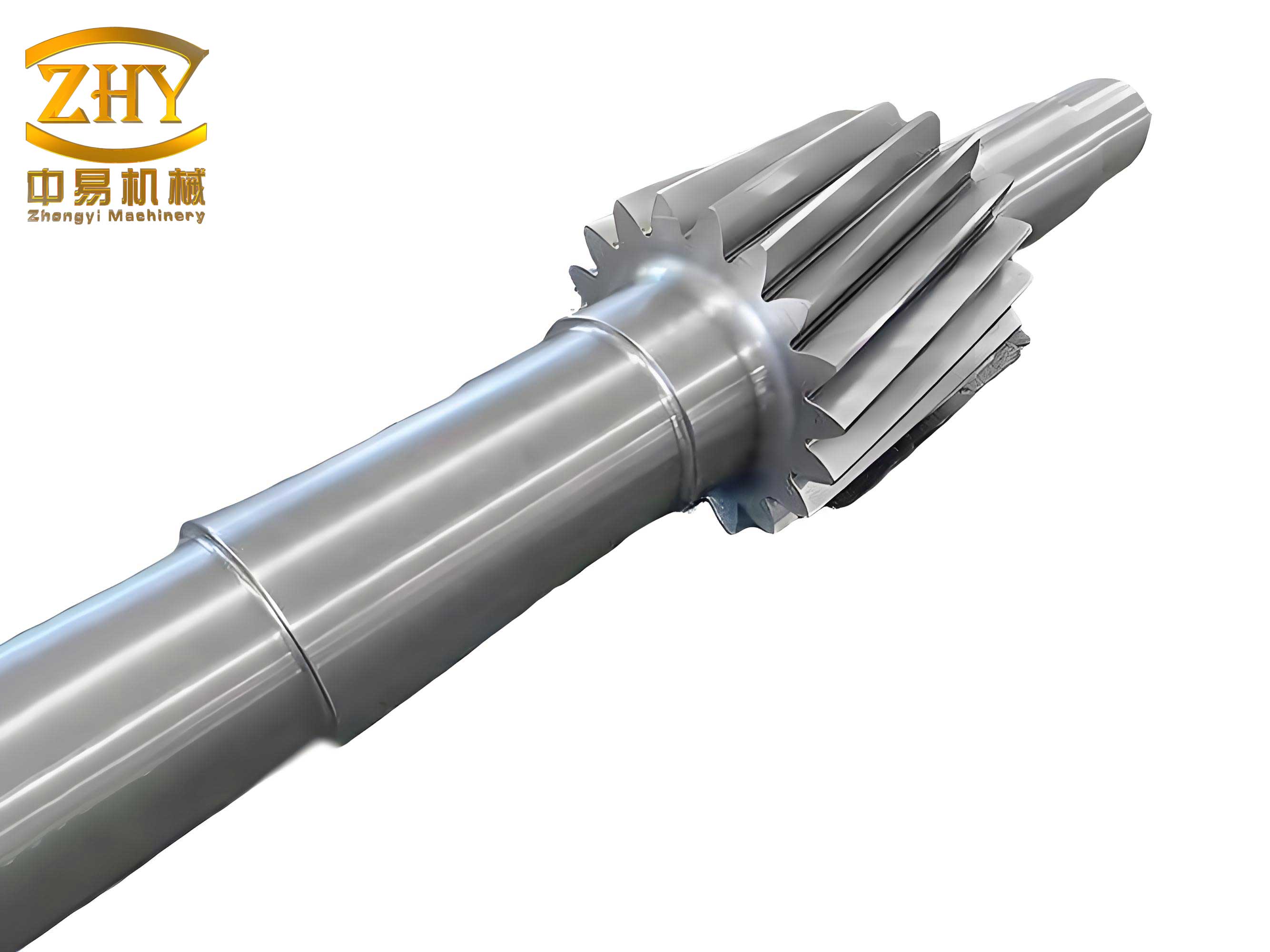
To begin, I conducted a macroscopic inspection of the cracked gear shafts. The cracks were axial in nature, extending along the length of the gear shaft and penetrating deep into the material. In one instance, the crack depth reached approximately 89 mm, initiating near the tooth root region, about 3 mm from the fillet. This location is a typical stress concentrator in gear shafts, making it susceptible to crack initiation. The crack surfaces were examined visually, revealing characteristics consistent with quenching cracks: sharp, straight paths with no signs of prior deformation. The macroscopic morphology indicated that the gear shaft failure was not due to overload but rather a result of internal stresses generated during heat treatment.
Next, I performed chemical analysis on samples taken from various locations of the gear shaft: the edge, mid-radius, and center. The composition of the gear shaft material was critical to rule out inhomogeneities that could predispose it to cracking. The results are summarized in Table 1, showing that the carbon and alloying elements were uniformly distributed, with no significant segregation. This uniformity in the gear shaft’s chemistry eliminated compositional anomalies as a contributing factor.
| Position in Gear Shaft | C (%) | Mn (%) | Si (%) | S (%) | P (%) | Ni (%) | Cr (%) | Mo (%) | Al (%) |
|---|---|---|---|---|---|---|---|---|---|
| Edge | 0.180 | 0.59 | 0.25 | 0.009 | 0.017 | 1.63 | 1.73 | 0.28 | 0.039 |
| Mid-Radius | 0.185 | 0.60 | 0.25 | 0.011 | 0.016 | 1.64 | 1.75 | 0.29 | 0.038 |
| Center | 0.190 | 0.60 | 0.26 | 0.010 | 0.017 | 1.64 | 1.73 | 0.29 | 0.039 |
The fracture surfaces of the gear shaft were then examined using scanning electron microscopy (SEM). The crack origin in each gear shaft was identified at the tooth root region, where stress concentrations are highest. In one gear shaft, the fracture mode was primarily intergranular, with some transgranular facets, indicating brittle failure. Energy-dispersive spectroscopy (EDS) did not reveal any significant non-metallic inclusions at the crack initiation site, except for isolated manganese sulfide inclusions measuring up to 270 µm in length. According to standard评级, these inclusions were rated at 1.5级, which is within acceptable limits for gear shaft materials and unlikely to be the sole cause of cracking. The absence of oxidation or decarburization along the crack faces confirmed that the cracking occurred after carburizing and during or after quenching, as no high-temperature exposure signs were present.
Microstructural analysis of the gear shaft involved preparing metallographic samples from sections near the crack. The microstructure consisted of tempered martensite and bainite in the core, with a carburized case showing tempered acicular martensite and retained austenite. The grain size was assessed using picric acid etching, revealing a fine grain structure of 7-8级, which is desirable for toughness in gear shafts. The cracks were observed to propagate through the matrix without deviation along grain boundaries or inclusion clusters, further supporting the notion of a stress-induced failure rather than a material defect. The hardness profile of the gear shaft was also measured, showing high surface hardness due to carburizing, which contributes to residual stresses during quenching.
To understand the cracking mechanism, I delved into the theory of quenching stresses in gear shafts. During quenching, the surface of the gear shaft cools rapidly, forming martensite, while the core cools slower, leading to thermal gradients and transformation stresses. The resultant stress state can be modeled using the following equation for thermal stress during quenching:
$$\sigma_{thermal} = E \alpha \Delta T / (1 – \nu)$$
where \(E\) is Young’s modulus, \(\alpha\) is the coefficient of thermal expansion, \(\Delta T\) is the temperature difference between surface and core, and \(\nu\) is Poisson’s ratio. For a gear shaft made of 18CrNiMo7-6 steel, the high hardenability increases the risk of martensitic transformation throughout the section, amplifying these stresses. Additionally, the volume change associated with martensite formation contributes to transformation stress:
$$\sigma_{transformation} = K \Delta V / V$$
where \(K\) is a material constant and \(\Delta V / V\) is the volumetric strain due to phase change. The combined stress can exceed the fracture strength of the material, leading to crack initiation in the gear shaft, particularly at stress concentrators like tooth roots.
The timing of tempering emerged as a critical factor. In the failed gear shafts, records indicated that there was a delay between quenching and tempering. For instance, one gear shaft waited 12.5 hours before tempering, while others with shorter delays (3-4 hours) did not crack. This delay allows for the continued transformation of retained austenite to martensite at room temperature, a phenomenon known as “autotempering” or “aging,” which adds to the internal stresses. The cumulative stress can be expressed as:
$$\sigma_{total} = \sigma_{thermal} + \sigma_{transformation} + \sigma_{aging}$$
where \(\sigma_{aging}\) represents the stress from ongoing phase transformations. If the gear shaft is not tempered promptly, \(\sigma_{total}\) may surpass the critical stress intensity factor \(K_{IC}\) for crack propagation, leading to longitudinal cracking. This aligns with the observation that cracks were more prevalent in winter, where ambient cooling rates could exacerbate thermal gradients in the gear shaft.
To quantify the risk, I considered the fracture toughness of the gear shaft material. For 18CrNiMo7-6 steel, the approximate fracture toughness is 50 MPa√m. The stress intensity for a surface crack in a gear shaft can be estimated using:
$$K_I = \sigma \sqrt{\pi a}$$
where \(a\) is the crack depth. Assuming a residual stress of 500 MPa from quenching and a crack depth of 1 mm at initiation, \(K_I\) calculates to about 28 MPa√m, which is below \(K_{IC}\). However, with delayed tempering, residual stresses can increase due to martensite formation, potentially raising \(\sigma\) to 800 MPa or more, resulting in \(K_I\) exceeding \(K_{IC}\) and causing crack propagation. This mathematical model underscores the importance of timely tempering for gear shafts.
Further analysis involved comparing the gear shaft’s properties with standard requirements. Table 2 summarizes key material properties for 18CrNiMo7-6 steel used in gear shafts, highlighting the balance between strength and toughness necessary to resist cracking.
| Property | Typical Value for Gear Shaft | Influence on Cracking |
|---|---|---|
| Yield Strength | ≥ 800 MPa | Higher strength increases stress susceptibility |
| Fracture Toughness | 50-60 MPa√m | Lower toughness reduces crack resistance |
| Hardness (Surface) | 58-62 HRC | High hardness induces residual stresses |
| Core Hardness | 35-40 HRC | Softer core can alleviate stress gradients |
In addition to material factors, the design of the gear shaft plays a role. The tooth root geometry can be optimized to reduce stress concentration factors. Using a formula for stress concentration factor \(K_t\) in a gear shaft fillet:
$$K_t = 1 + 2 \sqrt{\frac{t}{r}}$$
where \(t\) is the tooth thickness and \(r\) is the fillet radius. A smaller \(r\) increases \(K_t\), making the gear shaft more prone to crack initiation. In the failed gear shafts, the crack origin at the tooth root suggests that design improvements, such as increasing the fillet radius, could mitigate future failures.
The heat treatment process itself was scrutinized. The quenching medium, oil, provides a moderate cooling rate, but variations in agitation or temperature can affect the gear shaft’s cooling uniformity. Non-uniform cooling can lead to asymmetrical stresses, promoting longitudinal cracks. Implementing controlled quenching with additives to reduce cooling severity might benefit gear shaft production. Furthermore, the carburizing depth should be optimized to avoid excessive case depth, which can increase surface stresses in the gear shaft.
From a metallurgical perspective, the role of retained austenite in the gear shaft’s carburized case is significant. Retained austenite can transform to martensite over time, especially if the gear shaft is not tempered promptly, adding to the stress. The amount of retained austenite can be estimated using X-ray diffraction, and its stabilization through cryogenic treatment or adjusted tempering parameters could enhance the gear shaft’s durability. The relationship between retained austenite content and cracking propensity can be expressed as:
$$P_{crack} \propto A_{RA} \cdot \exp(-\frac{Q}{RT})$$
where \(P_{crack}\) is the probability of cracking, \(A_{RA}\) is the retained austenite fraction, \(Q\) is an activation energy, \(R\) is the gas constant, and \(T\) is the tempering temperature. This emphasizes the need for precise control over heat treatment parameters for gear shafts.
To prevent similar failures in gear shafts, I recommend several best practices. First, ensure immediate tempering after quenching, ideally within 1-2 hours, to relieve stresses before they accumulate. Second, monitor the cooling environment, especially in colder seasons, to maintain consistent quenching rates for the gear shaft. Third, conduct regular non-destructive testing on gear shafts, such as ultrasonic inspection, to detect subsurface flaws early. Fourth, optimize the gear shaft design to minimize stress concentrations, and fifth, maintain strict control over material purity to avoid inclusion-related issues.
In conclusion, the longitudinal cracks in the 18CrNiMo7-6 gear shafts were unequivocally identified as quenching cracks resulting from delayed tempering. No significant metallurgical defects were found in the gear shaft material; rather, the combination of high residual stresses from quenching and the additional stresses from room-temperature martensite transformation led to crack initiation and propagation. This analysis underscores the critical importance of timely heat treatment procedures for gear shafts to ensure their reliability and longevity. Future work could involve finite element modeling of stress distributions in gear shafts during quenching to predict failure risks more accurately.
The gear shaft, as a fundamental component, requires meticulous attention throughout its lifecycle. By integrating material science, mechanical design, and process control, we can enhance the performance of gear shafts in demanding applications. This case study serves as a reminder that even minor deviations in heat treatment schedules can have catastrophic consequences for gear shafts, highlighting the need for continuous improvement in manufacturing protocols.