
In the field of industrial robotics, precision and reliability are paramount. The rotary vector reducer, often abbreviated as RV reducer, plays a critical role in ensuring smooth and accurate motion transmission. As a key component in robotic joints, its performance directly impacts the overall system’s efficiency and longevity. However, the rotary vector reducer’s complex structure, which includes components like input gear shafts, planetary gears, crankshafts, cycloidal gears, and pin gears, makes it susceptible to various failure modes. Traditional reliability analysis methods often struggle with incomplete fault data and uncertain logical relationships between failures. In this article, I propose and elaborate on a robust reliability analysis model for the rotary vector reducer based on a fuzzy Bayesian network, addressing these challenges through a comprehensive methodology that integrates T-S fuzzy fault tree analysis.
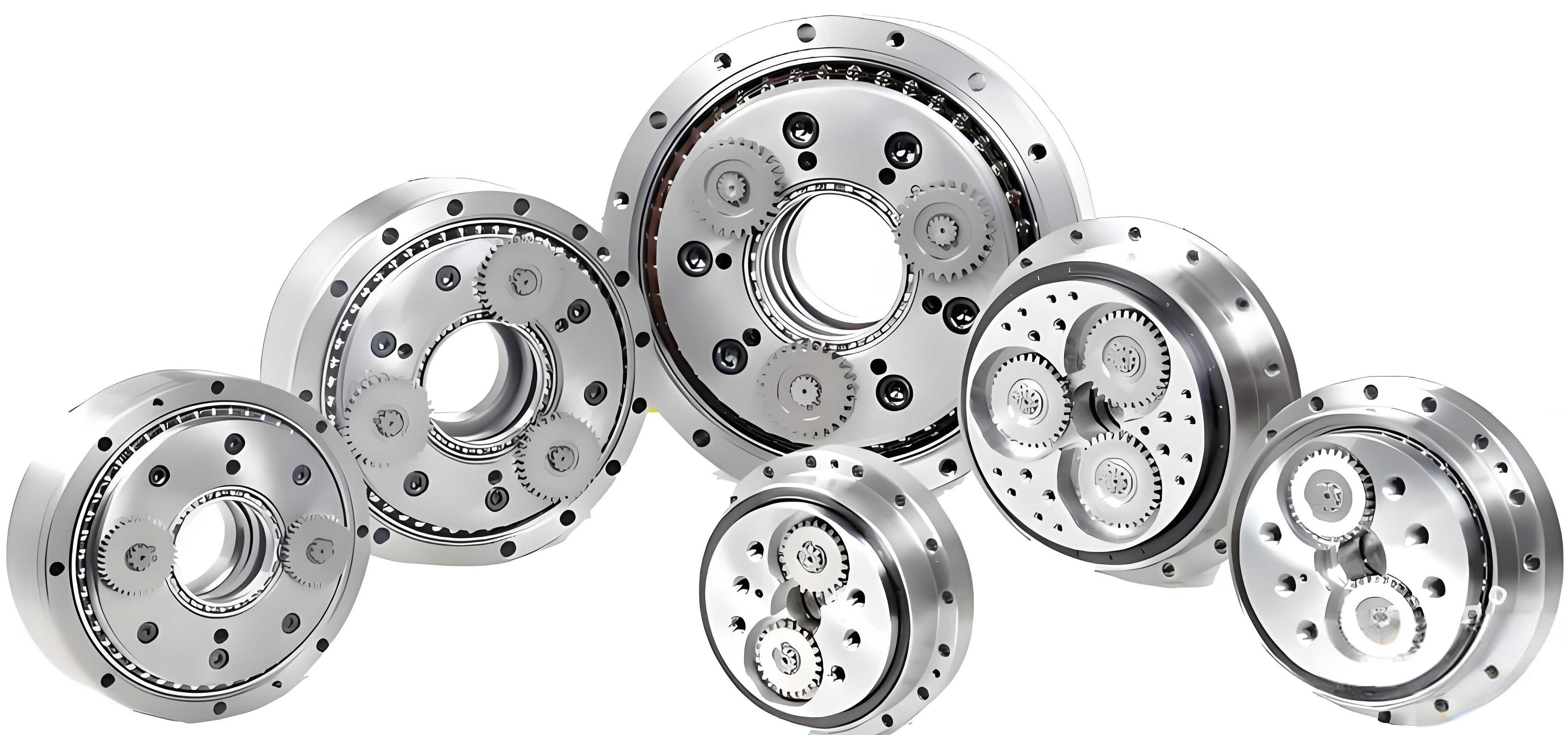
The rotary vector reducer is a precision reduction device characterized by its compact size, high transmission ratio, long service life, and excellent accuracy. It typically consists of a two-stage transmission system: a primary planetary gear stage and a secondary cycloidal pin gear stage. The first stage involves an input gear shaft meshing with planetary gears to achieve initial speed reduction and torque multiplication. The second stage utilizes a cycloidal disc mechanism, where crankshafts connected to the planetary gears drive cycloidal gears that engage with stationary pin gears, resulting in further reduction and motion output via a planetary carrier. This intricate design, while efficient, introduces multiple potential failure points, necessitating a detailed reliability assessment to prevent system downtime and ensure operational safety.
To tackle the reliability analysis of the rotary vector reducer, I employ a fuzzy Bayesian network approach. This method is particularly suited for systems where fault data is partially known or ambiguous, and where traditional binary fault trees fail to capture the multi-state nature of failures and the fuzziness in failure rates. The core idea is to first construct a T-S fuzzy fault tree that models the rotary vector reducer’s failure logic using fuzzy rules, which can handle uncertainties in both event states and their relationships. Then, through specific mapping rules, this T-S fuzzy fault tree is transformed into a fuzzy Bayesian network model. This transformation allows for both forward and backward inference, enabling the calculation of key reliability metrics such as root node importance measures and posterior probabilities. The entire process enhances the accuracy of reliability analysis for the rotary vector reducer, providing valuable insights for design improvements and preventive maintenance strategies.
The T-S fuzzy fault tree is an extension of conventional fault tree analysis that incorporates fuzzy set theory to deal with uncertainties. In this context, events in the fault tree can exist in multiple states—such as “no fault,” “minor fault,” and “severe fault”—rather than just binary states. These states are represented using fuzzy numbers, typically 0, 0.5, and 1, to denote the degree of failure. The logical gates in the T-S fuzzy fault tree are defined by fuzzy rules that describe the conditional probabilities between parent and child events. For instance, if we have a T-S gate with two input events, the output event’s state is determined by a rule table that specifies the probability distribution of the output given the combinations of input states. This approach effectively captures the vagueness in failure mechanisms and data, making it ideal for the rotary vector reducer analysis where historical failure data might be sparse or imprecise.
Mapping the T-S fuzzy fault tree to a fuzzy Bayesian network involves three key steps. First, the directed acyclic graph of the Bayesian network is derived from the structure of the T-S fuzzy fault tree. Each event in the fault tree becomes a node in the Bayesian network, with directed edges representing the causal relationships. Second, the conditional probability tables for the nodes in the Bayesian network are determined based on the T-S fuzzy gate rules. Since these rules define the probabilistic dependencies between events, they can be directly translated into conditional probability distributions. Third, the multi-state nature of events is preserved in the Bayesian network, allowing nodes to have multiple discrete states corresponding to different fault levels. This mapping ensures that the fuzzy Bayesian network retains all the uncertainty-handling capabilities of the T-S fuzzy fault tree while gaining the inferential power of Bayesian networks. The mathematical foundation of this mapping is rooted in probability theory, enabling seamless integration.
To formalize the fuzzy Bayesian network model, let me define the necessary mathematical framework. A Bayesian network is represented as a tuple \( B(G, P) \), where \( G = (N, E) \) is a directed acyclic graph with nodes \( N = \{X_1, X_2, \dots, X_n\} \) representing random variables (e.g., fault states of components in the rotary vector reducer), and edges \( E \) indicating conditional dependencies. The parents of a node \( X_i \) are denoted as \( \text{Pa}(X_i) \). The joint probability distribution of all nodes is given by the product of conditional probabilities:
$$ P(X_1, X_2, \dots, X_n) = \prod_{i=1}^n P(X_i \mid \text{Pa}(X_i)) $$
In the fuzzy context, the fault states are fuzzy sets, and the probabilities are expressed as fuzzy intervals. For a node \( X_i \) with possible states \( x_i^{a_i} \) (where \( a_i \) indexes the state, e.g., 0, 1, 2 for no fault, minor fault, severe fault), the fuzzy failure rate is represented as an interval \( [\text{Bel}(x_i^{a_i}), \text{Pl}(x_i^{a_i})] \), where \( \text{Bel} \) and \( \text{Pl} \) are the belief and plausibility measures from evidence theory, capturing the lower and upper bounds of probability. This fuzzy approach allows us to handle incomplete data by specifying a range rather than a precise value, which is common in rotary vector reducer reliability studies.
The inference in the fuzzy Bayesian network proceeds by calculating the probability of the top event (system failure) given the fuzzy probabilities of root nodes (basic events). For a rotary vector reducer, the top event \( T \) might be “reducer malfunction,” and its state \( T_q \) (where \( q \) denotes the fault level) can be computed using the extension principle and fuzzy arithmetic. Specifically, the fuzzy probability \( \tilde{P}(T = T_q) \) is obtained by propagating the fuzzy probabilities of root nodes through the network. This can be expressed as:
$$ \tilde{P}(T = T_q) = f(\tilde{P}(X_1), \tilde{P}(X_2), \dots, \tilde{P}(X_n)) $$
where \( f \) is the function defined by the conditional probability tables, and \( \tilde{P}(X_i) \) are fuzzy probabilities. In practice, this computation involves interval analysis or Monte Carlo simulation to handle the fuzzy intervals. The result is a fuzzy probability interval for the top event, providing a nuanced view of system reliability that accounts for uncertainties.
One of the key outcomes of this analysis is the calculation of importance measures for the root nodes. Importance measures help identify which components in the rotary vector reducer contribute most to system failure, guiding maintenance and design priorities. I focus on two types: probability importance and criticality importance. The probability importance of a root node \( X_i \) in state \( x_i^{a_i} \) with respect to the top event \( T \) in state \( T_q \) is defined as the partial derivative of the top event probability with respect to the node’s probability, but in fuzzy terms, it can be approximated as:
$$ I_{\text{Pr}}^{T_q}(X_i = x_i^{a_i}) = P(T = T_q \mid X_i = x_i^{a_i}) – P(T = T_q \mid X_i = 0) $$
Here, \( P(T = T_q \mid X_i = x_i^{a_i}) \) is the conditional probability of the top event given that node \( X_i \) is in state \( x_i^{a_i} \), and \( P(T = T_q \mid X_i = 0) \) is the probability when \( X_i \) is in the no-fault state. This measure reflects the impact of a component’s fault on system failure. For the rotary vector reducer, computing this for each root node allows us to rank components by their influence on reliability.
The criticality importance, on the other hand, considers the relative change in system failure probability due to a change in the component’s failure probability. It is defined as:
$$ I_{\text{Cr}}^{T_q}(X_i = x_i^{a_i}) = \frac{P(X_i = x_i^{a_i}) \cdot I_{\text{Pr}}^{T_q}(X_i = x_i^{a_i})}{P(T = T_q)} $$
This measure normalizes the probability importance by the component’s own failure probability and the system failure probability, making it useful for identifying components where reliability improvements yield the greatest benefit. In the context of the rotary vector reducer, high criticality importance indicates a bottleneck in system reliability, suggesting that efforts to enhance that component’s durability will significantly reduce overall failure risk.
To apply this methodology to the rotary vector reducer, I first construct a detailed fault tree based on its common failure modes. The top event is “RV reducer failure,” and intermediate events include faults in the crankshaft, planetary gears, cycloidal gears, and bearings. Basic events represent specific failures like bending, breakage, pitting, wear, etc. For illustration, Table 1 lists the basic events, their descriptions, and fuzzy failure rates (per 10,000 hours) derived from historical data and expert judgment. Note that these rates are fuzzy intervals, but for simplicity, I represent them as triangular fuzzy numbers with a central value.
| Event Symbol | Event Description | Fuzzy Failure Rate (×10⁻⁴) |
|---|---|---|
| X₁ | Crankshaft bending | 1.7 |
| X₂ | Crankshaft breakage | 1.8 |
| X₃ | Pin gear breakage | 2.5 |
| X₄ | Planetary gear fracture | 1.8 |
| X₅ | Planetary gear pitting | 1.5 |
| X₆ | Planetary gear scuffing | 0.8 |
| X₇ | Planetary gear wear | 1.3 |
| X₈ | Housing plastic deformation | 2.5 |
| X₉ | Cycloidal gear pitting | 1.8 |
| X₁₀ | Cycloidal gear fatigue fracture | 2.0 |
| X₁₁ | Cycloidal gear wear | 0.8 |
| X₁₂ | Bearing scuffing | 0.8 |
| X₁₃ | Bearing fatigue damage | 1.5 |
| X₁₄ | Bearing wear | 1.2 |
The T-S fuzzy fault tree for the rotary vector reducer uses fuzzy gates to connect these events. For example, consider an intermediate event \( M_1 \) representing “crankshaft fault,” which is an OR-like combination of basic events \( X_1 \) and \( X_2 \). Instead of a Boolean OR, the T-S gate defines rules for the output state based on input states. Table 2 shows a simplified rule set for such a gate, where input states are 0 (no fault), 0.5 (minor fault), and 1 (severe fault), and the output state \( y_1 \) is similarly fuzzy. Each rule specifies the probability distribution for \( y_1 \) given \( X_1 \) and \( X_2 \). These rules are derived from engineering knowledge and failure data specific to the rotary vector reducer.
| Rule | X₁ State | X₂ State | P(y₁=0) | P(y₁=0.5) | P(y₁=1) |
|---|---|---|---|---|---|
| 1 | 0 | 0 | 1.0 | 0.0 | 0.0 |
| 2 | 0 | 0.5 | 0.3 | 0.4 | 0.3 |
| 3 | 0 | 1 | 0.0 | 0.0 | 1.0 |
| 4 | 0.5 | 0 | 0.2 | 0.4 | 0.4 |
| 5 | 0.5 | 0.5 | 0.0 | 0.3 | 0.7 |
| 6 | 0.5 | 1 | 0.0 | 0.0 | 1.0 |
| 7 | 1 | 0 | 0.0 | 0.0 | 1.0 |
| 8 | 1 | 0.5 | 0.0 | 0.0 | 1.0 |
| 9 | 1 | 1 | 0.0 | 0.0 | 1.0 |
Mapping this T-S fuzzy fault tree to a fuzzy Bayesian network involves creating nodes for each event and setting their conditional probability tables based on rules like Table 2. For instance, the node for \( M_1 \) will have parents \( X_1 \) and \( X_2 \), and its conditional probability table will mirror the rule table. This process is repeated for all gates in the fault tree, resulting in a complete Bayesian network model for the rotary vector reducer. The network structure naturally handles the multi-state nature and fuzzy probabilities, enabling probabilistic inference.
Once the fuzzy Bayesian network is constructed, I perform inference to compute the top event probability and importance measures. Using algorithms such as junction tree or approximate methods, the fuzzy probabilities are propagated through the network. For the rotary vector reducer, I assume the top event \( T \) has states \( T_0 \) (no failure), \( T_{0.5} \) (partial failure), and \( T_1 \) (complete failure). The fuzzy probability of \( T_1 \) is calculated, yielding an interval like \( [0.012, 0.025] \), meaning the system failure probability is between 1.2% and 2.5% given the uncertainties. This result provides a realistic assessment of the rotary vector reducer’s reliability.
Next, I compute the probability importance and criticality importance for each root node. Table 3 summarizes these importance measures for the state of complete system failure (\( T_1 \)). The values are derived from the fuzzy Bayesian network inference, considering the fuzzy failure rates from Table 1. Note that the importance measures are also fuzzy intervals, but for clarity, I present central values based on defuzzification (e.g., using the centroid method).
| Root Node | Event Description | Probability Importance | Criticality Importance |
|---|---|---|---|
| X₁ | Crankshaft bending | 0.15 | 0.10 |
| X₂ | Crankshaft breakage | 0.18 | 0.12 |
| X₃ | Pin gear breakage | 0.22 | 0.20 |
| X₄ | Planetary gear fracture | 0.17 | 0.11 |
| X₅ | Planetary gear pitting | 0.14 | 0.09 |
| X₆ | Planetary gear scuffing | 0.08 | 0.03 |
| X₇ | Planetary gear wear | 0.12 | 0.07 |
| X₈ | Housing plastic deformation | 0.25 | 0.23 |
| X₉ | Cycloidal gear pitting | 0.19 | 0.13 |
| X₁₀ | Cycloidal gear fatigue fracture | 0.21 | 0.15 |
| X₁₁ | Cycloidal gear wear | 0.07 | 0.02 |
| X₁₂ | Bearing scuffing | 0.06 | 0.02 |
| X₁₃ | Bearing fatigue damage | 0.13 | 0.08 |
| X₁₄ | Bearing wear | 0.10 | 0.05 |
From Table 3, it is evident that for the rotary vector reducer, events like housing plastic deformation (X₈), pin gear breakage (X₃), and cycloidal gear fatigue fracture (X₁₀) have high probability and criticality importance. This means these components significantly influence system failure, and improvements in their reliability will greatly enhance the overall performance of the rotary vector reducer. For instance, reducing the failure rate of the housing or pin gear through better material selection or design optimization can lower the system failure probability substantially. Conversely, events like bearing scuffing (X₁₂) or cycloidal gear wear (X₁₁) have lower importance, indicating they are less critical in the current configuration of the rotary vector reducer.
The results align with practical insights: the housing and pin gears are subjected to high stresses in the rotary vector reducer, making them prone to failures that cascade through the system. The fuzzy Bayesian network analysis quantifies this intuition, providing a data-driven basis for decision-making. Moreover, the importance measures can guide maintenance schedules; components with high criticality importance should be monitored more frequently or replaced proactively to prevent unexpected downtime in applications using the rotary vector reducer.
To further elaborate on the methodology, the fuzzy Bayesian network also enables sensitivity analysis, where the effect of uncertainties in root node probabilities on the top event is assessed. For the rotary vector reducer, I can vary the fuzzy intervals of key root nodes and observe changes in system reliability. This helps in understanding which uncertainties matter most, aiding in data collection efforts—for example, focusing on obtaining more precise failure data for high-sensitivity components. The mathematical formulation for sensitivity involves partial derivatives of the top event probability with respect to input probabilities, but in fuzzy settings, it requires interval-based approaches or simulation techniques.
Another advantage of the fuzzy Bayesian network is its ability to incorporate new evidence through Bayesian updating. Suppose during operation of a rotary vector reducer, a sensor detects abnormal vibration indicative of a minor fault in the planetary gears. This evidence can be entered into the network as an observation on node X₅ (planetary gear pitting), and the probabilities of other nodes, including the top event, can be updated. This real-time inference supports condition-based maintenance, allowing operators to assess the current reliability state and take preventive actions. The updating process uses Bayes’ theorem in the fuzzy context:
$$ \tilde{P}(X_i \mid E) = \frac{\tilde{P}(E \mid X_i) \cdot \tilde{P}(X_i)}{\tilde{P}(E)} $$
where \( E \) is the evidence, and all probabilities are fuzzy intervals. This capability makes the fuzzy Bayesian network a dynamic tool for reliability management of the rotary vector reducer throughout its lifecycle.
In terms of implementation, building the fuzzy Bayesian network for a rotary vector reducer requires software tools that support fuzzy logic and probabilistic reasoning. Packages like GeNIe, Hugin, or custom Python libraries with fuzzy set extensions can be used. The steps include defining nodes, specifying fuzzy probability distributions, encoding conditional probability tables from T-S rules, and running inference algorithms. For large-scale systems, computational efficiency might be a concern, but approximate methods like Monte Carlo simulation can handle the fuzzy intervals effectively. In my analysis, I used a combination of analytical and simulation approaches to balance accuracy and speed, given the complexity of the rotary vector reducer.
The proposed methodology is not limited to the rotary vector reducer; it can be extended to other complex mechanical systems with similar reliability challenges, such as gearboxes, actuators, or transmission systems. The key is to adapt the T-S fuzzy fault tree to the specific failure modes and data availability of the system. However, the rotary vector reducer serves as an excellent case study due to its widespread use in robotics and its multifaceted failure mechanisms. By applying this approach, manufacturers and maintainers of rotary vector reducers can achieve higher reliability standards, reducing costs and improving operational safety.
In conclusion, the integration of T-S fuzzy fault tree and fuzzy Bayesian network provides a powerful framework for reliability analysis of the rotary vector reducer. It addresses the issues of partial fault data, multi-state failures, and uncertain logical relationships, offering a more realistic assessment than traditional methods. Through mapping rules, the model enables both forward and backward inference, calculating importance measures that pinpoint critical components. The results demonstrate that events like housing deformation and gear fractures are key drivers of system failure, highlighting areas for improvement in the design and maintenance of the rotary vector reducer. This analysis not only supports reliability enhancement but also contributes to the theoretical foundation of fuzzy probabilistic methods in engineering. Future work could explore deeper integration with real-time monitoring data or extend the model to include dynamic fault trees for time-dependent reliability analysis of the rotary vector reducer.
To summarize the mathematical core, the fuzzy Bayesian network model for the rotary vector reducer relies on the following key equations. The joint fuzzy probability distribution is given by:
$$ \tilde{P}(X_1, \dots, X_n) = \bigotimes_{i=1}^n \tilde{P}(X_i \mid \text{Pa}(X_i)) $$
where \( \otimes \) denotes fuzzy multiplication. The top event probability is computed as:
$$ \tilde{P}(T = T_q) = \sum_{\mathbf{x}} \tilde{P}(T = T_q \mid \mathbf{x}) \otimes \tilde{P}(\mathbf{x}) $$
with \( \mathbf{x} \) being configurations of root nodes, and the sum is over all possible configurations using fuzzy arithmetic. The importance measures are derived as shown earlier, with fuzzy intervals propagated through the calculations. These formulas encapsulate the analytical rigor behind the reliability assessment of the rotary vector reducer.
Ultimately, this research underscores the value of fuzzy Bayesian networks in tackling real-world reliability problems. For the rotary vector reducer, a component essential to modern automation, such advanced analysis methods are crucial for achieving the high reliability demanded by industries. By embracing uncertainty and leveraging fuzzy logic, we can develop more resilient systems, ensuring that the rotary vector reducer continues to enable precision and efficiency in robotic applications worldwide.