
The transmission of motion and power in mechanical systems relies heavily on gear mechanisms. Among various gear types, the helical gear is a cornerstone component in modern machinery, prized for its high transmission efficiency, smooth engagement, stable transmission ratio, and significant load-bearing capacity. Its application spans critical fields such as aerospace, marine propulsion, automotive systems, and precision instruments. However, during the meshing process, the interaction between tooth surfaces inevitably leads to wear. This wear can induce noise and vibration, reduce transmission efficiency, and, in severe cases, directly precipitate gear failure, thereby critically impacting the operational safety and service life of the entire transmission system. Consequently, research into the wear characteristics and predictive methods for helical gears holds substantial engineering value.
Helical gear wear is a complex phenomenon influenced by a multitude of interacting factors including geometry, material properties, lubrication conditions, operational loads, and environmental effects. The inherent uncertainties in manufacturing tolerances, material property scatter, and fluctuating service loads propagate through the system, leading to significant uncertainty in the predicted wear amount. A wear amount exceeding permissible limits constitutes a critical failure mode. Traditional reliability analysis, grounded in probabilistic models, requires extensive statistical data to accurately define the probability distribution functions of all uncertain input parameters. In practical engineering scenarios, especially during the early design phases or for novel applications, such comprehensive data is often scarce or unavailable, rendering probabilistic methods less applicable or potentially unreliable. This data-poor environment necessitates an alternative approach to quantifying and managing uncertainty.
This study addresses the challenge of helical gear wear reliability design under conditions of data scarcity. It adopts a non-probabilistic interval model to describe uncertain parameters, where only the bounds of variation are known, a condition typically easier to satisfy in practice. By integrating Hertzian contact theory and the Archard wear model, a framework for the reliability analysis and optimization design of helical gear wear is established. The methodology involves creating a parameterized finite element model to simulate the meshing process, analyze contact stresses, and predict wear patterns. Subsequently, considering the uncertainties in geometry, material, and load, a non-probabilistic reliability analysis is performed. Finally, a reliability-based optimization design model is formulated and solved, aiming to minimize gear volume while ensuring that non-probabilistic reliability indices for both contact strength and wear depth exceed specified safety thresholds. This integrated approach provides a practical and robust design strategy for enhancing helical gear performance and longevity in the face of uncertainty.
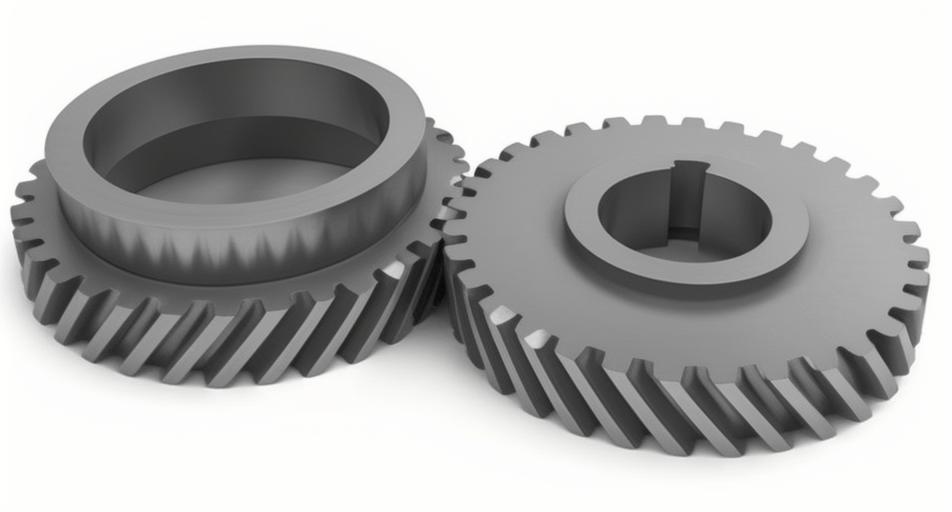
Wear Mechanism and Theoretical Foundation for Helical Gears
The fundamental process driving wear in helical gears is the repeated sliding and rolling contact between the meshing tooth surfaces. During engagement, a combination of normal load and tangential friction forces acts on the contact zone, leading to material removal over time. Among various wear models, the Archard wear equation, due to its relative simplicity and proven effectiveness for modeling mild adhesive and abrasive wear in many engineering contacts, is widely adopted for gear wear simulation. The Archard model relates the volumetric wear to the normal load and sliding distance.
$$ V = K \frac{F_N \cdot s}{H} $$
Where \( V \) is the volumetric wear loss, \( K \) is the dimensionless wear coefficient (dependent on materials and lubrication), \( F_N \) is the normal contact force, \( s \) is the sliding distance, and \( H \) is the hardness of the softer material. For gear analysis, it is often more convenient to work with wear depth. The wear depth \( h \) at a specific point on the tooth flank after \( N \) loading cycles can be expressed as:
$$ h = \sum_{i=1}^{N} k \cdot p_i \cdot \Delta s_i $$
Here, \( k = K/H \) is the dimensional wear coefficient (e.g., in \( \text{mm}^3/\text{N·mm} \)), \( p_i \) is the contact pressure at the point during the \( i \)-th meshing step, and \( \Delta s_i \) is the incremental sliding distance for that step. This formulation allows for the incremental accumulation of wear over the gear’s operational life.
The contact pressure \( p \) is governed by the Hertzian contact theory for elastic bodies, which for gear teeth provides a foundational understanding of stress distribution. The maximum contact pressure \( p_0 \) between two cylindrical bodies (approximating gear teeth contact) is given by:
$$ p_0 = \sqrt{\frac{F_N}{\pi L} \cdot \frac{\frac{1}{R_1} + \frac{1}{R_2}}{\frac{1-\nu_1^2}{E_1} + \frac{1-\nu_2^2}{E_2}}} $$
Where \( L \) is the length of contact (effective face width for a helical gear), \( R_1, R_2 \) are the radii of curvature at the contact point, \( E_1, E_2 \) are the elastic moduli, and \( \nu_1, \nu_2 \) are the Poisson’s ratios of the pinion and gear materials, respectively. For a helical gear pair, the contact is elliptical, and the radii of curvature and effective face width vary along the line of action and across the face width due to the helix angle. This complexity makes analytical calculation challenging, thus necessitating numerical methods like Finite Element Analysis (FEA) for accurate determination of the time-varying contact pressure distribution \( p_i \) throughout the meshing cycle.
The sliding distance \( \Delta s_i \) is determined by the kinematics of the helical gear mesh. Due to the helical twist, engagement starts at one end of the tooth and progresses across the face width. The relative sliding velocity between contacting points varies along the path of contact, from the root to the pitch line and then to the tip of the tooth. The sliding is highest at the points of initial contact and recess. Accurate calculation of \( \Delta s_i \) requires a detailed analysis of the gear geometry and instantaneous kinematics at each discretized point on the tooth surface.
The wear coefficient \( k \) is a critical empirical parameter that encapsulates the complex tribological behavior of the material pair under specific lubrication conditions. Its value can vary significantly and is often a major source of uncertainty in wear prediction. For common gear steels like 20CrMnTi under lubricated conditions, typical ranges for \( k \) are used based on experimental data or literature. In a comprehensive reliability analysis, this parameter would also be treated as an uncertain interval variable.
Finite Element Analysis and Wear Simulation of Helical Gears
To accurately capture the complex contact stresses and sliding kinematics necessary for wear prediction, a dynamic finite element analysis model of a helical gear pair is developed. The process begins with the precise parameterized geometric modeling of the helical gear. The geometry is defined by key parameters: number of teeth \( z \), normal module \( m_n \), face width \( B \), normal pressure angle \( \alpha_n \), helix angle \( \beta \), and addendum and dedendum coefficients. A three-dimensional solid model of both the driving pinion and the driven gear is created and assembled at their correct center distance and relative orientation to form the gear pair.
The material assigned to both gears is 20CrMnTi, a common case-hardening steel used in high-strength gears. Its basic elastic properties are defined as follows, though these will later be considered uncertain:
| Property | Symbol | Nominal Value |
|---|---|---|
| Elastic Modulus | \( E \) | 210 GPa |
| Poisson’s Ratio | \( \nu \) | 0.3 |
| Density | \( \rho \) | 7850 kg/m³ |
The FE model employs hexahedral elements (C3D8) for better accuracy in contact simulation. A fine mesh is applied to the active tooth flanks where contact occurs, while a coarser mesh is used for the gear body to reduce computational cost. The contact between the gear teeth is defined using a surface-to-surface contact algorithm with a penalty friction formulation; a friction coefficient of 0.1 is assumed to account for lubricated conditions.
The loading is applied in a multi-step sequence to simulate the meshing process:
- Step 1: A small rotational displacement is applied to the pinion to bring the teeth into initial contact.
- Step 2: The pinion’s degrees of freedom are constrained, and a resisting torque \( T \) is applied to the driven gear to generate the working contact forces.
- Step 3: The torque is maintained, and a prescribed angular velocity is applied to the pinion to simulate continuous rotation for several engagement cycles.
The analysis reveals the dynamic variation of contact stress during meshing. The maximum contact stress \( \sigma_{Hmax} \) occurs near the regions of single-tooth contact (around the start of active profile and the lowest point of single tooth contact). The FEA-predicted maximum contact stress is validated against the theoretical Hertzian calculation for the nominal parameters, showing good agreement and confirming the fidelity of the FE model.
For wear simulation, the Archard model is implemented via a user-defined subroutine (UMESHMOTION in Abaqus) coupled with Arbitrary Lagrangian-Eulerian (ALE) adaptive meshing techniques. This allows the nodal coordinates on the tooth surface to be updated incrementally based on the calculated local wear depth (\( h = k \cdot p \cdot \Delta s \)) after each simulated loading cycle. The contact pressure \( p \) and sliding distance \( \Delta s \) are extracted from the dynamic FE analysis at each integration point on the contacting surfaces.
After simulating a significant number of loading cycles (e.g., \( 1 \times 10^5 \) cycles), the wear pattern on the pinion tooth surface is obtained. The results typically show a non-uniform wear distribution:
- Maximum Wear Location: The greatest wear depth is usually found in the dedendum (root) region of the tooth.
- Distribution along the Profile: Wear is higher near the root and tip, decreasing to a minimum near the pitch line. This correlates with higher sliding velocities at the extremities of the contact path.
- Distribution across the Face Width: Due to the helix angle, wear is not uniform across the face. For a right-hand helix pinion driving a left-hand helix gear (or vice versa in an idler configuration), wear may progressively increase from one end of the tooth to the other, reflecting the gradual engagement process.
This detailed FEA-based wear simulation forms the core “performance function” that maps the input design and uncertainty parameters to the critical output response: the maximum wear depth \( W_h \).
Non-Probabilistic Reliability Analysis Using Interval Models
In the context of data scarcity, uncertain parameters are modeled as interval variables. An interval variable \( x^I \) is defined by its lower bound \( x^L \) and upper bound \( x^U \), denoted as \( x^I = [x^L, x^U] \), without assuming any internal probability distribution. The midpoint is \( x^c = (x^U + x^L)/2 \) and the radius (or deviation) is \( x^r = (x^U – x^L)/2 \).
For the helical gear wear problem, the major sources of uncertainty are categorized and modeled as interval variables, as summarized in the table below. The nominal value represents the design center, while the bounds reflect the estimated or tolerated variation.
| Category | Uncertain Variable | Symbol | Nominal | Lower Bound | Upper Bound |
|---|---|---|---|---|---|
| Geometry | Normal Module | \( m_n^I \) | 4 mm | 3.98 mm | 4.02 mm |
| Helix Angle | \( \beta^I \) | 13° | 12.935° | 13.065° | |
| Face Width | \( B^I \) | 40 mm | 39.8 mm | 40.2 mm | |
| Material | Elastic Modulus | \( E^I \) | 210 GPa | 199.5 GPa | 220.5 GPa |
| Poisson’s Ratio | \( \nu^I \) | 0.3 | 0.285 | 0.315 | |
| Load | Pinion Speed | \( n^I \) | 140 rpm | 135 rpm | 145 rpm |
| Resisting Torque | \( T^I \) | 300 N·m | 285 N·m | 315 N·m |
Similarly, the allowable limits for failure are also defined as intervals to account for their uncertainty:
- Allowable Contact Stress: \( \sigma_{HS}^I = [1892.76, 2092.0] \) MPa (midpoint 1992.38 MPa).
- Allowable Wear Depth: \( W_S^I = [23.75, 26.25] \) μm (midpoint 25 μm).
Two failure modes are considered, leading to two performance functions (limit-state functions):
- Contact Strength Failure: Occurs if maximum contact stress exceeds allowable stress.
$$ g_1(\mathbf{X}) = \sigma_{HS} – \sigma_{Hmax}(m_n, \beta, B, E, \nu, n, T) $$
Failure occurs if \( g_1 < 0 \). - Wear Failure: Occurs if maximum wear depth exceeds allowable depth.
$$ g_2(\mathbf{X}) = W_S – W_h(m_n, \beta, B, E, \nu, n, T) $$
Failure occurs if \( g_2 < 0 \).
Here, \( \mathbf{X} \) represents the vector of all interval input variables.
Since the functions \( \sigma_{Hmax}(\mathbf{X}) \) and \( W_h(\mathbf{X}) \) are implicit and computationally expensive (coming from FEA), surrogate models are constructed to facilitate reliability analysis. The Kriging (Gaussian Process) model is an excellent choice as it provides an interpolating surrogate with uncertainty estimation. A Design of Experiments (DoE) is performed within the hyper-rectangle defined by the interval bounds to generate sample points. The FEA model is run at these sample points to obtain the response values (maximum stress and wear). These input-output pairs are used to train accurate Kriging models \( \tilde{\sigma}_{Hmax}(\mathbf{X}) \) and \( \tilde{W}_h(\mathbf{X}) \), which approximate the true functions over the entire interval domain.
The non-probabilistic reliability index \( \eta \) for a performance function \( g(\mathbf{X}) \) is defined based on the interval of \( g \) itself. Let the lower and upper bounds of \( g(\mathbf{X}) \) over the interval domain of \( \mathbf{X} \) be \( g^L \) and \( g^U \), with midpoint \( g^c = (g^U+g^L)/2 \) and radius \( g^r = (g^U-g^L)/2 \). The reliability index \( \eta \) is defined as:
$$ \eta = \frac{g^c}{g^r} $$
The physical meaning is straightforward:
- If \( \eta > 1 \), then \( g^c > g^r \), which implies \( g^L > 0 \). This means the performance function is positive for all possible combinations of the interval variables. The structure is considered absolutely safe (reliable) within the defined uncertainty bounds.
- If \( 0 < \eta \le 1 \), then \( g^L \le 0 \) and \( g^U > 0 \). This signifies a feasible but uncertain state where safety depends on the specific realization of the uncertain parameters.
- If \( \eta < 0 \), then \( g^U < 0 \), meaning failure occurs for all possible parameter values.
Thus, the condition for reliability is \( \eta \ge \eta_{\text{target}} \), where \( \eta_{\text{target}} \) is often set to 1 for absolute safety, or a lower value if a certain level of uncertainty is acceptable.
Finding the bounds \( g^L \) and \( g^U \) is an optimization problem: \( g^L = \min(g(\mathbf{X})) \) and \( g^U = \max(g(\mathbf{X})) \) subject to \( \mathbf{X}^L \le \mathbf{X} \le \mathbf{X}^U \). Using the Kriging surrogates \( \tilde{g}_1 \) and \( \tilde{g}_2 \), these global optimizations can be performed efficiently using algorithms like Sequential Quadratic Programming (SQP). For the initial helical gear design, the analysis yields:
| Performance Function | Lower Bound (\( g^L \)) | Upper Bound (\( g^U \)) | Midpoint (\( g^c \)) | Radius (\( g^r \)) | Reliability Index (\( \eta \)) |
|---|---|---|---|---|---|
| \( g_1 \) (Contact Margin, MPa) | 937.50 | 1624.70 | 1281.10 | 343.60 | 3.73 |
| \( g_2 \) (Wear Margin, μm) | 2.31 | 22.16 | 12.23 | 9.92 | 1.23 |
Both indices are greater than 1 (\( \eta_1 = 3.73, \eta_2 = 1.23 \)), confirming the initial helical gear design is reliable against both contact stress and wear failure for the given interval uncertainties.
Non-Probabilistic Reliability-Based Optimization Design
The goal of optimization is to find a better helical gear design that is more economical (smaller, lighter) while remaining reliable. This is formulated as a Reliability-Based Design Optimization (RBDO) problem using the non-probabilistic framework.
Optimization Model:
Find the optimal design variable vector \( \mathbf{d} = (m_n, B, z_1, \beta)^T \) (chosen as key parameters to modify) that:
Minimizes the total volume of the gear pair \( V(\mathbf{d}) \) (objective function).
Subject to:
- Contact strength reliability index: \( \eta_1(\mathbf{d}, \mathbf{Y}) \ge \eta_{\text{target}} \) (e.g., \( \eta_{\text{target}} = 1 \)).
- Wear reliability index: \( \eta_2(\mathbf{d}, \mathbf{Y}) \ge \eta_{\text{target}} \).
- Bounds on design variables: \( \mathbf{d}^L \le \mathbf{d} \le \mathbf{d}^U \).
Here, \( \mathbf{Y} \) represents the vector of interval uncertainty variables (like \( E^I, \nu^I, T^I \), etc.) that are not being optimized but are considered in the reliability analysis. The reliability indices \( \eta_1 \) and \( \eta_2 \) are functions of both the design variables \( \mathbf{d} \) and the uncertain variables \( \mathbf{Y} \).
This is a nested optimization problem. The outer loop optimizes the design variables \( \mathbf{d} \). For each candidate \( \mathbf{d} \) proposed by the outer optimizer, an inner loop reliability analysis must be performed. This inner analysis involves:
- Building/Updating the Kriging surrogate models \( \tilde{\sigma}_{Hmax}(\mathbf{Y}; \mathbf{d}) \) and \( \tilde{W}_h(\mathbf{Y}; \mathbf{d}) \) for the current fixed \( \mathbf{d} \).
- Solving the optimization problems to find \( g_1^L, g_1^U, g_2^L, g_2^U \) over the domain of \( \mathbf{Y} \).
- Calculating the current reliability indices \( \eta_1(\mathbf{d}) \) and \( \eta_2(\mathbf{d}) \).
To solve this computationally challenging problem efficiently, a decoupled or sequential approach is often employed. Furthermore, the Kriging models built for the initial design space can be iteratively refined. A practical method is to use a global optimization algorithm (like a Multi-Island Genetic Algorithm) for the outer loop due to its ability to handle non-convex spaces, and efficient local optimizers (like SQP) for the inner bound-finding problems. The solution process yields an optimal set of design parameters.
| Design Vector & Result | Normal Module \( m_n \) (mm) | Face Width \( B \) (mm) | Pinion Teeth \( z_1 \) | Helix Angle \( \beta \) (°) | Contact Index \( \eta_1 \) | Wear Index \( \eta_2 \) | Gear Pair Volume \( V \) (×10⁶ mm³) |
|---|---|---|---|---|---|---|---|
| Initial Design | 4.000 | 40.00 | 26 | 13.000 | 3.728 | 1.233 | 3.178 |
| Optimized Solution | 3.419 | 39.01 | 25.7 | 13.415 | 2.144 | 2.845 | 2.220 |
| Rounded Practical Design | 3.5 | 39 | 26 | 13.4 | – | – | 2.38 |
The optimization results indicate a clear improvement. The algorithm reduces the gear size primarily by reducing the normal module and slightly adjusting the face width and helix angle. The final helical gear design, after rounding to practical manufacturing values, shows a 25.11% reduction in total volume compared to the initial design. Crucially, this is achieved while maintaining both non-probabilistic reliability indices above 1 (the optimized indices are \( \eta_1=2.14 \) and \( \eta_2=2.84 \)), ensuring safety against failure. A final verification FEA run on the rounded optimal helical gear design confirms that the maximum contact stress, while increased from the initial design due to smaller size, remains well below the allowable limit. Furthermore, the predicted maximum wear depth is reduced by approximately 16.09%, demonstrating that the optimization not only saves material but also enhances the wear resistance of the helical gear system under the considered uncertainties.
Conclusion
This study presents a comprehensive framework for the analysis and design of helical gears considering wear under uncertainty. By integrating advanced numerical simulation (FEA with wear modeling) with non-probabilistic reliability theory, the method effectively addresses the common engineering challenge of data scarcity. The use of interval variables to model uncertainties in geometry, material, and load provides a robust alternative to traditional probabilistic methods when statistical data is limited.
The core of the methodology lies in constructing accurate surrogate models (Kriging) for the computationally expensive performance functions—maximum contact stress and wear depth. This enables efficient propagation of interval uncertainties and the calculation of non-probabilistic reliability indices, which offer a clear measure of safety based on the worst-case bounds of variation.
The successful application of the non-probabilistic reliability-based optimization demonstrates its practical utility. The optimization formulation, which minimizes gear volume subject to reliability index constraints on both contact and wear, leads to a more economical and efficient helical gear design. The significant reduction in volume (25.11%) coupled with an improvement in wear performance (16.09% less wear) validates the effectiveness of the proposed approach. This framework provides engineers with a powerful and pragmatic tool for designing reliable, lightweight, and durable helical gear transmissions, ensuring their safe and efficient operation throughout the intended service life despite inherent uncertainties.