
In the field of mechanical transmission, screw gears, particularly the ZC1 type, play a crucial role due to their high load-bearing capacity, smooth operation, and self-locking characteristics. As an engineer specializing in gear design, I have focused on improving the meshing performance of ZC1 screw gears commonly used in escalators. The distribution of instantaneous contact lines on the gear tooth surface is a key factor influencing lubrication and durability, which directly impacts the efficiency and lifespan of screw gears. This article delves into a comprehensive analysis based on spatial meshing theory, aiming to optimize design parameters for better performance.
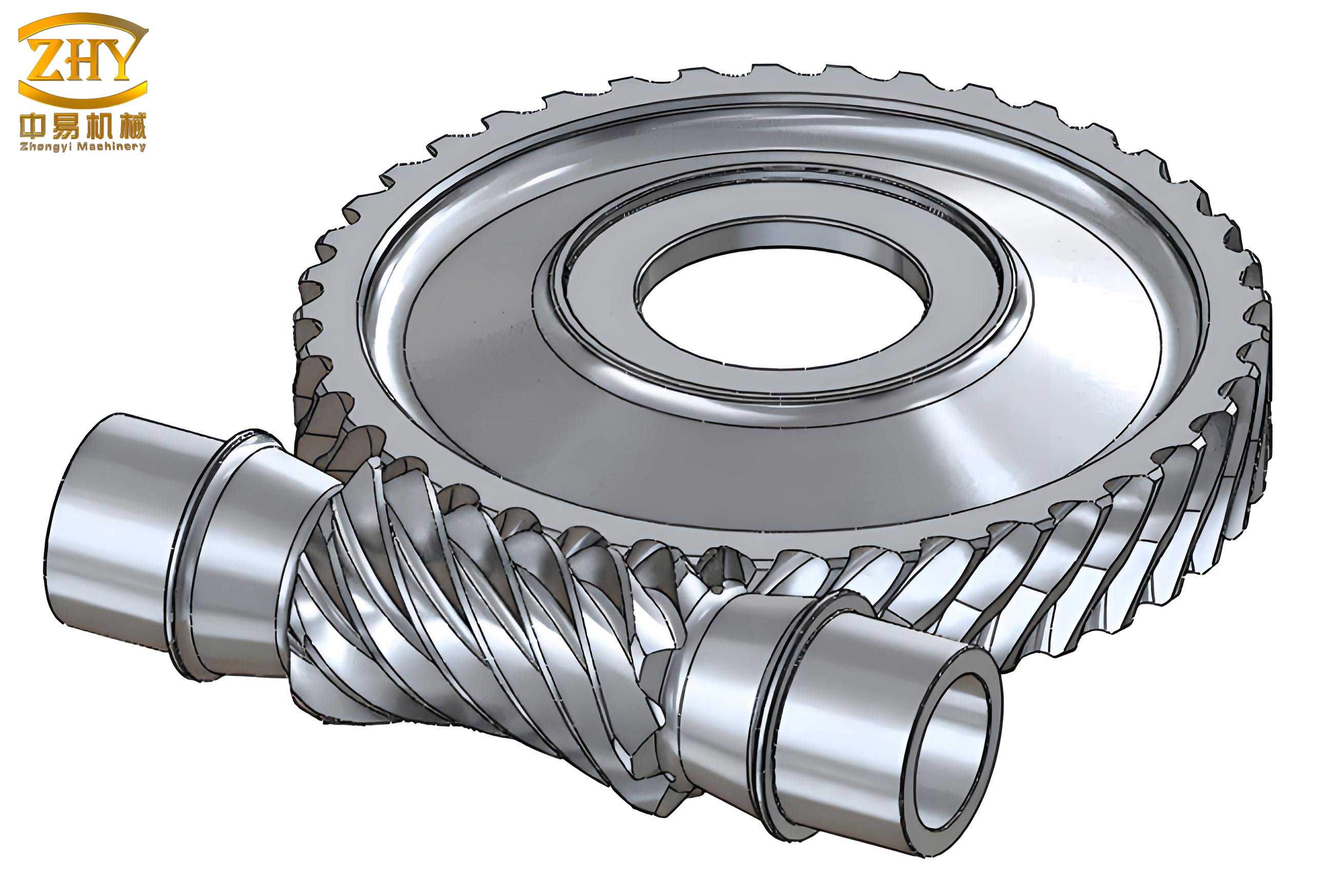
The ZC1 screw gears feature a circular arc tooth profile, which enhances meshing stability and lubrication compared to conventional cylindrical screw gears. In my analysis, I employ mathematical modeling to derive the instantaneous contact lines, as these lines determine the heat dissipation and wear patterns in screw gears. By using MATLAB for simulation, I visualize how design parameters affect these lines, providing insights for optimizing screw gears in escalator applications. The goal is to ensure that screw gears operate with minimal friction and maximum reliability, which is essential for high-traffic environments like shopping malls.
To begin, I establish the mathematical model for the double-enveloping process of ZC1 screw gears. This involves two stages: the first enveloping where the grinding wheel forms the worm surface, and the second enveloping where the worm generates the gear tooth surface. The coordinate systems are defined to facilitate the derivation. Let me denote the coordinate systems as follows: $S_1$ is fixed to the worm, $S_\sigma$ to the grinding wheel, and $S_2$ to the gear. The transformation matrices between these systems are crucial for describing the meshing of screw gears.
For the first enveloping, the grinding wheel surface is represented in its own coordinate system $S_\sigma$. The tooth profile is a circular arc with radius $\rho$, and its equation is given by:
$$ \mathbf{r}^{(\sigma)} = \begin{bmatrix} x_\sigma \\ y_\sigma \\ z_\sigma \end{bmatrix} = \begin{bmatrix} -\rho \sin \theta \cos \beta – d \cos \beta \\ \rho \sin \theta \sin \beta + d \sin \beta \\ \rho \cos \theta – c \end{bmatrix}, $$
where $\theta$ is the profile parameter, $\beta$ is the rotation angle, and $d$ and $c$ are installation parameters. The unit normal vector on the grinding wheel surface is derived as:
$$ \mathbf{n}^{(\sigma)} = \begin{bmatrix} \sin \theta \cos \beta \\ -\sin \theta \sin \beta \\ -\cos \theta \end{bmatrix}. $$
The relative velocity between the grinding wheel and the worm is calculated to apply the meshing condition. For screw gears, the meshing equation requires that the normal vector and relative velocity are orthogonal:
$$ \phi_{\sigma 1} = \mathbf{n}^{(\sigma)} \cdot \mathbf{v}_{\sigma 1} = 0. $$
Substituting the expressions, I obtain:
$$ \tan \theta – \frac{A_\sigma – d \cos \beta – p \cot \gamma}{c \cos \beta + A_\sigma \sin \beta \cot \gamma + p \sin \beta} = 0, $$
where $A_\sigma$ is the center distance, $p$ is the spiral parameter, and $\gamma$ is the lead angle. This equation defines the instantaneous contact lines on the worm surface during the first enveloping of screw gears.
Next, I transform these contact lines to the worm coordinate system $S_1$ using the transformation matrix $M_{1\sigma}$. The worm surface equation becomes:
$$ \mathbf{r}^{(1)} = M_{1\sigma} \mathbf{r}^{(\sigma)}, $$
with the meshing condition $\phi_{\sigma 1} = 0$. This forms the basis for the second enveloping, where the worm acts as the tool to generate the gear tooth surface in screw gears.
For the second enveloping, I set up the coordinate systems for the worm and gear meshing. The transformation from $S_1$ to $S_2$ is given by:
$$ M_{21} = \begin{bmatrix} \cos \varphi_1 \cos \varphi_2 & -\sin \varphi_1 \cos \varphi_2 & -\sin \varphi_2 & a \cos \varphi_2 \\ -\cos \varphi_1 \sin \varphi_2 & \sin \varphi_1 \sin \varphi_2 & -\cos \varphi_2 & -a \sin \varphi_2 \\ \sin \varphi_1 & \cos \varphi_1 & 0 & 0 \\ 0 & 0 & 0 & 1 \end{bmatrix}, $$
where $a$ is the center distance, and $\varphi_1$ and $\varphi_2$ are the rotation angles of the worm and gear, respectively. The meshing condition for screw gears in this stage is:
$$ \phi_{12} = \mathbf{n}^{(1)} \cdot \mathbf{v}_{12} = 0, $$
where $\mathbf{n}^{(1)}$ is the normal vector on the worm surface, and $\mathbf{v}_{12}$ is the relative velocity. After derivation, the meshing equation simplifies to:
$$ \phi_{12} = W_1 \cos \varphi_1 – W_2 \sin \varphi_1 – W_3 = 0, $$
with:
$$ W_1 = i_{21} (x_1 n_z^{(1)} – z_1 n_x^{(1)}), \quad W_2 = -i_{21} (z_1 n_y^{(1)} – y_1 n_z^{(1)}), \quad W_3 = -(i_{21} a n_z^{(1)} – y_1 n_x^{(1)} + x_1 n_y^{(1)}). $$
Here, $i_{21}$ is the transmission ratio, and $x_1, y_1, z_1$ are coordinates of points on the worm surface. The gear tooth surface equation is then obtained by applying the transformation $M_{21}$ to the worm surface points that satisfy $\phi_{12} = 0$. This yields the instantaneous contact lines on the gear tooth surface for screw gears.
To analyze the effects of design parameters on the instantaneous contact lines, I use MATLAB to plot these lines under varying conditions. The parameters include center distance $a$, grinding wheel profile radius $\rho$, lead angle $\gamma$, and others. The distribution of contact lines influences the lubrication performance of screw gears, as densely packed or crossed lines can lead to poor heat dissipation and accelerated wear.
I create a table to summarize the impact of center distance $a$ on the contact lines for screw gears. The table below shows how changes in $a$ affect the length and distribution of lines:
| Center Distance $a$ (mm) | Effect on Instantaneous Contact Lines | Implication for Screw Gears |
|---|---|---|
| 160 | Lines become sparse and shorter, with some交叉现象 | Reduced lubrication, increased risk of overheating |
| 170 | Moderate distribution, minimal crossing | Acceptable performance for screw gears |
| 180 | Uniform distribution, no crossing | Optimal for heat dissipation in screw gears |
| 190 | Dense lines, but potential crowding | May improve load capacity but require careful design |
From this, I conclude that a larger center distance generally benefits the meshing of screw gears by promoting均匀接触线分布. However, excessive values may lead to other issues like increased size and weight, so optimization is necessary for screw gears in escalators.
Similarly, I analyze the grinding wheel profile radius $\rho$. The formula for the meshing condition involves $\rho$ through the grinding wheel surface equation. A change in $\rho$ alters the curvature of the tooth profile, affecting the contact lines. I derive the sensitivity using partial derivatives:
$$ \frac{\partial \phi_{\sigma 1}}{\partial \rho} = \frac{\partial}{\partial \rho} \left( \tan \theta – \frac{A_\sigma – d \cos \beta – p \cot \gamma}{c \cos \beta + A_\sigma \sin \beta \cot \gamma + p \sin \beta} \right). $$
Since $\rho$ appears in $c$ and $d$ from the installation parameters, where $c = \rho \cos \alpha$ and $d$ is related to the worm geometry, the effect is nonlinear. For screw gears, I recommend values around $\rho = 55$ mm based on my simulations, as this minimizes line crossing.
The lead angle $\gamma$ is another critical parameter for screw gears. It influences the spiral parameter $p = \frac{H}{2\pi}$, where $H$ is the lead. The meshing equation includes $\gamma$ in the trigonometric terms. I evaluate the effect by plotting contact lines for different $\gamma$ values. The results show that $\gamma = 33^\circ$ provides均匀分布 without crossing, while deviations cause issues. The relationship can be expressed as:
$$ \gamma = \arctan \left( \frac{H}{\pi d_1} \right), $$
where $d_1$ is the worm pitch diameter. For screw gears in escalators, a lead angle of $33^\circ$ balances efficiency and durability.
To further quantify the performance of screw gears, I introduce the concept of lubrication angle, which is derived from the relative sliding velocity and contact line orientation. The lubrication angle $\psi$ for a point on the gear tooth surface is given by:
$$ \psi = \arccos \left( \frac{\mathbf{v}_s \cdot \mathbf{n}}{|\mathbf{v}_s| |\mathbf{n}|} \right), $$
where $\mathbf{v}_s$ is the sliding velocity vector, and $\mathbf{n}$ is the unit normal. A smaller $\psi$ indicates better lubrication potential. For screw gears, I compute this angle along the contact lines to assess regions prone to wear.
I also examine the induced normal curvature, which affects the contact stress in screw gears. The formula for the induced normal curvature $\kappa_n$ at a meshing point is:
$$ \kappa_n = \frac{\kappa_1 \kappa_2 \sin^2 \psi}{\kappa_1 \sin^2 \psi + \kappa_2 \cos^2 \psi}, $$
where $\kappa_1$ and $\kappa_2$ are the principal curvatures of the worm and gear surfaces, respectively. Lower $\kappa_n$ values reduce stress concentration, enhancing the lifespan of screw gears.
In my analysis, I consider multiple parameters simultaneously by creating a comprehensive table. Below is a summary of key design variables and their optimal ranges for ZC1 screw gears:
| Parameter | Symbol | Optimal Range | Effect on Screw Gears |
|---|---|---|---|
| Center Distance | $a$ | 175–185 mm | Ensures uniform contact line distribution |
| Grinding Wheel Radius | $\rho$ | 50–60 mm | Minimizes line crossing for better lubrication |
| Lead Angle | $\gamma$ | 30–35° | Balances efficiency and heat dissipation |
| Pressure Angle | $\alpha$ | 22–24° | Affects tooth strength and meshing smoothness |
| Spiral Parameter | $p$ | Derived from $\gamma$ and $d_1$ | Influences the lead and contact pattern |
Based on this, I propose an optimization framework for screw gears. The objective function maximizes the contact line length while minimizing crossing, formulated as:
$$ \text{Maximize } L_c = \int_{0}^{T} |\mathbf{v}_{12}| dt, \quad \text{subject to } \phi_{12} = 0 \text{ and } \psi < \psi_{\text{max}}, $$
where $L_c$ is the total contact line length over one meshing cycle $T$, and $\psi_{\text{max}}$ is a threshold for the lubrication angle. This approach helps in designing screw gears with enhanced performance.
In conclusion, my analysis demonstrates that the meshing performance of ZC1 screw gears is highly sensitive to design parameters such as center distance, grinding wheel radius, and lead angle. By modeling the double-enveloping process and deriving the instantaneous contact lines, I have shown how these parameters influence lubrication and durability. For screw gears used in escalators, optimizing these variables can lead to significant improvements in efficiency and lifespan. Future work could involve dynamic simulations and experimental validation to further refine the design of screw gears for high-demand applications.
Throughout this article, I have emphasized the importance of screw gears in mechanical systems, particularly the ZC1 type. The mathematical models and parameter analyses provided here serve as a foundation for advancing screw gear technology, ensuring reliable operation in escalators and beyond. By focusing on instantaneous contact lines, engineers can better predict and enhance the performance of screw gears, contributing to safer and more efficient transportation systems.