
In the field of mechanical engineering, the study of dynamic behavior in gear transmission systems is crucial for enhancing performance, reducing noise, and ensuring reliability. Among various gear types, herringbone gears stand out due to their high load-carrying capacity, smooth operation, and ability to balance axial forces, making them ideal for heavy-duty applications such as marine propulsion systems. However, the dynamic power transmission process in herringbone gear systems, especially when supported by rolling bearings, involves complex interactions that require detailed analysis. In this article, I will explore the dynamic transmission process in herringbone gear systems, focusing on modeling, load distribution, and vibration transfer. I aim to provide a comprehensive understanding that can aid in optimizing design and reducing vibrations. Throughout this discussion, I will emphasize the role of herringbone gears and incorporate mathematical models, tables, and formulas to summarize key points.
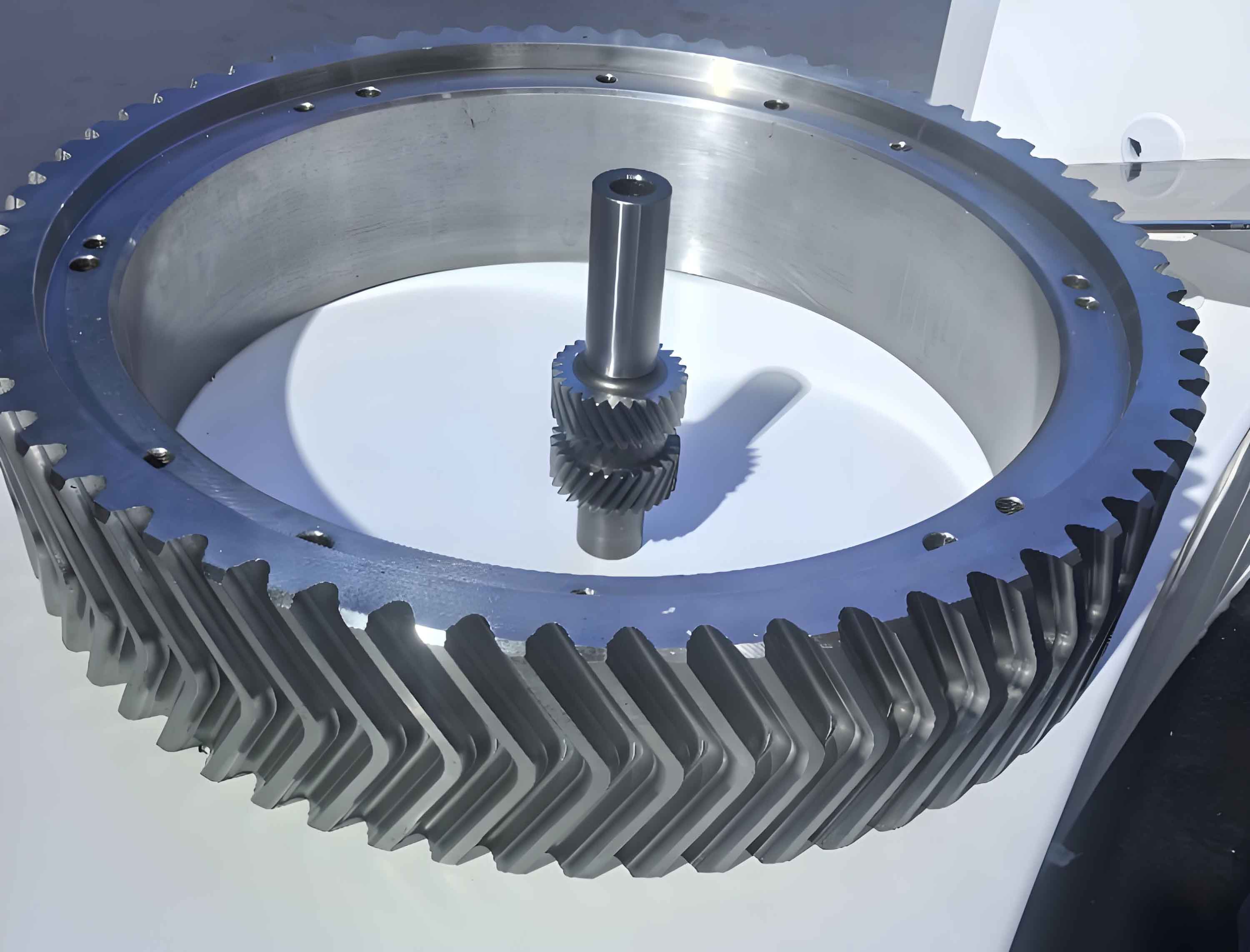
Herringbone gears consist of two helical gears with opposite hands, forming a V-shape that cancels out axial thrust forces. This unique configuration reduces the need for thrust bearings and minimizes axial loads on the shaft. However, in practical applications, factors such as manufacturing errors, misalignments, and time-varying meshing stiffness can lead to dynamic excitations that propagate through the system. The support from rolling bearings adds another layer of complexity, as bearings influence load distribution and vibration transmission. To accurately analyze this, I propose a coupled bending-torsional-axial vibration model for herringbone gears, considering time-varying meshing stiffness and impact excitations. Additionally, I develop methods for load distribution in rolling bearings and model the dynamic transfer of vibrations from gear pairs to bearing housings. This approach allows for a more scientific prediction of dynamic loads on gearbox structures, facilitating noise and vibration control. The importance of herringbone gears in modern machinery cannot be overstated, and their dynamic analysis is essential for advancing transmission technology.
The dynamic behavior of herringbone gear systems is governed by multiple factors, including gear geometry, support conditions, and external loads. I start by establishing a vibration model that accounts for the coupled motions of herringbone gears. This model considers 12 degrees of freedom, representing translational and rotational displacements of the pinion and gear centers. Based on Newton’s laws, the equations of motion can be derived. Let me denote the generalized displacement vector as:
$$ \delta = [y_{p1}, z_{p1}, \theta_{p1}, y_{g1}, z_{g1}, \theta_{g1}, y_{p2}, z_{p2}, \theta_{p2}, y_{g2}, z_{g2}, \theta_{g2}]^T $$
where \( y_{ij} \), \( z_{ij} \), and \( \theta_{ij} \) (with \( i = p, g \) for pinion and gear, and \( j = 1, 2 \) for left and right sides) represent the translational vibrations in the y and z directions and rotational vibrations, respectively. The equations of motion incorporate terms for mass, damping, stiffness, and external forces. For instance, the dynamic equations for the left-side pinion can be expressed as:
$$ m_{p1} \ddot{y}_{p1} + c_{p1y} \dot{y}_{p1} + k_{p1y} y_{p1} = -F_{y1} + m_{p1}g $$
$$ m_{p1} \ddot{z}_{p1} + c_{p12z} (\dot{z}_{p1} – \dot{z}_{p2}) + k_{p12z} (z_{p1} – z_{p2}) = -F_{z1} $$
$$ I_{p1} \ddot{\theta}_{p1} = -F_{y1} R_p + T_{s1} – F_{s1} R_p $$
Here, \( F_{y1} \) and \( F_{z1} \) are the dynamic meshing forces in the normal and axial directions, \( F_{s1} \) is the impact excitation force, \( R_p \) is the pitch radius, and \( T_{s1} \) is the input torque. Similar equations apply to the other components. The meshing stiffness for herringbone gears is computed using load tooth contact analysis (LTCA), which considers shaft torsional deformation and misalignment errors. This time-varying stiffness, along with impact forces from corner contact, serves as excitation in the model. The coupling between left and right sides of herringbone gears is captured through axial springs and dampers in the gap region, accounting for the unique structure of herringbone gears. This model forms the basis for analyzing dynamic loads at equivalent support points.
To compute dynamic loads, I solve the equations numerically using a variable-step Runge-Kutta method. The results provide radial and axial dynamic loads at the support points of herringbone gears. For example, the radial dynamic load at a support point is given by:
$$ F_{ij}(t) = k_{ijy} y_{ij} $$
where \( i \) and \( j \) index the gear and side. The axial dynamic load for the gear can be expressed as:
$$ F_a(t) = k_{g1z} z_{g1} + k_{g2z} z_{g2} $$
These loads are influenced by factors such as misalignment, which causes uneven loading on the left and right sides of herringbone gears. This uneven distribution highlights the need for precise analysis in herringbone gear systems.
Next, I address load distribution in rolling bearings that support the herringbone gear shafts. The pinion is typically supported by cylindrical roller bearings that allow axial float, while the gear uses tapered roller bearings to handle axial loads. For the pinion, the radial dynamic loads are distributed between the two bearings based on static equilibrium. If \( F_{p1}(t) \) and \( F_{p2}(t) \) are the radial loads at the left and right support points, and \( l_1 \), \( l_2 \), \( B \), and \( H \) are geometric parameters, the loads on the bearings are:
$$ F_{pr1}(t) = \frac{(l_2 + H + B) F_{p1}(t) + l_1 F_{p2}(t)}{l_1 + l_2 + H + B} $$
$$ F_{pr2}(t) = \frac{l_2 F_{p1}(t) + (l_1 + H + B) F_{p2}(t)}{l_1 + l_2 + H + B} $$
For the gear, tapered roller bearings require a more nuanced approach because the radial and axial loads are interdependent. Instead of simply relating them by the taper angle, I propose a method that considers internal load distribution within the bearings. This involves calculating the normal contact loads on each roller based on equilibrium conditions. Let \( Q_{10} \) and \( Q_{20} \) be initial guesses for the maximum roller loads on left and right bearings. Using contact mechanics, I determine the number of loaded rollers \( j_1 \) and \( j_2 \), and their distribution angles \( \psi_{1p} \) and \( \psi_{2q} \). The equilibrium equations for radial and axial forces are:
$$ \sum_{p=1}^{j_1} Q_{1p} \cos \psi_{1p} \cos \alpha_{e1} + \sum_{q=1}^{j_2} Q_{2q} \cos \psi_{2q} \cos \alpha_{e2} = F_{g1} + F_{g2} $$
$$ \sum_{q=1}^{j_2} Q_{2q} \sin \alpha_{e2} – \sum_{p=1}^{j_1} Q_{1p} \sin \alpha_{e1} = F_a $$
where \( \alpha_{e1} \) and \( \alpha_{e2} \) are taper angles. Solving these iteratively yields the dynamic loads on the bearing inner rings. The radial and axial loads for the left bearing are:
$$ F_{gr1}(t) = \sum_{p=1}^{j_1} Q_{1p} \cos \psi_{1p} \cos \alpha_{e1} $$
$$ F_{ga1}(t) = \sum_{p=1}^{j_1} Q_{1p} \sin \alpha_{e1} $$
And similarly for the right bearing. This method provides a more accurate distribution than simplistic assumptions, especially for herringbone gears where loads can vary significantly.
Once the loads on bearing inner rings are known, I analyze the vibration transmission through the rolling bearings. Bearings act as dynamic elements that transfer forces from the inner ring to the outer ring, which is connected to the gearbox housing. To model this, I establish dynamics models for both cylindrical and tapered roller bearings. For cylindrical roller bearings, the model includes degrees of freedom for the inner ring, rollers, and outer ring. The displacement vector is:
$$ \delta_p = [y_{pin}, y_{p1}, \ldots, y_{pn}, y_{pout}]^T $$
where \( n \) is the number of loaded rollers. The equations of motion involve contact forces between rings and rollers. For the inner ring:
$$ m_{pin} \ddot{y}_{pin} + \sum_{j=1}^{n} F_{in_j} \cos \psi_j = F_p(t) + m_{pin} g $$
For a roller:
$$ m_{pj} \ddot{y}_{pj} – F_{in_j} + F_{out_j} = m_{pj} g $$
And for the outer ring:
$$ m_{pout} \ddot{y}_{pout} + \sum_{j=1}^{n} F_{out_j} \cos \psi_j + c_{pb} \dot{y}_{pout} + k_{pb} y_{pout} = m_{pout} g $$
The contact forces \( F_{in_j} \) and \( F_{out_j} \) depend on relative displacements and contact stiffness/damping. The dynamic load on the housing wall is then:
$$ F’_p(t) = k_{pb} y_{pout} $$
For tapered roller bearings, the model is more complex due to axial loads. The displacement vector includes both radial and axial directions:
$$ \delta_g = [y_{gin}, z_{gin}, y_{g1}, z_{g1}, \ldots, y_{gn}, z_{gn}, y_{gout}, z_{gout}]^T $$
The equations incorporate radial and axial components. For the inner ring:
$$ m_{gin} \ddot{y}_{gin} + \sum_{j=1}^{n} F_{in_j} \cos \psi_j \cos \alpha_e = F_{gr}(t) + m_{gin} g $$
$$ m_{gin} \ddot{z}_{gin} + \sum_{j=1}^{n} F_{in_j} \sin \alpha_e = F_{ga}(t) $$
For the outer ring:
$$ m_{gout} \ddot{y}_{gout} + \sum_{j=1}^{n} F_{out_j} \cos \psi_j \cos \alpha_e + F_{g} \cos \alpha_e = m_{gout} g $$
$$ m_{gout} \ddot{z}_{gout} + \sum_{j=1}^{n} F_{out_j} \sin \alpha_e + F_{g} \sin \alpha_e = 0 $$
where \( F_{g} \) is the force from the housing support. The housing dynamic loads are:
$$ F’_{gr}(t) = k_{gb} (y_{gout} \cos \alpha_e + z_{gout} \sin \alpha_e) \cos \alpha_e $$
$$ F’_{ga}(t) = k_{gb} (y_{gout} \cos \alpha_e + z_{gout} \sin \alpha_e) \sin \alpha_e $$
These models show that rolling bearings can attenuate vibrations, similar to floating raft isolation systems, thereby reducing noise transmission in herringbone gear systems.
To illustrate the analysis, I apply the methods to a herringbone gear transmission system with specific parameters. The gear pair has the following properties, summarized in a table:
| Parameter | Pinion | Gear |
|---|---|---|
| Normal module (mm) | 6 | 6 |
| Pressure angle (°) | 20 | 20 |
| Helix angle (°) | 24.43 | -24.43 |
| Number of teeth | 17 | 44 |
| Face width (mm) | 55 | 55 |
| Material density (g/cm³) | 7.85 | 7.85 |
The support bearings are detailed in another table:
| Bearing Type | Pinion Left | Pinion Right | Gear Left | Gear Right |
|---|---|---|---|---|
| Type | Cylindrical roller | Cylindrical roller | Tapered roller | Tapered roller |
| Inner diameter (mm) | 45 | 35 | 50 | 40 |
| Outer diameter (mm) | 55 | 45 | 60 | 50 |
| Number of rollers | 28 | 20 | 32 | 24 |
| Taper angle (°) | — | — | 25 | 25 |
| Radial stiffness (×10⁸ N/m) | 4.04 | 2.35 | 5.29 | 3.40 |
| Axial stiffness (×10⁸ N/m) | — | — | 2.46 | 1.58 |
I assume a misalignment error of 0.05° in the shaft angle to simulate practical conditions. Solving the herringbone gear dynamics model yields dynamic loads at support points. The results show that due to misalignment, loads on the right side are higher than on the left, indicating slight bias loading. The axial dynamic load on the gear confirms this uneven distribution. For the pinion, the radial dynamic loads at equivalent supports are computed, and then distributed to the cylindrical roller bearings. After transmission through the bearing dynamics model, the loads on the housing walls are obtained. Similarly, for the gear, the tapered roller bearing loads are calculated using the internal distribution method, and then transferred to the housing. The dynamic load coefficients on the housing are lower than those on the inner rings, demonstrating the vibration isolation effect of rolling bearings. This effect is crucial for noise reduction in herringbone gear systems.
To emphasize the accuracy of my method, I compare the axial-to-radial load ratio in tapered roller bearings. A common simplification assumes the ratio equals the tangent of the taper angle, but my analysis shows deviations of about 0.1, highlighting the importance of considering internal load distribution. This is particularly relevant for herringbone gears, where load variations can impact performance.
In conclusion, I have presented a comprehensive analysis of dynamic power transmission in herringbone gear systems supported by rolling bearings. By developing a coupled vibration model for herringbone gears and incorporating detailed bearing dynamics, I provide a scientific approach to predict dynamic loads on gearbox structures. The methods account for time-varying stiffness, impact excitations, and internal bearing load distributions, offering improved accuracy over traditional approaches. The results confirm that rolling bearings play a role in vibration isolation, similar to floating raft systems, thereby contributing to noise control. This research underscores the significance of herringbone gears in advanced transmission systems and provides a foundation for optimizing design and reducing vibrations. Future work could explore the integration of these models with finite element analysis for full gearbox simulations, further enhancing the understanding of herringbone gear dynamics.
Throughout this article, I have focused on herringbone gears, discussing their unique characteristics and dynamic behavior. The use of mathematical models, tables, and formulas has allowed for a detailed summary of key concepts. I hope this analysis contributes to the ongoing development of efficient and quiet herringbone gear transmission systems in industrial applications.