
The reliable operation of material handling equipment is paramount in continuous industrial processes, such as automotive paint shops. A critical point of failure in these environments is often found in the power transmission components of drying oven elevators. This article presents a comprehensive, first-principles analysis of a recurring fracture problem observed in the gear shafts of such elevators. The investigation moves from field observation through systematic root cause analysis to the implementation and validation of an effective engineering solution. The focal point of this failure and our subsequent analysis is the elevator’s gear shaft, a component whose integrity is essential for uninterrupted production.
Drying ovens in automotive painting lines are typically configured in π, bridge, or straight-through layouts. The π-type oven, in particular, requires the use of high-temperature chain elevators at its entrance and exit to transfer vehicle bodies. These elevators are complex assemblies consisting of a structural frame, drive unit, lifting chains, driven sprocket assemblies, lifting carriages, counterweights, and safety mechanisms. The drive system, comprising a motor and reducer, transmits torque via a universal joint to a primary gear shaft. This gear shaft drives a chain system connected to an upper idler sprocket assembly. The chains themselves are fixed to the lifting carriage and a counterweight, creating a balanced system for vertical movement.
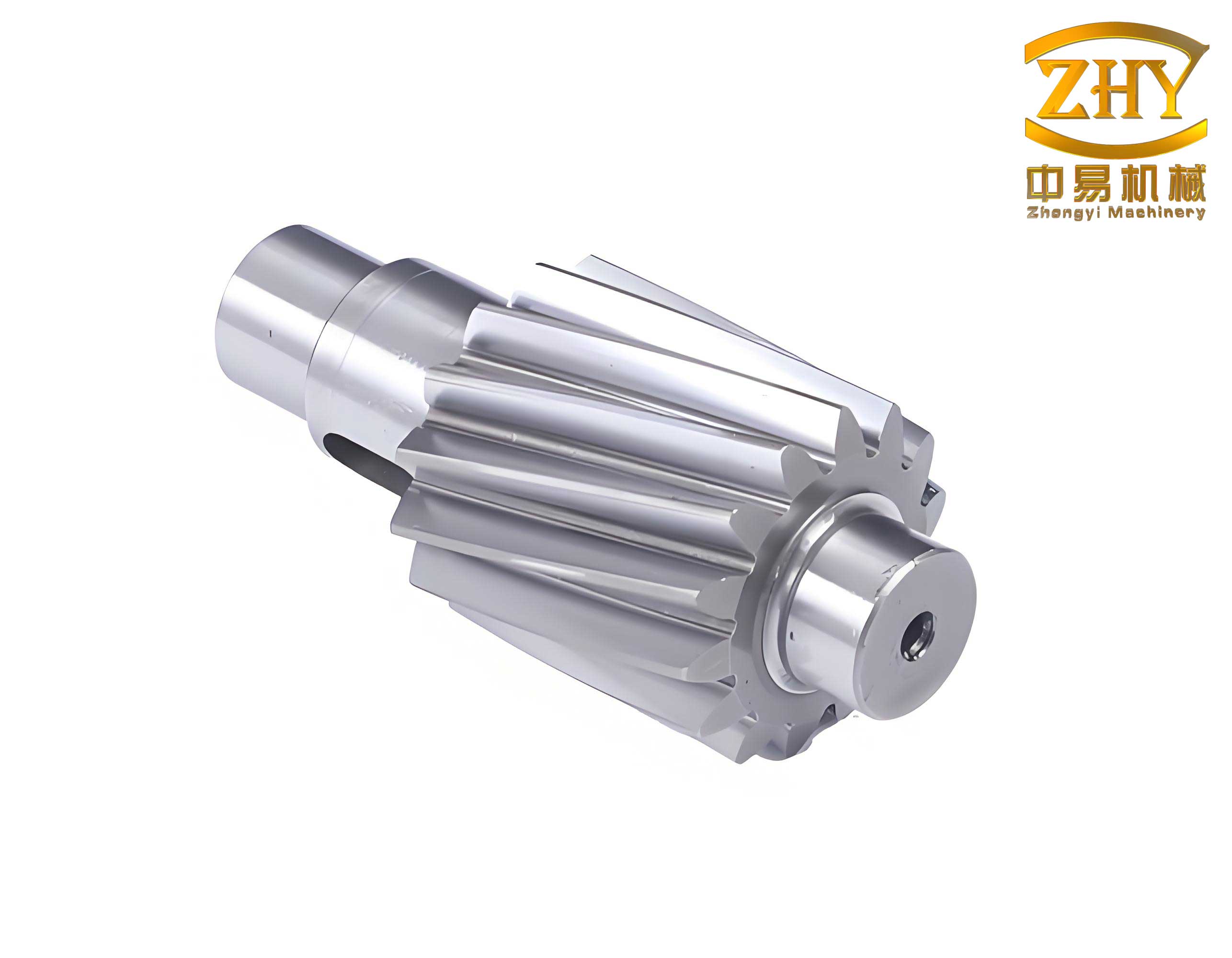
The driven gear shaft within the upper sprocket assembly is subject to continuous and cyclic loading. During operation, it sustains bending stresses from the chain tension and experiences variable stresses due to the start-stop cycles dictated by production tact time. In a high-volume manufacturing setting with a cycle time of 62 seconds and two-shift operation, this translates to millions of stress cycles annually. The failure mode observed was the catastrophic fracture of this driven gear shaft. Such a failure causes immediate and prolonged line stoppage. If a vehicle body is on the carriage at the moment of failure, it becomes stranded mid-elevator, complicating recovery and repair efforts significantly, posing both a production and a safety risk.
Our investigation followed a structured failure analysis protocol, sequentially eliminating potential causes to isolate the fundamental issue.
Phase 1: Verification of Material and Heat Treatment
The initial suspicion centered on possible deficiencies in material quality or heat treatment. A sample from the fractured gear shaft was subjected to metallographic and hardness testing. The specified material was 40Cr (AISI 4140 equivalent), requiring a tempered sorbite structure with a hardness range of 241-286 HB.
| Analysis Item | Technical Specification | Test Result | Conclusion |
|---|---|---|---|
| Surface Hardness (HB) | 241 – 286 | 242, 257 | Conforms |
| Metallographic Structure | Tempered Sorbite + Minor Ferrite | Tempered Sorbite + Minor Ferrite | Conforms |
Chemical composition analysis was also performed to ensure the material met the standard GB/T 3077-2015 for 40Cr steel.
| Element | Standard for 40Cr | Test Result | Conclusion |
|---|---|---|---|
| C | 0.37 – 0.44 | 0.440 | Conforms |
| Si | 0.17 – 0.37 | 0.250 | Conforms |
| Mn | 0.50 – 0.80 | 0.680 | Conforms |
| Cr | 0.80 – 1.10 | 0.990 | Conforms |
| S | ≤ 0.035 | 0.001 | Conforms |
| P | ≤ 0.035 | 0.023 | Conforms |
The results conclusively demonstrated that the material and its heat treatment were not the root cause of the gear shaft fracture.
Phase 2: Stress Analysis and Load Capacity Verification
With material integrity confirmed, the analysis shifted to the mechanical design. The driven gear shaft is primarily subject to bending moments with negligible torsion. A free-body diagram and finite element analysis (FEA) were employed to identify critical sections. The analysis revealed high stress concentrations at the shoulder fillets adjacent to the sprocket and locking assembly. The actual fracture location correlated precisely with the FEA-predicted maximum stress point, specifically at the fillet between the Ø90 mm and Ø95 mm diameters near the locking device.
The bending stress ($\sigma_b$) at this critical cross-section was calculated using the standard formula:
$$\sigma_b = \frac{M_b}{W}$$
where $M_b$ is the bending moment and $W$ is the section modulus. For a solid round shaft, $W = \frac{\pi d^3}{32}$, where $d$ is the diameter at the critical section (Ø90 mm).
Calculating the bending moment from the chain tension ($F$) and the relevant distances ($L_1$, $L_2$) between bearing supports and the load application point:
$$M_b = F \cdot L_{effective}$$
The calculated maximum bending stress was compared to the allowable stress ($\sigma_{all}$) for the 40Cr material, which is derived from its yield strength ($S_y$) and a design factor ($N_d$):
$$\sigma_{all} = \frac{S_y}{N_d}$$
Our calculations showed:
$$\sigma_b \approx 118 \text{ MPa}, \quad \sigma_{all} \approx 245 \text{ MPa} (for N_d=2.5)$$
Therefore, $\sigma_b < \sigma_{all}$, indicating the shaft diameter was theoretically sufficient for static loading.
We then performed a fatigue strength assessment, which is crucial for components under cyclic loading. The corrected endurance limit ($S_e’$) for the gear shaft material is modified by various factors:
$$S_e = k_a \cdot k_b \cdot k_c \cdot k_d \cdot k_e \cdot S_e’$$
where $k_a$ is the surface finish factor, $k_b$ is the size factor, $k_c$ is the reliability factor, $k_d$ is the temperature factor, and $k_e$ is the miscellaneous effects factor. The fatigue safety factor ($n_f$) for bending is given by:
$$n_f = \frac{S_e}{\sigma_a}$$
where $\sigma_a$ is the alternating stress amplitude. Initial calculations, assuming a standard fillet, yielded a safety factor greater than 1, suggesting adequate fatigue life under design conditions. This confirmed there was no fundamental design flaw in the shaft’s dimensions.
Phase 3: Geometric and Stress Concentration Analysis
The discrepancy between the theoretical analysis and the empirical failure data pointed to a factor not yet considered in detail: the geometric stress concentration at the diameter transition. Examination of the failed gear shaft revealed a critical deviation from best practice. The fillet radius ($r$) at the Ø90 to Ø95 mm shoulder was measured to be only 0.5 mm. Furthermore, this sharp transition was located in close proximity to a keyway, creating a compound stress concentration effect.
According to engineering standards such as GB/T 6403.4-2008 (ISO equivalent), for shaft diameters in the range of 80-120 mm, the recommended minimum fillet radius is 2.5 mm. The severe undersizing of this radius dramatically increased the theoretical stress concentration factor ($K_t$). For a shaft shoulder, $K_t$ is a function of the ratio of the larger diameter ($D$), the smaller diameter ($d$), and the fillet radius ($r$):
$$K_t = f\left(\frac{D}{d}, \frac{r}{d}\right)$$
With $D=95$ mm, $d=90$ mm, and $r=0.5$ mm, the ratios become $D/d \approx 1.056$ and $r/d \approx 0.0056$. Consulting standard charts or using empirical formulas, the stress concentration factor for such a geometry is exceptionally high, often exceeding 2.5. The fatigue stress concentration factor ($K_f$) is then:
$$K_f = 1 + q(K_t – 1)$$
where $q$ is the notch sensitivity factor for the material. This leads to the actual alternating stress at the notch being:
$$\sigma_{a, actual} = K_f \cdot \sigma_a$$
When this corrected, much higher stress is used in the fatigue safety factor calculation, the result changes drastically:
$$n_{f, actual} = \frac{S_e}{K_f \cdot \sigma_a}$$
Recalculation with the appropriate $K_f$ yielded a safety factor below 1, clearly predicting fatigue failure. The fracture surface exhibited classic fatigue characteristics: a smooth fatigue propagation zone originating at the root of the sharp fillet, covering approximately 75% of the cross-section, followed by a final fast fracture zone.
| Investigated Factor | Method of Analysis | Result/Conclusion |
|---|---|---|
| Material & Heat Treatment | Hardness test, Metallography, Chemical Analysis | Conformed to 40Cr specification. NOT the root cause. |
| Static Load Capacity | Bending stress calculation, FEA simulation | Nominal stress below allowable limit. NOT the root cause. |
| Fatigue Load Capacity (Theoretical) | Standard fatigue safety factor calculation | Safety factor > 1 for standard geometry. NOT the root cause. |
| Geometric Stress Concentration | Physical measurement, standards comparison, Fractography | Fillet radius (0.5 mm) severely undersized vs. standard (2.5 mm). Proximity to keyway compounded the issue. This is the ROOT CAUSE. |
Solution and Implementation
The corrective action was precise and targeted the identified geometric deficiency. The manufacturing drawing for the gear shaft was revised with two key changes:
- The fillet radius at all critical diameter transitions, especially at the Ø90/Ø95 mm shoulder, was increased to the standard value of R=2.5 mm.
- The axial distance between this fillet and the nearby keyway was increased by 5 mm to decouple the two stress concentrators.
The bending stress at the critical section remains unchanged as it is a function of the minimal diameter and load. However, the dramatic reduction in the stress concentration factor ($K_f$) directly increases the fatigue safety factor. Recalculating with the new geometry:
$$K_{t,new} = f\left(\frac{95}{90}, \frac{2.5}{90}\right) = f(1.056, 0.0278)$$
The new $K_t$ value is significantly lower, approximately 1.5. This leads to:
$$n_{f,new} = \frac{S_e}{K_{f,new} \cdot \sigma_a} \approx 1.96$$
A safety factor near 2.0 is considered robust for such applications. Gear shafts manufactured to the revised drawing were installed and have operated without failure, validating the solution.
Generalized Learnings and Preventive Measures
This case study yields several critical lessons for the design, specification, and maintenance of power transmission shafts, particularly in demanding cyclical applications:
- Design Review Focus: For any gear shaft or similar axially loaded component, drawing reviews must mandate scrutiny of fillet radii at all shoulder transitions. Compliance with standards like ISO 6266 or equivalent must be verified. Finite Element Analysis is highly recommended to visually identify maximum stress points, which are often at these geometric discontinuities.
- Manufacturing and Quality Control: Procurement specifications should explicitly call out critical fillet radii and surface finish requirements. Non-destructive testing (e.g., magnetic particle inspection) on a sampling basis is advisable for high-stress components to catch subsurface defects or grinding burns.
- System Design Considerations: For elevator systems, optimizing the motion profile to reduce acceleration/deceleration inertial forces minimizes dynamic peak loads on the gear shaft. The interaction of the motor brake engagement with the system’s dynamics should also be analyzed to avoid shock loads.
- Handling and Maintenance: Installed shafts must be protected from scratches, nicks, or unauthorized modifications like welding, as these can initiate cracks. Regular inspections for signs of fretting or corrosion at bearing seats and shoulders are prudent.
- Architectural Layout: In new facility planning, the preference should be for shorter, within-floor elevator lifts over multi-story versions. Reducing the total lift height decreases the travel time and the number of stress cycles per unit time, indirectly enhancing the fatigue life of all drive components, including the central gear shaft.
In conclusion, the fracture of the drying oven elevator gear shaft was a textbook case of fatigue failure driven by an excessively sharp geometric transition, not by material failure or basic design error. This underscores a fundamental engineering principle: the theoretical strength of a component is often dictated not by its bulk dimensions but by the severity of its stress concentrations. A systematic, data-driven investigation that progresses from material verification to detailed stress analysis is essential for diagnosing such failures. The implemented solution—standardizing and optimizing fillet geometry—was low-cost but highly effective, ensuring long-term reliability and preventing recurrence in future projects. This analysis highlights the critical importance of meticulous attention to detail in the geometry of power transmission components like the gear shaft, where small, easily overlooked features can have outsized consequences on system uptime and operational safety.