
In my experience working with automotive painting workshops, the drying elevator is a critical component for vehicle throughput, especially in π-type drying ovens that require high-temperature chain-driven elevators at the entrance and exit. The gear shafts in these elevators are paramount to reliable operation. When a gear shaft fractures, it can lead to prolonged production line stoppages, complex repairs, and significant downtime, particularly in single-line designs where the entire painting process halts. This article delves into a comprehensive analysis of gear shaft fracture issues, based on firsthand investigations, and presents effective solutions to ensure long-term stability and reliability. Throughout this discussion, the term ‘gear shafts’ will be emphasized repeatedly, as they are the focal point of this mechanical integrity challenge.
The structure of a typical drying elevator consists of several standard components: a column framework, a drive unit (including a motor and reducer), a universal shaft, gear shafts, driven gear sets at the top, lifting chains, lifting skids, counterweights, guide mechanisms, and safety devices. The drive unit powers the universal shaft, which rotates the gear shafts. These gear shafts engage with the driven gear sets, connected by lifting chains that carry the skids and counterweights. When a烘干 vehicle moves onto the skid, the motor drives the bottom sprocket, causing the chains to move vertically and transport the vehicle. The control of acceleration and deceleration is set based on production cycle time and the allowable stress ranges of the components. The gear shafts, particularly the driven ones, are continuously under load and subjected to cyclic alternating stresses during operation.
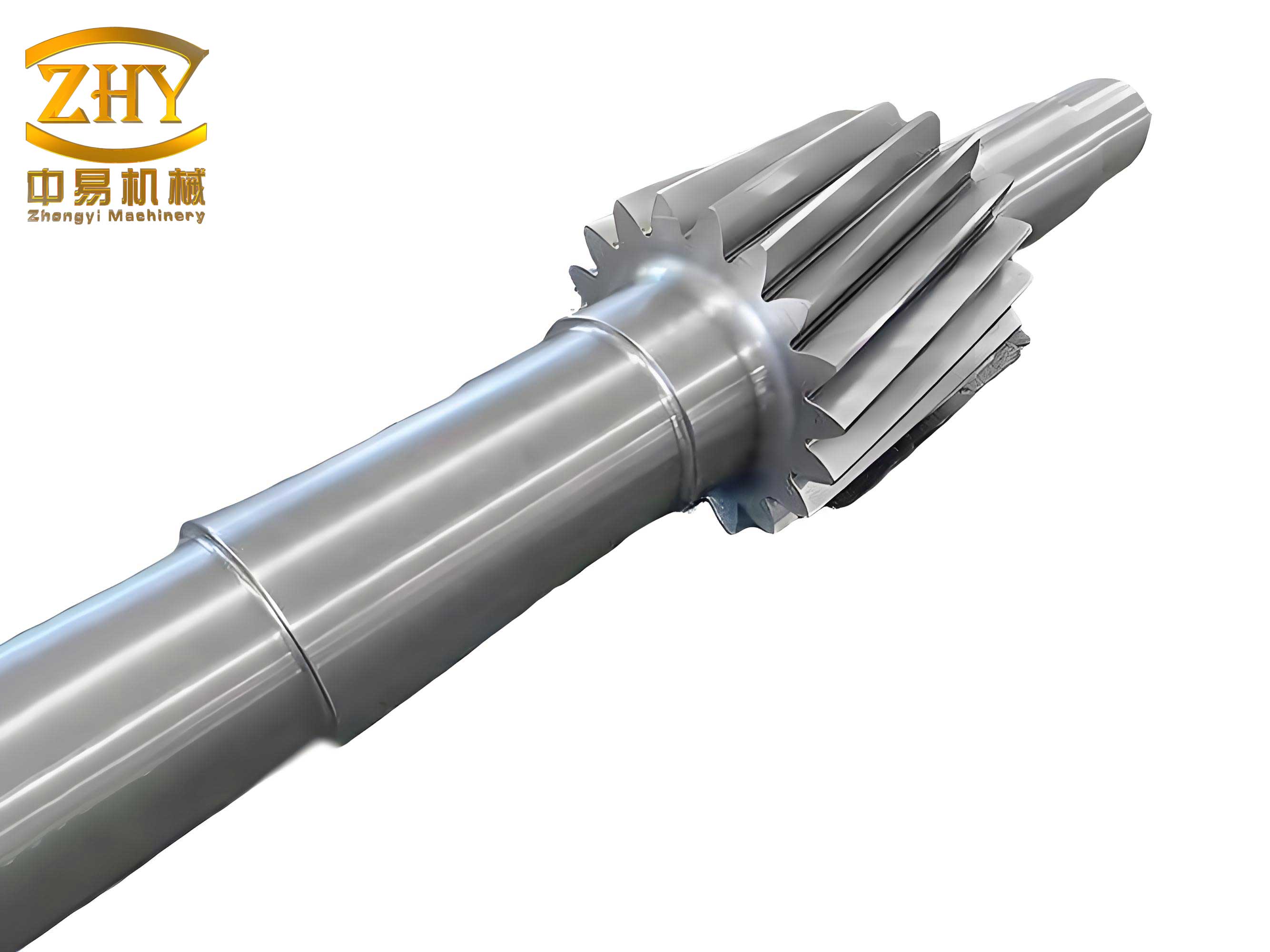
The problem emerged in multiple production lines at a facility operating on a 62-second cycle time with two shifts. The gear shafts, which are primary load-bearing elements, experienced fractures during operation. Such failures caused the elevators to halt due to drive faults, sometimes leaving烘干 vehicles stranded mid-air, complicating maintenance and part replacement. This recurrent issue severely disrupted normal production, prompting a thorough root cause analysis.
Initially, we considered potential quality issues in the heat treatment process of the gear shafts. To verify, we examined the fracture surfaces of failed shafts. The fracture appearance typically showed characteristics indicative of fatigue failure. We extracted samples from the fracture zone for metallographic and hardness testing. The results are summarized in Table 1.
| Item | Technical Requirement | Test Result (Shaft Surface) |
|---|---|---|
| Hardness (HB) | 241–286 | 242, 257 |
| Metallographic Structure | Tempered to achieve sorbite + minor ferrite | Sorbite + minor ferrite |
The hardness and microstructure met the specifications, ruling out heat treatment defects. Next, we assessed whether the material composition of the gear shafts complied with standards. Chemical analysis was performed on samples from the shafts, and the results were compared against GB/T 3077-2015 for 40Cr steel, as shown in Table 2.
| Element | Standard for 40Cr | Fractured Shaft |
|---|---|---|
| C | 0.37–0.44 | 0.440 |
| Si | 0.17–0.37 | 0.250 |
| Mn | 0.50–0.80 | 0.680 |
| Cr | 0.80–1.10 | 0.990 |
| S | ≤0.035 | 0.001 |
| P | ≤0.035 | 0.023 |
The chemical composition was within the required limits, confirming that the material itself was not the primary cause. With material and process quality validated, we shifted focus to mechanical analysis. We performed a detailed force analysis on the entire gear shaft to identify critical sections. Using finite element analysis (FEA), we modeled the shaft under operational loads. The bending moment diagram and stress distribution indicated that the maximum stress concentrations occurred at the diameter transition zones near the sprocket installation. Specifically, these were at the change from φ90 mm to φ95 mm (where a locking sleeve is mounted) and from φ95 mm to φ105 mm (at the thrust shoulder). The section adjacent to the sprocket at the locking sleeve side was identified as the most critical. We then conducted stress calculations to verify if this section met the allowable stress criteria.
Since the gear shaft is a driven shaft, the primary loading is due to bending from chain forces, with negligible torque from friction in bearings. Thus, we evaluated the shaft’s strength based on bending stress. The maximum bending moment \( M \) at the critical section can be derived from the chain tension \( F \) and the distance \( L \) from the bearing support. The bending stress \( \sigma_b \) is given by:
$$ \sigma_b = \frac{M}{S} $$
where \( S \) is the section modulus for a circular cross-section, calculated as \( S = \frac{\pi d^3}{32} \), with \( d \) being the diameter at the critical section (e.g., φ90 mm). The chain tension \( F \) depends on the total load, including the weight of the vehicle, skid, and chains, plus dynamic forces from acceleration. For a production cycle of 62 seconds, we estimated the maximum dynamic load. Assuming a total mass \( m \) and acceleration \( a \), the force \( F \) is:
$$ F = m \cdot g + m \cdot a $$
where \( g \) is gravitational acceleration (9.81 m/s²). The bending moment \( M = F \cdot L \), where \( L \) is the lever arm. Substituting values, we computed \( \sigma_b \). The allowable stress \( [\sigma] \) for 40Cr steel, considering a safety factor, is typically derived from the yield strength \( \sigma_y \) (approx. 785 MPa for 40Cr after tempering). Using a safety factor \( n \) of 1.5, \( [\sigma] = \frac{\sigma_y}{n} \approx 523 \, \text{MPa} \). Our calculation showed that \( \sigma_b \) was less than \( [\sigma] \), indicating that the shaft should theoretically withstand the operational loads.
To further assess durability, we performed a fatigue strength check. The fatigue safety factor \( n_f \) is given by:
$$ n_f = \frac{\sigma_{-1}}{K_f \cdot \sigma_a} $$
where \( \sigma_{-1} \) is the endurance limit of the material (for 40Cr, approximately 0.45 times the tensile strength, or ~350 MPa), \( K_f \) is the fatigue stress concentration factor, and \( \sigma_a \) is the alternating stress amplitude. The stress amplitude \( \sigma_a \) is half the range of the alternating bending stress during cycling. From operational data, \( \sigma_a \) was calculated. The stress concentration factor \( K_f \) depends on the geometry, particularly at diameter transitions and keyways. For a shaft with a small fillet radius, \( K_f \) can be high. Initial design specifications showed a fillet radius of only 0.5 mm at the φ90 mm to φ95 mm transition, which is significantly below the standard requirement of 2.5 mm per GB/T 6403.4-2008 for shafts in the 80–120 mm diameter range. This small radius, coupled with the proximity of the keyway to the transition, created a severe stress concentration. We estimated \( K_f \) using empirical formulas based on notch sensitivity. The fatigue safety factor computed with the original design was below the recommended minimum of 1.5, explaining the premature fractures. The fracture surface examination revealed that approximately 75% of the area was fatigue propagation, with the fatigue origin at the root of the φ95 mm to φ90 mm transition, confirming stress concentration as the primary driver.
A detailed structural analysis of the critical section highlighted two key issues: insufficient fillet radius and minimal distance between the diameter transition and the keyway. Table 3 summarizes the geometric parameters before and after improvement.
| Parameter | Original Design | Improved Design |
|---|---|---|
| Diameter Transition | φ90 mm to φ95 mm | φ90 mm to φ95 mm |
| Fillet Radius (R) | 0.5 mm | 2.5 mm (per GB/T 6403.4-2008) |
| Distance from Transition to Keyway | Minimal (~2 mm) | Increased by 5 mm (~7 mm) |
| Stress Concentration Factor (K_f) | High (estimated >2.5) | Reduced (estimated ~1.8) |
To address these, we implemented two corrective measures: first, redesigning all diameter transitions on the gear shafts to have a standard fillet radius of R = 2.5 mm; second, increasing the distance between the transition and the keyway by 5 mm to further reduce stress concentration. After implementing these changes, we recalculated the fatigue safety factor. The alternating stress \( \sigma_a \) remained unchanged as it depends on operational loads, but the reduced \( K_f \) significantly increased \( n_f \). The new safety factor was computed as:
$$ n_f_{\text{new}} = \frac{\sigma_{-1}}{K_f_{\text{new}} \cdot \sigma_a} $$
With \( K_f_{\text{new}} \) lowered, \( n_f_{\text{new}} \) rose to 1.96, well above the minimum requirement. This improvement ensured that the gear shafts could endure the cyclic stresses over their intended lifespan. Field trials with the modified gear shafts installed in the original elevators confirmed no recurrence of fractures, validating the solutions.
Beyond the immediate fixes, we derived broader lessons for preventing similar issues in gear shafts. Firstly, during drawing reviews for shaft components, special attention must be paid to fillet radii at all diameter changes, ensuring they meet standard specifications. Additionally, potential stress concentrations, especially near keyways or other discontinuities, should be identified, preferably using finite element analysis for visualization. Secondly, for elevators with top-driven configurations, extending acceleration and deceleration times can minimize inertial shocks, reducing dynamic loads on the gear shafts. Also, the engagement of motor brakes during stops can introduce additional stresses, necessitating careful design considerations. Thirdly, load-bearing gear shafts must be maintained free of surface defects like scratches or welds, which can act as stress risers and initiate cracks. Finally, in new facility planning, opting for in-floor elevators rather than cross-floor designs is advisable, as the latter involve longer travel heights, increasing the duration of stress cycles on the gear shafts and potentially compromising fatigue life.
In conclusion, the fracture of gear shafts in drying elevators was primarily attributable to stress concentrations from non-compliant fillet radii and unfavorable geometric spacing. Through systematic analysis involving material verification, mechanical stress calculations, and fatigue assessments, we identified the root causes and implemented effective design modifications. These measures not only resolved the immediate problem but also provided a framework for enhancing the reliability of gear shafts in future projects. Continuous emphasis on proper geometric design, coupled with rigorous validation techniques, is essential for ensuring the durability of critical components like gear shafts in industrial applications.