
As a researcher deeply involved in the precision transmission field, I have long been fascinated by the intricate mechanics of RV (Rotary Vector) reducers. These components are the unsung heroes within industrial robots, silently dictating their reliability, precision, and lifespan. The compact RV reducer houses a complex transmission system where a small, yet critically stressed component often becomes the weak link: the needle roller bearing. Positioned between the crankshaft and the cycloidal wheel, these bearings operate under severe spatial constraints and endure wildly fluctuating dynamic loads. In practical applications, pronounced wear and even failure of these bearings are frequently reported, leading to a dramatic decline in the RV reducer’s performance, loss of its famed transmission accuracy, and potential catastrophic failure. To address this, our research team embarked on a mission to unravel the dynamic wear characteristics of these bearings. We developed a novel coupled model integrating contact multi-body dynamics with Archard’s wear theory, specifically for the cycloidal-pin and needle bearing transmission mechanism. This model allows us to predict wear progression under operational loads, offering crucial insights for optimizing bearing design and enhancing the overall durability of the RV reducer.
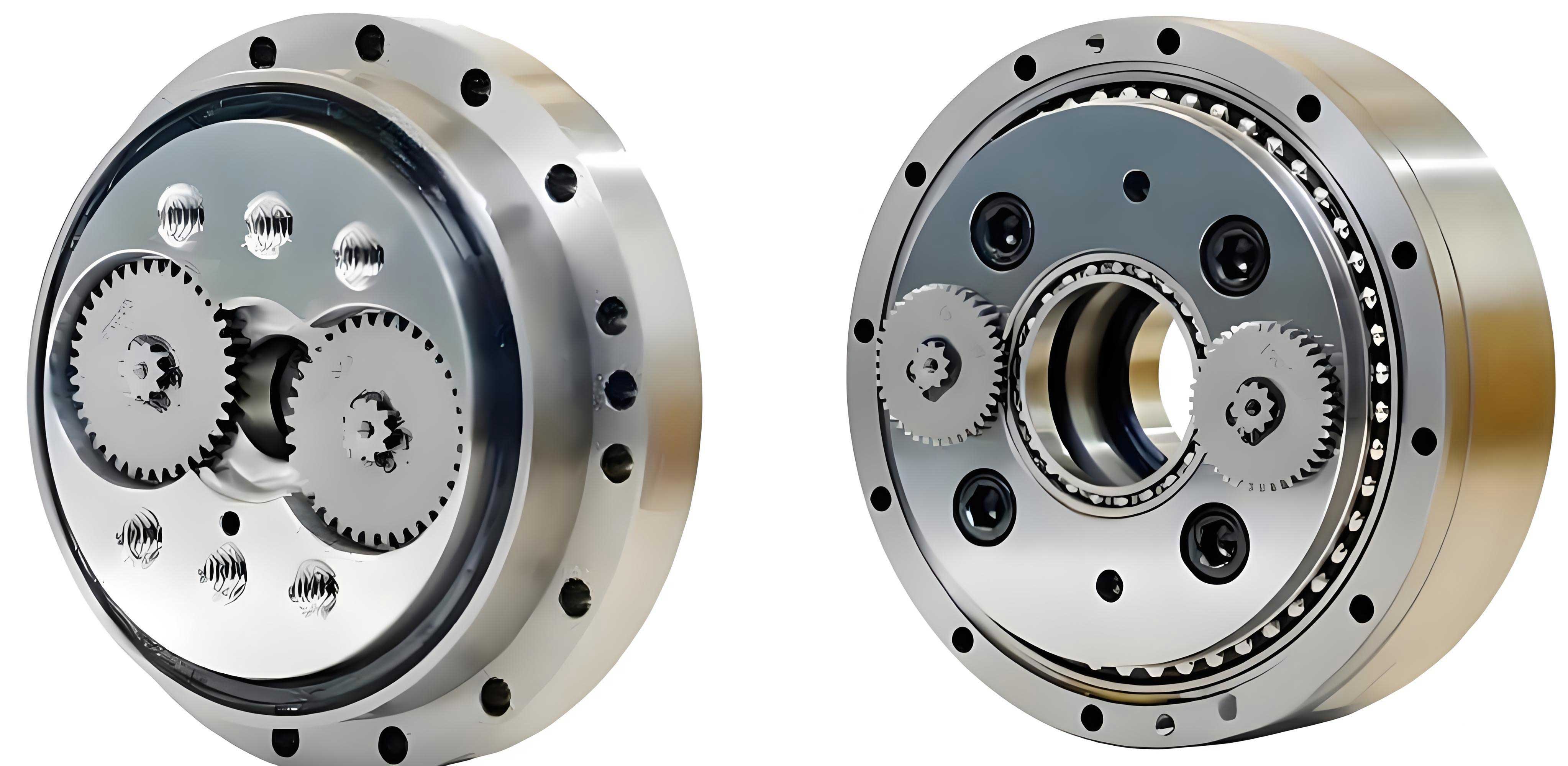
The core of our methodology lies in bridging two computational domains: the instantaneous mechanical environment and the long-term material degradation. First, we establish a high-fidelity multi-body dynamics model of the RV reducer transmission system. This model is not a simplistic representation; it accounts for all major components including two crankshafts, two cycloidal wheels, the planet carrier, and the fixed pin wheel. We incorporate the influence of support bearings and, most importantly, the translational bearings (needle roller bearings) themselves. The generalized coordinates of this 15-degree-of-freedom system are defined as:
$$ \mathbf{q} = [x_{g1}, y_{g1}, \theta_{g1}, x_{g2}, y_{g2}, \theta_{g2}, x_{c1}, y_{c1}, \theta_{c1}, x_{c2}, y_{c2}, \theta_{c2}, x_o, y_o, \theta_o]^T $$
The equations of motion are derived using a standard Lagrangian approach with constraint equations, leading to the following matrix form:
$$ \begin{bmatrix} \mathbf{M} & \mathbf{\Phi}_q^T \\ \mathbf{\Phi}_q & \mathbf{0} \end{bmatrix} \begin{Bmatrix} \mathbf{\ddot{q}} \\ \mathbf{\lambda} \end{Bmatrix} = \begin{Bmatrix} \mathbf{Q}_G \\ \mathbf{\gamma} – 2\alpha \dot{\mathbf{\Phi}} – \beta^2 \mathbf{\Phi} \end{Bmatrix} $$
The heart of the dynamic interaction lies in calculating contact forces. For the cycloid-pin meshing, we employ a nonlinear Hertzian contact model combined with a damping term. The contact force $F_j$ for the $j$-th pin is computed as:
$$ F_j = K_{pc} (\delta_{ij}^{max})^{10/9} + C_{pc} c_c \mathbf{v}_{jn} $$
Where $K_{pc}$ is the contact stiffness, $\delta_{ij}^{max}$ is the maximum penetration depth, $C_{pc}$ is the damping coefficient, $c_c$ is a damping tuning factor, and $\mathbf{v}_{jn}$ is the relative normal velocity at the contact point.
For the needle roller bearing, the modeling requires careful consideration of its role as both a support and a load-transfer element. The eccentricity vector $\mathbf{e}$ between the crankshaft’s eccentric circle center and the cycloidal wheel’s bearing hole center is fundamental. The contact force $F_r$ on the $k$-th roller is similarly modeled as:
$$ F_r = K_r (\delta_{r}^k)^{10/9} + C_r c_c v_r^k $$
Where $\delta_{r}^k$ is the radial deflection of the $k$-th roller and $v_r^k$ is its relative approach velocity. The dynamic solution provides the time-varying normal contact force $F_r(t, n)$ for each roller $n$, which becomes the primary driver for the wear calculation.
To transition from dynamics to wear, we adopt the renowned Archard wear model. It posits that the volumetric wear is proportional to the normal load and the sliding distance, and inversely proportional to the material hardness. The differential form is:
$$ \frac{dV}{ds} = K \frac{F}{H} $$
For our application, focusing on wear depth $h$ at a discrete contact point under pressure $p$, it simplifies to:
$$ \frac{dh}{ds} = I_h = \mu p $$
Where $\mu = K/H$ is the dimensional wear coefficient. The total wear depth is obtained by integration: $h = \int \mu p \, ds$. The challenge is determining the instantaneous pressure $p(t, n)$ and the appropriate wear coefficient $\mu(t, n)$ for the roller-raceway contacts within the RV reducer.
We calculate the contact pressure using Hertzian theory for line contact. The contact half-widths $b_{ir}$ and $b_{or}$ for the inner (crankshaft) and outer (cycloidal wheel) raceways are:
$$ b_{ir} = \sqrt{ \frac{4 F_r(t,n) \rho_{ir}}{\pi L_r} \left( \frac{1-\nu_c^2}{E_c} + \frac{1-\nu_r^2}{E_r} \right) }, \quad b_{or} = \sqrt{ \frac{4 F_r(t,n) \rho_{or}}{\pi L_r} \left( \frac{1-\nu_c^2}{E_c} + \frac{1-\nu_r^2}{E_r} \right) } $$
The corresponding contact pressures are then:
$$ p_{ir}(t,n) = \frac{F_r(t,n)}{2 b_{ir} L_r}, \quad p_{or}(t,n) = \frac{F_r(t,n)}{2 b_{or} L_r} $$
Determining the wear coefficient $\mu$ is critical. For the boundary lubrication regime typical in low-speed, grease-lubricated RV reducer bearings, we employ a dynamic model relating $\mu$ to operating conditions. The dimensionless wear coefficient $k$ is calculated as:
$$ k_{ir}(t,n) = 3.981 \times 10^{-29} C_{ir}(t,n) G_r S_{ir}(t,n)^{-1.589} E_r’ $$
Where $C_{ir}$ is the dimensionless load, $G_r$ is the dimensionless materials parameter, $S_{ir}$ is a function of the surface roughness and composite curvature, and $E_r’$ is the equivalent elastic modulus. The dimensional wear coefficient is then $\mu = k / H$. The sliding distance $ds$ is derived from the roller’s relative motion, considering a slip-roll ratio $\xi$.
The instantaneous wear depth increment for a contact point is:
$$ dh_{ir}(t,n) = I_{h-ir}(t,n) \cdot ds_{ir}(t,n) = \mu_{ir}(t,n) p_{ir}(t,n) \cdot ds_{ir}(t,n) $$
The final step is the coupling loop. The accumulated wear on the raceway changes its geometry, effectively increasing the bearing clearance locally. This altered geometry then affects the subsequent dynamic contact forces. Our model incorporates this feedback by iteratively updating the effective radial clearance in the dynamics simulation based on the predicted wear profile, creating a true two-way coupling between system dynamics and progressive wear.
To demonstrate the power of this coupled model, we applied it to a widely used RV reducer, the RV20E-121. The key geometric and dynamic parameters for our simulation are summarized in the tables below.
| Parameter | Symbol | Value |
|---|---|---|
| Number of Cycloidal Teeth | $z_c$ | 39 |
| Number of Pins | $z_p$ | 40 |
| Pin Radius | $r_{rp}$ | 2.0 mm |
| Pin Length | $b_p$ | 8.82 mm |
| Pin Circle Radius | $r_p$ | 52.0 mm |
| Crankshaft Eccentric Circle Radius | $r_i$ | 10.25 mm |
| Eccentricity | $e$ | 0.9 mm |
| Cycloidal Wheel Bearing Hole Radius | $r_o$ | 13.25 mm |
| Needle Roller Radius | $r_r$ | 1.5 mm |
| Needle Roller Length | $L_r$ | 8.0 mm |
| Number of Needle Rollers | $Z_r$ | 16 |
| Parameter | Symbol | Value |
|---|---|---|
| Input Speed | $n_g$ | 2000 rpm |
| Load Torque | $T_{load}$ | 167 N·m |
| Slip-Roll Ratio (Inner/Outer) | $\xi_{ir}$, $\xi_{or}$ | 0.05 |
| Cycloid-Pin Contact Stiffness | $K_{pc}$ | $3.2 \times 10^8$ N/m |
| Roller-Raceway Contact Stiffness | $K_r$ | $5.1 \times 10^8$ N/m |
We simulated the wear progression over an equivalent of 10,000 operating hours, segmented into 2,000-hour intervals. The results revealed compelling and non-uniform wear patterns.
For the inner raceway (the crankshaft’s eccentric circle), wear is not distributed evenly around its circumference. The wear depth is significantly higher in the region aligned with the positive direction of the axis perpendicular to the eccentricity vector. Conversely, the region on the opposite side experiences minimal wear. This asymmetry stems from the kinematics of the RV reducer. During counter-clockwise output rotation, the force transmission through the bearing creates a consistent “tight side.” Furthermore, the instantaneous center of the cycloid-pin meshing periodically aligns near the bearing, causing that specific bearing to momentarily carry a disproportionately large share of the torque, accelerating wear in that localized zone. The maximum predicted wear depth on the inner raceway after 10,000 hours was approximately 3.97 µm. The cumulative wear distribution clearly shows this lopsided pattern.
The wear on the outer raceway (the cycloidal wheel’s bearing hole) also exhibits pronounced non-uniformity, but with a different pattern. The severe wear is concentrated on the side of the hole’s circumference that is in the clockwise direction relative to the wheel’s rotation. This aligns with the region that is consistently under high compressive load during operation. The wear is minimal on the opposite circumferential side. The maximum predicted wear depth here was about 3.11 µm, which is less severe than on the inner raceway, indicating the inner raceway is the more critically worn component in this RV reducer configuration.
To validate our theoretical model, we conducted a durability fatigue test on an actual RV20E-121 reducer under rated conditions. After the test, the reducer was disassembled, and the key components were meticulously cleaned. The wear profiles of the crankshaft eccentric circles and the cycloidal wheel bearing holes were measured using a high-precision coordinate measuring machine (CMM).
The physical inspection of the crankshafts confirmed the predicted wear pattern. Visible scoring and wear were evident on the specific regions of the eccentric circles. The CMM data quantified this: the wear depth was maximal in the direction perpendicular to the eccentricity, with a measured maximum of about 12.0 µm. The shape and trend of the worn profile matched our simulation results remarkably well, lending strong credence to our dynamic wear model.
Similarly, examination of the cycloidal wheels showed clear wear marks inside the bearing holes. The CMM scan of the hole geometry revealed that the deepest wear occurred not along the line connecting the hole center to the wheel center, but rather in the circumferential direction, consistent with our simulation’s prediction of higher wear in the “loaded arc.” The measured maximum wear depth was around 5.6 µm, which is of the same order of magnitude as our simulated value, with the difference attributable to real-world material variations and run-in wear not captured in the initial simulation phase.
In conclusion, our investigation successfully demystifies the dynamic wear characteristics of needle roller bearings in RV reducers. The coupled dynamics-wear model we developed provides a powerful analytical tool that captures the complex interplay between transient mechanical loads and progressive surface degradation. The key findings are unequivocal: wear in these bearings is inherently non-uniform. The inner raceway (crankshaft) generally suffers more severe wear than the outer raceway (cycloidal wheel). Specifically, the inner raceway wears most heavily in the direction perpendicular to the crankshaft’s eccentricity, while the outer raceway wear is concentrated along a circumferential arc corresponding to the loaded zone during operation. These patterns were consistently observed in both our detailed simulations and the post-test metrology of actual components from a fatigued RV reducer. This work not only advances the fundamental understanding of failure mechanisms in precision reducers but also paves the way for physics-based design optimization. Engineers can now use such models to evaluate bearing parameters, select materials, or assess lubrication strategies aimed at mitigating uneven wear, ultimately enhancing the longevity and reliability of the indispensable RV reducer in robotic and precision industrial applications.