
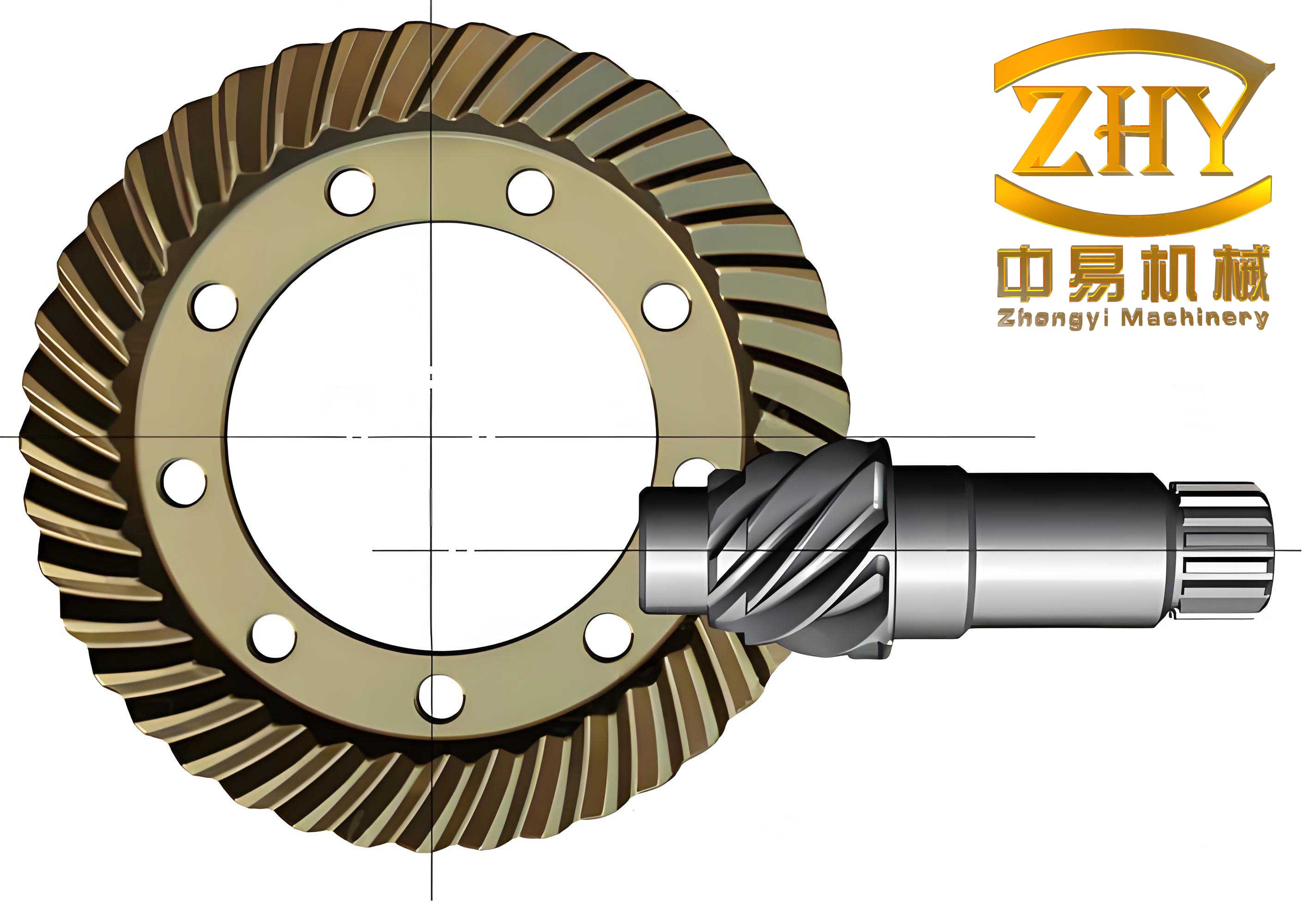
In the realm of automotive drivetrain systems, hypoid gears play a pivotal role due to their superior advantages, including high reduction ratios, compact design, smooth transmission, low noise, and the ability to adjust vehicle height. These gears are extensively utilized in truck driving axles. However, prevalent issues such as tooth breakage and poor reliability in domestically produced heavy-duty truck hypoid gears have severely impacted the competitiveness and reputation of the automotive industry. The failure of hypoid gear transmission can lead to vehicle breakdowns or even accidents, underscoring the critical necessity for research into anti-fatigue manufacturing. Within the broader anti-fatigue manufacturing process chain for hypoid gears, the cold rotary forging process stands out as a key stage. This process is specifically employed for the precision finishing of the forged large gear’s tooth flank and root, aiming to meet stringent anti-fatigue manufacturing requirements. Traditional cold rotary forging techniques for hypoid gears often involve complex die structures and relatively high forming forces, which can lead to defects like stress concentration and insufficient fatigue resistance. To address these limitations, this study proposes an innovative cold rotary forging method characterized by a simplified die structure and a localized line-contact continuous plastic forming mechanism.
The proposed methodology is fundamentally derived from the form-cutting principle used in machining large hypoid gears. Instead of a cutting tool, a trapezoidal forming die is employed to achieve localized line-contact continuous plastic deformation. In conventional form-grinding, the grinding wheel’s conical surface can be mathematically described. The coordinate system for the form-grinding process is well-established, involving a series of transformations to derive the final gear tooth surface equation from the grinding wheel surface equation. The foundational equations are presented below. The equation for the virtual grinding wheel’s conical surface is given by:
$$r_c = r_c(s_c, \theta_c)$$
Here, $s_c$ represents the length variable along the generatrix of the grinding wheel cone, and $\theta_c$ is the rotational angle variable of the grinding wheel. Through a series of coordinate transformations based on the machine tool setup parameters, the tooth surface equation $r_2$ for the gear is derived, which can be succinctly expressed as a function of grinding parameters and machine adjustments:
$$r_2 = r_2(s_c, \theta_c, \gamma_2, V_2, H_2, \Delta X_2)$$
In this equation, $\gamma_2$, $H_2$, $V_2$, and $\Delta X_2$ correspond to the machine setup adjustments: the machine root angle, horizontal cutter location, vertical cutter location, and horizontal workpiece offset, respectively.
The core of the new cold rotary forging method lies in replacing the complex, full-tooth-form die with a simple trapezoidal die. This die is mounted on a conical swing head. The die’s central axis is intentionally inclined at a specific angle relative to the axis corresponding to the virtual grinding wheel used in form-grinding. This inclination ensures instantaneous line contact between the trapezoidal die and the ideal tooth slot profile while preventing interference at other positions. The kinematic process involves the swing head continuously oscillating around the machine’s main spindle center (aligned with the grinding wheel axis) while simultaneously rotating about its own axis. This self-rotation converts sliding friction into rolling friction between the die and the workpiece. Concurrently, the lower die pushes the workpiece upward at a constant speed, applying axial pressure to cause plastic deformation. Through this复合运动 (combined motion) of upper die oscillation and lower die feed, the workpiece material is incrementally and repeatedly挤压 (compressed) until the desired tooth profile is fully formed. After one tooth is finished, an indexing mechanism rotates the blank for the next tooth. The envelope surface formed by the contact line between the forming die and the ideal tooth slot during one complete swing cycle is designed to exactly match the trajectory of the grinding wheel’s cutting surface in form-grinding. Therefore, ensuring no interference outside the designated contact lines guarantees the precision and quality of the forged hypoid gears.
To describe the forging process mathematically, a comprehensive coordinate system is established, particularly for the right-hand spiral large gear. The key coordinate systems include the machine tool coordinate system $O_0X_0Y_0Z_0$, the virtual grinding wheel coordinate system $O_cX_cY_cZ_c$ determined by form-grinding parameters, the swing head and trapezoidal die coordinate system $O_dX_dY_dZ_d$, and the workpiece gear coordinate system $O_2X_2Y_2Z_2$. The transformation between these systems involves offsets and angular rotations defined by process parameters. Within the die coordinate system $O_dX_dY_dZ_d$, the surface equation of the forming die’s forging cone is:
$$r_d = r_d(s_d, \theta_d)$$
where $s_d$ and $\theta_d$ are parameters for the die cone surface. Through coordinate transformation, the die surface equation in the grinding wheel coordinate system is obtained:
$$r_d^c = r_d^c(s_d, \theta_d, L, N, \gamma)$$
The parameters $L$, $N$, and $\gamma$ represent the installation adjustments of the die relative to the grinding wheel. An interference check between the theoretical die forging surface and the virtual grinding wheel surface confirms that contact occurs only along specific lines without undesired interference elsewhere, validating the geometric feasibility of the method. The geometric parameters for the hypoid gear driven wheel analyzed in this study are summarized in the table below.
| Parameter | Value |
|---|---|
| Number of Teeth | 41 |
| Face Width (mm) | 28 |
| Outer Cone Distance (mm) | 101.26 |
| Whole Depth (mm) | 9.73 |
| Pitch Apex to Crossing Point (mm) | -3.05 |
| Face Apex to Crossing Point (mm) | -3.60 |
| Root Apex to Crossing Point (mm) | -1.36 |
| Pitch Angle (°) | 73.70 |
| Face Angle (°) | 74.8333 |
| Root Angle (°) | 68.1333 |
The corresponding cold rotary forging process adjustment parameters, which bridge the form-grinding setup to the forging die setup, are provided in the following table.
| Adjustment Parameter | Value |
|---|---|
| Form-Grinding Wheel Radius (mm) | 95.25 |
| Inner Blade Profile Angle (°) | 17 |
| Outer Blade Profile Angle (°) | 24 |
| Wheel Point Width (mm) | 2.286 |
| Swing Angle (°) | 2 |
| Horizontal Cutter Location (mm) | 41.11 |
| Vertical Cutter Location (mm) | 83.66 |
| Axial Workpiece Offset (mm) | -1.36 |
| Angle Between Gear Axis and Machine Plane (°) | 68.1333 |
| Die Offset in $X_c$ Direction (mm) | 0 |
| Die Offset in $Z_c$ Direction (mm) | -12 |
The successful application of this new cold rotary forging technique for hypoid gears hinges on a deep understanding of the complex, multi-factor metal deformation process. Analytical methods alone are insufficient to fully validate the method’s correctness and practicality. Therefore, numerical simulation emerges as a powerful tool for virtual prototyping, providing detailed historical data of the forming process, reducing costs associated with physical trials, and accelerating development cycles. Given the high degree of geometric and boundary condition nonlinearity in hypoid gear cold rotary forging, a robust three-dimensional finite element model is essential. In this preliminary study, elastic deformations are neglected, focusing solely on plastic deformation. The rigid-plastic finite element method, implemented via the commercial software DEFORM-3D, is employed for the simulation due to its strong solver capabilities for metal forming processes.
The first step in numerical simulation involves creating accurate geometric models. The workpiece is a simplified version of a forged large hypoid gear, where the tooth slots are uniformly contracted by 0.1 mm to represent the finishing allowance. Both the workpiece and the forming die assembly are modeled using CAD software and imported into DEFORM-3D in STL format. The swing head and trapezoidal die are treated as rigid bodies to save computational time. Mesh generation is critical for simulation accuracy and efficiency. An absolute meshing method is used with a minimum element size of 0.5 mm, a size ratio of 4, and a maximum element size of 2 mm. This setup allows for automatic remeshing during simulation to prevent excessive element distortion in areas of severe deformation. The initial mesh for the workpiece consists of 288,386 elements and 66,489 nodes. The overall three-dimensional finite element model is appropriately simplified for assembly and simulation without compromising result validity.
The material model for the workpiece is defined as a nonlinear strain-hardening plastic model. The material selected is AISI 1045 steel. The boundary conditions involve defining contact between the workpiece and the dies using a node-to-segment contact algorithm. A shear friction model with a constant friction factor is applied at the contact interfaces. The selection of time step is crucial for numerical stability and continuity of force transfer. After several trials, a time step of 0.002 seconds is chosen. The key process parameters for the cold rotary forging simulation are consolidated in the table below.
| Process Parameter | Value |
|---|---|
| Workpiece Temperature (°C) | 20 |
| Swing Head Speed (rpm) | 10 |
| Swing Angle (°) | 2 |
| Friction Type | Shear Friction |
| Friction Factor | 0.12 |
| Time Step (s) | 0.002 |
With the finite element model established, the simulation provides profound insights into the deformation mechanism of cold rotary forging for hypoid gears. One critical aspect is the evolution of the contact zone between the workpiece and the forming die. The contact area, visualized by nodal regions in contact, exhibits a distinct局部变形 (localized deformation) characteristic. At any moment during the process, the contact area is significantly smaller than the total surface area of a single tooth slot. The process can be divided into three stages. In the initial stage, the die first contacts the convex side of the tooth at the large end, then gradually engages the concave side, causing the contact area to rapidly increase from zero to a steady value. During the intermediate or main forming stage, material accumulation in the tooth slot leads to a notable increase in contact area. In the final stage, the die disengages from the convex side first, then the concave side, resulting in a gradual decrease in contact area. This dynamic change in contact directly influences metal flow and forming forces.
The metal flow velocity field, represented by vector arrows indicating direction and magnitude, reveals complex flow patterns governed by principles like the minimum resistance law and volume constancy. In the initial stage, metal primarily flows along the tooth length direction towards the outer end of the large-end tooth slot, potentially forming a small flash. Away from the large end, metal flows upward towards the tooth tip or along the tooth towards the small end due to resistance. During the intermediate stage, the dominant flow direction is towards the small end and the tooth tip, which may cause slight crowning at the tooth tip. In the final stage, as the die disengages near the small end, metal flows mainly towards the small end along the tooth length, possibly forming a minor flash there. Given the small finishing allowance, these flashes and crownings are minimal.
The analysis of forces acting on the forging die is crucial for equipment design. The simulation records the variation of the Z-direction force component ($F_Z$) and the torque on the swing head during the forming of one tooth. The trends for both parameters are similar: they gradually increase, reach a stable maximum range, and then gradually decrease. The stable maximum range for the Z-direction force is found to be between 101 kN and 116 kN. This value is approximately one-tenth of the force reported for traditional rotary forging methods for similar components, highlighting a significant advantage of the proposed technique in reducing forming load. The reduction in force directly impacts the required stiffness of the equipment and the strength of its components. It is important to control the feed amount (压下量), as increasing it raises the forming force, requiring higher hydraulic pump capacity and motor power for the swing head. The stable maximum torque range on the swing head is between 718 N·m and 880 N·m. This torque value is essential for calculating the required drive motor power for the swing mechanism. The force and torque curves confirm that the process is stable and feasible within practical equipment limits.
In conclusion, this study presents a groundbreaking cold rotary forging method specifically designed for hypoid gears. The method addresses the longstanding issues of complex die structures and high forming forces associated with conventional techniques. By adopting a simplified trapezoidal die that engages in localized line-contact continuous plastic forming, the process not only reduces tooling complexity but also significantly lowers the required forming force. This reduction in force, coupled with the favorable grain flow orientation induced by the process, contributes directly to the anti-fatigue manufacturing goals for hypoid gears. The three-dimensional dynamic finite element simulation, based on the rigid-plastic finite element method, successfully models the entire forming process. The simulation results provide detailed insights into the deformation mechanism, including the dynamic nature of the contact zone, the complex metal flow velocity fields, and the evolution of forming forces and torques. All findings are consistent with theoretical塑性成形 (plastic forming) principles, thereby validating the合理性 (rationality) and可行性 (feasibility) of the proposed cold rotary forging technology for hypoid gears. This innovative approach holds great promise for enhancing the manufacturing quality, reliability, and performance of hypoid gears in automotive applications, potentially leading to more durable and efficient drivetrain systems. Future work may involve experimental verification, optimization of process parameters for different hypoid gear designs, and investigation of the resulting microstructural and fatigue properties.