
The pursuit of miniaturization, lightweight design, and enhanced energy efficiency in modern mechanical transmission systems has driven significant interest in specialized gear designs. Among these, helical gears with a low number of teeth and asymmetric tooth profiles present a compelling solution. This configuration offers advantages such as compact size, high transmission ratios, and potentially superior load-bearing capacity, making them suitable for demanding applications in aerospace, automotive powertrains, and marine exploration equipment. However, a critical aspect governing their reliable application is their bending fatigue strength. Traditional international (ISO) and national (GB) standards lack calculation methods for these non-standard geometries. Therefore, a dedicated investigation into the bending fatigue stress characteristics of these asymmetric helical gears is not only necessary but also provides a foundation for their safe and optimized design.
This article presents a comprehensive analysis, from theoretical modeling to experimental validation, of the bending fatigue performance of asymmetric helical gears with a small tooth count. The core of the theoretical approach is based on gear generation principles to establish complete tooth profile equations. An analytical calculation method incorporating the effects of asymmetric tooth profiles and tangential displacement (a form of profile shift) is proposed for determining root bending stress. These results are compared with those obtained from detailed finite element analysis (FEA). To validate the theoretical predictions, both asymmetric and symmetric helical gear specimens are manufactured using high-precision numerical control machining. Bending fatigue tests are then conducted on a high-frequency testing machine. By applying fatigue cumulative damage theory and statistical analysis (Weibull distribution) to the test data at different stress levels, complete and reliable Confidence-Reliability-Stress-Life (C-R-S-N) curves are derived. These curves serve as a vital basis for estimating the bending fatigue life of such gears.
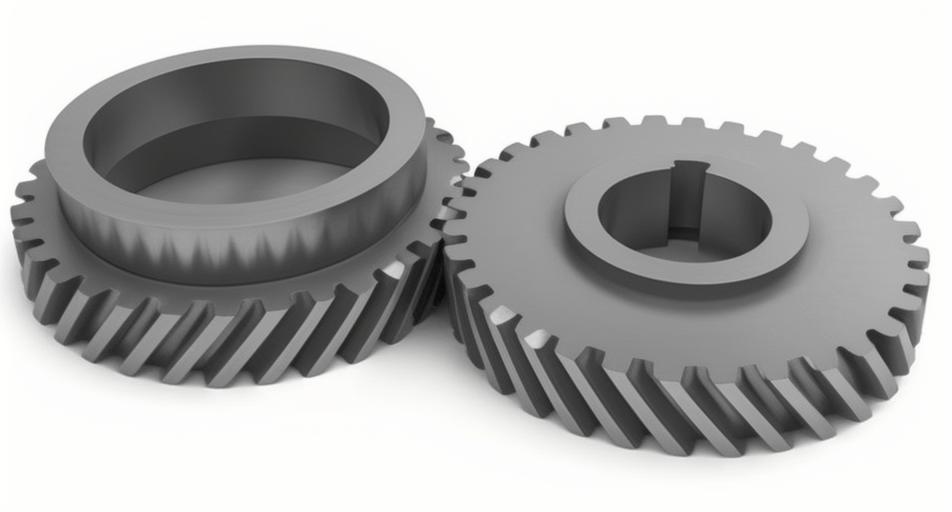
1. Mathematical Modeling of the Complete Tooth Profile
The unique geometry of an asymmetric helical gear necessitates a precise mathematical description of its entire tooth flank, including the working and non-working involute profiles, the fillet transition curves, and the helical sweep. The following sections derive these coordinate equations.
1.1. Involute Tooth Profile in the Transverse Plane
The asymmetric involute profile is generated from two base circles of different diameters. A right-handed Cartesian coordinate system is established in the transverse plane (perpendicular to the gear axis). The origin O is at the gear center. The y-axis is defined by the line connecting O to the midpoint B of the tooth space along the pitch circle. For any point U(x, y) on the working-side involute, the following geometric relationships hold:
$$
\begin{aligned}
\varphi_U &= \varphi + \theta_d – \theta_U = \frac{s}{2r_1} + \text{inv} \alpha_{td} – \text{inv} \alpha_U \\
&= \frac{\pi/2 + x_t \tau + x_t (\tan \alpha_{td} + \tan \alpha_{tc})}{z} + \text{inv} \alpha_{td} – \text{inv} \alpha_U \\
r_U &= \frac{r_{tbd}}{\cos \alpha_U} = \frac{m_t z \cos \alpha_{td}}{2 \cos \alpha_U}
\end{aligned}
$$
where:
$m_t$ is the transverse module,
$z$ is the number of teeth,
$\alpha_{td}$, $\alpha_{tc}$ are the working and non-working transverse pressure angles,
$x_t$ is the transverse profile shift coefficient,
$\tau$ is a geometric parameter,
$\text{inv} \alpha = \tan \alpha – \alpha$ is the involute function.
Thus, the parametric equations for the working-side transverse involute profile are:
$$
\begin{bmatrix} x_U \\ y_U \end{bmatrix} = \frac{m_t z \cos \alpha_{td}}{2 \cos \alpha_U} \begin{bmatrix}
\sin\left( \frac{\pi/2 + x_t \tau + x_t(\tan \alpha_{td} + \tan \alpha_{tc})}{z} + \text{inv} \alpha_{td} – \text{inv} \alpha_U \right) \\
\cos\left( \frac{\pi/2 + x_t \tau + x_t(\tan \alpha_{td} + \tan \alpha_{tc})}{z} + \text{inv} \alpha_{td} – \text{inv} \alpha_U \right)
\end{bmatrix}
$$
The parameter $\alpha_U$ varies from $\alpha_{sd}$, the pressure angle at the start of the active profile (SAP), to $\alpha_{tad}$, the pressure angle at the tip circle. A similar set of equations can be derived for the non-working side involute profile, using its corresponding base circle radius and pressure angle $\alpha_{tc}$.
1.2. Root Fillet Transition Curve in the Transverse Plane
The root fillet of a gear generated by a rack-type cutter is an equidistant curve of the cutter tip trochoid, often approximated as an extended involute. For a point M(x, y) on the working-side fillet curve, the parametric equations are derived based on the tool geometry and generation motion:
$$
\begin{bmatrix} x_M \\ y_M \end{bmatrix} = \begin{bmatrix}
\sin \phi_d & -\cos(\alpha_M – \phi_d) \\
\cos \phi_d & -\sin(\alpha_M – \phi_d)
\end{bmatrix} \begin{bmatrix}
\frac{m_t z}{2} \\
\rho_d + \frac{a_d – x_t m_t}{\sin \alpha_M}
\end{bmatrix}
$$
where:
$\rho_d$ is the tool tip radius for the working side,
$a_d$ is the corresponding addendum of the tool,
$\phi_d = \dfrac{2\left( \frac{a_d – x_t m_t}{\tan \alpha_M} + b_d \right)}{m_t z}$, and $b_d$ is a tool parameter.
The parameter $\alpha_M$ ranges from the transverse pressure angle $\alpha_{td}$ to 90°.
Similarly, for a point N(x, y) on the non-working side fillet:
$$
\begin{bmatrix} x_N \\ y_N \end{bmatrix} = \begin{bmatrix}
-\sin \phi_c & -\cos(\alpha_N – \phi_c) \\
\cos \phi_c & -\sin(\alpha_N – \phi_c)
\end{bmatrix} \begin{bmatrix}
\frac{m_t z}{2} \\
\rho_c + \frac{a_c – x_t m_t}{\sin \alpha_N}
\end{bmatrix}
$$
Here, $\rho_c$, $a_c$, $b_c$, and $\phi_c$ are the corresponding parameters for the non-working side of the tool.
1.3. Three-Dimensional Helical Tooth Surface
The three-dimensional helical surface is obtained by performing a screw motion on the transverse profile. A coordinate system is defined with the z-axis along the gear axis. The helical surface for the working-side involute is obtained by rotating the transverse profile by an angle $\theta$ while translating it along z:
$$
\begin{bmatrix} x_U \\ y_U \\ z \end{bmatrix}_U = \begin{bmatrix}
\cos \theta & -\sin \theta & 0 \\
\sin \theta & \cos \theta & 0 \\
0 & 0 & 1
\end{bmatrix} \begin{bmatrix}
X_U(\alpha_U) \\
Y_U(\alpha_U) \\
\frac{m_t z \theta}{2 \tan \beta}
\end{bmatrix}
$$
where $\beta$ is the helix angle, and $X_U(\alpha_U)$, $Y_U(\alpha_U)$ are the coordinates from the transverse involute equation. The term $\frac{m_t z \theta}{2 \tan \beta}$ represents the axial translation proportional to the rotation $\theta$, defining the lead of the helical gear.
The equation for the non-working side involute helical surface is analogous, using its respective transverse profile. The helical surfaces for the fillet regions are derived similarly by applying the same screw transformation to the fillet curve equations $[x_M, y_M]^T$ and $[x_N, y_N]^T$, resulting in:
$$
\begin{bmatrix} x_M \\ y_M \\ z \end{bmatrix}_M = \begin{bmatrix}
\cos \theta & -\sin \theta & 0 \\
\sin \theta & \cos \theta & 0 \\
0 & 0 & 1
\end{bmatrix} \begin{bmatrix}
\sin \phi_d & -\cos(\alpha_M – \phi_d) & 0 \\
\cos \phi_d & -\sin(\alpha_M – \phi_d) & 0 \\
0 & 0 & 1
\end{bmatrix} \begin{bmatrix}
\frac{m_t z}{2} \\
\rho_d + \frac{a_d – x_t m_t}{\sin \alpha_M} \\
\frac{m_t z \theta}{2 \tan \beta}
\end{bmatrix}
$$
$$
\begin{bmatrix} x_N \\ y_N \\ z \end{bmatrix}_N = \begin{bmatrix}
\cos \theta & -\sin \theta & 0 \\
\sin \theta & \cos \theta & 0 \\
0 & 0 & 1
\end{bmatrix} \begin{bmatrix}
-\sin \phi_c & -\cos(\alpha_N – \phi_c) & 0 \\
\cos \phi_c & -\sin(\alpha_N – \phi_c) & 0 \\
0 & 0 & 1
\end{bmatrix} \begin{bmatrix}
\frac{m_t z}{2} \\
\rho_c + \frac{a_c – x_t m_t}{\sin \alpha_N} \\
\frac{m_t z \theta}{2 \tan \beta}
\end{bmatrix}
$$
These complete surface equations are essential for accurate finite element modeling and contact analysis of the asymmetric helical gear pair.
2. Calculation of Bending Stress
2.1. Analytical Method
To assess the bending strength, the maximum tensile stress at the tooth root needs to be calculated. The analytical method adapted here accounts for asymmetric geometry and tangential displacement. The fundamental bending stress formula for a gear tooth loaded at the highest point of single tooth contact (or a defined point) is:
$$
\sigma_F = \frac{F_t}{b m} Y_F Y_S Y_{ST} Y_{\delta relT} Y_{RrelT} Y_X
$$
For the purpose of comparative evaluation of asymmetric versus symmetric designs, the focus is on the product of the form factor $Y_F$ and the stress correction factor $Y_S$. $F_t$ is the nominal tangential load, $b$ is the face width, and $m$ is the module. The other factors ($Y_{ST}$, $Y_{\delta relT}$, $Y_{RrelT}$, $Y_X$) are taken as 2, 1, 1, and 1 respectively for this baseline comparison.
The form factor $Y_F$ and stress correction factor $Y_S$ for load applied at a point $E$ on the involute are given by:
$$
Y_F = \frac{6 (h_F / m) \cos \alpha_F}{(s_F / m)^2 \cos \alpha_d}, \quad Y_S = \left(1.2 \frac{h_F}{s_F} + 0.13\right)\left(\frac{s_F}{2\rho_M}\right)^{\left(\frac{s_F}{2.3h_F + 1.21 s_F}\right)}
$$
where:
$h_F$ is the distance from the critical section to the load application point along the tooth centerline,
$s_F$ is the chordal thickness at the critical root section,
$\alpha_F$ is the load angle at the application point,
$\rho_M$ is the radius of curvature at the critical point M on the fillet.
The critical section is determined using the 30° tangent method. For the working-side fillet, the condition is $\alpha_M – \phi_d = \pi/6$. Solving the equation $f(\phi_d) = \phi_d m z – 2b_d – \frac{2(a_d – x m)}{\tan(\phi_d + \pi/6)} = 0$ yields $\phi_d$. Subsequently, $h_F$, $s_F$, and $\rho_M$ can be calculated. The chordal thickness $s_F$ is the sum of the distances from the tooth centerline to the critical points on the working and non-working side fillets ($s_F = x_M + |x_N|$).
Using this analytical method, the root bending stresses for both asymmetric and symmetric helical gear designs under various loads are calculated. The results are summarized in the table below.
| Load (kN) | Asymmetric Gear Stress (MPa) | Symmetric Gear Stress (MPa) |
|---|---|---|
| 13 | 250.76 | 290.36 |
| 15 | 289.34 | 335.03 |
| 17 | 328.59 | 380.47 |
| 19 | 367.99 | 426.10 |
| 21 | 407.56 | 471.91 |
The table clearly shows that under identical loading conditions, the calculated bending stress for the asymmetric helical gear is consistently lower than that for the symmetric gear.
2.2. Finite Element Method (FEM)
To verify the analytical results and gain a more detailed view of the stress distribution, a 3D finite element model was constructed. The model includes the test gear and a dual-tooth loading fixture to simulate the pulsating test condition. The gear bore was fully constrained, and the load was applied to the top of the fixture. Contact pairs were defined between the fixture pads and the gear tooth flanks. The mesh consisted of approximately 89,040 elements and 103,390 nodes.
The von Mises stress contour for a load of 15 kN is analyzed. While the compressive stress on the concave side of the tooth root is higher, fatigue cracks initiating from the tensile side (convex side) are more critical as they propagate more readily under cyclic tension. Therefore, the maximum tensile stress on the convex side is extracted for comparison.
The FEM results for the maximum tensile root bending stress at different load levels are presented in the following table.
| Load (kN) | Asymmetric Gear Stress (MPa) | Symmetric Gear Stress (MPa) |
|---|---|---|
| 13 | 209.31 | 245.60 |
| 15 | 241.51 | 283.38 |
| 17 | 273.72 | 321.16 |
| 19 | 305.91 | 358.95 |
| 21 | 338.10 | 396.73 |
A comparison of the two calculation methods is plotted. The analytical method yields higher stress values than the FEM: approximately 19.80% higher for the asymmetric gear and 18.22% higher for the symmetric gear. This conservative bias in the analytical method aligns with engineering safety principles. More importantly, both methods show the same trend: the asymmetric helical gear exhibits lower root bending stress. Quantitatively, the stress reduction for the asymmetric design compared to the symmetric one is 13.64% from the analytical method and 14.78% from the FEM.
3. Bending Fatigue Test and Life Analysis
3.1. Specimen Manufacturing
To experimentally validate the calculated strength improvement, bending fatigue tests were conducted. Specimens of both asymmetric and symmetric helical gears with a small number of teeth were manufactured. The key geometric parameters are listed below.
| Gear Type | Module, m (mm) | Teeth, z | Addendum Coeff., ha* | Pressure Angle (αd/αc) (°) | Profile Shift Coeff., x |
|---|---|---|---|---|---|
| Asymmetric Helical Gear | 4 | 10 | 0.95 | 28 / 20 | 0.37 |
| Symmetric Helical Gear | 4 | 10 | 0.95 | 20 / 20 | 0.37 |
The material was 45# steel (E = 210 GPa, ν = 0.25). High-precision wire electrical discharge machining (WEDM) was employed. The tooth profile coordinates generated from the mathematical models were imported into CAD/CAM software (CAXA) to create the tool paths, ensuring accurate realization of the non-standard asymmetric geometry.
3.2. Fatigue Test Procedure
Tests were performed on a high-frequency pulsating testing machine (M6311 type). A dual-tooth loading fixture was used to apply a cyclic load at the gear’s pitch line, creating a state of pure bending in the loaded teeth. The test was stopped when a visible crack appeared or when the system resonance frequency shifted significantly (indicating stiffness loss), corresponding to a load drop of 5-10%. This cycle count was recorded as the fatigue failure life (N).
The test strategy combined the group test method for the finite-life (high-stress) region and the stair-case (up-and-down) method for the endurance limit region. In the finite-life region, four stress levels were selected, with five valid specimens tested at each level. The highest stress level aimed for a life slightly above 105 cycles, and the lowest was near the presumed endurance limit (3×10⁶ cycles). The stair-case method was used to accurately determine the bending fatigue limit with 16 specimens.
3.3. Data Analysis and S-N Curve Fitting
The raw fatigue life data for both gear types under different loads (stress levels) are listed below. The stress levels correspond to the analytical bending stress calculated for each load.
| Load, F (kN) | 15 | 17 | 19 | 21 |
|---|---|---|---|---|
| Stress, σ (MPa) | 289.34 | 328.59 | 367.99 | 407.56 |
| Life, N (cycles × 10²) | 827, 951, 1180, 1336, 1392 | 599, 650, 761, 817, 852 | 402, 529, 582, 665, 684 | 261, 310, 429, 440, 483 |
| Load, F (kN) | 15 | 17 | 19 | 21 |
|---|---|---|---|---|
| Stress, σ (MPa) | 335.03 | 380.47 | 426.10 | 471.91 |
| Life, N (cycles × 10²) | 458, 652, 704, 723, 814 | 320, 375, 397, 403, 494 | 233, 262, 279, 350, 371 | 129, 135, 176, 205, 261 |
Fatigue life data are statistically scattered and best described by a distribution. The two-parameter Weibull distribution is commonly used for this purpose. Its cumulative distribution function (CDF) is:
$$
F(N) = 1 – \exp\left[ -\left( \frac{N}{b} \right)^k \right]
$$
where $k$ is the shape parameter and $b$ is the scale parameter (characteristic life). Taking double logarithms yields a linear form:
$$
\ln \ln \left( \frac{1}{1-F(N)} \right) = k \ln N – k \ln b
$$
By setting $x = \ln N$, $y = \ln \ln(1/(1-F(N)))$, $A=k$, and $B=-k \ln b$, the equation becomes $y = Ax + B$. The median rank estimator ($F(N_i) \approx (i-0.3)/(n+0.4)$) was used to estimate the failure probability for each ordered life data point $N_i$ at a given stress level. Linear regression (least squares) on the transformed data $(x_i, y_i)$ provides estimates for $A$ and $B$, hence $k$ and $b$.
Once the Weibull parameters are estimated for each stress level, the reliable fatigue life $N_R$ for a required reliability $R$ (where $R = 1 – F(N)$) is:
$$
N_R = \exp\left( \ln b + \frac{1}{k} \ln \ln \frac{1}{R} \right)
$$
These $N_R$ values for different $R$ (e.g., 0.90, 0.95, 0.99, 0.999, 0.9999) are calculated at each stress level. Then, for each reliability level $R$, the pairs of stress ($S_R$) and reliable life ($N_R$) are fitted to a power-law (Basquin) equation of the form:
$$
S_R^m \cdot N = C_R \quad \text{or} \quad m_R \ln S_R + \ln N = \ln C_R
$$
where $m_R$ is the fatigue strength exponent and $C_R$ is a constant for reliability $R$. This process generates a family of C-R-S-N curves. The parameters for the asymmetric helical gear at a 95% confidence level are shown below.
| Reliability, R | Exponent, m | Correlation Coeff., r | Fatigue Limit (MPa) | Knee Point Life |
|---|---|---|---|---|
| 0.90 | 3.5360 | -0.9924 | 217.52 | 2.2748 × 10⁵ |
| 0.95 | 3.5759 | -0.9882 | 214.78 | 2.1014 × 10⁵ |
| 0.99 | 3.7374 | -0.9696 | 209.22 | 1.8172 × 10⁵ |
| 0.999 | 4.1318 | -0.9261 | 202.86 | 1.6310 × 10⁵ |
| 0.9999 | 4.7149 | -0.8707 | 198.79 | 1.5685 × 10⁵ |
The obtained fatigue limit for R=0.99 (209.22 MPa) falls within the range expected for the material, confirming the validity of the test data and analysis method.
3.4. Comparison of Fatigue Life
The average bending fatigue life of the asymmetric and symmetric helical gears in the finite-life region is compared. The improvement in life for the asymmetric design is substantial and consistent across all load levels:
- At 15 kN load: 41.07% life increase
- At 17 kN load: 45.65% life increase
- At 19 kN load: 47.72% life increase
- At 21 kN load: 52.99% life increase
This results in an average fatigue life improvement of 46.86% for the asymmetric helical gear under the same applied load. This experimental finding strongly correlates with and validates the theoretical predictions from both the analytical (13.64% lower stress) and FEM (14.78% lower stress) calculations. A lower root stress directly translates to a longer fatigue life for the same material, confirming the fundamental mechanical advantage of the asymmetric tooth profile in helical gears with a small number of teeth.
4. Conclusions
This integrated study, encompassing theoretical modeling, numerical simulation, and experimental testing, provides a clear analysis of the bending fatigue stress characteristics in asymmetric helical gears with a low tooth count. The following key conclusions are drawn:
- Analytical Framework: A comprehensive mathematical model for the complete tooth profile of an asymmetric helical gear was established based on gear generation principles. An analytical method for calculating root bending stress, explicitly incorporating the effects of asymmetric pressure angles and tangential displacement, was successfully proposed and implemented.
- Theoretical Strength Improvement: Both the proposed analytical method and finite element analysis consistently predict a significant reduction in root bending stress for the asymmetric helical gear compared to its symmetric counterpart. The stress reduction was quantified as 13.64% (analytical) and 14.78% (FEM). The conservative nature of the analytical method was noted, which is acceptable for engineering design.
- Experimental Validation and Life Estimation: Fatigue tests conducted on CNC-machined specimens provided definitive validation. The asymmetric helical gear exhibited an average improvement in bending fatigue life of 46.86% under identical loading conditions. This experimental life extension aligns perfectly with the trend predicted by the lower calculated stresses. Furthermore, a complete set of C-R-S-N curves was developed using Weibull statistical analysis, providing a robust and reliable basis for estimating the bending fatigue life of such gears at various required confidence and reliability levels.
In summary, the asymmetric tooth profile offers a demonstrable and significant advantage in enhancing the bending fatigue strength and life of helical gears with a small number of teeth. The methodologies presented—from profile modeling and stress calculation to fatigue testing and statistical life analysis—provide a valuable reference framework for the design and application of these high-performance gears in advanced mechanical transmission systems where size, weight, and reliability are critical constraints.