
In the field of precision transmission systems, the harmonic drive gear has long been celebrated for its compact design, high reduction ratios, and excellent positional accuracy. My research focuses on a novel variant known as the oscillating tooth end face harmonic drive gear. This design aims to retain all the inherent advantages of conventional harmonic drive gear systems while significantly enhancing power transmission capacity. The core innovation lies in the integration of oscillating teeth mechanisms with an end face engagement topology. A critical component determining the longevity, efficiency, and reliability of this novel harmonic drive gear is the sliding pair formed between the oscillating teeth and the guide grooves of the sheave. This article presents a detailed investigation into the force state within this sliding pair, deriving the structural conditions necessary for achieving single-sided contact force transmission during single-tooth engagement. This analysis provides a foundational theoretical basis for optimizing the structural design of this key interface in the oscillating tooth end face harmonic drive gear.
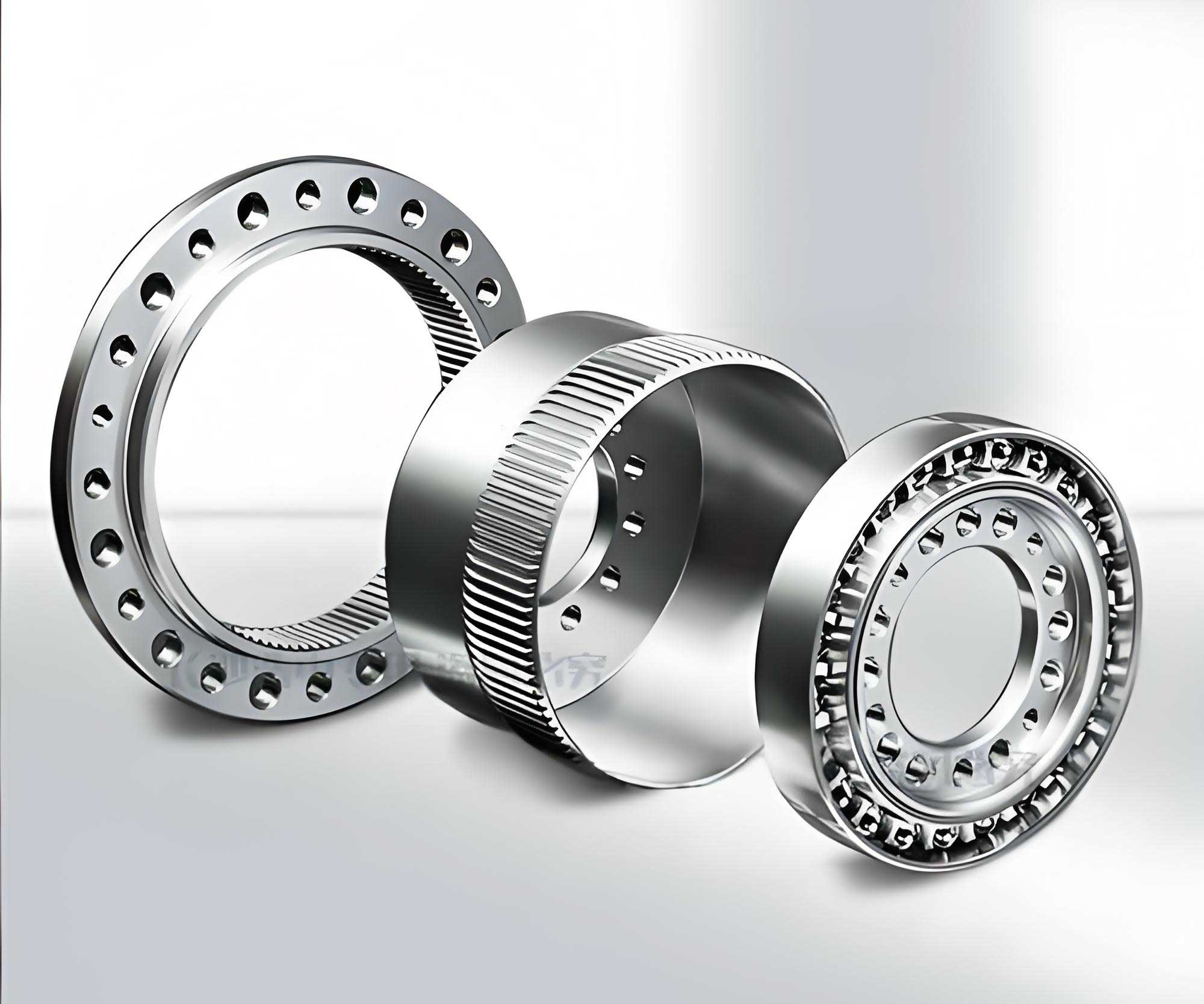
The oscillating tooth end face harmonic drive gear comprises three fundamental kinematic pairs: two meshing pairs and one sliding pair. The first meshing pair is between the front end of the oscillating teeth and the end face gear, and the second is between the rear end of the oscillating teeth and the end face cam of the wave generator. The sliding pair is constituted by the oscillating teeth and the guide grooves on the sheave (or槽轮). The performance of this harmonic drive gear—its load capacity, transmission precision, and operational life—is profoundly influenced by the structural characteristics and force state of this sliding pair. In practical applications of oscillating tooth transmissions, severe wear is often observed on both elements of the sliding pair. This wear, which escalates with increased transmitted load, is primarily attributed to a detrimental force condition: double-sided contact and localized stress concentration. Therefore, a paramount design objective for my oscillating tooth end face harmonic drive gear is to engineer the sliding pair to operate under a single-sided contact force condition, thereby mitigating wear and improving overall system performance.
The configuration of the oscillating tooth end face harmonic drive gear can be classified based on the number of teeth on each oscillating tooth block. This analysis is confined to the single-tooth drive configuration, where each block carries one tooth (\(Z_A = 1\)). The kinematic behavior and force transmission differ significantly depending on the relationship between the number of teeth on the end face gear (\(Z_E\)) and the theoretical total number of oscillating teeth (\(Z_O\)). The force state in the sliding pair, and consequently its propensity for single-sided contact, is critically dependent on whether \(Z_E > Z_O\) or \(Z_E < Z_O\).
When \(Z_E > Z_O\) and the end face gear is fixed, the sheave rotates in the opposite direction to the wave generator. In this scenario, the force analysis reveals that the driving force from the wave generator (\(F_W\)) acts on the right flank of the oscillating tooth’s rear end, while the reaction force from the end face gear (\(F_E\)) acts on the left flank of the tooth’s front end during the working meshing (engagement) phase. Since \(F_E\) and \(F_W\) act on opposite sides of the oscillating tooth’s longitudinal axis, their lines of action converge at a point outside the contact surface area of the sliding pair. This inevitably creates a force couple, leading to double-sided contact and localized pressure on the guide groove walls, as illustrated by forces \(F_1\) and \(F_2\) in the analysis. This condition is highly undesirable for the longevity of this harmonic drive gear.
Conversely, when \(Z_E < Z_O\) (with the end face gear still fixed), the sheave rotates in the same direction as the wave generator. Here, \(F_W\) still acts on the right flank of the rear end, but \(F_E\) now acts on the right flank of the front end during working meshing. Both major forces act on the same side of the tooth. This configuration allows for the possibility that the intersection point (B) of the lines of action of \(F_E\) and \(F_W\) lies within the confines of the sliding pair’s contact surface. If this condition is maintained throughout the engagement cycle, the sliding pair experiences only a single resultant reaction force (e.g., \(F_3\)) from one wall of the guide groove, achieving the desired single-sided contact state. Therefore, the subsequent detailed force analysis focuses exclusively on the case where \(Z_E < Z_O\), as it holds the potential for optimizing the harmonic drive gear’s sliding pair design.
To determine the condition for sustained single-sided contact, it is essential to analyze the position of the intersection point of forces \(F_E\) and \(F_W\) throughout the working meshing (or啮入) process. Without loss of generality, the analysis assumes the sheave is fixed, and the oscillating tooth only undergoes axial reciprocating motion within the guide groove. In this frame of reference, the end face gear moves in the opposite direction to the wave generator. The engagement process is divided into distinct phases based on the contact condition between the oscillating tooth’s rear end and the rising surface of the wave generator’s end face cam.
| Symbol | Description | Unit |
|---|---|---|
| \(H\) | Length of the oscillating tooth body | mm |
| \(h\) | Height of the oscillating tooth | mm |
| \(\alpha\) | Tooth profile semi-angle of the oscillating tooth | rad |
| \(\beta\) | Lead angle of the wave generator’s end face cam | rad |
| \(\varphi_1\) | Friction angle between oscillating tooth and cam | rad |
| \(\varphi_2\) | Friction angle between oscillating tooth and end face gear | rad |
| \(\theta_w\) | Rotation angle of the wave generator’s cam | rad |
| \(U\) | Number of waves (lobes) on the generator | – |
| \(L_D\) | Distance from the intersection point B to the tooth tip reference | mm |
| \(M\) | Distance from end face gear tooth tip to sheave end face | mm |
| \(L_H\) | Thickness of the sheave | mm |
Phase 1: Full Contact at the Rear End. This phase spans from the initial engagement to the critical point where the rear end of the oscillating tooth begins to lose full contact with the cam’s rising surface. Let \(\theta_w\) be the cam rotation angle from the start of engagement. Using geometric relations from the force diagrams, the position \(L_D\) of the intersection point B is derived. At the initial engagement point (\(\theta_w = 0\)), force \(F_E\) acts at the tooth tip \(A_1\), and \(F_W\) acts at the midpoint \(C_1\) of the rear working flank. The geometry yields:
$$ L_{D1} = \frac{(H + A h) \tan(\alpha + \varphi_1) – (h \tan \beta)/2}{C} $$
where \(A = 1 + (\tan \alpha \tan \beta)/2\) and \(C = \tan(\alpha + \varphi_1) + \cot(\alpha + \varphi_2)\).
As the cam rotates, \(F_E\)’s point of action moves along the tooth flank, while \(F_W\) remains at the midpoint until full contact is lost. For a general angle \(\theta_w\) within this phase:
$$ L_D = \frac{(H + A h) \tan(\alpha + \varphi_1) – (h \tan \beta)/2 – (B h U \theta_w)/(2\pi)}{C} $$
with \(B = 2\tan(\alpha + \varphi_1) + \cot(\alpha + \varphi_2) – \tan \beta\).
The critical angle \(\theta_{wb}\) marking the end of full contact occurs when the contact length at the rear equals the tooth height \(h\) affected by the lead. It is given by \(\theta_{wb} = \pi (1 – \tan \alpha \tan \beta) / U\). Substituting this into the general equation gives the intersection point position \(L_{D2}\) at this critical instant:
$$ L_{D2} = \frac{(H + A h) \tan(\alpha + \varphi_1) – (h \tan \beta)/2 – B h (1 – \tan \alpha \tan \beta) / 2}{C} $$
For typical design ranges of \(\alpha\) (0.349 to 0.524 rad, or 20° to 30°), coefficient \(B\) is positive. Therefore, \(L_D\) decreases linearly with \(\theta_w\) in this phase, implying \(L_{D1} > L_{D2}\). Thus, \(L_{D2}\) represents the minimum distance of the intersection point from the tooth tip reference during the full-contact phase of this harmonic drive gear’s operation.
Phase 2: Partial Contact at the Rear End. Beyond the critical angle, the rear contact area diminishes. Let the additional cam rotation be \(\theta_w’ = \theta_w – \theta_{wb}\). The point of application of \(F_W\) now shifts from the midpoint towards the tooth tip as contact area reduces. The geometry for this phase leads to a different expression for \(L_D\):
$$ L_D = \frac{ (H + A h) \tan(\alpha + \varphi_1) – \frac{h \tan \beta}{2} – \frac{ [B h U \theta_{wb} + (B U – D) h \theta_w’] }{2\pi} }{C} $$
where \(D = \tan(\alpha + \varphi_1) + \cot \beta\).
A special sub-case occurs when the line connecting the force application points \(A_3C_3\) becomes parallel to the axis (i.e., the lateral offset becomes zero). The corresponding cam rotation \(\theta_w’\) for this is:
$$ \theta_w’ = \frac{(\pi – U \theta_{wb}) \tan \alpha \tan \beta}{1 + U \tan \alpha \tan \beta} = \frac{\pi – U \theta_{wb}}{U + \cot \alpha \cot \beta} $$
Substituting this gives the intersection point position \(L_{D3}\) at this alignment moment.
Finally, at the point of full meshing, \(F_E\) acts at the midpoint \(A_4\) of the front working flank, and \(F_W\) acts at the rear tooth tip \(C_4\). The position \(L_{D4}\) is:
$$ L_{D4} = \frac{ [H + h \tan \alpha \tan \beta] \tan(\alpha + \varphi_1) + E h }{C} $$
with \(E = [\tan \beta – \cot(\alpha + \varphi_2)] / 2\). For the typical \(\alpha\) range, \((B U – D)\) in the Phase 2 equation is negative, meaning \(L_D\) now increases linearly with \(\theta_w’\). Consequently, \(L_{D4} > L_{D2}\). Comparing all critical positions, \(L_{D2}\) is the minimum value of \(L_D\) throughout the entire working engagement cycle in this harmonic drive gear configuration. This minimum point is pivotal for design.
The derived equations show that for given design parameters—such as tooth numbers \(Z_E, Z_O\), module \(m\), wave number \(U\), tooth profile angle \(\alpha\), and material-dependent friction angles \(\varphi_1, \varphi_2\)—the tooth height \(h\) and cam lead angle \(\beta\) become determined. The key variable influencing \(L_D\) is the oscillating tooth body length \(H\), to which \(L_D\) is directly proportional. A larger \(H\) favors moving the force intersection point deeper into the contact zone, promoting single-sided contact. Therefore, a deliberate increase in \(H\) is a straightforward design strategy to improve the force state in this harmonic drive gear’s sliding pair.
However, simply increasing \(H\) is not sufficient. To guarantee that the sliding pair operates under single-sided contact force throughout the engagement cycle, two structural conditions must be satisfied simultaneously. The first is kinematic: the tooth number relationship must be \(Z_E < Z_O\). The second is geometric: the force intersection point must always lie within the physical bounds of the sliding contact surface. Referring to the sheave’s geometry, let \(M\) be the distance from the end face gear’s tooth tip plane to the adjacent sheave end face, and \(L_H\) be the axial thickness of the sheave guide groove wall. To ensure the oscillating tooth’s working flank does not improperly enter the guide groove at the start of engagement, we require \(M \geq h\). For single-sided contact, the intersection point distance \(L_D\) must satisfy \(h \leq L_D \leq h + L_H\) for all engagement positions. Since \(L_{D2}\) is the minimum \(L_D\), the critical condition becomes:
$$ h \leq L_{D2} \leq h + L_H $$
Substituting the expression for \(L_{D2}\) provides a comprehensive design inequality that links the tooth body length \(H\), sheave dimensions \(L_H\) and \(M\), and other fundamental parameters of the harmonic drive gear.
| Condition | Effect on Sliding Pair | Design Requirement |
|---|---|---|
| \(Z_E > Z_O\) | Forces on opposite flanks; double-sided contact inevitable. | Avoid for single-sided contact designs. |
| \(Z_E < Z_O\) | Forces on same side; single-sided contact possible. | Essential primary condition. |
| \(L_D\) within \([h, h+L_H]\) | Ensures force intersection is within contact surface. | Governed by \(H, h, L_H, \alpha, \beta, \varphi_1, \varphi_2\). |
| \(M \geq h\) | Prevents tooth interference with sheave. | Basic assembly and function constraint. |
To further elaborate on the design implications, consider the sensitivity of \(L_{D2}\) to key parameters. The following analytical expansion helps visualize the dependencies crucial for optimizing this harmonic drive gear:
Let us define a dimensionless parameter \(\kappa = H / h\), representing the slenderness ratio of the oscillating tooth. The condition \(h \leq L_{D2}\) can be rearranged to provide a minimum required \(\kappa\):
$$ \kappa \geq \frac{ C + (B(1 – \tan \alpha \tan \beta) / 2) – A \tan(\alpha + \varphi_1) }{\tan(\alpha + \varphi_1)} $$
This inequality clearly shows that for a given tooth geometry (\(\alpha, \beta\)) and friction condition (\(\varphi_1, \varphi_2\)), there is a minimum slenderness ratio to prevent the intersection point from falling below the tooth tip reference (\(L_D < h\)), which would indicate a severe double-sided contact condition. Simultaneously, the upper bound \(L_{D2} \leq h + L_H\) constrains the maximum allowable tooth body length or the minimum required sheave thickness \(L_H\) to accommodate the force intersection point. This interplay is central to the robust design of the sliding pair in an oscillating tooth end face harmonic drive gear.
In practice, the friction angles \(\varphi_1\) and \(\varphi_2\) depend on the material pairing and lubrication condition. For a steel-on-steel pair with lubrication, typical values might range from 0.05 to 0.1 rad. Their influence on \(C\) and \(B\), while secondary compared to \(\alpha\) and \(\beta\), must be accounted for in high-precision or high-load applications of the harmonic drive gear. Furthermore, the wave number \(U\) directly affects the critical angle \(\theta_{wb}\) and the coefficients in \(L_D\). A higher \(U\) generally increases the number of engaging teeth, improving load sharing but also influencing the kinematic details of the force intersection point trajectory.
The transition from the derived single-tooth analysis to the multi-tooth engagement case (where \(Z_A \geq 2\)) is a logical extension for future work. In multi-tooth configurations, the load distribution among teeth and the potential phase differences in their engagement cycles would modify the force state on individual sliding pairs. However, the fundamental principle established here—that single-sided contact requires forces on the same side and a force intersection point within the guide groove contact zone—remains valid for each tooth. The design condition \(Z_E < Z_O\) likely still applies, but the analysis of \(L_D\) would require superposition or system-level force equilibrium considerations, adding complexity to the optimization of such a harmonic drive gear system.
Another important consideration is the dynamic behavior and manufacturing tolerances. The static force analysis presented assumes ideal geometry and quasi-static loading. In reality, inertial forces, vibrations, and geometric inaccuracies from manufacturing will perturb the force paths. Therefore, a prudent design approach for a reliable harmonic drive gear would incorporate a safety margin \(\delta\) into the geometric condition, perhaps designing for \(h + \delta \leq L_{D2} \leq h + L_H – \delta\). This ensures that under operational variations, the sliding pair remains in the benign single-sided contact regime.
In conclusion, the analysis of the force state within the sliding pair of an oscillating tooth end face harmonic drive gear reveals a clear path to mitigate wear and enhance performance. The primary enabler is designing the system such that \(Z_E < Z_O\). Under this condition, the critical design task is to ensure the intersection point of the wave generator force \(F_W\) and the end face gear reaction force \(F_E\) remains within the axial span of the sliding contact surface throughout the working meshing cycle. This is achieved by appropriately sizing the oscillating tooth body length \(H\) relative to the tooth height \(h\) and the sheave thickness \(L_H\), as governed by the derived inequality involving \(L_{D2}\). The mathematical framework provided here, complete with geometric parameters and friction considerations, offers a solid theoretical foundation. It empowers designers to make informed decisions on dimensional synthesis for the sliding pair, directly contributing to the development of more durable, efficient, and high-capacity oscillating tooth end face harmonic drive gear systems. Future work will involve experimental validation of these conditions, extension to multi-tooth drives, and investigation of elastohydrodynamic lubrication effects within the optimized sliding pair.