
In modern mechanical engineering, the design and analysis of gear systems are critical for ensuring efficient power transmission and operational reliability. Among various gear types, helical gears are widely used due to their smooth engagement and high load-carrying capacity. Specifically, crossed helical gears, which transmit motion between non-parallel and non-intersecting shafts, offer unique advantages in compact designs and flexibility. However, designing these gears, especially with angular modifications (referred to as angular modified or angle-corrected gears), requires precise parametric modeling and simulation to avoid interference and optimize performance. In this article, I will explore the parametric design and motion simulation of angular modified crossed helical gears using advanced CAD software, focusing on how parameterization enhances design efficiency and accuracy. I will delve into the mathematical foundations, modeling steps, assembly techniques, and simulation processes, with an emphasis on helical gears throughout.
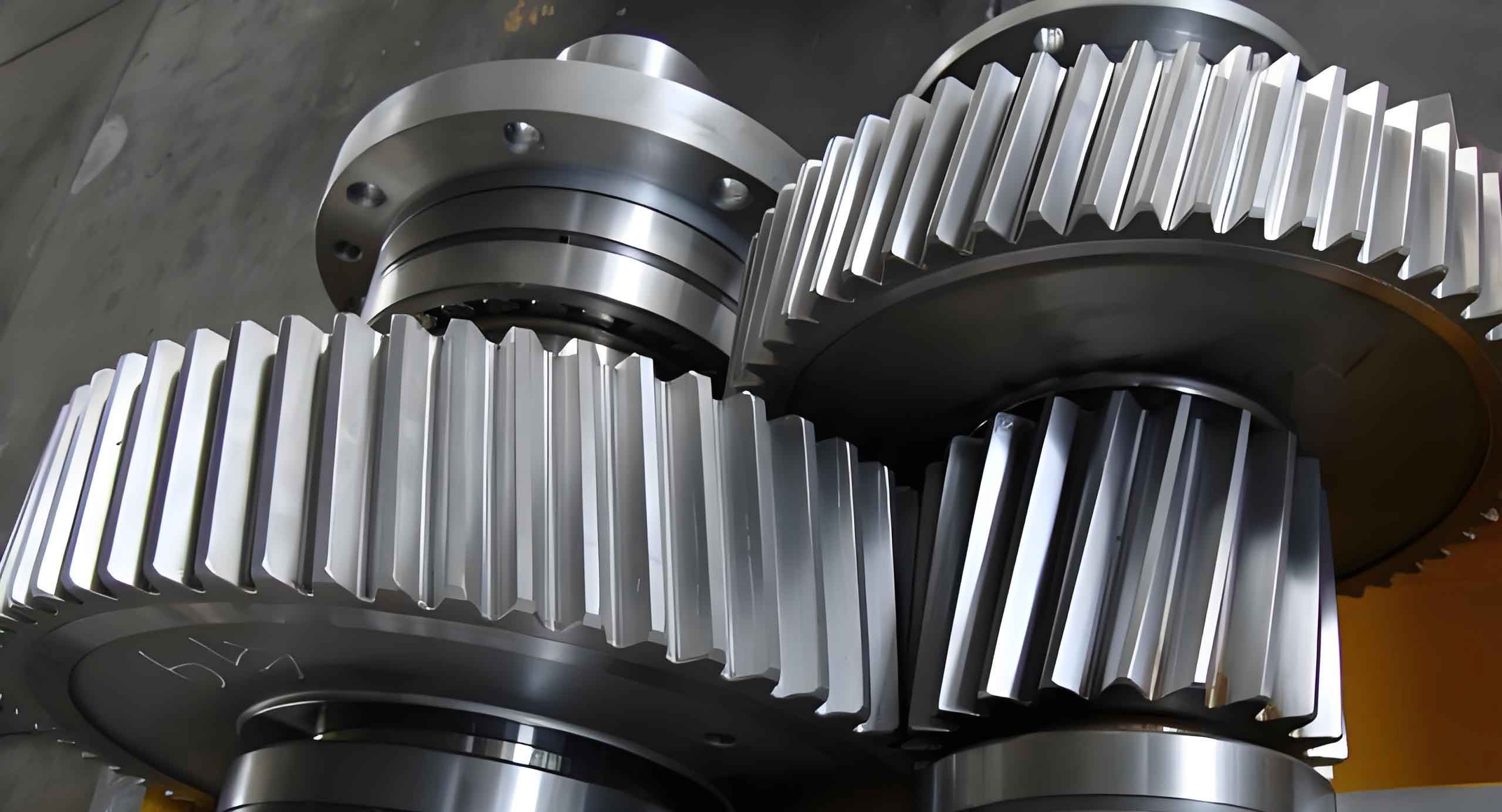
The use of parametric design software, such as Pro/ENGINEER or similar integrated 3D modeling tools, has revolutionized gear design by allowing rapid modifications through parameter changes. For crossed helical gears, which involve complex geometry due to their spiral teeth and angular corrections, parametric approaches enable designers to quickly iterate and validate models. Helical gears, in general, are characterized by their teeth being cut at an angle to the gear axis, which results in gradual engagement and reduced noise. In crossed helical gear pairs, each gear is essentially a helical gear, but with potentially different helix angles and directions, allowing them to mesh on non-parallel shafts. This article will detail how to implement parametric design for such gears, incorporating angular modifications to improve meshing conditions and avoid undercutting or interference.
Parametric design revolves around defining key geometric parameters as variables, which can be adjusted to generate different gear models. For crossed helical gears, the basic parameters include the number of teeth, module, pressure angle, helix angle, addendum coefficient, dedendum coefficient, face width, and direction of helix (left-handed or right-handed). Additionally, for angular modified gears, correction factors or shift coefficients are introduced to alter the tooth profile and ensure proper meshing. I will present these parameters in a table for clarity, and then discuss the formulas that relate them to critical dimensions like pitch diameter, base diameter, addendum diameter, and dedendum diameter. The parametric approach not only speeds up design but also facilitates optimization through simulation, as changes in parameters can be evaluated for performance metrics such as contact ratio, stress distribution, and kinematic behavior.
To begin, let me list the essential parameters for designing angular modified crossed helical gears. These parameters serve as inputs in the CAD software, and their relationships are defined using equations. The table below summarizes the parameters, their symbols, and typical values or descriptions.
| Parameter | Symbol | Description |
|---|---|---|
| Number of teeth | z | Integer value for each gear in the pair |
| Normal module | m_n | Module in the normal plane, typically in mm |
| Normal pressure angle | α_n | Pressure angle in the normal plane, usually 20° |
| Helix angle | β | Angle of tooth inclination relative to gear axis; positive for right-hand, negative for left-hand |
| Addendum coefficient | h_a* | Typically 1.0 for standard gears, but can vary for modified gears |
| Dedendum coefficient | h_f* | Typically 1.25 for standard gears, accounting for clearance |
| Face width | b | Width of the gear tooth along the axis |
| Helix direction | — | Left-hand (LH) or right-hand (RH), denoted by sign of β |
| Angular modification coefficient | x | Profile shift coefficient for angular correction |
| Center distance | a | Distance between the shafts of the two gears |
For crossed helical gears, the helix angles of the two gears may not be equal, and their sum determines the shaft angle Σ. In many applications, Σ is 90°, but it can vary. The parametric design must account for this by calculating the effective helix angles and ensuring proper meshing. The relationships between these parameters are derived from gear geometry theory. For instance, the transverse module m_t is related to the normal module by the helix angle: $$m_t = \frac{m_n}{\cos \beta}.$$ Similarly, the pitch diameter d is given by $$d = z \cdot m_t = \frac{z \cdot m_n}{\cos \beta}.$$ The base diameter d_b, crucial for defining the involute tooth profile, is calculated as $$d_b = d \cdot \cos \alpha_t,$$ where α_t is the transverse pressure angle, obtained from $$\tan \alpha_t = \frac{\tan \alpha_n}{\cos \beta}.$$ These formulas are fundamental for modeling helical gears with angular modifications.
When angular modifications are applied, the tooth profile is shifted to improve strength or avoid interference. The profile shift coefficient x modifies the addendum and dedendum diameters. For a gear with angular modification, the addendum diameter d_a is $$d_a = d + 2 \cdot (h_a^* + x) \cdot m_n,$$ and the dedendum diameter d_f is $$d_f = d – 2 \cdot (h_f^* – x) \cdot m_n.$$ However, for crossed helical gears, additional corrections might be needed due to the non-parallel axes. The center distance a for a pair of crossed helical gears is computed based on the pitch diameters and the shaft angle. If the helix angles are β1 and β2, and the shaft angle is Σ, then the condition for meshing is $$\Sigma = |\beta_1 + \beta_2|,$$ where the signs depend on the hand of the helices. For crossed axes, the gears must have the same hand of helix (both left-hand or both right-hand) to mesh properly. The center distance is given by $$a = \frac{d_1 + d_2}{2 \cos \Sigma},$$ but this can be adjusted with modifications to ensure backlash and contact.
In parametric CAD software, these parameters and formulas are input as variables and relations. I typically start by creating a new part file and defining the parameters in the software’s parameter table. For example, in tools like Creo Parametric or SolidWorks, I use the parameters dialog to enter symbols such as z, mn, beta, etc., along with their values. Then, I establish relations that calculate derived dimensions like d, d_b, d_a, and d_f. This parametric setup allows me to change a single parameter, such as the number of teeth or helix angle, and automatically update the entire gear model. This is especially useful for helical gears, as their complex geometry requires precise control over tooth form and orientation.
The next step is to create the gear’s geometric model. The foundation of the tooth profile is the involute curve, which is generated mathematically. In a Cartesian coordinate system, the parametric equations for an involute curve are: $$x = r_b (\cos \theta + \theta \sin \theta),$$ $$y = r_b (\sin \theta – \theta \cos \theta),$$ where r_b is the base radius (d_b/2) and θ is the roll angle parameter ranging from 0 to a maximum value that defines the tooth flank. This curve is sketched in a plane normal to the gear axis, and then manipulated to form the complete tooth. For helical gears, the tooth is swept along a helical path, defined by the helix angle and face width. The helical path is a spiral with pitch P related to the helix angle: $$P = \pi \cdot d \cdot \cot \beta.$$ In CAD, I often create a helix curve using the equation: $$x = \frac{d}{2} \cos(t \cdot 360 \cdot \frac{b}{P}),$$ $$y = \frac{d}{2} \sin(t \cdot 360 \cdot \frac{b}{P}),$$ $$z = b \cdot t,$$ where t is a parameter from 0 to 1. This curve serves as the sweep trajectory for the tooth.
However, for angular modified crossed helical gears, the tooth profile may need adjustment along the helix to account for corrections. I implement this by creating multiple cross-sections along the sweep path and blending them. The rotation of the tooth profile along the helix is determined by the helical twist, but with angular modifications, additional rotations might be applied. The maximum rotation angle φ_max for the profile can be derived from geometric considerations. Based on the reference, for a tooth with angular correction, the rotation angle is related to the helix angle and modification factor. A simplified formula is $$\phi_{\text{max}} = \frac{b \cdot \tan \beta}{r_b},$$ but in practice, I use CAD relations to compute this dynamically. I then create a swept blend feature, inserting cross-sections at key points along the helix and rotating them by calculated angles to achieve the desired tooth form. This ensures that the helical gears mesh properly without interference.
After modeling a single tooth, I pattern it around the gear circumference. The number of teeth z determines the pattern count, and the angular spacing is $$ \Delta \theta = \frac{360^\circ}{z}.$$ In CAD, I use pattern features with this angle as the increment. For helical gears, it is crucial to ensure that the patterned teeth align correctly with the helical path; otherwise, the gear may not function. I often add a relation to control the pattern based on the parameter z, so that changing z automatically updates the tooth count. This parametric flexibility is a key advantage when designing helical gears for different applications.
Once the gear models are created, the next phase is assembly. For crossed helical gears, the assembly must position the two gears correctly relative to their shafts. I create an assembly file and import the two gear parts. The assembly constraints include aligning the gear axes with the shaft axes and setting the center distance a. Since the shafts are crossed, I use a pin connection or mate to define the rotational axes and a distance constraint to set a. The orientation of the gears must account for the helix directions; for crossed helical gears, both gears should have the same hand of helix (e.g., both right-hand) to mesh on crossed shafts. I verify the meshing by checking the contact points in the assembly module. Parametric assembly is possible by linking the center distance a to the gear parameters, so that changes in gear sizes automatically update the assembly position.
With the assembly complete, I proceed to motion simulation. In CAD software like Creo or SolidWorks, the mechanism module allows for dynamic analysis. I define the gear pair as a gear connection, specifying the gear ratio based on the number of teeth: $$i = \frac{z_2}{z_1},$$ where z1 and z2 are the teeth counts of the driving and driven gears, respectively. For crossed helical gears, the transmission ratio also depends on the helix angles, but for simplicity, the tooth count ratio is often used. I then add a servo motor to the driving gear to provide motion input. The servo motor can be configured with velocity, acceleration, or position profiles. For example, I might set a constant angular velocity to simulate steady-state operation. The simulation parameters include duration, frame rate, and gravity effects, but for gear analysis, I often disable gravity to focus on kinematic behavior.
During simulation, I analyze the motion for interference, contact patterns, and performance metrics. The software can detect collisions and calculate values like transmission error or contact pressure. For helical gears, the gradual engagement should result in smooth motion with minimal vibration. I use the simulation results to optimize parameters such as helix angle or modification coefficient. If interference is detected, I adjust the tooth profile or center distance and rerun the simulation. This iterative process is efficient due to the parametric design, as changes propagate automatically. Additionally, I can measure angular velocities, torques, and forces to evaluate the gear pair’s dynamic response. The table below summarizes key performance metrics that can be derived from motion simulation for helical gears.
| Metric | Description | Formula or Method |
|---|---|---|
| Contact Ratio | Measure of smoothness; higher values reduce noise | Calculated from tooth geometry and overlap |
| Transmission Error | Deviation from ideal motion; indicates precision | Measured as angular displacement difference |
| Contact Stress | Stress at tooth contact points; affects durability | Finite element analysis or Hertzian contact formulas |
| Efficiency | Power transmission efficiency | Ratio of output to input power, considering losses |
| Backlash | Clearance between mating teeth; affects precision | Controlled by center distance and tooth thickness |
To illustrate the mathematical depth, let me expand on the involute generation for helical gears. The involute function is central to gear tooth design, ensuring conjugate action. For helical gears, the involute is defined in the transverse plane, but due to the helix, the tooth surface becomes a helicoid. The parametric equations for a point on the tooth surface can be expressed in 3D. If we denote u as the parameter along the tooth width and v as the roll angle parameter, the coordinates are: $$x(u,v) = r_b (\cos(v + u \tan \beta / r_b) + (v + u \tan \beta / r_b) \sin(v + u \tan \beta / r_b)),$$ $$y(u,v) = r_b (\sin(v + u \tan \beta / r_b) – (v + u \tan \beta / r_b) \cos(v + u \tan \beta / r_b)),$$ $$z(u) = u.$$ This representation accounts for the helical twist, and it is useful for advanced analysis. In CAD, however, simpler sweep methods are often sufficient for modeling helical gears.
For angular modified gears, the profile shift coefficient x alters the tooth thickness and space width. The tooth thickness on the pitch circle s is given by $$s = \frac{\pi m_n}{2} + 2 x m_n \tan \alpha_n,$$ and this affects the meshing clearance. When designing crossed helical gears, I ensure that the sum of tooth thicknesses equals the circular pitch to avoid jamming. The backlash B can be controlled by adjusting the center distance or tooth thicknesses parametrically. In simulation, I monitor backlash to ensure it within acceptable limits, typically a few micrometers to millimeters depending on application.
Another critical aspect is the lubrication and thermal analysis for helical gears, but in motion simulation, I focus on kinematics and basic dynamics. However, parametric design can be extended to include thermal parameters, such as coefficient of thermal expansion, to model heat effects. For now, I stick to geometric and kinematic aspects. The use of helical gears in crossed configurations is common in applications like skew shaft drives, where space constraints exist. The parametric approach allows quick adaptation to different shaft angles Σ. For example, if Σ changes from 90° to 60°, I update the helix angles accordingly using the relation $$\Sigma = \beta_1 + \beta_2$$ for gears of the same hand. Then, the CAD model regenerates with new geometry, and I rerun simulation to verify meshing.
In terms of software implementation, I often use Python scripts or CAD API to automate parameter updates. For instance, I can write a script that reads parameters from a spreadsheet and drives the CAD model, generating multiple design variants for optimization. This is particularly useful for helical gears, as small changes in helix angle can significantly affect performance. I can also integrate with finite element analysis (FEA) tools to perform stress simulations, but that is beyond the scope of this article. Here, the focus is on parametric design and motion simulation for validation.
To ensure the article is comprehensive, I will discuss a case study. Suppose I am designing a pair of crossed helical gears for a conveyor system with a shaft angle of 90°. The input parameters are: z1 = 20, z2 = 30, m_n = 2 mm, α_n = 20°, β1 = 45° (RH), β2 = 45° (RH), so Σ = 90°. I add an angular modification coefficient x = 0.2 for both gears to increase strength. Using the formulas, I compute pitch diameters: d1 = (20 * 2) / cos(45°) ≈ 56.57 mm, d2 = (30 * 2) / cos(45°) ≈ 84.85 mm. The center distance a = (56.57 + 84.85) / (2 cos 90°) but cos 90° = 0, so this formula is invalid; actually, for crossed helical gears, the center distance is calculated differently. From gear theory, for crossed axes, the center distance is $$a = \frac{d_1}{2 \cos \beta_1} + \frac{d_2}{2 \cos \beta_2}$$ if the gears are viewed as having virtual spur gears. With β1 = β2 = 45°, this gives a ≈ 70.71 mm. I then model the gears parametrically, assemble them with this distance, and run motion simulation.
In the simulation, I apply a servo motor to gear 1 with 100 rpm constant speed. I analyze the motion for 10 seconds and observe the velocity ratio. Ideally, it should be z2/z1 = 1.5, so gear 2 should rotate at 66.67 rpm. The simulation output confirms this, with minor fluctuations due to numerical precision. I also check for interference using collision detection; none is found, indicating good design. The contact pattern shows a diagonal line across the tooth face, typical for helical gears. I can further optimize by adjusting β or x to improve contact stress distribution. This process demonstrates the power of parametric design for helical gears.
In conclusion, parametric design and motion simulation are invaluable for developing angular modified crossed helical gears. By defining parameters and relations, I can quickly generate and modify gear models, ensuring accuracy and avoiding design flaws. The use of helical gears in crossed configurations offers flexibility in mechanical systems, and parametric tools enhance this by enabling rapid prototyping and validation. Through simulation, I can assess kinematic performance, detect interference, and optimize parameters for efficiency and durability. This approach reduces development time and cost, while improving product quality. As technology advances, integrating parametric design with AI-driven optimization will further revolutionize gear engineering, making helical gears even more reliable and efficient in diverse applications.
To further elaborate, I will add more details on the formulas and tables. Let me present another table summarizing the key formulas for helical gear design, especially for crossed axes. This table can serve as a quick reference for engineers.
| Quantity | Formula | Notes |
|---|---|---|
| Transverse module | $$m_t = \frac{m_n}{\cos \beta}$$ | β is helix angle |
| Pitch diameter | $$d = z \cdot m_t$$ | For each gear |
| Base diameter | $$d_b = d \cdot \cos \alpha_t$$ | α_t from tan α_t = tan α_n / cos β |
| Addendum diameter | $$d_a = d + 2(h_a^* + x)m_n$$ | x is profile shift coefficient |
| Dedendum diameter | $$d_f = d – 2(h_f^* – x)m_n$$ | Ensure positive clearance |
| Center distance (crossed) | $$a = \frac{d_1}{2 \cos \beta_1} + \frac{d_2}{2 \cos \beta_2}$$ | For gears of same hand |
| Shaft angle | $$\Sigma = \beta_1 + \beta_2$$ | If gears same hand; otherwise, |β1 – β2| |
| Helical pitch | $$P = \pi d \cot \beta$$ | Lead of helix |
| Tooth thickness (pitch circle) | $$s = \frac{\pi m_n}{2} + 2 x m_n \tan \alpha_n$$ | In normal plane |
Additionally, for motion simulation, the gear ratio in terms of angular velocity ω is $$\frac{\omega_2}{\omega_1} = \frac{z_1}{z_2} \cdot \frac{\cos \beta_2}{\cos \beta_1},$$ but for crossed helical gears with same helix angles, this simplifies to z1/z2. In simulation, I define the gear connection with this ratio to ensure accurate kinematics.
Parametric design also facilitates the creation of design charts or nomograms. For example, I can plot the contact ratio against helix angle for different modification coefficients to find optimal values. Contact ratio CR for helical gears is higher than for spur gears due to the axial overlap. It can be approximated as $$CR = \frac{\sqrt{d_{a1}^2 – d_{b1}^2} + \sqrt{d_{a2}^2 – d_{b2}^2} – a \sin \alpha_t}{\pi m_t \cos \alpha_t},$$ but for crossed gears, this formula may need adjustment. In practice, I rely on CAD simulation to compute exact contact patterns.
Throughout this article, I have emphasized helical gears because of their importance in modern machinery. The parametric approach is not limited to crossed helical gears; it applies to all gear types, but helical gears benefit particularly due to their complex geometry. By using parameters like helix angle and modification coefficient, designers can tailor gears for specific needs, such as high-speed applications where noise reduction is critical, or heavy-load situations where strength is paramount. The motion simulation validates these designs virtually, saving physical prototyping costs.
In future work, I plan to integrate thermal and lubricant analysis into the parametric model, allowing for holistic design optimization. Additionally, machine learning algorithms could be trained on parametric data to predict performance, further accelerating design cycles. For now, the methods described here provide a robust framework for designing angular modified crossed helical gears efficiently. I encourage engineers to adopt parametric tools and simulation techniques to enhance their gear design processes, ensuring reliability and innovation in mechanical systems.
Finally, I reiterate that helical gears, with their angled teeth, offer superior performance in many applications, and parametric design makes them more accessible. By mastering the formulas, tables, and simulation steps outlined, designers can confidently create optimized gear systems for diverse industries, from automotive to robotics. The key is to leverage software capabilities and maintain a parametric mindset, where every dimension is driven by intelligent parameters, enabling rapid iteration and improvement.