
The pursuit of advanced vertical take-off and landing (VTOL) aircraft has led to the development of tiltrotor technology, exemplified by platforms like the V-22 Osprey and V-280 Valor. These machines uniquely combine the hover capability of a helicopter with the high-speed cruise efficiency of a turboprop aircraft. A critical and complex subsystem enabling this dual-mode operation is the tilt transmission, which must reliably transfer power from the engines to the proprotors while they rotate between vertical and horizontal orientations. Within this system, counter-rotating spiral bevel gear sets are often employed as key power transmission elements. The lubrication of these bevel gears during the dynamic tilt transition presents a significant engineering challenge, as conventional oil lubrication systems can suffer from oil starvation or improper flow due to positional changes and inertial forces. Grease lubrication, with its ability to adhere to gear tooth surfaces, offers a potential solution for maintaining a stable lubricating film under such extreme operational conditions. This article presents a detailed analysis of the thermal elastohydrodynamic lubrication (TEHL) characteristics of grease-lubricated counter-rotating bevel gears operating under the differential speed conditions inherent to the tilt transition state of a tiltrotor aircraft.
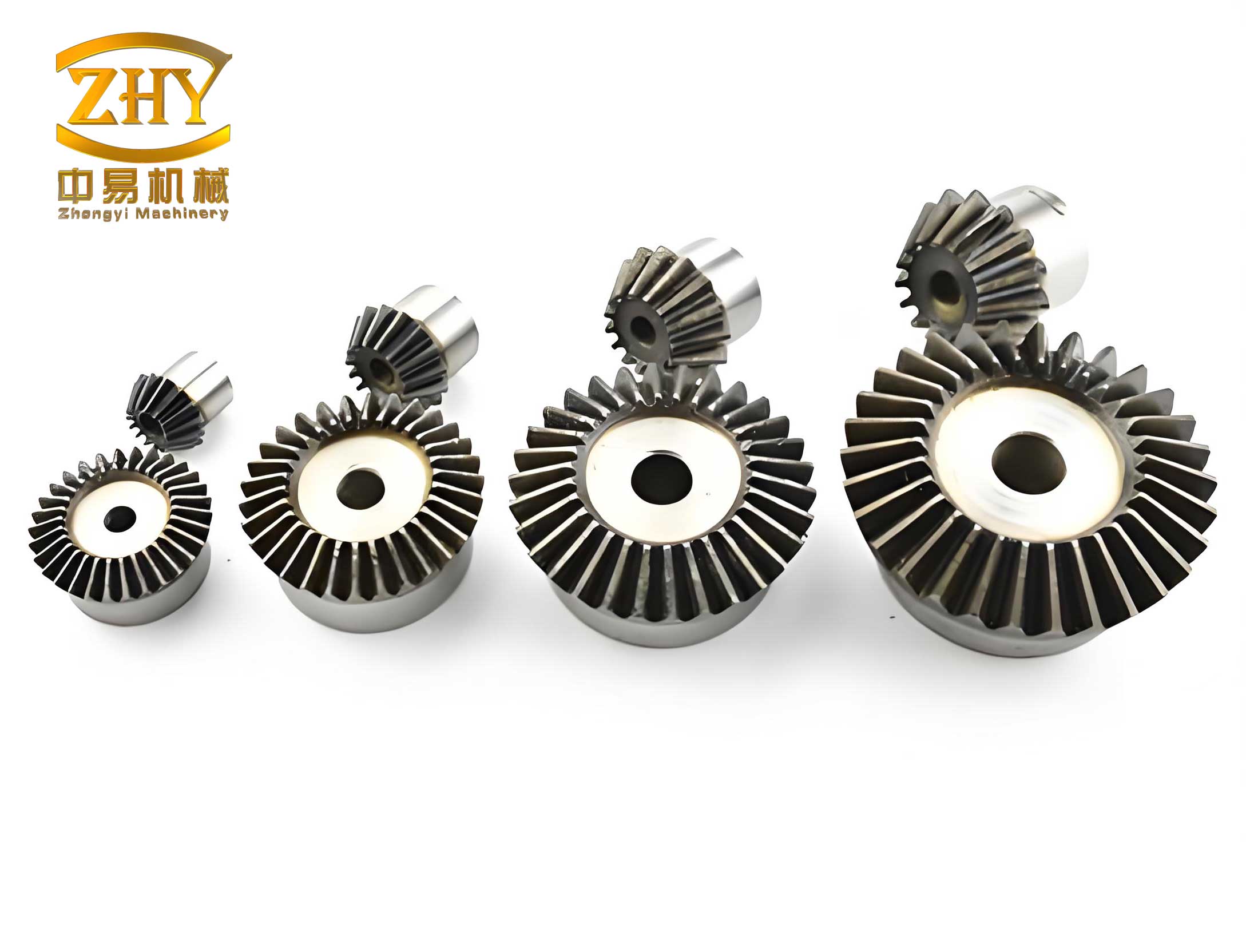
The fundamental challenge in analyzing the lubrication state of bevel gears in a tilting rotor system lies in accurately characterizing the kinematic conditions. In a standard, non-tilting configuration with two pinions driving a single crown gear, if the pinion speeds are equal, the system behaves as a fixed-axis gear train. However, during the tilt transition, a differential speed between the two pinions is required to drive the rotation of the entire gearbox assembly (the “tilt” motion). This differential speed imparts an additional rotational velocity component to the crown gear, fundamentally altering the surface velocities at the meshing interfaces of the bevel gears. This effect must be rigorously captured in the input parameters for any subsequent elastohydrodynamic lubrication analysis.
To model this, we define the coordinate system and velocity vectors at a contact point \(M\) on the tooth flank. For a conventional fixed-axis spiral bevel gear pair, the surface velocities for the gear (crown gear) and the pinion are given by:
$$ \mathbf{v}_G^{(M)} = \boldsymbol{\omega}_G \times \mathbf{R}_G^{(M)} $$
$$ \mathbf{v}_P^{(M)} = \boldsymbol{\omega}_P \times \mathbf{R}_P^{(M)} $$
where \(\boldsymbol{\omega}_G\) and \(\boldsymbol{\omega}_P\) are the angular velocity vectors of the gear and pinion about their respective axes, and \(\mathbf{R}_G^{(M)}\) and \(\mathbf{R}_P^{(M)}\) are the position vectors from the gear and pinion centers to the contact point \(M\).
In the counter-rotating, tilting configuration, let \(\omega_{Pr}\) and \(\omega_{Pl}\) represent the angular speeds of the right and left pinions, respectively, with \(\omega_{Pr} > 0\) and \(\omega_{Pl} < 0\). The crown gear’s angular speed about its own axis, \(\omega_G\), and its “tilt” or revolution angular speed about the pinion axis, \(\omega_{rot}\), are derived from the system kinematics. The relationship can be expressed as:
$$ \omega_G = – \frac{(\omega_{Pr} – \omega_{Pl})}{2} \cdot \frac{z_P}{z_G} $$
$$ \omega_{rot} = \frac{(\omega_{Pr} + \omega_{Pl})}{2} $$
where \(z_P\) and \(z_G\) are the number of teeth on the pinion and gear, respectively. Consequently, the surface velocity of the crown gear at the contact point is modified to include the component from this revolution:
$$ \mathbf{v}_G^{(M)} = \boldsymbol{\omega}_G \times \mathbf{R}_G^{(M)} + \boldsymbol{\omega}_{rot} \times \mathbf{R}_P^{(M)} $$
The pinion surface velocity remains \(\mathbf{v}_P^{(M)} = \boldsymbol{\omega}_P \times \mathbf{R}_P^{(M)}\). The side where \(\boldsymbol{\omega}_{rot}\) aligns with \(\boldsymbol{\omega}_P\) results in a higher effective surface velocity for the crown gear and is termed the “acceleration side.” The opposite side is the “deceleration side.” These velocity vectors are decomposed into components normal and tangential to the contact plane. The tangential components are further resolved along the major (\(x\)) and minor (\(y\)) axes of the contact ellipse to calculate the entrainment and sliding velocities, which are critical inputs for EHL analysis:
$$ U_{e}^{x} = \frac{1}{2}(v_{G}^{t,x} + v_{P}^{t,x}), \quad U_{e}^{y} = \frac{1}{2}(v_{G}^{t,y} + v_{P}^{t,y}) $$
$$ U_{e} = \sqrt{(U_{e}^{x})^2 + (U_{e}^{y})^2}, \quad \theta_e = \arctan(U_{e}^{y} / U_{e}^{x}) $$
$$ U_{s}^{x} = v_{P}^{t,x} – v_{G}^{t,x}, \quad U_{s}^{y} = v_{P}^{t,y} – v_{G}^{t,y} $$
$$ U_{s} = \sqrt{(U_{s}^{x})^2 + (U_{s}^{y})^2}, \quad \theta_s = \arctan(U_{s}^{y} / U_{s}^{x}) $$
To analyze the lubrication performance, a full thermal elastohydrodynamic lubrication model for grease is established. Grease rheology is complex, often modeled by the Herschel-Bulkley or Ostwald-de Waele (power-law) relationships. For the high shear rates expected in gear contacts, the simpler power-law model is frequently adequate and is adopted here for its computational efficiency. The constitutive relation is:
$$ \tau = \eta \dot{\gamma}^n $$
where \(\tau\) is the shear stress, \(\eta\) is the apparent viscosity, \(\dot{\gamma}\) is the shear rate, and \(n\) is the flow index (\(n < 1\) for shear-thinning grease). The generalized Reynolds equation governing grease flow in an elliptical contact, accounting for the entrainment angle \(\theta_e\), is derived as:
$$
\frac{\partial}{\partial x}\left( \frac{\rho}{\eta^{*}} \frac{\partial p}{\partial x} \right) + \frac{\partial}{\partial y}\left( \frac{\rho}{\eta^{*}} \frac{\partial p}{\partial y} \right) = \frac{\partial}{\partial x} \left[ \left( \frac{U_{e} \cos \theta_e + U_{s}}{2} \right) \rho h \right] + \frac{\partial}{\partial y} \left[ \left( \frac{U_{e} \sin \theta_e}{2} \right) \rho h \right]
$$
where \(p\) is pressure, \(h\) is film thickness, \(\rho\) is density, and \(\eta^{*}\) is an equivalent viscosity based on the power-law model. The film thickness equation includes both the geometric gap and the elastic deformation:
$$ h(x,y) = h_{0} + \frac{x^{2}}{2R_x} + \frac{y^{2}}{2R_y} + \frac{2}{\pi E’} \iint_{\Omega} \frac{p(s,t) \, ds \, dt}{\sqrt{(x-s)^2 + (y-t)^2}} $$
Here, \(h_0\) is the central rigid film thickness, \(R_x\) and \(R_y\) are the equivalent radii of curvature, \(E’\) is the effective elastic modulus, and \(\Omega\) is the contact domain. The pressure-viscosity-temperature relationship for the grease is described by the modified Roelands equation:
$$ \eta(p, T) = \eta_0 \exp\left\{ (\ln \eta_0 + 9.67) \left[ -1 + (1 + 5.1 \times 10^{-9} p)^{z_0} \left( \frac{T – 138}{T_0 – 138} \right)^{-s_0} \right] \right\} $$
where \(\eta_0\) is the ambient viscosity at temperature \(T_0\), \(z_0\) is the pressure-viscosity index, and \(s_0\) is the temperature-viscosity index. The density variation with pressure and temperature follows:
$$ \rho(p, T) = \rho_0 \left[ 1 + \frac{0.6 \times 10^{-9} p}{1 + 1.7 \times 10^{-9} p} – D_0 (T – T_0) \right] $$
The energy equation governing heat generation and transfer within the grease film, neglecting conduction in the \(x\) and \(y\) directions compared to shear heating and convection, is:
$$
\rho c_f \left( u \frac{\partial T}{\partial x} + v \frac{\partial T}{\partial y} + w \frac{\partial T}{\partial z} \right) – k_f \frac{\partial^2 T}{\partial z^2} = -\frac{T}{\rho} \frac{\partial \rho}{\partial T} \left( u \frac{\partial p}{\partial x} + v \frac{\partial p}{\partial y} \right) + \eta^{*} \left[ \left( \frac{\partial u}{\partial z} \right)^2 + \left( \frac{\partial v}{\partial z} \right)^2 \right]
$$
The coupling between the fluid film and the solid gear teeth is completed by the heat conduction equations in the solids and the temperature/flux continuity conditions at the interfaces. The numerical solution of this strongly coupled, non-linear system employs the finite difference method. A multi-grid technique or Discrete Convolution and Fast Fourier Transform (DC-FFT) method is typically used to accelerate the computation of elastic deformations. The pressure field is solved iteratively using the Gauss-Seidel method with appropriate relaxation, and the energy equation is solved column-by-column using the Tri-Diagonal Matrix Algorithm (TDMA). Convergence is checked for pressure, load balance, and temperature fields.
The analysis requires detailed input parameters from the specific bevel gear pair and operational conditions. A Loaded Tooth Contact Analysis (LTCA) via finite element software (e.g., ABAQUS) is first performed to extract the time-varying contact geometry (principal curvatures, orientation), load, and kinematic data at discrete meshing positions across the path of contact. For this study, a Gleason system spiral bevel gear set is analyzed. The basic gear blank parameters are summarized in the following table:
| Parameter | Pinion | Gear (Crown) |
|---|---|---|
| Number of Teeth | 30 | 41 |
| Module (mm) | 9.3 | 9.3 |
| Face Width (mm) | 80 | 80 |
| Shaft Angle (°) | 90 | |
| Pressure Angle (°) | 25 | |
To investigate the tilt transition, several operational cases are defined. The baseline helicopter-mode speed is set with both pinions at 9000 rpm. Transition modes are simulated by introducing a differential speed \(\Delta n\) between the pinions. The following table outlines the studied differential speed cases for a nominal pinion speed of 9000 rpm, distinguishing between acceleration and deceleration sides.
| Case | Description | Pinion Speeds (rpm) | Side |
|---|---|---|---|
| 1 | Slow Transition | 9000 & 9001.5 | Acceleration |
| 2 | Fast Transition | 9000 & 9005.0 | Acceleration |
| 3 | Slow Transition | 9000 & 8998.5 | Deceleration |
| 4 | Fast Transition | 9000 & 8995.0 | Deceleration |
The material properties for the steel bevel gears and the grease parameters at a reference temperature of 70°C (343 K) are essential for the TEHL calculation.
| Parameter | Value (Gear Material) |
|---|---|
| Equivalent Elastic Modulus, \(E’\) (GPa) | 207 |
| Density, \(\rho\) (kg/m³) | 7850 |
| Specific Heat Capacity, \(c\) (J/(kg·K)) | 470 |
| Thermal Conductivity, \(k\) (W/(m·K)) | 46 |
| Parameter | Value (Grease at 343K) |
|---|---|
| Ambient Viscosity, \(\eta_0\) (Pa·s) | 0.336 |
| Pressure-Viscosity Coeff., \(\alpha\) (Pa⁻¹) | 2.3×10⁻⁸ |
| Flow Index, \(n\) | 0.822 |
| Ambient Density, \(\rho_0\) (kg/m³) | 980 |
The analysis first examines the influence of differential speed magnitude at a constant nominal speed. Comparing the computed entrainment velocity \(U_e\) and sliding velocity \(U_s\) for the transition cases against the non-tilting baseline reveals predictable trends. On the acceleration side, \(U_e\) increases, while it decreases on the deceleration side. The change magnitude is proportional to the differential speed \(\Delta n\). The sliding velocity \(U_s\) increases on both sides, with a more pronounced effect on the deceleration side. These altered kinematic inputs directly affect the lubrication film formation and friction.
The TEHL results for five representative meshing positions across the path of contact are analyzed. Key output parameters include the central/average film thickness \(h_c\), maximum Hertzian pressure \(p_{max}\), maximum flash temperature \(T_{max}\), and the traction coefficient \(f\). For the differential speed study at 9000 rpm, the changes in these parameters relative to the non-tilting case are generally minimal for the small \(\Delta n\) values (1.5 and 5 rpm) considered. This is expected, as the differential speed constitutes less than 0.06% of the nominal pinion speed. The most systematic observable trend is for the maximum average temperature, which shows a measurable increase for the deceleration side cases (Case 3 and 4), with the larger differential (Case 4) causing a greater temperature rise. The acceleration side cases show negligible thermal impact. Variations in film thickness, maximum pressure, and friction coefficient do not exhibit a strong, consistent correlation with the differential speed under these conditions, as their changes are within the numerical noise level for such a small perturbation.
A more significant effect is observed when analyzing the lubrication state across the tilt transition corridor, i.e., at different nominal speeds under a constant differential. Here, we consider a constant \(\Delta n = 5\) rpm and increase the nominal pinion speed from 8500 rpm (helicopter mode) to 10000 rpm (airplane mode), with intermediate steps at 9000 rpm and 9500 rpm. The results clearly show that the rotational speed has a dominant influence on the lubrication of the bevel gears. As speed increases, the entrainment velocity rises, leading to a stronger hydrodynamic effect. This is reflected in the following consistent trends across the meshing cycle:
1. Film Thickness: The central and average film thickness increases substantially with increasing speed, following a relationship close to \(h_c \propto U_e^{0.67}\) for line contacts, modified for elliptical contact and grease shear-thinning.
2. Friction Coefficient: The traction coefficient also shows an increasing trend with speed under these thermal conditions, as the higher shear rates in a thicker film generate more frictional heat, reducing the effective viscosity in the contact zone.
3. Maximum Pressure: The trend for maximum Hertzian pressure is more nuanced. At the entry and exit regions of the mesh, \(p_{max}\) tends to increase with speed. However, during the central portion of the meshing cycle, it may slightly decrease due to the increased film thickness altering the pressure distribution and potentially the load sharing among contact ellipses.
4. Maximum Temperature: The flash temperature behavior mirrors that of pressure. It increases with speed at the mesh inlet and outlet but may show a more complex or even decreasing trend in the mid-mesh region, where the beneficial cooling effect of increased entraining flow can sometimes offset the increased shear heating.
The performance difference between the acceleration and deceleration sides for the same \(\Delta n\) and nominal speed is negligible in terms of film thickness and pressure but can be discerned in the temperature field, with the deceleration side consistently running slightly hotter due to its lower entrainment velocity and consequently less effective cooling.
In conclusion, the lubrication analysis of counter-rotating bevel gears in a tiltrotor transition state requires a careful kinematic model that accounts for the differential speed-induced revolution of the crown gear. For the specific gear geometry and operational parameters studied, the primary driver of lubrication characteristic variation is the absolute rotational speed of the bevel gears as the aircraft transitions from hover to cruise. The small differential speeds required for the tilt motion itself have a negligible impact on film formation and pressure but can lead to a measurable, though small, increase in operating temperature on the deceleration side of the gear mesh. The established TEHL model and analysis methodology provide a viable tool for assessing the lubrication state of these critical components under complex dynamic flight conditions. Future work will focus on incorporating transient effects, surface roughness, and more detailed grease rheology models (like Herschel-Bulkley with a yield stress) to capture the behavior under start-up or very low-speed tilting conditions more accurately.