
In the manufacturing of critical components like gear shafts, the forging process plays a pivotal role in determining the final product quality. As an engineer specializing in metal forming, I have extensively studied how various process parameters influence the成形质量 of gear shafts, particularly through warm forging. Gear shafts, which integrate shaft and gear elements into a single piece, are essential in power transmission systems, such as reducers, where they endure dynamic loads and high rotational speeds. The成形质量 of these gear shafts is highly sensitive to forging parameters, including die design, loading methods, and loading rates. Different combinations of these parameters affect the flow patterns of the billet, filling behavior of the die cavity, temperature distribution, and cooling dynamics, ultimately impacting the mechanical properties and dimensional accuracy of the forged gear shafts. This article delves into a comparative analysis of unidirectional and bidirectional loading methods in the closed-die warm forging of a reducer drive gear shaft, focusing on billet flow velocity distribution, die load variations, and cavity filling performance. The goal is to optimize the forging process to enhance the成形质量 of gear shafts, ensuring they meet the rigorous demands of industrial applications.
The gear shaft under consideration is designed for a reducer operating at speeds up to 3,500 rpm, where it transmits torque from an engine under variable loading conditions. This environment necessitates a material with high strength, toughness, wear resistance, and good machinability. After evaluating several alloys, I selected 40CrNiMoA alloy steel for these gear shafts due to its excellent综合性能 after heat treatment. This material is renowned for its use in critical components like heavy-duty shafts, turbine blades, and high-load transmission parts, where both plasticity and strength are paramount. To provide a clear overview, the chemical composition and physical properties of 40CrNiMoA are summarized in the following tables.
| Element | C | Si | Mn | Cr | Ni | Mo | Cu | Fe |
|---|---|---|---|---|---|---|---|---|
| Content | 0.40 | 0.36 | 0.65 | 0.75 | 1.26 | 0.25 | 0.10 | Balance |
| Property | Tensile Strength (MPa) | Elongation (%) | Hardness (HB) | Poisson’s Ratio | Elastic Modulus (GPa) |
|---|---|---|---|---|---|
| Value | 1020 | 12 | 265 | 0.30 | 220 |
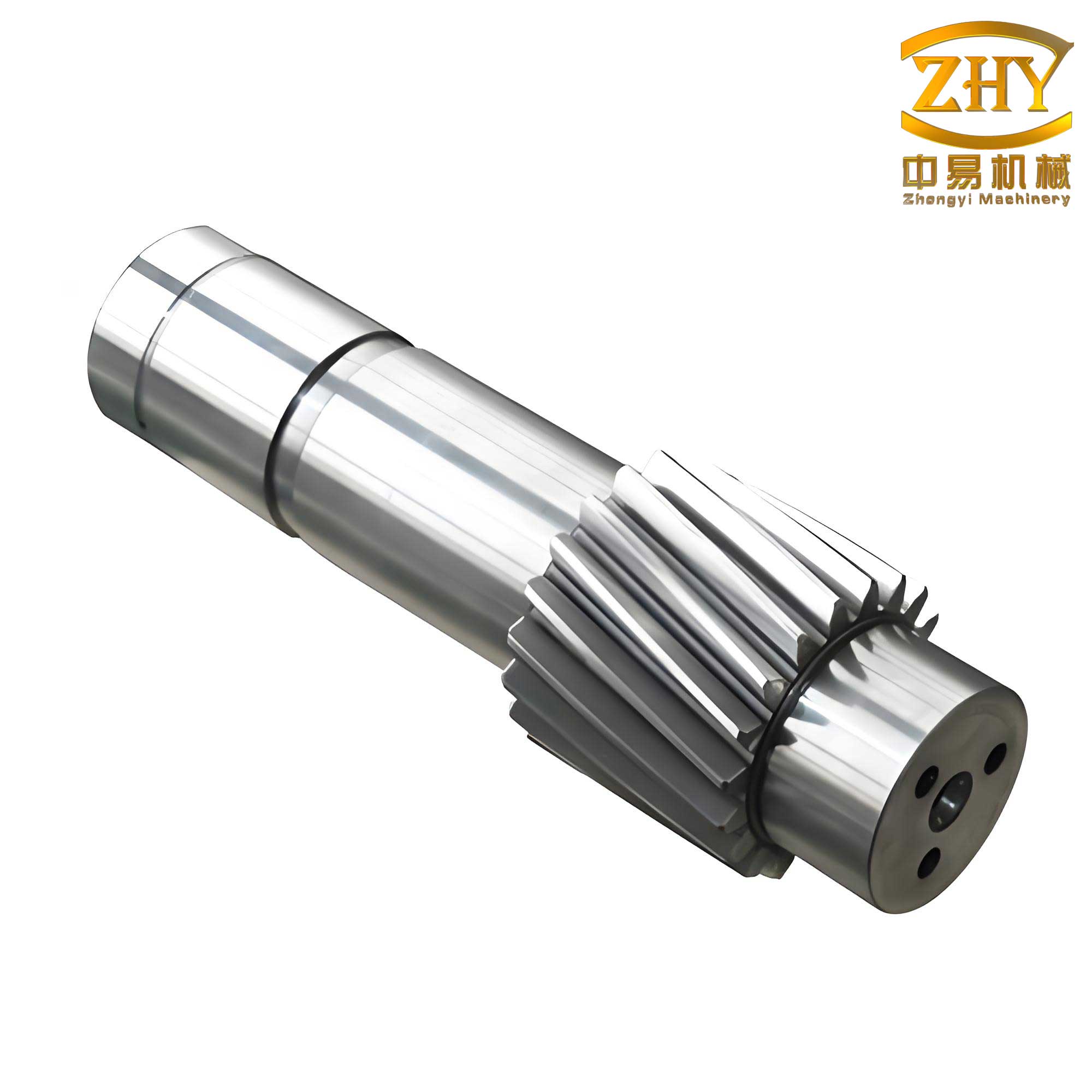
The gear shaft’s structure features an integrated design with a central gear section flanked by shaft ends. The total length is 305 mm, with left and right shaft diameters of 75 mm and 85 mm, respectively, each 120 mm long. The gear section has a width of 65 mm, a tip diameter of 155 mm, a root diameter of 128 mm, a module of 3 mm, and 25 teeth. Transitions between the gear and shafts are achieved through fillet radii to stress concentration. To visualize this configuration, refer to the following illustration, which provides a detailed schematic of the gear shaft geometry.
In warm forging, the die structure and loading method are critical factors. I designed two distinct die configurations for this study: one for unidirectional loading and another for bidirectional loading. The unidirectional setup includes a fixed ejector, left die, tooth-profile die, right die, billet, and a right punch that applies forging pressure. Conversely, the bidirectional setup incorporates left and right punches that both exert pressure during forging, allowing for simultaneous deformation from both ends. This差异 in loading mechanisms significantly influences the material flow and stress distribution within the gear shafts. The warm forging process was chosen over cold or hot forging due to its balance between energy efficiency and成形质量. Cold forging would impose excessive die loads, reducing tool life, while hot forging could lead to scale formation and dimensional inaccuracies. The process parameters were carefully selected: die material as 4Cr5W2VSi hot-work tool steel with a preheat temperature of 280°C, billet material as 40CrNiMoA with a preheat temperature of 850°C, convective heat transfer coefficient between die and environment as 22.5 kW/(m²·°C), interfacial heat transfer coefficient between billet and die as 135.9 kW/(m²·°C), and a friction coefficient of 0.22. For unidirectional loading, the punch speed was set at 16 mm/s, whereas for bidirectional loading, both punches moved at 5.5 mm/s initially, with further optimization discussed later.
To analyze the effects of loading methods on the成形质量 of gear shafts, I employed finite element simulation software, Deform, to model the forging process. The simulations captured key aspects such as billet flow velocity, die load evolution, and cavity filling. The flow velocity distribution under unidirectional loading revealed a stark contrast between the移动端 (punch side) and固定端 (ejector side). The移动端 exhibited velocities around 28 mm/s, while the固定端 lagged at approximately 10 mm/s. This disparity created a distinct flow boundary near the gear section, leading to folding defects, particularly at the tooth ends adjacent to the固定端. The flow behavior can be described by the continuity equation for incompressible flow in metal forming:
$$ \nabla \cdot \mathbf{v} = 0 $$
where \(\mathbf{v}\) is the velocity vector. The non-uniform velocity field under unidirectional loading results in shear strains that promote folding. In contrast, bidirectional loading produced a more uniform flow velocity distribution, averaging around 25 mm/s across the gear shafts. Although a flow boundary formed at the mid-section due to opposing punch movements, it was less prone to causing defects in critical areas like the tooth profiles. This uniformity minimizes internal stresses and enhances the integrity of the forged gear shafts.
Die load analysis further highlighted the advantages of bidirectional loading. I monitored the load on the tooth-profile die, a critical component, over the forging duration. Under unidirectional loading, the die load followed a three-stage pattern: gradual increase, accelerated rise, and rapid surge, peaking at 1,150 kN. The load evolution can be modeled using a power-law relation for forging pressure:
$$ P = K \cdot \epsilon^n \cdot f(\dot{\epsilon}, T) $$
where \(P\) is the pressure, \(K\) is the strength coefficient, \(\epsilon\) is the strain, \(n\) is the strain-hardening exponent, \(\dot{\epsilon}\) is the strain rate, and \(T\) is the temperature. For bidirectional loading, the peak die load was significantly lower at 770 kN, representing a 33.1% reduction. This decrease is attributed to the more balanced stress distribution, which alleviates concentrated loading on the die. The lower load not only extends die life but also reduces the risk of die failure, making bidirectional loading more economical for producing high-quality gear shafts.
Cavity filling performance is another crucial metric for评估 the成形质量 of gear shafts. Under unidirectional loading, simulation results showed noticeable filling defects at the tooth tips and minor imperfections along the tooth flanks, as illustrated by volume shortfalls in the fill distribution maps. These defects arise from the uneven material flow, which hinders complete die filling. In contrast, bidirectional loading ensured complete filling at both tooth tips and flanks, resulting in a fully formed gear profile. The filling efficiency can be quantified by the fill ratio \(\eta\), defined as:
$$ \eta = \frac{V_{\text{filled}}}{V_{\text{cavity}}} \times 100\% $$
where \(V_{\text{filled}}\) is the volume of material in the cavity and \(V_{\text{cavity}}\) is the total cavity volume. For bidirectional loading, \(\eta\) approached 100%, whereas unidirectional loading yielded lower values due to flow-induced voids. This complete filling is essential for achieving the desired mechanical properties and dimensional accuracy in gear shafts, ensuring reliable performance in service.
Given the superiority of bidirectional loading, I further investigated the optimization of punch speed to minimize die load and enhance成形质量. Holding other parameters constant, I varied the punch speed in the bidirectional setup from 0.5 to 9.5 mm/s and recorded the corresponding peak die loads. The relationship between punch speed \(v\) and peak die load \(F_{\text{max}}\) exhibited a non-linear trend: initially, \(F_{\text{max}}\) decreased slowly from 820 kN at 0.5 mm/s to 710 kN at 4.5 mm/s, then increased rapidly to 1,160 kN at 9.5 mm/s. This behavior can be explained by the interplay between strain rate sensitivity and thermal effects. At lower speeds, strain rate hardening is minimal, but as speed increases, adiabatic heating softens the material, reducing load until higher speeds induce excessive strain rates that elevate flow stress. The optimal punch speed was identified as 4.5 mm/s, where \(F_{\text{max}}\) reached a minimum of 710 kN. This optimization underscores the importance of fine-tuning process parameters for manufacturing gear shafts efficiently.
| Punch Speed (mm/s) | 0.5 | 1.5 | 2.5 | 3.5 | 4.5 | 5.5 | 6.5 | 7.5 | 8.5 | 9.5 |
|---|---|---|---|---|---|---|---|---|---|---|
| Peak Die Load (kN) | 820 | 790 | 760 | 730 | 710 | 750 | 820 | 920 | 1040 | 1160 |
To generalize these findings, I derived a empirical model for predicting die load in warm forging of gear shafts. Based on the simulation data, the peak load \(F_{\text{max}}\) can be expressed as a function of punch speed \(v\) and loading method \(M\) (where \(M=0\) for unidirectional and \(M=1\) for bidirectional):
$$ F_{\text{max}} = A \cdot v^B + C \cdot M + D $$
where \(A\), \(B\), \(C\), and \(D\) are constants determined from regression analysis. For the studied gear shafts, the values are approximately \(A = 500\), \(B = 0.5\), \(C = -300\), and \(D = 1000\), with \(F_{\text{max}}\) in kN and \(v\) in mm/s. This model highlights the significant load reduction achievable with bidirectional loading (\(C\) being negative) and the non-linear speed dependence.
In addition to mechanical aspects, thermal management is vital in warm forging of gear shafts. The temperature distribution within the billet affects flow stress and microstructural evolution. I simulated the temperature field using the heat conduction equation:
$$ \rho c_p \frac{\partial T}{\partial t} = k \nabla^2 T + \dot{q} $$
where \(\rho\) is density, \(c_p\) is specific heat, \(k\) is thermal conductivity, and \(\dot{q}\) is heat generation rate due to plastic deformation. Under bidirectional loading, the more uniform deformation reduced localized heating, leading to a more homogeneous temperature distribution compared to unidirectional loading. This homogeneity minimizes thermal gradients that can cause residual stresses or distortion in the forged gear shafts, further enhancing their dimensional stability and performance.
Microstructural considerations also play a role in the成形质量 of gear shafts. Warm forging at 850°C for 40CrNiMoA promotes dynamic recrystallization, refining the grain structure and improving toughness. The uniform flow in bidirectional loading ensures consistent grain refinement across the gear section, whereas unidirectional loading may lead to banded structures due to shear bands. The grain size \(d\) can be related to the Zener-Hollomon parameter \(Z\):
$$ Z = \dot{\epsilon} \exp\left(\frac{Q}{RT}\right) $$
$$ d = \alpha Z^{-\beta} $$
where \(\dot{\epsilon}\) is strain rate, \(Q\) is activation energy, \(R\) is gas constant, \(T\) is temperature, and \(\alpha\) and \(\beta\) are material constants. For gear shafts, a fine, uniform grain size is desirable to enhance fatigue resistance under cyclic loading, making bidirectional loading preferable.
From a practical standpoint, implementing bidirectional loading in production requires careful design of the forging press and control system. Synchronization of the left and right punches is crucial to maintain symmetry and avoid tilting of the gear shafts. Modern servo-driven presses offer precise speed and position control, enabling the optimal parameters identified in this study. Additionally, die wear analysis should be conducted, as lower loads in bidirectional loading can prolong die life, reducing maintenance costs for manufacturing gear shafts.
In conclusion, my analysis demonstrates that bidirectional loading significantly improves the成形质量 of gear shafts in warm forging compared to unidirectional loading. The uniform flow velocity distribution, reduced die loads, and complete cavity filling contribute to superior mechanical properties and dimensional accuracy. Optimization of punch speed further minimizes die load, with an optimal value of 4.5 mm/s for the studied gear shafts. These insights provide a foundation for advancing forging processes, ensuring that gear shafts meet the demanding requirements of modern industrial applications. Future work could explore the effects of other parameters, such as billet geometry or advanced die coatings, to further enhance the performance and efficiency of producing high-quality gear shafts.