
In my experience, the machining of straight bevel gears typically employs forming methods, profiling methods, and generating methods. A common characteristic of these approaches is that they approximate the spherical involute with the planar involute on the back cone. Among forming methods, the finger-type module milling cutter is primarily used for machining large module straight bevel gears, completing the process in a single pass. Other methods are often limited by machine tool availability and productivity. The finger-type milling cutter offers unique advantages: higher productivity, applicability on general milling machines, and, especially in repair shops with limited equipment, it represents an economical and practical solution. Its main drawback is relatively lower machining accuracy. However, large module straight bevel gears generally do not require high precision. By rationally selecting the cutter, adjusting machining parameters, and applying necessary cutter modification, the requirements for practical use can be met. This method has been used previously, but detailed analysis and research, particularly regarding cutter modification and the calculation of errors between the machined tooth profile and the theoretical profile, have been scarce. My aim here is to provide a detailed analysis and calculation in this area, utilizing computer assistance to enhance the practical application level of this method.
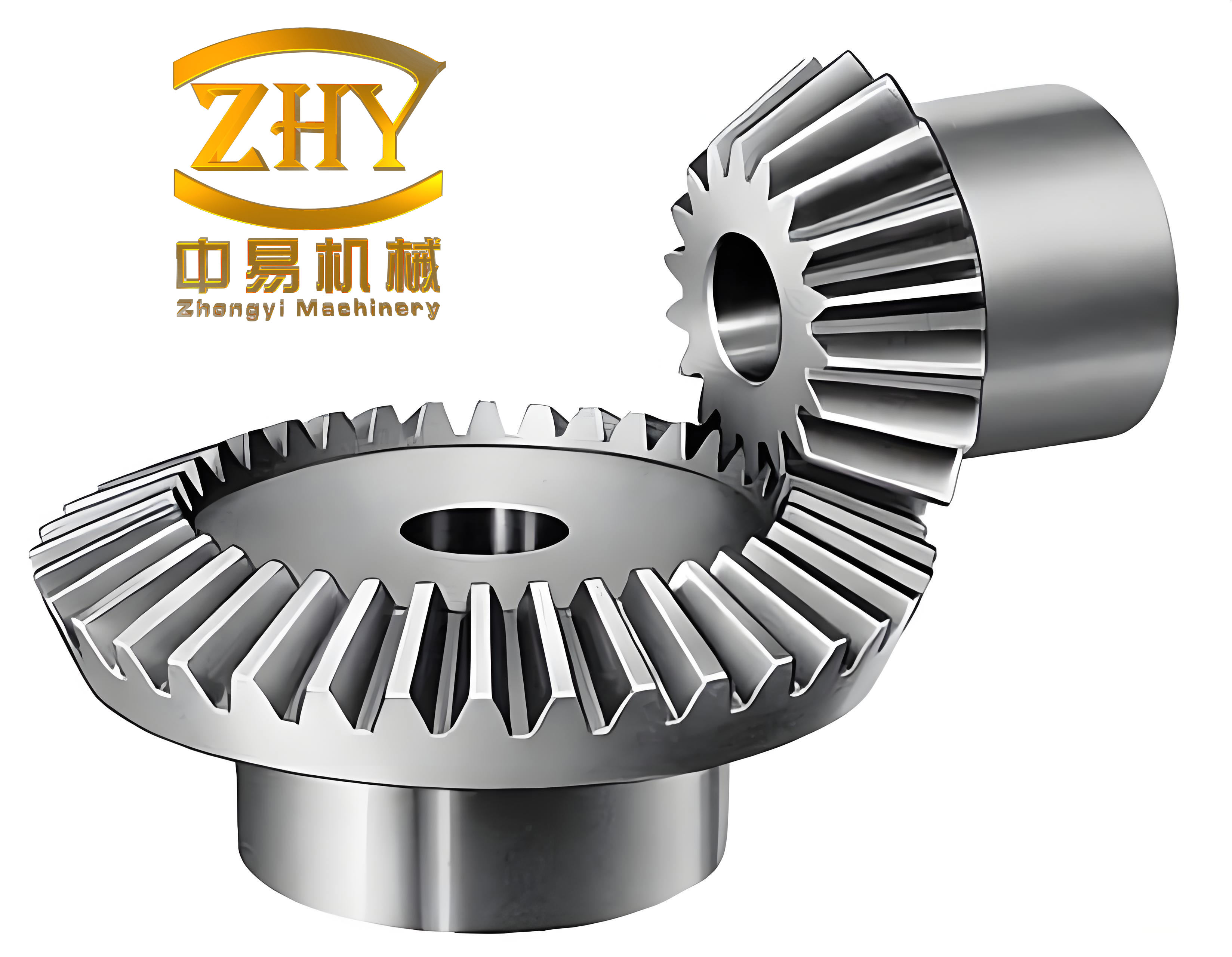
The design and manufacture of straight bevel gears rely on understanding their fundamental geometry. From gear engagement principles, the tooth surface equation of a bevel gear can be derived. Its intersection with the back cone surface gives the theoretical tooth profile on the back cone. However, this approach is complex and of limited practical value. Therefore, I still consider the involute on the back cone surface as the correct tooth profile—referred to as the reference tooth profile. For straight bevel gears, the reference profile is central to defining machining parameters.
The reference tooth profile’s module and pressure angle vary along the gear width. Let the standard module of the straight bevel gear be $$m$$, the large end module be $$m_e$$, the number of teeth be $$z$$, and the pitch cone half-angle be $$\delta$$. As shown in the conceptual diagram, at any distance $$x$$ along the pitch cone line from the standard module section (where decreasing $$x$$ is positive), the reference tooth profile module $$m_x$$ is given by the consistency of virtual teeth numbers on different back cone surfaces:
$$m_x = m \frac{R_x}{R}$$
where $$R_x$$ is the distance from the cone apex to the section at $$x$$, and $$R$$ is the pitch cone radius. The virtual number of teeth $$z_v$$ is:
$$z_v = \frac{z}{\cos \delta}$$
Thus, the reference tooth profile on any back cone surface of the straight bevel gear is represented by an involute determined by $$m_x$$ and the pressure angle $$\alpha_x$$. When the reference tooth profile module $$m_0$$ and pressure angle $$\alpha_0$$ are selected on the standard module section, the unfolding angle $$\theta_0$$ is $$\theta_0 = \inv \alpha_0 = \tan \alpha_0 – \alpha_0$$. If the unfolding angle $$\theta_x$$ on the section at $$x$$ is the same as $$\theta_0$$, then its pressure angle must also be $$\alpha_0$$. From the formation of the bevel gear tooth flank, we have $$\theta_x = \theta_0$$, so the reference tooth profile pressure angle at that section is $$\alpha_x = \alpha_0$$. This principle simplifies the analysis for straight bevel gears.
During milling with a finger-type cutter, the cutter axis should be perpendicular to the pitch cone line, and the gear is completed in one pass. Once the cutter is selected, the actual tooth profile and tooth thickness variation on different back cone surfaces can only be achieved through the cutter’s profile and the depth of cut (or a slight rotation of the cutter axis). Here, I focus on the variation in cutting depth. Generally, the actual slot width at the pitch circle should match the reference slot width. Under this condition, the cutting depth variation $$\Delta h$$ (where positive means shallower cut) can be determined. In the selected cutter section, the cutter’s module, number of teeth, and pressure angle $$\alpha_0$$ are chosen. The cutter’s chordal tooth thickness $$s_w$$ at the pitch circle is:
$$s_w = 2 r_w \sin \left( \frac{\pi}{2z_w} + \inv \alpha_0 – \inv \alpha_a \right)$$
where $$r_w$$ is the cutter’s pitch radius, $$z_w$$ is the cutter’s number of teeth, $$\alpha_a$$ is the pressure angle at the start of the involute, and $$\inv \alpha = \tan \alpha – \alpha$$ is the involute function. On the straight bevel gear, at a distance $$x$$ from the reference section, the reference tooth profile’s chordal tooth thickness $$s_x$$ at the pitch circle is:
$$s_x = 2 r_x \sin \left( \frac{\pi}{2z_v} \right)$$
where $$r_x$$ is the reference profile’s pitch radius at that section, and $$z_v$$ is the virtual number of teeth. From the relation $$r_x = m_x z_v / 2$$, the cutting depth variation is:
$$\Delta h = \frac{s_w – s_x}{2 \tan \alpha_0}$$
This formula shows that $$\Delta h$$ varies non-linearly with $$x$$. For simplicity in machining, a linear approximation can be used. By calculating $$\Delta h$$ at the small end ($$\Delta h_s$$) and large end ($$\Delta h_e$$), the slope of cutter adjustment can be determined. If $$B$$ is the gear width and $$y$$ is the distance from the cutter’s selected section to the gear’s large end, the linear variation can be expressed as:
$$\Delta h(x) = \Delta h_s + \frac{x}{B} (\Delta h_e – \Delta h_s)$$
or relative to the cutter section:
$$\Delta h(y) = \Delta h_s + \frac{y}{B} (\Delta h_e – \Delta h_s)$$
This adjustment is crucial for maintaining proper tooth geometry in straight bevel gears.
To evaluate machining accuracy, I compare the actual tooth profile with the reference tooth profile, focusing on the right flank (the left flank is symmetric). I establish coordinate systems as shown conceptually: let $$O-XY$$ be the reference tooth profile system, with the Y-axis as the slot symmetric axis; and $$O_w-X_wY_w$$ be the cutter coordinate system, with the $$Y_w$$-axis as the cutter symmetric axis. In the discussed section, the $$X$$ and $$X_w$$ axes coincide, and the origins are offset by $$\Delta h$$ in the Y-direction. The reference tooth profile equation in $$O-XY$$ is:
$$
\begin{cases}
X = r_b (\cos \theta + \theta \sin \theta) \\
Y = r_b (\sin \theta – \theta \cos \theta)
\end{cases}
$$
where $$\theta$$ is the involute angle, $$r_b$$ is the base circle radius of the reference profile at that section, calculated from $$r_b = r_x \cos \alpha_0$$, and $$r_x = m_x z_v / 2$$. The cutter profile equation in $$O_w-X_wY_w$$ (which is also the actual tooth profile equation after machining) is:
$$
\begin{cases}
X_w = r_{bw} (\cos \phi + \phi \sin \phi) \\
Y_w = r_{bw} (\sin \phi – \phi \cos \phi)
\end{cases}
$$
where $$r_{bw}$$ is the cutter’s base radius, and $$\phi$$ is the involute angle for the cutter. Transforming to the $$O-XY$$ system, the actual profile equation becomes:
$$
\begin{cases}
X = X_w \\
Y = Y_w + \Delta h
\end{cases}
$$
From these equations, for any given $$Y$$ value, the error in the X-direction between the actual and reference tooth profiles can be calculated as $$\Delta X = X_{\text{actual}} – X_{\text{reference}}$$. This error serves as a basis for cutter modification for straight bevel gears.
However, the X-direction error does not fully reflect meshing error. Tooth profile error is transmitted along the common normal direction; therefore, I also calculate the normal direction error. As illustrated, let $$P_0(X_0, Y_0)$$ be a point on the reference tooth profile. The normal line at this point has the equation:
$$\frac{X – X_0}{-\sin \psi} = \frac{Y – Y_0}{\cos \psi}$$
where $$\psi$$ is the angle of the normal, given by $$\psi = \arctan(\theta_0)$$, with $$\theta_0$$ being the involute angle at $$P_0$$. The intersection of this normal with the actual tooth profile gives point $$P_1(X_1, Y_1)$$. The tooth profile error in the normal direction is:
$$\Delta N = \sqrt{(X_1 – X_0)^2 + (Y_1 – Y_0)^2}$$
The sign of $$\Delta N$$ is determined by the relative positions of $$P_1$$ and $$P_0$$ along the normal. This normal error is critical for assessing the performance of straight bevel gears in transmission.
Selection and modification of the cutter are key to improving accuracy. From the analysis, the cutter’s module can be chosen between the large and small end modules of the straight bevel gear, and the number of teeth can vary. Different combinations yield different errors. Generally, selecting the cutter module close to the mean module and the number of teeth close to the virtual number of teeth is advisable. For gears with small width and low requirements, adjusting the cutting depth variation may suffice. For wider gears, cutter modification is often necessary. Modification is based on the calculated X-direction error. Primarily, the portions of the cutter profile outside the meshing points on the selected module section are modified. The portion between meshing points is addressed by cutting depth variation and minor modification; otherwise, tooth profile error increases and meshing deteriorates for straight bevel gears.
After cutter modification, the tooth profile error must be recalculated. The modified cutter profile points can be fitted using a least-squares curve, typically a cubic polynomial, yielding an equation $$Y = f(X)$$. Replacing the cutter’s involute equation with this fitted equation allows recomputation of cutting depth variation and errors. If results are unsatisfactory, further modification or optimization methods can be applied to achieve the optimal cutter profile for straight bevel gears.
When machining a pair of mating straight bevel gears, it is beneficial to consider them together rather than individually. Individual analysis may lead to larger modification amounts and greater tooth profile errors. Joint consideration allows error compensation, reducing modification and meshing error. The method involves allowing some interference on each gear, provided that the sum of their normal direction errors at meshing points is greater than or equal to zero. This ensures no interference during meshing. For low-accuracy requirements, no modification may be needed, only cutting depth adjustment. For higher accuracy, modification calculations can be performed. The meshing points on each gear are determined by calculating the start and end points of engagement on the respective gear’s reference profile, represented by radii $$r_{a1}$$ and $$r_{a2}$$. At any point in between, as shown in a conceptual diagram, the corresponding radii on each gear can be found using engagement line principles. The normal errors $$\Delta N_1$$ and $$\Delta N_2$$ are then computed. If the sum $$\Delta N_1 + \Delta N_2 \geq 0$$, no interference occurs. This approach optimizes the manufacturing of paired straight bevel gears.
To illustrate, I present a calculation example. Consider a pair of straight bevel gears with identical parameters: standard module $$m = 10 \, \text{mm}$$, face width $$B = 100 \, \text{mm}$$, pitch cone half-angle $$\delta = 30^\circ$$, and number of teeth $$z_1 = z_2 = 20$$. The reference tooth profile modules are: small end $$m_s = 8 \, \text{mm}$$, middle $$m_m = 10 \, \text{mm}$$, large end $$m_e = 12 \, \text{mm}$$. Virtual number of teeth $$z_v = z / \cos \delta = 20 / \cos 30^\circ \approx 23.09$$. The cutter is selected with a standard module of $$10 \, \text{mm}$$ or $$12 \, \text{mm}$$; however, to minimize error, a non-standard module might be chosen. Given the gear width, cutter modification is recommended. Suppose a cutter with module $$10 \, \text{mm}$$ is selected. Without modification, using cutting depth variation determined from ends, the pair may have interference. By slightly increasing the cutting depth at the small end to create pitch circle clearance, interference can be eliminated, but meshing error may be significant, up to $$0.2 \, \text{mm}$$. After modification to avoid interference on individual gears, the maximum error might not be less than $$0.15 \, \text{mm}$$. Through paired gear modification calculation, the sum of normal errors can be reduced to no more than $$0.1 \, \text{mm}$$. Such a pair of straight bevel gears manufactured by this method has been used in a rolling mill for nearly a year with good performance.
In summary, the method I propose for machining straight bevel gears offers several advantages. It is fast, convenient, practical, and has been validated. Cutter modification should be considered based on full-tooth-surface error calculation to understand actual conditions. Allowing slight slot clearance at the small end during cutting depth adjustment can reduce or eliminate interference. The tooth profile errors generated when machining paired straight bevel gears with finger-type milling cutters are complementary. Leveraging this can minimize cutter modification and improve meshing accuracy. Straight bevel gears are essential components in many mechanical systems, and this method provides a viable solution for large module applications.
To encapsulate key formulas and parameters, I present the following tables:
| Symbol | Description | Formula |
|---|---|---|
| $$m$$ | Standard module | Given |
| $$m_x$$ | Reference module at distance x | $$m_x = m \frac{R_x}{R}$$ |
| $$z_v$$ | Virtual number of teeth | $$z_v = \frac{z}{\cos \delta}$$ |
| $$\alpha_0$$ | Reference pressure angle | Constant along width |
| $$r_x$$ | Pitch radius at x | $$r_x = \frac{m_x z_v}{2}$$ |
| $$r_b$$ | Base radius at x | $$r_b = r_x \cos \alpha_0$$ |
| Variable | Description | Expression |
|---|---|---|
| $$s_w$$ | Cutter chordal tooth thickness | $$s_w = 2 r_w \sin \left( \frac{\pi}{2z_w} + \inv \alpha_0 – \inv \alpha_a \right)$$ |
| $$s_x$$ | Reference chordal tooth thickness at x | $$s_x = 2 r_x \sin \left( \frac{\pi}{2z_v} \right)$$ |
| $$\Delta h$$ | Cutting depth variation | $$\Delta h = \frac{s_w – s_x}{2 \tan \alpha_0}$$ |
| Linear approx. | For simplicity | $$\Delta h(x) = \Delta h_s + \frac{x}{B} (\Delta h_e – \Delta h_s)$$ |
| Error Type | Direction | Calculation Method | Significance |
|---|---|---|---|
| X-direction error | Along tooth profile width | $$\Delta X = X_{\text{actual}} – X_{\text{reference}}$$ | Basis for cutter modification |
| Normal direction error | Along common normal | $$\Delta N = \sqrt{(X_1 – X_0)^2 + (Y_1 – Y_0)^2}$$ | Reflects meshing performance |
Furthermore, the engagement condition for paired straight bevel gears can be expressed using the following formula for the sum of normal errors:
$$\Delta N_{\text{sum}} = \Delta N_1(r_1) + \Delta N_2(r_2) \geq 0$$
where $$r_1$$ and $$r_2$$ are the corresponding radii on gear 1 and gear 2 at a meshing point, determined from the engagement line equation. This ensures non-interference and is vital for the reliable operation of straight bevel gears.
In conclusion, the finger-type module milling cutter method for large module straight bevel gears is a practical approach that balances productivity and accuracy. Through systematic analysis of reference profiles, cutting depth adjustment, error calculation, and cutter modification, acceptable machining quality can be achieved. The complementary nature of errors in paired gears further enhances this method’s utility. Straight bevel gears machined this way can serve effectively in heavy-duty applications where high precision is not paramount but reliability is crucial.