
The harmonic drive gear, a revolutionary transmission technology, represents a paradigm shift in motion control through its unique operating principle. Unlike conventional gear systems that rely on rigid body kinematics, the harmonic drive gear utilizes controlled elastic deformation of a flexible component to transmit torque and motion with exceptional precision and high reduction ratios in a compact package. This article provides a comprehensive, first-person perspective on the working theory, detailed design methodology, and critical engineering considerations for the core components of a harmonic drive gear system. The fundamental advantage of the harmonic drive gear lies in its ability to achieve high reduction ratios, often exceeding 100:1, within a single stage, combined with near-zero backlash, high torque capacity, and coaxial input/output shaft alignment.
At the heart of every harmonic drive gear are three primary components: the wave generator, the flexspline, and the circular spline. The wave generator, typically an elliptical cam assembly or a set of rotating bearings, is the input element. The flexspline is a thin-walled, flexible cylindrical cup or ring with external teeth. The circular spline is a rigid internal gear ring. The genius of the harmonic drive gear mechanism is the interaction between these parts. By fixing one of these three components, various speed reduction, speed increase, or differential motion configurations can be achieved. The most common configuration for a high-ratio speed reducer involves fixing the circular spline, using the wave generator as the input, and the flexspline as the output.
The operational principle of the harmonic drive gear is elegantly simple yet profound. When the elliptical wave generator is inserted into the flexspline, it deforms the flexible component into an elliptical shape. This deformation causes the teeth of the flexspline to engage with the teeth of the circular spline at two diametrically opposite regions along the major axis of the ellipse. At the minor axis, the teeth are completely disengaged. In the quadrants between the major and minor axes, the teeth transition from engagement to disengagement. As the wave generator rotates, the points of engagement and disengagement travel around the circumference of the harmonic drive gear. Crucially, the flexspline has fewer teeth (typically 2 teeth fewer for a standard dual-wave system) than the circular spline. Therefore, for every full rotation of the wave generator, the elliptical deformation wave travels once around the flexspline, but the flexspline itself rotates a small amount relative to the circular spline in the opposite direction. This relative motion is the source of the high reduction ratio. The reduction ratio, \( i \), for a system with a fixed circular spline is given by:
$$ i = -\frac{N_f}{N_f – N_c} $$
where \( N_f \) is the number of teeth on the flexspline and \( N_c \) is the number of teeth on the circular spline. The negative sign indicates reversal of rotation.
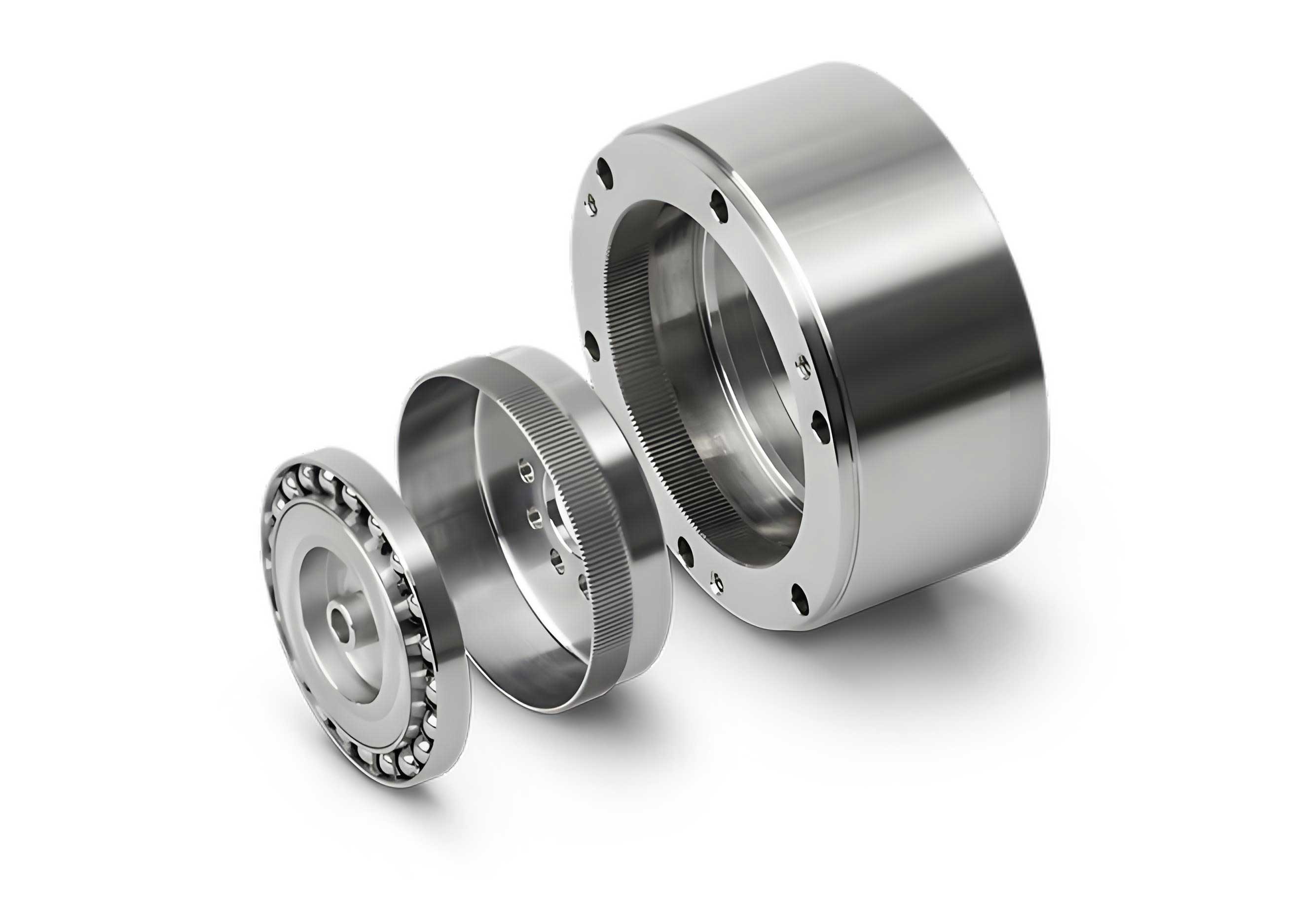
Moving from principle to practice, the design of a harmonic drive gear is a meticulous process that balances gear geometry, material science, and structural mechanics. The selection of meshing parameters is the foundational step. Key parameters include the module \( m \), the pressure angle \( \alpha_0 \), and the number of teeth on the flexspline \( z_1 \) and circular spline \( z_2 \). The tooth profile is typically an involute, but with significant modifications. To prevent interference and ensure proper meshing across the deformed flexspline, both gears require substantial profile shift (addendum modification). The determination of the optimal shift coefficients \( x_1 \) and \( x_2 \) is critical. Based on established theories for ensuring non-interference and adequate backlash, the shift coefficient for the flexspline can be selected from design charts or calculated using specialized algorithms. The corresponding gear diameters are then calculated with modified formulas:
Flexspline Root Diameter: $$ d_{f1} = m(z_1 + 2x_1 – 2h_a^* – 2c^*) $$
Flexspline Addendum Diameter (Approx.): $$ d_{a1} = d_{f1} + 3.5m $$
Circular Spline Addendum Diameter: $$ d_{a2} = d_{f1} + 2.45m $$
Circular Spline Root Diameter (Minimum): $$ d_{f2} \ge d_{a2} + 2.3m $$
Here, \( h_a^* \) is the addendum coefficient (typically 1.0) and \( c^* \) is the clearance coefficient (typically 0.25). For a harmonic drive gear intended for power transmission, the module must first satisfy a strength condition based on permissible surface pressure or bending stress at the tooth root of the flexspline, which is the most critically stressed element. A simplified check for specific pressure can be expressed as:
$$ m \ge \sqrt[3]{\frac{2}{z_1} \cdot \frac{K M}{k_z \psi [p]}} $$
where \( K \) is a load distribution factor, \( M \) is the torque on the flexspline, \( k_z \) is the simultaneous mesh factor (often close to 0.3 for dual-wave), \( \psi \) is the facewidth coefficient (\( \psi = b / d_{f1} \)), and \( [p] \) is the allowable contact pressure.
The flexspline is unequivocally the most critical and complex component in any harmonic drive gear. Its design dictates the performance, life, and reliability of the entire transmission. The flexspline undergoes perpetual cyclic elastic deformation, leading to a multiaxial state of alternating stress. Therefore, material selection and heat treatment are paramount. High-performance alloy steels with excellent fatigue strength, toughness, and hardenability are mandatory. Common choices include:
| Material | Key Properties | Typical Application |
|---|---|---|
| 30CrMnSiA | High strength, good weldability | General purpose power transmission |
| 40CrNiMoA | Exceptional toughness and fatigue strength | High-cycle, high-impact applications |
| 18Cr2Ni4WA | Excellent core properties after case hardening | Heavy-duty, high-torque harmonic drive gear |
| Maraging Steels (e.g., 18Ni) | Ultra-high strength, good fracture toughness | Aerospace, miniature high-performance drives |
The heat treatment process for a harmonic drive gear flexspline is carefully staged to minimize distortion and achieve the desired mechanical properties. A typical sequence involves: 1) Isothermal annealing of the forging to ensure uniform microstructure; 2) Rough machining; 3) Quenching and high-temperature tempering (tempering) to achieve a core hardness of approximately HB 200-240 for machinability and toughness; 4) Finish machining of the tooth profile; 5) Final heat treatment, often via austempering (isothermal quenching) to produce a bainitic microstructure that offers an optimal combination of high strength, good ductility, and minimal distortion. For maximum wear resistance and fatigue life enhancement, a final nitriding process can be applied, followed by meticulous polishing to remove the brittle white layer.
The dimensional design of the flexspline for a harmonic drive gear involves balancing stress, stiffness, and manufacturability. Key dimensions and their empirical relationships to the flexspline’s nominal diameter \( d_{f1} \) are:
| Dimension | Empirical Formula | Notes & Rationale |
|---|---|---|
| Total Length \( L_0 \) | \( L_0 \approx (0.7 \, \text{to} \, 1.2) \, d_{f1} \) | Ensures smooth stress decay from the diaphragm; longer lengths reduce peak stress but increase size. |
| Cylinder Wall Thickness \( \delta \) | \( \delta \approx (0.01 \, \text{to} \, 0.03) \, d_{f1} \) | Thicker for smaller reduction ratios (higher torque density), thinner for larger ratios. Critical for fatigue life. |
| Tooth Face Width \( b \) | \( b = \psi \cdot d_{f1} \), \( \psi = 0.03-0.10 \) (motion), \( 0.10-0.20 \) (power) | Wider for higher torque capacity, but increases bending moment on the flexspline cylinder. |
| Diaphragm Thickness & Profile | Designed via FEA | Optimized to provide necessary axial stiffness while minimizing stress concentration at the fillet radius. |
Stress analysis in the flexspline of a harmonic drive gear is complex due to the combined loading: bending stress from the wave generator deformation, torsional shear stress from the transmitted torque, and hoop stress from the press-fit with the wave generator bearing. An approximate formula for the maximum nominal bending stress on the outer surface of the cylinder at the major axis is:
$$ \sigma_b \approx \frac{E \delta w_0}{(1-\nu^2) R_m^2} $$
where \( E \) is Young’s modulus, \( \nu \) is Poisson’s ratio, \( \delta \) is the wall thickness, \( w_0 \) is the radial deflection (wave amplitude), and \( R_m \) is the mean radius of the flexspline cylinder. This stress is fully reversed during each rotation of the wave generator. A comprehensive safety factor based on the material’s endurance limit must be applied.
The design of the circular spline for a harmonic drive gear, while less critical from a fatigue perspective, is vital for accurate meshing and system stiffness. It is a rigid, thick-walled ring, usually made from high-strength steel or, for weight-critical applications, from high-strength aluminum alloys with a hardened steel insert for the tooth ring. Its primary design considerations are ensuring sufficient structural rigidity to prevent distortion under load and accurate machining of the internal tooth profile with the correct profile shift. The interference fit between the circular spline and its housing must be calculated to prevent slip under maximum torque.
The wave generator is the actuator that creates the controlled deformation wave in the harmonic drive gear. The most common and efficient type for precision applications is the cam-based wave generator with a thin-walled, preloaded ball bearing (a “flex bearing”). This assembly ensures a smooth, continuous elliptical contour. The geometry of the cam is paramount. A standard ellipse provides near-ideal conjugate action. Its contour in polar coordinates, relative to the cam center, is given by:
$$ \rho_H(\phi_H) = \frac{a_H b_H}{\sqrt{a_H^2 \sin^2 \phi_H + b_H^2 \cos^2 \phi_H}} $$
where \( a_H \) and \( b_H \) are the semi-major and semi-minor axes of the cam, and \( \phi_H \) is the angle from the major axis. The relationship between the cam dimensions and the required radial deflection \( w_0 \) of the flexspline is:
$$ a_H = r_b + w_0, \quad b_H = r_b – w_0 $$
$$ w_0 = \frac{d_{c0} – d_{f0}}{2} $$
Here, \( r_b \) is the radius of the flex bearing’s inner race, \( d_{c0} \) is the circular spline’s datum diameter, and \( d_{f0} \) is the flexspline’s datum diameter. The deflection \( w_0 \) is a key design parameter influencing gear mesh depth, stress, and torsional stiffness of the harmonic drive gear.
To synthesize these principles, let’s consider an extended design example for a precision motion control harmonic drive gear. We will design a component for a rotary joint in a robotic arm, requiring high positional accuracy, zero backlash, and a reduction ratio of 100:1.
Step 1: Specify Requirements. Required reduction ratio \( i = 100:1 \). Output torque \( M_{out} = 150 \, \text{Nm} \). Input speed \( n_{in} = 3000 \, \text{rpm} \). Lifespan: 10,000 hours. Configuration: Circular Spline fixed, Wave Generator input, Flexspline output.
Step 2: Determine Tooth Numbers and Module. For a dual-wave system, \( z_2 – z_1 = 2 \). Using \( i = z_1 / (z_1 – z_2) = -z_1 / 2 \). For \( i = -100 \), \( z_1 = 200 \). Therefore, \( z_2 = 202 \). We choose a standard pressure angle \( \alpha_0 = 20^\circ \). A preliminary module is estimated from torque. Assuming \( k_z \approx 0.35 \), \( \psi = 0.12 \), allowable pressure \( [p] = 600 \, \text{MPa} \), and load factor \( K=1.5 \). The torque on the flexspline \( M_f \approx M_{out} = 150 \, \text{Nm} \).
$$ m \ge \sqrt[3]{\frac{2}{200} \cdot \frac{1.5 \times 150}{0.35 \times 0.12 \times 600 \times 10^6}} \approx 0.0024 \, \text{m} = 2.4 \, \text{mm} $$
We select a standard module of \( m = 2.5 \, \text{mm} \).
Step 3: Determine Profile Shift and Gear Dimensions. For \( z_1 = 200 \), consulting advanced design guides for a harmonic drive gear, we select a flexspline shift coefficient \( x_1 = +2.40 \). The circular spline shift is typically \( x_2 = x_1 – \Delta x \), where \( \Delta x \) is between 0.3 and 0.5 to ensure appropriate working clearance. We choose \( \Delta x = 0.35 \), so \( x_2 = +2.05 \). Using standard coefficients \( h_a^* = 1.0, c^* = 0.25 \), we calculate:
| Parameter | Formula | Calculation | Result (mm) |
|---|---|---|---|
| Flexspline Ref. Diameter | \( d_1 = m z_1 \) | \( 2.5 \times 200 \) | 500.00 |
| Circular Spline Ref. Diameter | \( d_2 = m z_2 \) | \( 2.5 \times 202 \) | 505.00 |
| Flexspline Root Diameter \( d_{f1} \) | \( m(z_1+2x_1-2h_a^*-2c^*) \) | \( 2.5(200+4.8-2-0.5) \) | 505.75 |
| Flexspline Addendum Diameter \( d_{a1} \) | \( d_{f1} + 3.5m \) | \( 505.75 + 8.75 \) | 514.50 |
| Circular Spline Addendum Diameter \( d_{a2} \) | \( d_{f1} + 2.45m \) | \( 505.75 + 6.125 \) | 511.875 |
| Circular Spline Min. Root Diameter \( d_{f2} \) | \( \ge d_{a2} + 2.3m \) | \( \ge 511.875 + 5.75 \) | \( \ge 517.625 \) |
Step 4: Flexspline Detailed Design. Material: 30CrMnSiA. Heat treatment: Austempered to HRC 32-36. Key dimensions based on \( d_{f1} \approx 506 \, \text{mm} \):
– Cylinder Length \( L_0 \): Choose \( 0.9 \times d_{f1} = 455 \, \text{mm} \).
– Wall Thickness \( \delta \): For a ratio ~100:1, choose \( 0.015 \times d_{f1} = 7.6 \, \text{mm} \).
– Face Width \( b \): For power transmission, \( \psi = 0.15 \), so \( b = 0.15 \times 506 = 75.9 \, \text{mm} \), round to 76 mm.
– Deflection \( w_0 \): Using datum diameters, \( w_0 = (505.0 – 500.0)/2 = 2.5 \, \text{mm} \).
– Bending Stress Check: \( E = 210 \, \text{GPa}, \nu = 0.3, R_m \approx (d_{f1} – \delta)/2 = 249.2 \, \text{mm} \).
$$ \sigma_b \approx \frac{210 \times 10^9 \times 0.0076 \times 0.0025}{(1-0.3^2) \times (0.2492)^2} \approx 69 \, \text{MPa} $$
The fully reversed stress amplitude is \( \sigma_a = 69 \, \text{MPa} \). The endurance limit for the material in this condition is approximately \( \sigma_e’ \approx 450 \, \text{MPa} \). Applying suitable fatigue reduction factors (surface finish, size, reliability), the design is safe with a high fatigue safety factor.
Step 5: Wave Generator Design. Assume a flex bearing with inner race radius \( r_b = 250 \, \text{mm} \). Cam dimensions:
$$ a_H = r_b + w_0 = 250 + 2.5 = 252.5 \, \text{mm} $$
$$ b_H = r_b – w_0 = 250 – 2.5 = 247.5 \, \text{mm} $$
The cam profile is machined according to the polar equation \( \rho_H(\phi_H) \) defined above.
This detailed example illustrates the interconnected calculations involved in designing a functional harmonic drive gear. The process is iterative, often requiring refinement based on stress analysis results, manufacturing constraints, and system-level integration needs. Modern design of a high-performance harmonic drive gear relies heavily on Finite Element Analysis (FEA) to accurately predict the multiaxial stress state in the flexspline under combined deformation and torque, optimizing the diaphragm profile, and simulating the complex tooth meshing action across the deformation wave.
The applications of the harmonic drive gear are vast and growing, spanning robotics (where its compactness and zero-backlash are invaluable), aerospace (actuators for control surfaces), medical equipment (for precise motion), and semiconductor manufacturing. Future trends in harmonic drive gear technology focus on advanced materials like carbon-fiber reinforced composites for the flexspline to reduce inertia and weight, integrated motor actuators, and advanced lubrication techniques for extended life in harsh environments. The fundamental principle of using elastic deformation for motion transmission, perfected in the harmonic drive gear, continues to offer unmatched advantages in precision motion control, securing its place as a cornerstone of modern mechanical design.