
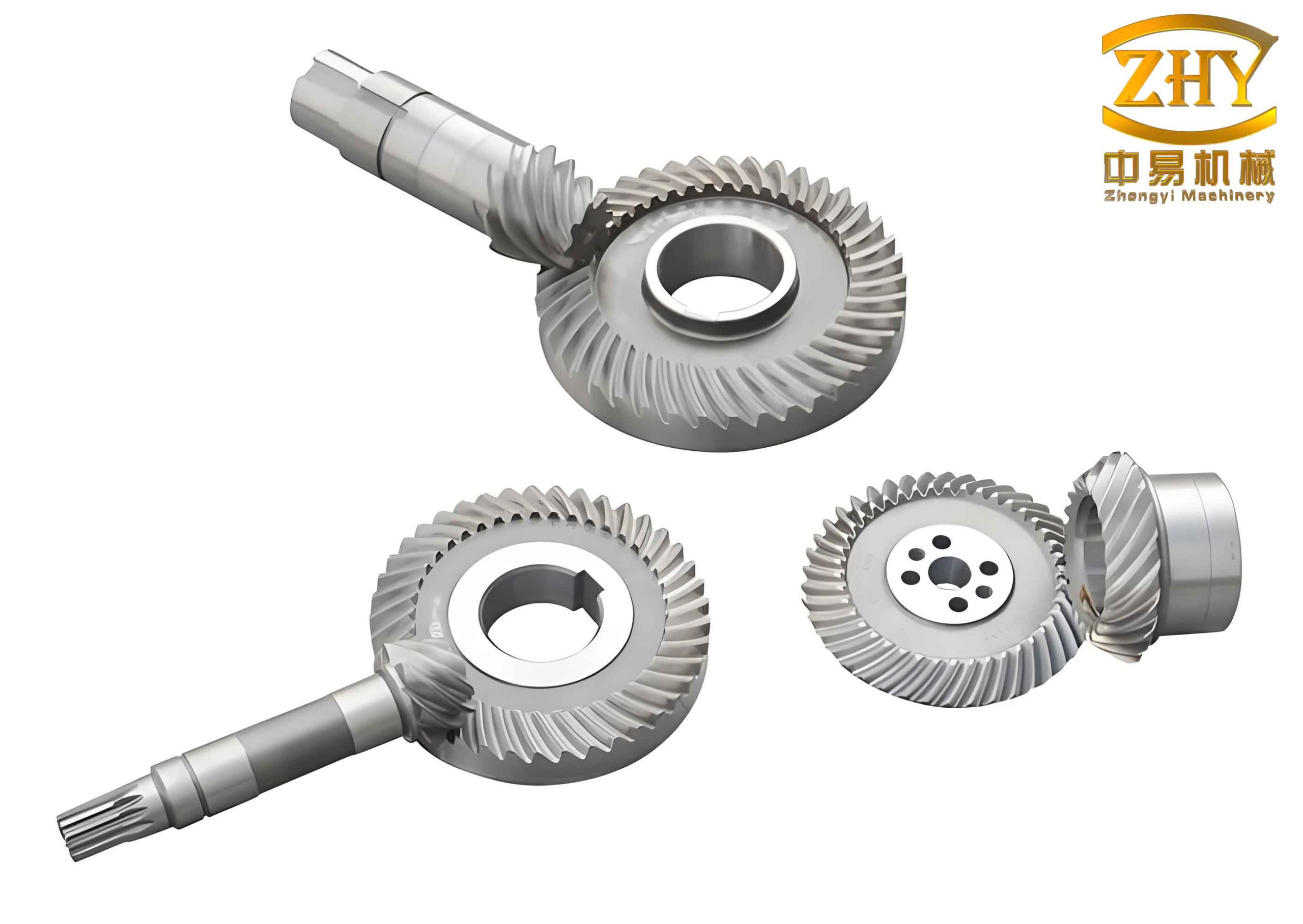
The accurate characterization of time-varying meshing parameters under loaded conditions is a fundamental prerequisite for constructing dynamic models that precisely describe the internal excitation mechanisms in gear systems. This is especially critical for hyperboloidal gears, such as hypoid and spiral bevel gears, which feature complex tooth surface geometry and contact kinematics compared to parallel-axis gears. Understanding these parameters is essential for evaluating dynamic mesh behavior, predicting noise and vibration (NVH) performance, and ensuring structural durability in critical applications like automotive drivetrains, aerospace transmissions, and heavy machinery. The complex curvature and spatial contact conditions in hyperboloidal gears render traditional analytical methods, such as the Ishikawa formula or Weber’s energy method, insufficient for precise stress-strain calculation. While experimental techniques like photoelasticity offer insights, they present significant practical challenges. Consequently, the Finite Element Method (FEM) has emerged as the dominant and most reliable technique for simulating and extracting key loaded meshing parameters. This analysis focuses on elucidating the evolution of critical meshing characteristics—including equivalent mesh force, loaded transmission error, composite elastic deformation, time-varying mesh stiffness, and actual contact ratio—in a hypoid gear pair subject to a wide range of operational loads.
1. Mathematical Formulation of Time-Varying Meshing Parameters
The interaction between mating hyperboloidal gears is inherently dynamic and load-dependent. To quantify this interaction, a set of key parameters must be defined and calculated from the results of a Loaded Tooth Contact Analysis (LTCA). The following mathematical descriptions form the basis for parameter extraction.
1.1 Equivalent Meshing Force
At any given instant during mesh, multiple tooth pairs may be in contact, each with a distributed contact pressure over an elliptical patch. For system-level dynamic analysis, it is practical to represent these distributed forces with a single resultant force. In the gear mesh coordinate system, let $\vec{r}_i = (r^i_x, r^i_y, r^i_z)$ be the position vector from the origin to the midpoint of the major axis of the instantaneous contact ellipse on the $i$-th tooth pair. Let $\vec{f}_i = (f^i_x, f^i_y, f^i_z)$ be the equivalent meshing force vector acting at that midpoint, directed normal to the tooth surface. The resultant force vector $\vec{F}_Q$ for all $q$ contacting pairs is:
$$
\vec{F}_Q = \sum_{i=1}^{q} \vec{f}_i
$$
Its components and magnitude are:
$$
F_x = \sum_{i=1}^{q} f^i_x, \quad F_y = \sum_{i=1}^{q} f^i_y, \quad F_z = \sum_{i=1}^{q} f^i_z, \quad |\vec{F}_Q| = \sqrt{F_x^2 + F_y^2 + F_z^2}
$$
The unit direction vector $\vec{L}_Q = (n_x, n_y, n_z)$ of the resultant force is:
$$
n_k = \frac{F_k}{|\vec{F}_Q|}, \quad k = x, y, z
$$
1.2 Equivalent Mesh Point
The equivalent mesh point is a virtual point where the total resultant meshing force $\vec{F}_Q$ can be considered to act, satisfying static force and moment equilibrium. Its position vector $\vec{R}_Q = (x_Q, y_Q, z_Q)$ in the mesh coordinate system is derived from the individual force vectors and their points of application:
$$
x_Q = \frac{\sum_{i=1}^{q} (r^i_x \cdot |\vec{f}_i|)}{\sum_{i=1}^{q} |\vec{f}_i|}, \quad y_Q = \frac{M_x + F_z \cdot x_Q}{F_z}, \quad z_Q = \frac{M_y + F_x \cdot x_Q}{F_x}
$$
where $M_x$ and $M_y$ are the moments generated by $\vec{F}_Q$ about the x and y axes, respectively. The trajectory of this point over a mesh cycle provides insight into the stability and smoothness of power transmission in hyperboloidal gears.
1.3 Loaded Transmission Error Function
Transmission Error (TE) is a primary source of gear vibration excitation. For hyperboloidal gears operating under load, the contact pattern shifts, altering the instantaneous kinematics from the unloaded (theoretical) condition. The loaded TE is defined as the deviation of the driven gear’s actual angular position from its theoretical position when the driver rotates uniformly. For a pinion (driver) and gear (driven), it is expressed as:
$$
\delta(\phi_1) = \left( \phi_2 – \phi_2^0 \right) – \frac{z_1}{z_2} \left( \phi_1 – \phi_1^0 \right)
$$
where $z_1$ and $z_2$ are tooth numbers, $\phi_1^0$ and $\phi_2^0$ are initial reference angular positions at the design contact point, and $\phi_1$ and $\phi_2$ are the instantaneous angular positions under load. The function $\delta(\phi_1)$ is calculated directly from the LTCA output.
1.4 Composite Elastic Deformation
The total deflection at the mesh is a composite of contact (Hertzian) deformation, bending deformation, and shear deformation of the teeth. For hyperboloidal gears, calculating these components separately via analytical methods is highly complex and approximate. A more accurate method leverages the full displacement field from FEM. The principle involves comparing the actual path of a surface node (including deformation) with its theoretical rigid-body rotation path. The composite deformation $u_n(t)$ at time $t$ is the average difference between these paths for all contacting nodes on both gears:
$$
u_n(t) = \frac{1}{m} \sum_{j=1}^{m} \left[ S^g_j(t) – s^g_j(t) \right] + \frac{1}{l} \sum_{h=1}^{l} \left[ S^p_h(t) – s^p_h(t) \right]
$$
Here, for the gear (g) and pinion (p):
- $S^g_j(t)$ is the actual magnitude of displacement of the $j$-th contacting node from its initial position at $t=0$ to its position at time $t$, calculated from nodal coordinates: $S = \sqrt{(x’-x)^2 + (y’-y)^2 + (z’-z)^2}$.
- $s^g_j(t)$ is the theoretical rigid-body displacement along a circular arc: $s = 2 r_j \cdot \sin(\phi(t)/2)$, where $r_j$ is the initial perpendicular distance from the node to the axis of rotation and $\phi(t)$ is the total rotation angle.
- $m$ and $l$ are the number of contacting nodes on the gear and pinion, respectively.
This method captures the combined effect of all deformation modes without requiring their explicit separation.
1.5 Time-Varying Mesh Stiffness
Mesh stiffness is the ratio of the equivalent meshing force to the composite elastic deformation along the line of action. It is a critical parameter for dynamic modeling. The instantaneous mesh stiffness $k_n(t)$ is given by:
$$
k_n(t) = \frac{|\vec{F}_Q(t)|}{u_n(t)}
$$
Due to the changing number of contacting tooth pairs and the varying position of contact on the tooth flank, $k_n(t)$ is inherently periodic and non-linear, especially for hyperboloidal gears.
2. Loaded Tooth Contact Analysis (LTCA) Framework
The foundation for extracting the aforementioned parameters is a robust LTCA simulation. The process is outlined for a hypoid gear pair, a common type of hyperboloidal gear.
2.1 Gear Pair Specifications and Model Generation
The analysis is performed on an automotive rear axle hypoid drive. Key geometric parameters are summarized in Table 1. The pinion is left-hand spiral, and the gear is right-hand spiral with a negative offset (pinion below gear center).
| Parameter | Pinion (Driver) | Gear (Driven) |
|---|---|---|
| Hand of Spiral | Left | Right |
| Number of Teeth | 10 | 41 |
| Shaft Angle | 90° | |
| Offset | -31.8 mm | |
| Mean Spiral Angle | 49.98° | 29.00° |
| Pitch Cone Angle | 15.53° | 73.70° |
| Face Width | 33.64 mm | 28.00 mm |
Tooth surfaces are generated based on the machine-tool settings from the Formate (gear) and Helixform (pinion) processes. A high-fidelity solid model is created from the computed point cloud. A sub-modeling or zone-refinement approach is employed for the Finite Element model: the teeth in contact and the fillet regions are meshed densely with first-order reduced-integration hexahedral elements (C3D8R), while the rim, web, and hub regions use a coarser mesh to balance accuracy and computational cost. The final model includes the full pinion and a segment of the gear (18 teeth out of 41), which is sufficient due to the periodic nature of meshing.
2.2 Boundary Conditions and Load Steps
Reference points are created at the centers of the pinion and gear bores and coupled rigidly to the inner bore nodes. All loads and constraints are applied at these reference points. A multi-step static procedure is used to ensure convergence:
- Initial Positioning: Gears are rotated to establish a small, controlled clearance between the intended contacting flanks.
- Load Step 1 (Gap Closing): The gear is fully constrained. A small rotational displacement is applied to the pinion to eliminate the backlash and establish initial contact, stabilizing the model.
- Load Step 2 (Pre-loading): The pinion is constrained. A small torque is applied to the gear to seat the contact into the desired pattern under a light load, establishing the initial stress state.
- Load Step 3 (Dynamic Meshing Simulation): Both components are free to rotate only about their respective axes. A constant angular velocity is applied to the pinion, and a constant resisting torque is applied to the gear. This step simulates the steady-state meshing cycle. The output from this step (nodal coordinates, contact forces, reaction forces, etc.) is used for all parameter calculations.
Material properties are standard for gear steel: Young’s Modulus $E = 209$ GPa, Poisson’s ratio $\nu = 0.3$, density $\rho = 7850$ kg/m³. Surface-to-surface contact with a “hard” contact pressure-overclosure relationship and a friction coefficient of $\mu=0.1$ is defined.
3. Case Study: Meshing Parameter Analysis Under a Specific Load
First, a baseline LTCA is conducted with a gear torque of $T_g = 4000$ Nm and a pinion speed of $n_p = 200$ rpm. The extracted and calculated parameters validate the methodology.
3.1 Contact Pattern Validation
The simulated instantaneous contact ellipses coalesce to form a complete contact pattern on the gear tooth flank. This pattern, characterized by its location, size, and orientation, is a critical indicator of correct gear alignment and load distribution. The LTCA-predicted pattern shows excellent qualitative agreement with patterns obtained from physical loaded rolling tests on a gear tester. Both show the contact path progressing from the toe (inner end) towards the heel (outer end) of the gear tooth, confirming the accuracy of the underlying gear geometry and the FEM contact algorithm.
3.2 Equivalent Mesh Point Trajectory
The calculated positions of the equivalent mesh point over one complete mesh cycle (corresponding to one pinion tooth space, i.e., 36°) are plotted. In an ideal, perfectly conjugate and rigid system, this trajectory would be a closed loop confined to a very small area. The results show the point moving within a confined planar region, indicating stable meshing. The small scatter is attributable to numerical discretization and the realistic, non-perfect conjugate action of hyperboloidal gears.
3.3 Time-Varying Parameter Plots
The key dynamic parameters are calculated throughout the mesh cycle, as shown in Figure Set 1 (conceptual description):
- Equivalent Meshing Force ($|\vec{F}_Q|$): Exhibits a clear periodic fluctuation with a frequency matching the gear mesh frequency ($f_m = n_p \times z_1 / 60$). The waveform is smooth without sharp discontinuities.
- Loaded Transmission Error ($\delta(\phi_1)$): Shows a periodic waveform. Its amplitude and shape are direct indicators of kinematic excitation under load.
- Composite Elastic Deformation ($u_n(t)$): Also periodic, its magnitude represents the total compliance of the tooth pairs in contact.
- Time-Varying Mesh Stiffness ($k_n(t)$): Derived from the force and deformation, it displays a characteristic periodic profile. The stiffness is not constant but varies significantly within a single mesh cycle, impacting the system’s natural frequencies and dynamic response.
All parameters confirm the expected periodic behavior linked to the mesh frequency of the hyperboloidal gears.
4. Evolution of Meshing Parameters with Load Variation
The core investigation involves performing LTCA simulations across a broad spectrum of load torques, from 100 Nm to 6000 Nm. This reveals the non-linear evolution of meshing characteristics in hyperboloidal gears.
4.1 Contact Pattern Evolution
The contact pattern is highly load-sensitive. Table 2 summarizes the observed trend:
| Load Torque Range | Contact Pattern Characteristics | Implication |
|---|---|---|
| Low (100-500 Nm) | Small elliptical patch located centrally on the tooth flank, closer to the toe. | Design intent for light load is verified. High contact stress. |
| Medium (1000-3000 Nm) | Patch expands significantly in length and width, moving towards the center and heel of the tooth. | Optimal load distribution is achieved, covering the “design contact zone”. |
| High (4000-6000 Nm) | Patch covers most of the active flank area, extending to the edges (toe, heel, top, and root). | Full utilization of tooth surface. Risk of edge contact and modified mesh stiffness. |
This evolution directly influences all other meshing parameters.
4.2 Equivalent Meshing Force and Load Sharing
The magnitude of the equivalent meshing force $|\vec{F}_Q|$ increases nearly proportionally with the applied gear torque. However, its waveform—the fluctuation around the mean—also changes. At lower loads, the transition between single and double-tooth contact zones can be more abrupt, potentially causing sharper force variations. At higher loads, the increased deformation and contact area tend to smooth the transition, although the absolute fluctuation amplitude increases. The force on individual tooth pairs, as extracted from the LTCA, shows how load is shared. The actual contact ratio, defined as the average number of tooth pairs in contact carrying significant load, evolves non-linearly with load, as shown in Section 4.4.
4.3 Loaded Transmission Error Evolution
The amplitude of the loaded transmission error waveform shows a distinct non-monotonic relationship with load, as conceptualized in Figure 2. Initially, at very low loads (e.g., 100 Nm), the TE amplitude is relatively high because the contact is localized and sensitive to minor geometric deviations. As load increases to a medium range (e.g., 1000-3000 Nm), the contact patch expands into the optimally corrected region of the tooth surface, minimizing kinematic mismatch. This results in a minimum in TE amplitude. At even higher loads (>4000 Nm), the patch is forced into regions near the tooth edges where surface modifications are less optimal or non-existent, and bending deflections become more pronounced, causing the TE amplitude to increase again. This “V-shaped” trend highlights the importance of designing hyperboloidal gears for a specific target load range.
4.4 Actual Contact Ratio
The actual contact ratio ($\varepsilon_\gamma$) is a dynamic parameter, not a fixed geometric property. It is calculated from the LTCA results as the proportion of the mesh cycle where the total contact force is shared by more than one tooth pair. Table 3 illustrates its load dependence:
| Load Condition | Actual Contact Ratio ($\varepsilon_\gamma$) | Explanation |
|---|---|---|
| Very Low Load | Just above 1.0 | Deformation is small; contact is primarily on one pair. Transitions are brief. |
| Increasing Load | Rapid increase | Tooth deflection allows adjacent teeth to come into contact earlier and separate later, lengthening the double-contact zones. |
| High Load | Approaches a plateau (~2.0 or higher) | Deflections are large, but the geometric length of the contact lines limits further increase. The ratio stabilizes near the theoretical maximum for the geometry. |
This non-linear behavior significantly affects load distribution and dynamic tooth loading, which must be accounted for in advanced dynamic models of hyperboloidal gear systems.
4.5 Composite Deformation and Mesh Stiffness Evolution
The mean composite deformation $u_n$ increases with load, but not linearly due to the increasing contact area. The stiffness $k_n(t)$, being the ratio $F/u_n$, exhibits profound changes in its periodic waveform shape. Key observations include:
- Amplitude: The mean mesh stiffness generally increases with load because a larger portion of the stiffer tooth cross-section (closer to the root and towards the heel) is engaged.
- Waveform Asymmetry: At low loads, the stiffness curve peak often occurs late in the single-tooth contact period. As load increases, the contact shifts towards the heel earlier in the mesh cycle. Since the tooth is thicker and stiffer at the heel, this causes the stiffness peak to shift earlier within the mesh period, resulting in a pronounced asymmetric waveform. This asymmetry is a critical feature of loaded hyperboloidal gears that influences the phasing of dynamic forces.
- Non-linearity: The relationship between applied torque and instantaneous stiffness is highly non-linear, especially during the transition intervals between tooth pairs.
The stiffness curves for different loads, when plotted together, clearly show this progression in peak timing and waveform shape.
5. Conclusions
This comprehensive analysis of a hypoid gear pair through Loaded Tooth Contact Analysis (LTCA) has elucidated the complex, non-linear evolution of key meshing parameters with varying operational load. The methodology, which computes composite elastic deformation directly from nodal displacement fields, provides a more accurate foundation for determining time-varying mesh stiffness compared to simplified analytical or superposition methods. The principal findings for these hyperboloidal gears are summarized as follows:
- Parameter Periodicity and Load Sensitivity: All dynamic meshing parameters—equivalent force, transmission error, composite deformation, and mesh stiffness—exhibit periodic fluctuations at the gear mesh frequency. Their magnitudes and waveform characteristics are strongly dependent on the applied load, driven primarily by the load-induced evolution of the contact pattern across the tooth flank.
- Non-linear Contact Ratio: The actual contact ratio increases non-linearly with load, rising sharply at low loads due to deflection-assisted contact and then plateauing at higher loads as it approaches geometric limits. This behavior is crucial for accurate modeling of load sharing and dynamic factors.
- Transmission Error Minimum: Loaded transmission error amplitude follows a “V-shaped” trend versus load, reaching a minimum at a medium load range corresponding to the designed contact zone. This identifies an optimal load range for minimal kinematic excitation in these hyperboloidal gears.
- Asymmetric Stiffness Behavior: The time-varying mesh stiffness waveform undergoes significant shape change with load, most notably a shift in the timing of its peak value due to the heel-ward movement of the contact. This results in pronounced asymmetry in the stiffness curve under high load conditions, a critical detail for dynamic response prediction.
The obtained set of time-varying parameters provides a high-fidelity representation of the internal excitation mechanisms within hyperboloidal gear pairs. This data is essential for developing advanced, non-linear dynamic models capable of predicting vibration, noise, and dynamic stresses under diverse operating conditions, thereby enabling more robust and quieter gear design.