
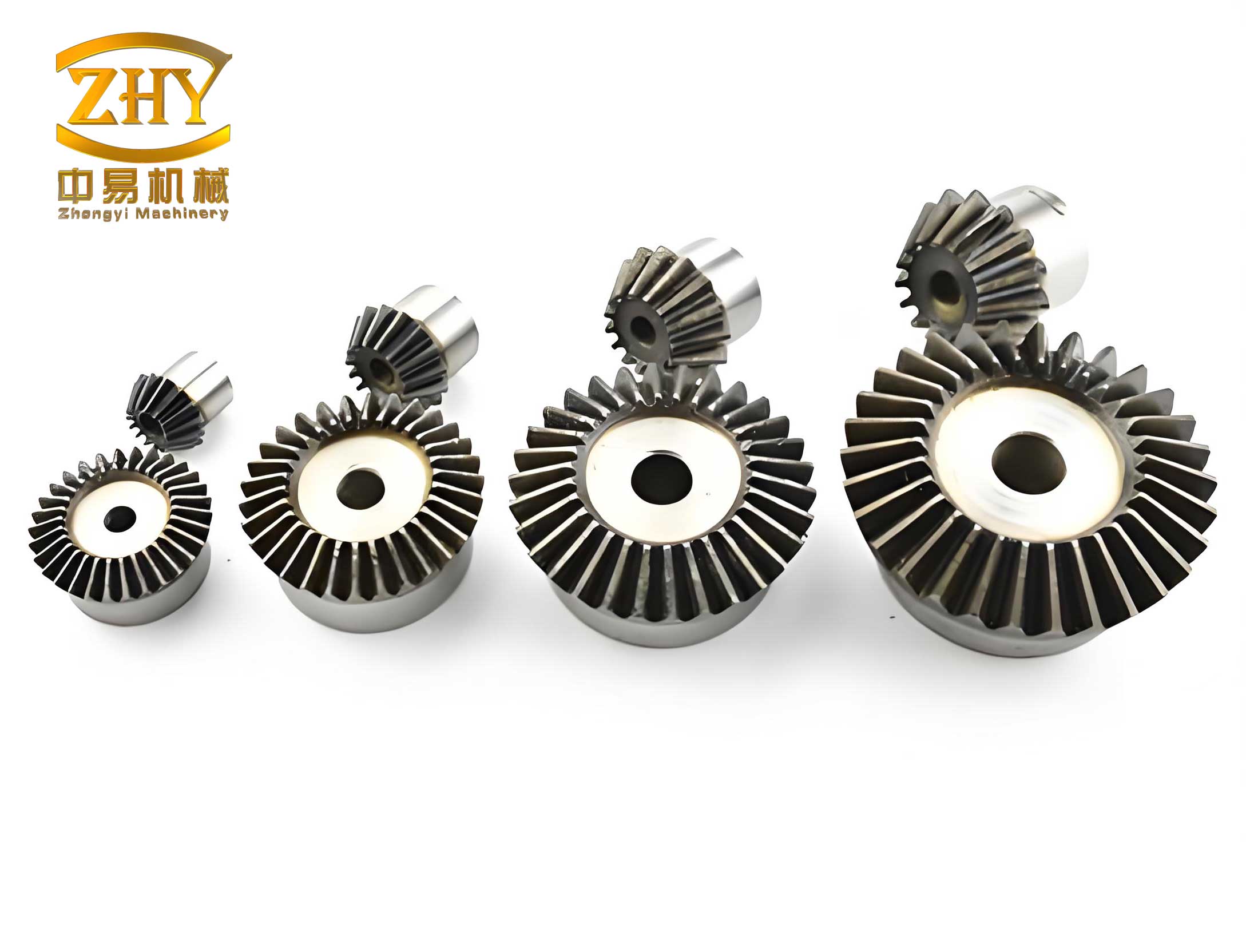
In the domain of automotive powertrain systems, the final drive assembly, housing the crucial differential, stands as a core component. Within this assembly, the drive and driven bevel gears play a pivotal role in torque transmission and speed conversion between the propeller shaft and the axle shafts. A fracture in the drive pinion shaft, particularly in its splined section, represents one of the most severe and critical failure modes for bevel gears, leading directly to a complete loss of drive. This article details a comprehensive failure investigation I conducted on a fractured drive bevel gear shaft from an SUV, elucidating the root cause through systematic metallurgical and fractographic analysis.
The subject component was the drive pinion shaft, identified as having fractured after approximately 50,000 kilometers of vehicle service. The fracture occurred at the transition radius between the splined section and the smooth shaft body. The shaft material was specified as case-hardening steel 20CrMnTiH, a chromium-manganese-titanium alloy commonly used for high-stress automotive gears. The typical manufacturing route for such components involves: closed-die forging, normalizing, machining, spline rolling (or machining), gear tooth cutting, carburizing, quenching, low-temperature tempering, shot peening, and localized annealing of threads if present. The intact fracture surface was preserved for analysis, showing no significant corrosion, which allowed for a clear examination of the failure features.
1. Initial Macroscopic Examination
My initial visual inspection of the failed bevel gear shaft revealed the precise fracture location. The break was perpendicular to the shaft axis and exhibited a relatively flat, featureless appearance at low magnification. Critically, there was no obvious macroscopic plastic deformation or signs of abnormal mechanical damage on the surrounding surfaces. The fracture origin was preliminarily identified at the surface of the carburized case, precisely at the root fillet of the last spline tooth adjacent to the shaft body. This area is a known stress concentrator, especially under torsional and bending loads.
2. Chemical Composition Verification
To rule out material mix-up or gross compositional deviation as a contributing factor, I performed spectrochemical analysis on a sample taken from the failed shaft. The results are summarized in Table 1. All element concentrations were well within the limits specified by the relevant standard for 20CrMnTiH steel, confirming the material grade was correct and its composition was nominal.
| Element | C | Si | Mn | P | S | Cr | Ti | Ni | Cu |
|---|---|---|---|---|---|---|---|---|---|
| Measured Value | 0.21 | 0.24 | 1.02 | 0.012 | 0.030 | 1.21 | 0.060 | 0.035 | 0.10 |
| Standard for 20CrMnTiH | 0.17-0.23 | 0.17-0.37 | 0.80-1.15 | ≤0.035 | ≤0.035 | 1.00-1.35 | 0.04-0.10 | ≤0.30 | ≤0.30 |
3. Hardness and Case Depth Profiling
The surface hardness, core hardness, and effective case depth are key indicators of a successful heat treatment for bevel gears. I measured the surface Rockwell C hardness at multiple locations and conducted a micro-hardness traverse from the surface to the core on a transverse section. The results, presented in Table 2, demonstrate that both surface and core hardness values, as well as the effective case depth (defined as the depth where hardness falls to 550 HV), met the design specifications. This initially suggested that the carburizing and quenching processes were fundamentally sound.
| Test Parameter | Specification | Measured Value | Judgment |
|---|---|---|---|
| Surface Hardness (HRC) | 58 – 64 | 63.9 (Average) | Conforms |
| Core Hardness (HRC) | 32 – 45 | 32.7 (Average) | Conforms |
| Effective Case Depth, 550 HV (mm) | 0.9 – 1.3 | ~1.05 | Conforms |
4. Macro-Etch and Non-Metallic Inclusion Assessment
A transverse section was subjected to a hot acid etch to reveal the macro-structure. The examination showed no detrimental defects such as pipe, segregation bands, porosity, or internal cracks. The general forge flow lines appeared normal. Furthermore, evaluation of non-metallic inclusions (oxides, sulfides, etc.) on a longitudinal section near the fracture according to standard chart ratings yielded acceptable results, as shown in Table 3. This eliminated gross forging defects or excessive inclusions as primary failure causes.
| Inclusion Type | Thin Series (Max Allowed) | Thick Series (Max Allowed) | Measured Rating |
|---|---|---|---|
| Type A (Sulfides) | 3.0 | 2.5 | 2.5 / 1.0 |
| Type B (Aluminates) | 3.0 | 2.5 | 0 / 0.5 |
| Type C (Silicates) | 2.0 | 2.0 | 0.5 / 0 |
| Type D (Globular Oxides) | 2.0 | 2.0 | 1.0 / 0.5 |
5. Critical Microscopic Metallography
This phase of the investigation revealed the first significant anomaly. I prepared and examined transverse metallographic specimens from the spline region, both away from and adjacent to the fracture.
In areas away from the fracture, the microstructure of the carburized case consisted primarily of tempered martensite with a small amount of retained austenite, which is a typical and desirable high-strength structure for bevel gears. The core microstructure showed a mixture of low-carbon martensite and bainite, also acceptable for providing adequate toughness.
However, examination at the spline root surface, particularly in the critical stress-concentration zone, revealed a deleterious subsurface feature. Immediately beneath the surface, within the carburized case, I observed a continuous dark-etching layer. In the unetched condition, this layer appeared as grey networks along prior austenite grain boundaries. After etching with nital, the entire layer turned dark and unresolvable under optical microscopy. The depth of this layer was measured to be approximately 0.03 mm.
This dark layer is classically known as “non-martensitic transformation product” or “black layer,” often comprising fine pearlite (troostite) and upper bainite. Its formation is primarily attributed to intergranular oxidation (IGO) during carburizing. Silicon, manganese, and chromium in the steel oxidize at the surface, creating oxide particles along grain boundaries and depleting the adjacent matrix of these alloying elements. This local depletion lowers the hardenability, allowing these boundary regions to transform into softer, non-martensitic phases during quenching instead of the intended hard martensite. The presence of this layer can be critically assessed using a parameter like its depth, $d_{nm}$. In this instance, $d_{nm} \approx 30 \mu m$.
Furthermore, I discovered multiple micro-cracks initiating from the surface and propagating inwards, predominantly associated with this dark etching layer at the spline root grooves. This was a clear indicator of embrittlement.
6. Fractographic Analysis via Scanning Electron Microscopy (SEM)
The fracture surface was examined in detail using SEM to determine the fracture mode and initiation site(s). The overall view confirmed a brittle fracture morphology with minimal ductility.
- Fracture Origin: The primary origin was confirmed at the surface of the spline root radius. At high magnification, the morphology at this origin was predominantly intergranular fracture. The facets corresponded to the prior austenite grain boundaries, indicating severe embrittlement of these boundaries.
- Crack Propagation: From the primary origin, the crack had propagated in both circumferential directions. The propagation zone also exhibited a mixed mode of intergranular and cleavage fracture, with the cleavage facets indicative of transgranular brittle fracture. Significantly, the fractography revealed that secondary crack origins had initiated at other spline root locations during the propagation phase, creating a multi-origin fracture front. This is characteristic of a component subjected to high stress where multiple weak points fail in sequence.
- Final Fracture Zone: The central region of the shaft, representing the final overload fracture of the core material, showed a cleavage-dominant morphology with secondary cracking, consistent with a final brittle fast fracture event.
To further characterize the dark layer observed optically, I examined a polished cross-section of the spline root under the SEM. High-magnification imaging unequivocally identified the layer as non-martensitic, consisting of lamellar pearlite/ troostite and feathery upper bainite, confirming the optical microscopy findings.
7. Synthesis and Root Cause Analysis
Integrating all analytical findings allows for a conclusive determination of the failure mechanism. The chemical composition, macro-structure, inclusion content, core hardness, and nominal case depth of the drive bevel gear shaft were all within specification. This rules out material error, gross processing defects, or an improperly set carburizing cycle as the direct cause.
The central piece of evidence is the presence of an excessively deep layer of non-martensitic transformation products ($d_{nm} \approx 0.03$ mm) at the spline root surface. For high-performance automotive bevel gears, this layer depth is typically strictly controlled, often to a maximum of 0.02 mm ($d_{nm}^{spec} \leq 20 \mu m$). This layer has detrimental effects:
- Reduced Surface Strength & Hardness: The bainitic/pearlitic structure is significantly softer and weaker than the designed martensitic case, creating a mechanical “soft skin.”
- Embitterment: The oxidized grain boundaries act as preferential sites for crack initiation, drastically reducing fatigue resistance.
- Stress Concentration Synergy: The spline root is a geometric stress concentrator. The stress concentration factor, $K_t$, for such a feature under torsion can be significant. The local stress, $\tau_{local}$, is amplified:
$$ \tau_{local} = K_t \cdot \tau_{nominal} $$
The embrittled surface layer at this very location cannot withstand this amplified stress, leading to facile crack nucleation.
The failure sequence can be reconstructed as follows:
- During service, the splined section of the bevel gear shaft transmits high torque, subjecting the spline root to cyclic torsional and bending stresses.
- At the stress-concentrated root fillet, the embrittled, non-martensitic surface layer (weakened by intergranular oxides) could not accommodate the applied stresses.
- A primary fatigue crack initiated via intergranular fracture at the surface of this layer.
- The crack propagated through the case, initially in a brittle intergranular/cleavage mode. As it grew, stress redistribution led to the initiation of secondary cracks at other similarly embrittled spline roots.
- Eventually, the remaining cross-sectional area of the shaft could no longer support the load, resulting in instantaneous brittle fracture of the core, culminating in complete separation.
Therefore, the root cause of the spline fracture in this drive bevel gear shaft was surface embrittlement due to an excessive depth of non-martensitic transformation products (troostite/upper bainite) at the spline root, resulting from intergranular oxidation during carburizing and subsequent inadequate quenching severity at that specific geometry. This created a network of weakened grain boundaries that acted as initiation sites for brittle fatigue cracks under service loads.
8. Conclusions and Preventive Recommendations for Bevel Gear Manufacturing
The investigation underscores that for critical components like drive bevel gears, conformity in bulk properties (hardness, case depth) is necessary but not sufficient. The quality of the surface and subsurface microstructure, especially at stress concentrators, is paramount for fatigue performance.
To prevent such failures in future production of bevel gears, the following controls should be emphasized:
- Atmosphere Control During Carburizing: Minimize the oxygen potential of the furnace atmosphere to reduce the tendency for intergranular oxidation of alloying elements like Si and Mn. This may involve tighter control of carrier gas composition and dew point.
- Quenching Optimization: Ensure adequate quenching agitation and oil flow, particularly around complex geometries like spline roots, to achieve the critical cooling rate needed to bypass the formation of bainite and pearlite. Finite element analysis (FEA) of quenching can help identify “slow-cooling” zones.
- Stricter Microstructural Specification: Implement and enforce a strict metallographic standard specifying the maximum allowable depth of non-martensitic products, especially for highly stressed areas like gear tooth roots and spline roots. A common specification is $d_{nm} \leq 0.02$ mm, with a target of being as low as possible. For heavy-duty bevel gears, this is non-negotiable.
- Process Monitoring: Regularly perform metallographic audits on finished bevel gears, sampling from high-risk areas, to monitor the consistency of surface microstructure.
- Design Consideration: While not a fix for the process issue, increasing the spline root fillet radius where possible can reduce the stress concentration factor $K_t$, providing a larger safety margin.
In summary, this failure analysis highlights a classic yet critical failure mode in carburized bevel gears. It demonstrates that meticulous control over surface integrity during heat treatment is essential to realize the full fatigue strength potential of these high-performance powertrain components.