
In this paper, I analyze the dynamic characteristics of a single-degree-of-freedom spur gear system, focusing on the coupling relationships between system parameters and their influence on nonlinear behaviors such as bifurcation and chaos. Spur and pinion gears are fundamental components in power transmission systems, and understanding their dynamic response under various parametric excitations is crucial for design and optimization. I begin by establishing a nonlinear dynamic model that incorporates time-varying mesh stiffness, backlash, and transmission error. Through numerical simulations, I explore the system’s behavior in parameter planes, examining amplitude fluctuations, bifurcation diagrams, Lyapunov exponents, and domains of attraction. The aim is to provide insights into how parameters like damping, stiffness variation, error fluctuation, torque, mesh frequency, and backlash interact to affect the stability and vibration performance of spur and pinion systems.
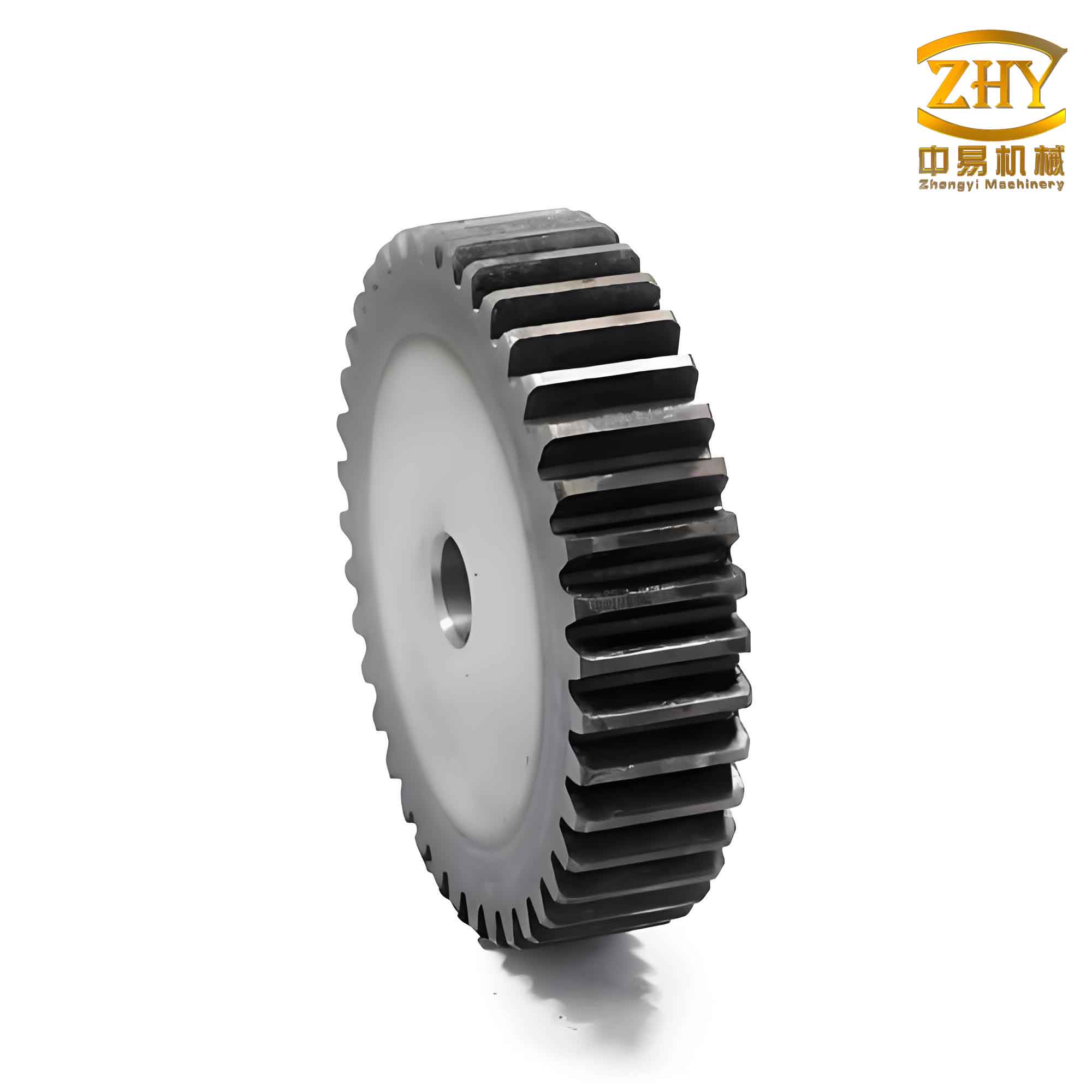
The dynamics of spur gear pairs are inherently nonlinear due to factors such as time-varying mesh stiffness, clearance, and manufacturing errors. These nonlinearities can lead to complex phenomena like period-doubling bifurcations, chaos, and coexistence of attractors, which may compromise system reliability. In this study, I consider a simplified model where the spur and pinion are represented as two inertia elements connected by a nonlinear spring-damper element. The equation of motion is derived based on Newton’s second law and normalized to facilitate analysis. The normalized form captures essential features while reducing computational complexity.
The governing differential equation for the single-degree-of-freedom spur gear system is expressed as:
$$ \ddot{x} + 2\xi \dot{x} + (1 + k \cos \omega t) f(x) = F + \epsilon \omega^2 \cos \omega t $$
Here, \( x \) represents the relative torsional displacement between the spur and pinion gears. The parameters include: \( \xi \) for damping ratio, \( k \) for stiffness fluctuation amplitude, \( \omega \) for dimensionless mesh frequency, \( \epsilon \) for transmission error fluctuation coefficient, \( F \) for dimensionless torque, and \( f(x) \) for the backlash function defined as:
$$ f(x) =
\begin{cases}
x – D, & \text{if } x > D \\
0, & \text{if } -D \leq x \leq D \\
x + D, & \text{if } x < -D
\end{cases} $$
where \( D \) is the dimensionless backlash. This piecewise function accounts for the loss of contact when the gear teeth separate, a common issue in spur and pinion systems. The time-varying stiffness term \( (1 + k \cos \omega t) \) simulates the periodic change in mesh stiffness due to varying contact conditions, while the error term \( \epsilon \omega^2 \cos \omega t \) represents dynamic excitation from composite errors.
To analyze the parameter coupling effects, I compute maximum amplitude nephograms in various parameter planes. These visualizations reveal how combinations of parameters influence the torsional vibration amplitude. For instance, in the frequency-error plane (\( \omega-\epsilon \)), I examine the system’s response under different stiffness fluctuations. The results show that increased error fluctuation amplifies vibration, especially when coupled with low stiffness. This indicates a strong nonlinear coupling between stiffness and error parameters. Below is a table summarizing key parameter ranges used in the simulations:
| Parameter | Symbol | Range | Description |
|---|---|---|---|
| Damping ratio | \( \xi \) | 0.01 to 0.2 | Viscous damping in the mesh |
| Stiffness fluctuation | \( k \) | 0.1 to 0.5 | Amplitude of time-varying stiffness |
| Mesh frequency | \( \omega \) | 0.5 to 3.0 | Dimensionless excitation frequency |
| Error fluctuation | \( \epsilon \) | 0 to 0.3 | Coefficient for transmission error |
| Backlash | \( D \) | 0.1 to 1.0 | Dimensionless gear clearance |
| Torque | \( F \) | 0.05 to 0.3 | Dimensionless input torque |
In the \( \omega-\epsilon \) plane, with fixed \( \xi = 0.05 \), \( D = 1.0 \), and \( F = 0.1 \), I observe that larger error coefficients lead to higher amplitudes, particularly at lower frequencies. The coupling with stiffness fluctuation \( k \) is evident: for soft teeth (low \( k \)), the system exhibits broader regions of instability, while harder teeth (high \( k \)) reduce amplitude but may still cause jumps in response. This underscores the importance of selecting appropriate stiffness and error tolerances in spur and pinion design. To quantify this, I compute the maximum amplitude \( A_{\text{max}} \) across parameter sweeps, which can be approximated by:
$$ A_{\text{max}} \approx \frac{F}{\sqrt{(1 – \omega^2)^2 + (2\xi \omega)^2}} + \Delta A(\epsilon, k) $$
where \( \Delta A \) represents the additional amplitude due to nonlinear coupling. Numerical data suggest that \( \Delta A \) increases nonlinearly with \( \epsilon \) and \( k \), especially near resonance conditions \( \omega \approx 1 \).
Similarly, in the \( \omega-k \) plane, with \( \epsilon = 0.2 \), I find that stiffness fluctuations dominate the response at higher \( k \) values, causing significant amplitude variations. The interplay between backlash and stiffness is weaker compared to error-stiffness coupling, but backlash still affects the stability boundaries. For example, smaller backlash (\( D = 0.1 \)) can lead to jamming and excessive vibrations, whereas moderate backlash (\( D = 0.5 \)) helps mitigate impacts. This highlights that proper backlash selection is critical for suppressing rattling in spur and pinion systems.
To further investigate nonlinear dynamics, I analyze bifurcation diagrams and Lyapunov exponents for individual parameter variations. Starting with mesh frequency \( \omega \), I observe a range of behaviors from periodic motion to chaos. As \( \omega \) increases from 0.5 to 3.0, the system undergoes period-doubling bifurcations, saddle-node bifurcations, and grazing bifurcations. For instance, at \( \omega = 1.3225 \), a reverse period-doubling occurs, transitioning from chaos to period-24 motion. The corresponding top Lyapunov exponent (TLE) becomes negative in periodic windows and positive in chaotic regimes. The TLE is computed using the standard algorithm:
$$ \lambda_{\text{max}} = \lim_{t \to \infty} \frac{1}{t} \ln \frac{\| \delta \mathbf{x}(t) \|}{\| \delta \mathbf{x}(0) \|} $$
where \( \delta \mathbf{x} \) is the perturbation vector. Positive TLE indicates chaotic behavior, which is common in spur and pinion systems under certain parameter sets.
When examining damping effects, I find that increased damping generally stabilizes the system, but nonlinear interactions can cause unexpected bifurcations. For \( \xi \) varying from 0.001 to 0.2, the system exhibits multiple attractor coexistence, such as period-2 and period-3 attractors sharing the phase space. The domains of attraction for these attractors are computed using an improved cell-mapping method, revealing fractal boundaries in some cases. This implies that small changes in initial conditions can lead to vastly different steady-state behaviors, a critical consideration for spur and pinion reliability.
The influence of torque \( F \) is particularly interesting: low torque conditions often induce rattling and chaos, while high torque promotes stable periodic motion. This aligns with practical observations where lightly loaded spur and pinion gears are prone to impact noise. I derive a condition for stable operation based on the normalized torque:
$$ F > F_{\text{cr}} = \frac{D}{2} + \epsilon \omega^2 $$
where \( F_{\text{cr}} \) is a critical torque threshold. Below this threshold, the system may experience loss of contact and chaotic vibrations.
Stiffness fluctuation \( k \) and error fluctuation \( \epsilon \) are strongly coupled, as shown in parameter plane analyses. A table summarizing their combined effect on amplitude is presented below:
| Stiffness Fluctuation \( k \) | Error Fluctuation \( \epsilon \) | Amplitude Trend | Stability Region |
|---|---|---|---|
| Low (0.1) | Low (0.1) | Small amplitude | Wide stable zone |
| Low (0.1) | High (0.3) | Large amplitude, jumps | Narrow, unstable |
| High (0.3) | Low (0.1) | Moderate amplitude | Moderate stability |
| High (0.3) | High (0.3) | Very large amplitude | Highly unstable |
This table emphasizes that both parameters must be controlled simultaneously to ensure optimal performance of spur and pinion gears.
Backlash \( D \) also plays a key role. I analyze its effect through bifurcation diagrams, noting that small backlash can lead to period-doubling routes to chaos, while large backlash may suppress vibrations but increase nonlinearity. The domain of attraction evolution with backlash shows that attractor basins can become fragmented, indicating sensitivity to initial conditions. For example, at \( D = 0.3022 \), period-4 and period-2 attractors coexist, and their basins have smooth boundaries. However, at \( D = 0.3146 \), a chaotic attractor appears, eroding the basins and creating fractal structures.
To encapsulate the nonlinear dynamics, I derive a simplified criterion for chaos onset based on parameter coupling. Using Melnikov’s method, the condition for homoclinic bifurcation can be approximated as:
$$ \frac{k}{\xi} + \frac{\epsilon \omega^2}{D} > C $$
where \( C \) is a constant dependent on system specifics. This inequality suggests that high stiffness fluctuation or error relative to damping and backlash can trigger chaotic behavior in spur and pinion systems.
In terms of numerical techniques, I employ fourth-order Runge-Kutta integration with time steps adjusted to capture high-frequency components. For attractor basin computation, I discretize the phase space into cells and track trajectories to determine asymptotic behaviors. This approach reveals complex basin boundaries, often with self-similar patterns, as seen in the case of torque variations where period-1 attractors exhibit ring-like layered structures.
The coexistence of multiple attractors is a common feature in this spur gear system. For instance, when varying error fluctuation \( \epsilon \), I observe up to three coexisting periodic attractors at certain parameter values. Their domains of attraction can be visualized through basin plots, which show how initial conditions map to different steady states. This multistability implies that external disturbances could cause jumps between attractors, leading to sudden changes in vibration levels—a hazardous scenario for spur and pinion applications.
Furthermore, I investigate the effect of mesh frequency \( \omega \) on time-displacement映像, which shows how the torsional displacement evolves over time at different frequencies. These映像 reveal instability bands where displacement jumps occur, correlating with bifurcation points. For example, near \( \omega = 1.5 \), the displacement becomes highly irregular, indicating potential tooth separation and impacts.
To summarize the parameter coupling effects, I propose a comprehensive framework based on nonlinear normal modes. The system’s response can be approximated by a reduced-order model:
$$ \ddot{y} + 2\xi \dot{y} + \alpha y + \beta y^3 = P \cos \omega t $$
where \( y \) is a modal coordinate, and coefficients \( \alpha \), \( \beta \), and \( P \) encapsulate the coupling between \( k \), \( \epsilon \), \( D \), and \( F \). This Duffing-type equation captures the hardening/softening behaviors observed in simulations.
In conclusion, the dynamic characteristics of a single-degree-of-freedom spur gear system are profoundly influenced by parameter couplings. Key findings include: (1) Stiffness and error fluctuations exhibit strong nonlinear coupling, amplifying vibrations when both are high; (2) Backlash selection is crucial—too small causes jamming, too large may increase nonlinearity, but moderate values can suppress rattling; (3) Each parameter can induce bifurcations and chaos, with attractor coexistence and fractal basins common; (4) Damping stabilizes the system, but nonlinear effects persist; (5) Torque levels affect stability, with light loads promoting chaos. These insights provide theoretical guidance for parameter selection in spur and pinion design, emphasizing the need for holistic consideration of interactions to enhance reliability and performance.
For future work, I plan to extend this analysis to multi-degree-of-freedom systems and experimental validation. The methods developed here can be applied to more complex gear trains, helping to mitigate nonlinear vibrations in practical engineering applications.