
In mechanical transmission systems, spur and pinion gears are fundamental components widely used for power and motion transfer. Understanding their dynamic behavior is crucial for designing reliable and efficient machinery. I have extensively studied the nonlinear dynamics of a single degree-of-freedom spur and pinion gear pair, focusing on how parameter coupling influences system responses. This analysis delves into the interplay between time-varying stiffness, transmission errors, backlash, damping, torque, and meshing frequency, revealing complex behaviors such as bifurcations, chaos, and fractal attraction domains. The insights gained here aim to provide theoretical guidance for parameter selection in gear system design, enhancing stability and performance. Throughout this work, I emphasize the role of spur and pinion gear interactions, as they form the basic unit of more complex gear trains.
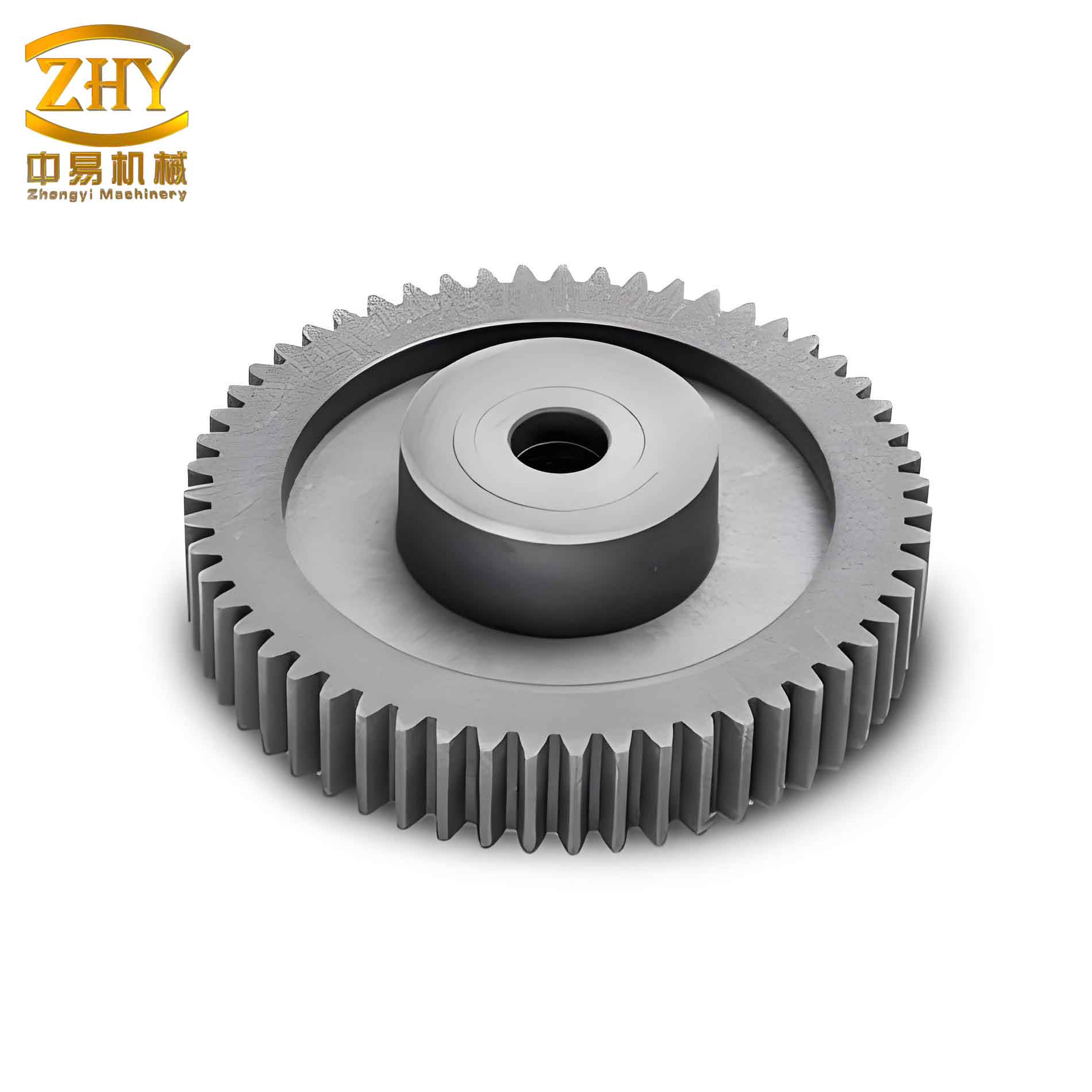
The dynamic model of a spur and pinion gear system is derived from a simplified physical representation, considering key nonlinear factors. I start with a pair of spur and pinion gears, modeled as two rotating bodies connected via a viscoelastic coupling. The system accounts for time-varying meshing stiffness, backlash, and composite transmission errors, which are common in real-world spur and pinion gear applications. Using Newton’s second law, the equations of motion are established. For a spur and pinion gear pair with pinion as the driver and gear as the driven element, the absolute rotation equations are:
$$ I_1 \ddot{\theta}_1 + c_g r_{b1} (r_{b1} \dot{\theta}_1 – r_{b2} \dot{\theta}_2 – \dot{e}(t)) + k(t) r_{b1} f(r_{b1} \theta_1 – r_{b2} \theta_2 – e(t)) = T_1 $$
$$ I_2 \ddot{\theta}_2 – c_g r_{b2} (r_{b1} \dot{\theta}_1 – r_{b2} \dot{\theta}_2 – \dot{e}(t)) – k(t) r_{b2} f(r_{b1} \theta_1 – r_{b2} \theta_2 – e(t)) = -T_2 $$
Here, \( \theta_i \) (i=1,2) are torsional displacements, \( I_i \) are moments of inertia, \( r_{bi} \) are base circle radii, \( c_g \) is meshing damping, \( e(t) \) is composite transmission error, \( k(t) \) is time-varying stiffness, \( T_i \) are torques, and \( f(\cdot) \) is the backlash function. For spur and pinion gears, these parameters are critical in determining dynamic responses. Through dimensionless processing, I obtain a simplified nonlinear differential equation:
$$ \ddot{x} + 2\xi \dot{x} + (1 + k \cos \omega t) f(x) = F + \varepsilon \omega^2 \cos \omega t $$
In this equation, \( x \) is dimensionless torsional displacement, \( \xi \) is damping ratio, \( k \) is stiffness fluctuation amplitude, \( \varepsilon \) is error fluctuation coefficient, \( \omega \) is dimensionless meshing frequency, \( F \) is dimensionless torque, and \( f(x) \) represents backlash nonlinearity. The backlash function is defined as:
$$ f(x) =
\begin{cases}
x – D, & \text{if } x > D \\
0, & \text{if } -D \leq x \leq D \\
x + D, & \text{if } x < -D
\end{cases} $$
where \( D \) is dimensionless backlash. This model captures essential nonlinearities in spur and pinion gear systems, enabling detailed analysis of parameter couplings.
To investigate parameter coupling effects, I numerically compute maximum amplitude nephograms, amplitude-frequency superposition plots, and time-displacement images across parameter planes. These visualizations reveal how spur and pinion gear dynamics shift with varying parameters. For instance, in the frequency-error (\(\omega\)-\(\varepsilon\)) plane, I analyze the coupling between meshing frequency and error fluctuation. The stiffness fluctuation amplitude \( k \) is varied to simulate different tooth surface hardness: \( k = 0.1 \) for soft, \( k = 0.2 \) for medium, and \( k = 0.3 \) for hard spur and pinion gears. The results show that larger error fluctuations increase torsional amplitudes, but this effect is modulated by stiffness. Specifically, higher stiffness (e.g., \( k = 0.3 \)) reduces amplitude regions, indicating better stability for hard spur and pinion gears. The coupling between error and stiffness is strongly nonlinear; even small errors can cause significant responses under inappropriate stiffness conditions. Table 1 summarizes amplitude trends in the \(\omega\)-\(\varepsilon\) plane for different \( k \) values:
| Stiffness Fluctuation \( k \) | Amplitude Behavior | Stability Region |
|---|---|---|
| 0.1 (Soft) | Large amplitudes, wide unstable zones | Narrow for high \( \varepsilon \) |
| 0.2 (Medium) | Moderate amplitudes, reduced instability | Moderate expansion |
| 0.3 (Hard) | Small amplitudes, minimal instability | Wide and stable |
Backlash \( D \) also couples with error fluctuations. For spur and pinion gear pairs, choosing appropriate backlash is vital. I compute maximum amplitude nephograms for different \( D \) values (0.1, 0.2, 0.5, 1.0) in the \(\omega\)-\(\varepsilon\) plane. With minimal backlash (\( D = 0.1 \)), large error fluctuations lead to severe instability at low frequencies, potentially causing tooth jamming and bending deformation. As backlash increases, torsional amplitudes decrease, suggesting that larger backlash can suppress vibrations in spur and pinion gears with significant errors. Conversely, for small errors, smaller backlash is preferable to maintain precision. This highlights the importance of matching backlash with error tolerance in spur and pinion gear design.
Next, I explore the frequency-stiffness (\(\omega\)-\(k\)) plane to assess stiffness-error coupling. For fixed backlash \( D = 1.0 \) and varying error coefficients \( \varepsilon \), amplitude nephograms indicate that stiffness fluctuations dominate response at higher \( k \) values. When \( \varepsilon \) is small, amplitude regions are limited, but as \( \varepsilon \) increases, these regions expand dramatically, underscoring the nonlinear coupling. The relationship can be expressed via a coupling coefficient \( C_{se} \):
$$ C_{se} = \frac{\partial A}{\partial \varepsilon \partial k} $$
where \( A \) is amplitude. For spur and pinion gears, \( C_{se} \) is positive and nonlinear, implying synergistic effects. Time-displacement images further show that system stability deteriorates under combined high error and low stiffness, leading to intermittent impacts and disengagement. These findings emphasize that spur and pinion gear performance is highly sensitive to parameter interactions.
Nonlinear dynamics analysis involves bifurcation diagrams, Lyapunov exponents, and attraction domains. I examine how each parameter induces bifurcations and chaos in spur and pinion gear systems. Starting with meshing frequency \( \omega \), I compute single-initial-value bifurcation diagrams and Top Lyapunov Exponents (TLE). As \( \omega \) varies, the system undergoes period-doubling bifurcations, grazing bifurcations, and saddle-node bifurcations. For example, at \( \omega = 1.3225 \), chaos transitions to period-24 motion via inverse period-doubling. Attraction domains evolve with \( \omega \), showing coexistence of attractors and fractal boundaries. Table 2 lists key bifurcation points for \( \omega \):
| Bifurcation Type | Frequency \( \omega \) | System State |
|---|---|---|
| Inverse Period-Doubling | 1.3225 | Chaos → Period-24 |
| Grazing Bifurcation | 2.1057 | Period-3 → Period-1 |
| Period-Doubling | 1.7268 | Period-1 → Period-2 |
| Saddle-Node | 1.5829 | Chaos → Period-3 |
Backlash \( D \) variations also trigger complex dynamics. In the range \( 0.2 \leq D \leq 0.4 \), multiple coexistences occur, such as period-4 with period-2 attractors, and chaos with period-3 attractors. Attraction domains display self-similar structures, indicating fractal characteristics. For spur and pinion gears, this implies that backlash adjustments can lead to unpredictable jumps in response, necessitating careful selection. The evolution of attraction domains with \( D \) shows erosion effects, where one attractor’s domain expands at the expense of another, impacting global stability.
Stiffness fluctuation amplitude \( k \) influences both local and global dynamics. As \( k \) increases, spur and pinion gear systems experience period-doubling routes to chaos, followed by inverse sequences. At \( k = 0.1456 \), period-2 motion bifurcates to period-4, and at \( k = 0.3352 \), chaos transitions to period-6 via saddle-node bifurcation. Attraction domains reveal coexistence, such as period-6 attractors alongside chaotic attractors. The stiffness-error coupling exacerbates these behaviors, as seen in amplitude nephograms. Proper tooth profile modification in spur and pinion gears can reduce stiffness fluctuations, thereby enhancing stability.
Damping \( \xi \) plays a nuanced role in nonlinear spur and pinion gear systems. Unlike linear systems, damping here induces bifurcations and attractor coexistence. For low damping (\( \xi < 0.00565 \)), period-3 motion prevails, but as damping increases, saddle-node bifurcations lead to chaos. Attraction domains show fractal boundaries, with periodic and chaotic attractors competing. Higher damping generally stabilizes spur and pinion gear responses, reducing amplitudes, but intermediate values can cause instability due to nonlinear interactions. This contrasts with linear theory, where damping merely attenuates resonance.
Torque \( F \) effects are significant for spur and pinion gear operation. Light loads (\( F \) small) often induce rattling and instability, while heavier loads promote stable periodic motions. Bifurcation diagrams indicate grazing bifurcations at points A and B, where attraction domains transform smoothly. At \( F = 0.145 \), three period-1 attractors create a fractal domain boundary, exhibiting self-similar layering. This fractal structure arises from non-smooth vector fields due to backlash, a hallmark of spur and pinion gear nonlinearity. Engineers can leverage this by applying preloads or adding rotors to suppress vibrations under light loads.
Error fluctuation amplitude \( \varepsilon \) directly impacts spur and pinion gear dynamics. Multi-initial-value bifurcation diagrams show that larger \( \varepsilon \) values promote chaos, whereas smaller \( \varepsilon \) yields relative stability. Attraction domain evolution with \( \varepsilon \) reveals bifurcations that generate new attractors, such as period-1 attractors emerging at \( \varepsilon = 0.1352 \). Domain boundaries become fractal under certain conditions, e.g., at \( \varepsilon = 0.1572 \), where period-2 and period-1 attractors form ring-like layered structures. This fractal nature complicates prediction, underscoring the need for tight error control in spur and pinion gear manufacturing.
To synthesize these findings, I propose a coupled parameter index \( \Gamma \) for spur and pinion gear design:
$$ \Gamma = \alpha k + \beta \varepsilon + \gamma D + \delta \xi + \eta F + \lambda \omega $$
where coefficients \( \alpha, \beta, \gamma, \delta, \eta, \lambda \) are weights derived from sensitivity analysis. Optimizing \( \Gamma \) can minimize unstable responses. For instance, Table 3 recommends parameter ranges for stable spur and pinion gear operation:
| Parameter | Recommended Range | Effect on Stability |
|---|---|---|
| Stiffness Fluctuation \( k \) | < 0.2 | Reduces amplitude jumps |
| Error Fluctuation \( \varepsilon \) | < 0.1 | Limits chaos onset |
| Backlash \( D \) | 0.5–1.0 (high error) | Suppresses vibrations |
| Damping \( \xi \) | > 0.1 | Enhances damping of nonlinear modes |
| Torque \( F \) | > 0.15 | Prevents rattling |
| Meshing Frequency \( \omega \) | Avoid 1.0–1.6 resonance | Minimizes bifurcations |
The interplay between parameters in spur and pinion gear systems is profound. Time-varying stiffness and composite error exhibit strong nonlinear coupling, meaning small changes in one can amplify the other’s effects. Backlash couples weakly with stiffness but significantly with error, influencing amplitude stability. Damping and torque modify global dynamics, often dictating whether the system remains periodic or descends into chaos. These insights are crucial for designing robust spur and pinion gear transmissions, especially in applications requiring high precision and reliability.
In conclusion, my analysis demonstrates that parameter coupling is pivotal in shaping the dynamic characteristics of single degree-of-freedom spur and pinion gear systems. Through numerical simulations and nonlinear dynamics tools, I have mapped out how stiffness, error, backlash, damping, torque, and frequency interact, leading to complex behaviors like bifurcations, chaos, and fractal attraction domains. Key takeaways include the strong coupling between stiffness and error, the stabilizing role of appropriate backlash, and the sensitivity of light-load conditions to instability. These findings offer practical guidance for engineers selecting parameters in spur and pinion gear design, aiming to enhance performance and longevity. Future work could extend this to multi-degree-of-freedom systems or incorporate additional factors like friction and thermal effects, further enriching our understanding of spur and pinion gear dynamics.
The mathematical models and results presented here underscore the importance of a holistic approach to gear system analysis. By considering parameter couplings, designers can avoid pitfalls such as unexpected vibrations or premature failure. For spur and pinion gears, which are ubiquitous in machinery, this knowledge is invaluable for advancing transmission technology and meeting the demands of modern engineering applications.