
In modern industrial advancements, spiral bevel gears serve as critical transmission components widely utilized in aerospace, automotive, and energy sectors due to their unique tooth design and superior meshing performance. However, as operational environments become increasingly complex and demands for transmission system performance escalate, the machining quality of spiral bevel gears faces higher requirements. Grinding, as a key process in the manufacturing of spiral bevel gears, significantly impacts surface integrity, particularly the residual stress induced post-grinding. This residual stress directly influences the service performance of gears, potentially leading to reduced load-bearing capacity, fatigue crack initiation, and ultimately decreased transmission accuracy and shortened service life. Therefore, investigating the factors affecting grinding residual stress in spiral bevel gears is crucial for optimizing machining processes and holds substantial practical significance in engineering applications. This study aims to reveal the influence laws of grinding parameters on residual stress in spiral bevel gear tooth surfaces, address gaps in existing research regarding the correlation mechanisms between process parameters and residual stress, and thereby optimize grinding processes to enhance gear durability.
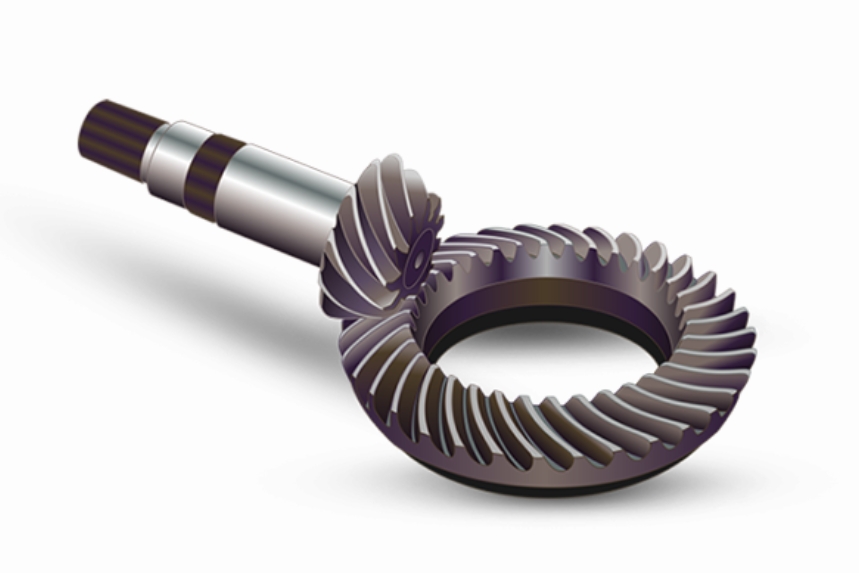
The grinding of spiral bevel gears is fundamentally based on the “imaginary generating gear” principle, similar to gear milling processes. In gear grinding, an imaginary generating gear concentric with the machine tool cradle axis is constructed, and as the cradle rotates, this imaginary gear engages with the workpiece gear without backlash to achieve precise grinding. During grinding, abrasive grains on the wheel cut the gear surface, leading to plastic deformation and chip formation. The interaction between a single abrasive grain and the tooth surface typically undergoes three stages: sliding, ploughing, and chip formation. Initially, the grain slides over the surface, causing elastic deformation and frictional heat generation. As penetration increases, plastic deformation occurs, forming grooves with side ridges. Finally, at a critical depth, shear slip leads to chip formation and material removal. Understanding these mechanisms is essential for analyzing residual stress generation in spiral bevel gears.
To simulate the grinding process efficiently, a single abrasive grain model is adopted, considering that the grinding wheel comprises numerous grains performing micro-cutting tasks. The abrasive grain is simplified as a conical shape with a height of 0.07 mm, cone angle of 90°, and edge radius of 0.01 mm. The workpiece, representing a segment of the spiral bevel gear tooth surface, is modeled as a cuboid with dimensions 0.4 mm × 0.3 mm × 0.15 mm. The material for the spiral bevel gear workpiece is AISI 4340 steel, known for its high strength, toughness, and fatigue resistance, making it suitable for gear applications. Its properties are summarized in Table 1.
| Parameter | Value |
|---|---|
| Density (kg/mm³) | 7830 |
| Elastic Modulus (MPa) | 2 × 10⁵ |
| Yield Strength (MPa) | 792 |
| Tensile Strength (MPa) | 980 |
| Poisson’s Ratio | 0.29 |
| Thermal Conductivity (W/(m·°C)) | 38 |
Given the high strain, temperature, and strain rate variations during grinding, the Johnson-Cook (J-C) constitutive model is employed to describe the material behavior accurately. The J-C model expresses flow stress as:
$$ \sigma = (A + B\varepsilon^n) \left(1 + C \ln \frac{\dot{\varepsilon}}{\dot{\varepsilon}_0}\right) \left[1 – \left( \frac{T – T_0}{T_m – T_0} \right)^m \right] $$
where \(\sigma\) is the equivalent stress, \(A\) is the yield stress, \(B\) is the hardening modulus, \(\varepsilon\) is the plastic strain, \(n\) is the strain hardening exponent, \(C\) is the strain rate sensitivity coefficient, \(\dot{\varepsilon}\) is the strain rate, \(\dot{\varepsilon}_0\) is the reference strain rate, \(T\) is the workpiece temperature, \(T_0\) is the room temperature, \(T_m\) is the melting temperature, and \(m\) is the thermal softening coefficient. For AISI 4340 steel, the J-C parameters are listed in Table 2.
| Parameter | Value |
|---|---|
| A (MPa) | 792 |
| B (MPa) | 510 |
| n | 0.26 |
| C | 0.014 |
| m | 1.03 |
Material failure during grinding is assessed using the J-C failure criterion, where damage accumulation \(D\) is computed as:
$$ D = \sum \frac{\Delta \varepsilon}{\varepsilon_f} $$
with the failure strain \(\varepsilon_f\) given by:
$$ \varepsilon_f = \left[ D_1 + D_2 \exp\left(D_3 \frac{p}{q}\right) \right] \left(1 + D_4 \ln \frac{\dot{\varepsilon}}{\dot{\varepsilon}_0}\right) \left[1 + D_5 \left( \frac{T – T_0}{T_m – T_0} \right) \right] $$
where \(D_1\) to \(D_5\) are material failure parameters, \(p\) is the hydrostatic pressure, and \(q\) is the Mises stress. The failure parameters for AISI 4340 steel are provided in Table 3.
| Parameter | Value |
|---|---|
| D₁ | 0.05 |
| D₂ | 3.44 |
| D₃ | -2.12 |
| D₄ | 0.002 |
| D₅ | 0.61 |
In the finite element model, the abrasive grain is treated as a rigid body, while the spiral bevel gear workpiece is modeled as an elastoplastic material. The friction between the grain and workpiece is simulated using a penalty friction model with a coefficient of 0.3. The simulation is conducted in two stages: grinding and cooling. The grinding stage employs an explicit solver to capture dynamic interactions, with the workpiece bottom fixed for stability. After grinding, the cooling stage uses an implicit solver to simulate heat dissipation, applying convective boundary conditions. Residual stresses are extracted along the depth direction (S11 stress component, representing normal stress in the grinding direction), averaging values from 170 nodes per layer to ensure representativeness.
The simulation results reveal that residual stress distribution in the spiral bevel gear tooth surface follows a characteristic pattern: compressive stress near the surface, peaking at the subsurface as maximum compressive stress, transitioning to tensile stress at greater depths, and eventually approaching zero. This distribution is attributed to combined mechanical and thermal effects during grinding. Mechanical forces induce plastic compression near the surface, while heat generation leads to thermal expansion and subsequent cooling-induced tension. To analyze parameter influences, single-factor simulations are performed varying grinding speed, grinding depth, and abrasive rake angle. The parameter ranges are set as: grinding speed from 10 to 25 m/s, grinding depth from 0.01 to 0.04 mm, and abrasive rake angle from -20° to -50°. Table 4 summarizes the simulation design for residual stress analysis.
| Level | Grinding Speed \(v_s\) (m/s) | Grinding Depth \(a_p\) (mm) | Abrasive Rake Angle \(\gamma\) (°) |
|---|---|---|---|
| 1 | 10 | 0.01 | -20 |
| 2 | 15 | 0.02 | -30 |
| 3 | 20 | 0.03 | -40 |
| 4 | 25 | 0.04 | -50 |
The effects of each parameter on residual stress are quantified. For abrasive rake angle, with grinding speed fixed at 25 m/s and depth at 0.01 mm, increasing the absolute value of the rake angle (from -20° to -50°) elevates both compressive and tensile residual stresses. This is because a larger negative rake angle enhances ploughing action over cutting, leading to more severe plastic deformation and higher stress accumulation in the spiral bevel gear. For grinding depth, at a speed of 25 m/s and rake angle of -20°, increasing depth from 0.01 to 0.04 mm raises residual stresses due to greater contact area and force, intensifying plastic deformation. For grinding speed, at a depth of 0.04 mm and rake angle of -20°, increasing speed from 10 to 25 m/s slightly increases residual stresses, as higher speeds reduce individual grain loads but increase thermal effects. The influence ranking is: abrasive rake angle > grinding depth > grinding speed. To validate the single-grain approach, a multi-grain model with three randomly distributed grains is simulated under optimal conditions. The residual stress trend remains similar, though maximum compressive stress is lower due to inter-grain stress interactions, confirming the single-grain model’s utility for efficient analysis of spiral bevel gear grinding.
To optimize grinding parameters for desirable residual stress states (maximizing compressive stress and minimizing tensile stress), response surface methodology (RSM) is employed. Based on single-factor ranges, a Box-Behnken design is adopted with three factors at three levels, as shown in Table 5. The responses are maximum residual compressive stress (\(S_1\)) and maximum residual tensile stress (\(S_2\)).
| Factor | Lower Level | Upper Level |
|---|---|---|
| Grinding Speed \(v_s\) (m/s) | 10 | 25 |
| Grinding Depth \(a_p\) (mm) | 0.01 | 0.04 |
| Abrasive Rake Angle \(\gamma\) (°) | -50 | -20 |
Simulations are conducted for 15 experimental runs, and results are analyzed to develop predictive models. Using least-squares regression, quadratic models for \(S_1\) and \(S_2\) are derived after eliminating insignificant terms (p > 0.05). The model for maximum residual compressive stress is:
$$ S_1 = 646.2 – 4.85v_s – 23208a_p + 42.81\gamma + 216744a_p^2 + 0.4331\gamma^2 – 216.8a_p\gamma $$
The model for maximum residual tensile stress is:
$$ S_2 = 5.99 – 0.434v_s – 523a_p – 1.124\gamma – 0.01363\gamma^2 + 24.89v_s a_p – 12.89a_p\gamma $$
Analysis of variance (ANOVA) is performed to assess model significance. For the compressive stress model, the p-value is less than 0.0001, indicating high significance. The coefficient of determination \(R^2\) is 97.29%, and adjusted \(R^2\) is 95.27%, demonstrating good fit. The F-values reveal that abrasive rake angle has the strongest effect, followed by grinding depth and grinding speed. Similarly, for the tensile stress model, p < 0.0001, \(R^2\) = 97.74%, and adjusted \(R^2\) = 96.05%, confirming reliability. Residual plots show points closely clustered around fit lines, indicating normal distribution and model adequacy. These predictive models enable optimization of spiral bevel gear grinding parameters.
A multi-objective optimization is formulated to maximize compressive stress \(S_1\) and minimize tensile stress \(S_2\), subject to parameter constraints. The objective functions are:
$$ \text{max}(S_1), \quad \text{min}(S_2) $$
subject to:
$$ 10 \leq v_s \leq 25 \, \text{m/s}, \quad 0.01 \leq a_p \leq 0.04 \, \text{mm}, \quad -50 \leq \gamma \leq -20^\circ $$
Using the response surface models, optimal parameters are found: grinding speed \(v_s = 25 \, \text{m/s}\), grinding depth \(a_p = 0.01 \, \text{mm}\), and abrasive rake angle \(\gamma = -48^\circ\). At this setting, the predicted maximum residual compressive stress is 638.6 MPa, and the minimum residual tensile stress is 24.9 MPa. To verify, comparative simulations are conducted with five alternative parameter sets, as shown in Table 6. The optimal set outperforms others, yielding the highest compressive stress and lowest tensile stress, thus validating the optimization for enhancing spiral bevel gear performance.
| Set | Grinding Speed \(v_s\) (m/s) | Grinding Depth \(a_p\) (mm) | Abrasive Rake Angle \(\gamma\) (°) | Max Compressive Stress \(S_1\) (MPa) | Max Tensile Stress \(S_2\) (MPa) |
|---|---|---|---|---|---|
| Optimal | 25 | 0.01 | -48 | 638.6 | 24.9 |
| 1 | 30 | 0.01 | -48 | 676.1 | 30.7 |
| 2 | 25 | 0.02 | -48 | 657.3 | 29.5 |
| 3 | 25 | 0.01 | -45 | 610.9 | 19.8 |
| 4 | 25 | 0.01 | -50 | 662.4 | 30.2 |
| 5 | 20 | 0.01 | -48 | 624.4 | 22.1 |
In conclusion, this study systematically analyzes residual stress in spiral bevel gear tooth surfaces under single abrasive grinding through finite element simulation and response surface optimization. Key findings are: First, residual stress distribution along depth exhibits a compressive-to-tensile transition, with maximum compressive stress occurring at the subsurface. This pattern is critical for assessing gear durability, as compressive stresses can inhibit crack propagation while tensile stresses may promote fatigue. Second, grinding parameters significantly influence residual stress, with abrasive rake angle having the greatest impact, followed by grinding depth and grinding speed. Increasing these parameters generally elevates residual stresses, but the effects vary due to mechanical and thermal couplings. Third, predictive models developed via RSM demonstrate high accuracy, enabling parameter optimization to achieve desirable stress states. The optimal parameters (grinding speed 25 m/s, depth 0.01 mm, rake angle -48°) yield a maximum compressive stress of 638.6 MPa and minimum tensile stress of 24.9 MPa, balancing surface enhancement and damage mitigation. These results provide a basis for optimizing grinding processes for spiral bevel gears, potentially improving load capacity and service life in industrial applications. Future work could explore multi-grain interactions, different gear materials, and experimental validation to further refine the models. Overall, this research contributes to a deeper understanding of residual stress mechanisms in spiral bevel gear grinding, supporting advancements in precision manufacturing.