
Power transmission systems form the backbone of modern machinery, and among their key components, gear trains hold paramount importance. The **spur and pinion gear** pair, characterized by its simplicity, reliability, and efficiency in transmitting motion and power between parallel shafts, is ubiquitous in applications ranging from automotive transmissions to industrial gearboxes and precision instruments. The performance, durability, and efficiency of these mechanical systems are intrinsically linked to the tribological phenomena occurring at the gear tooth interface. Friction between meshing teeth is not merely a source of energy loss; it is a critical factor influencing wear patterns, surface fatigue (pitting), scuffing failure, system vibrations, and noise generation. Consequently, a profound understanding and analysis of the frictional characteristics of **spur and pinion gear** contacts are essential for advancing gear technology towards higher loads, greater speeds, longer service life, and improved energy efficiency.
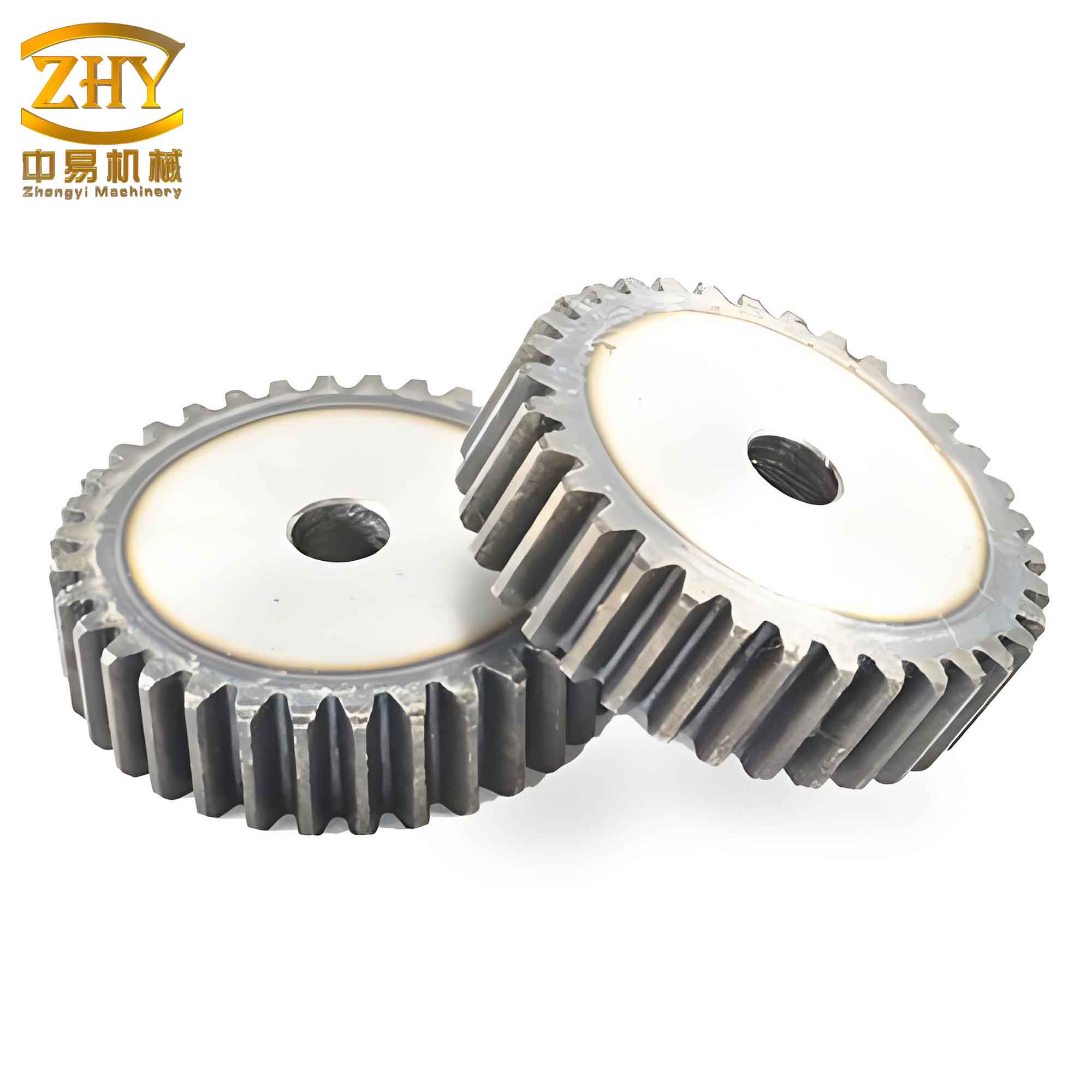
This article presents a comprehensive investigation into the frictional behavior of **spur and pinion gear** systems. We will delve into the fundamental geometry, explore advanced modeling techniques, perform detailed finite element analysis to simulate contact conditions, and synthesize the results to establish practical correlations between operational parameters and tribological performance. The primary focus will be on how the coefficient of friction, a pivotal tribological parameter, governs the contact stress state, frictional forces, and overall pressure distribution along the path of contact, ultimately dictating the gear’s propensity for failure.
Fundamental Geometry of Involute Spur Gears
The involute curve is the cornerstone of modern gear design for **spur and pinion gear** systems due to its conjugate action, which ensures a constant velocity ratio and smooth power transmission. The mathematical definition of an involute curve generated from a base circle of radius $r_b$ is given by the following parametric equations:
$$ x = r_b (\sin \theta – \theta \cos \theta) $$
$$ y = r_b (\cos \theta + \theta \sin \theta) $$
where $\theta$ is the involute roll angle in radians. From this foundation, the key geometric dimensions of a standard **spur and pinion gear** are derived. Let $m$ be the module, $z$ the number of teeth, and $\alpha$ the pressure angle (typically 20° or 25°).
| Parameter | Symbol | Formula |
|---|---|---|
| Pitch Diameter | $d$ | $d = m \cdot z$ |
| Base Circle Diameter | $d_b$ | $d_b = d \cdot \cos \alpha$ |
| Addendum (Tooth Tip Height) | $h_a$ | $h_a = m$ (for standard gears) |
| Dedendum (Tooth Root Height) | $h_f$ | $h_f = 1.25m$ (common value) |
| Addendum Circle Diameter | $d_a$ | $d_a = d + 2m$ |
| Dedendum Circle Diameter | $d_f$ | $d_f = d – 2.5m$ |
The path of contact for a meshing **spur and pinion gear** pair is a straight line tangent to both base circles, known as the line of action. The length of this line segment between the outer circles is the path of contact. The region where two teeth are in mesh is defined by the start of engagement (tip of driven gear contacting root of driver) and the end of engagement (tip of driver gear contacting root of driven). During this meshing cycle, the point of contact moves along the line of action, and the radius of curvature at the contact point changes continuously. This dynamic change in geometry is a primary reason why contact stresses and sliding velocities vary significantly from the root to the tip of the tooth, making friction analysis complex.
Parametric Modeling and Digital Prototyping
Accurate digital modeling is the first critical step in modern gear analysis. Parametric modeling allows for the creation of a gear model where dimensions are driven by fundamental parameters (module, teeth, pressure angle). This enables rapid iteration and analysis of different gear geometries. Several approaches exist:
- Dedicated CAD Software (e.g., CATIA, SolidWorks): These platforms often have gear generation toolkits or allow for the creation of involute curves using equation-driven sketches. The process involves defining the base circle, generating the involute profile for one tooth flank, mirroring it about the tooth centerline, and then performing a circular pattern to create the full gear. The model of the pinion and the larger gear (spur gear) are created separately and then virtually assembled.
- Programming/ Scripting (e.g., Python, MATLAB): For higher flexibility and integration with analysis scripts, the gear tooth coordinates can be calculated using the involute equations and then exported to a format readable by CAD or FEA software. This method is excellent for generating non-standard profiles or for automated design-of-experiments studies.
- Specialized Gear Software: Applications like Romax, KissSoft, or MASTA are built specifically for gear and transmission design, offering highly accurate models and direct interfaces for analysis.
Once the three-dimensional solid model of the **spur and pinion gear** assembly is created, it is typically exported in a neutral format like STEP (Standard for the Exchange of Product Data) or IGES (Initial Graphics Exchange Specification). This file is then imported into Finite Element Analysis (FEA) software, such as ANSYS, Abaqus, or COMSOL, for subsequent stress and tribological analysis. The integrity of this data translation is crucial to avoid geometry errors that could compromise the analysis results.
Finite Element Analysis Framework for Gear Contact
Finite Element Analysis provides a powerful numerical method to solve the complex contact mechanics problem of meshing gear teeth. The process involves several systematic steps:
1. Material Properties and Definition
The mechanical properties of the gear material directly influence deformation, stress, and contact behavior. Common materials for **spur and pinion gear** applications include case-hardened steels, through-hardened steels, and sometimes polymers or composites for specific applications. A typical structural steel like AISI 4140 or similar is used for demonstration.
| Property | Symbol | Value | Unit |
|---|---|---|---|
| Young’s Modulus | $E$ | 210 | GPa |
| Poisson’s Ratio | $\nu$ | 0.3 | – |
| Density | $\rho$ | 7850 | kg/m³ |
| Yield Strength | $\sigma_y$ | ≥ 450 | MPa |
| Ultimate Tensile Strength | $\sigma_u$ | ≥ 750 | MPa |
2. Contact Formulation and Friction Modeling
Defining the interaction between the pinion and gear tooth flanks is the core of the analysis. Two primary contact formulations are used:
- Surface-to-Surface Contact: This is the most accurate method for gear analysis. It defines contact between deformable bodies, typically designating one surface as the “contact” surface and the other as the “target” surface. Advanced algorithms handle the detection of penetration and calculation of contact pressure.
- Node-to-Surface Contact: An older, less accurate formulation where nodes on the contact surface interact with the target surface.
The choice of friction model is critical for tribological analysis. The most widely used model is the Coulomb friction model, which states that the tangential frictional force $F_f$ is proportional to the normal contact force $F_n$:
$$ F_f = \mu \cdot F_n $$
where $\mu$ is the coefficient of friction. It is important to note that $\mu$ is not a constant material property but depends on surface roughness, lubrication regime, sliding velocity, and contact pressure. In FEA, this is often implemented as a constant value for parametric studies, or with more complex models accounting for velocity dependence.
3. Meshing Strategy
The gear teeth in the contact region require a very fine mesh to accurately capture the high stress gradients. Global mesh size is set to be coarse, and local mesh refinement is applied to the tooth flanks, especially along the potential path of contact. Hexahedral (brick) elements are preferred for their accuracy, but tetrahedral elements with refinement are often used for complex gear geometries. A mesh convergence study is mandatory to ensure the results (like maximum contact stress) are independent of further mesh refinement.
4. Loads and Boundary Conditions
Realistic simulation of gear operation requires correct constraints and loading:
- Boundary Conditions: The inner bore (hub) of the driven **spur gear** is typically fixed in all degrees of freedom (DOF). The inner bore of the driving **pinion gear** is constrained radially and axially but is free to rotate. A rotational displacement (or velocity) is applied to the pinion hub to simulate motion.
- Loading: The primary load is the transmitted torque. This can be applied indirectly by fixing the rotation of the spur gear hub and applying a rotational displacement to the pinion, which generates reactive torque. Alternatively, a direct torque can be applied to the pinion shaft. The analysis is usually performed for a static position representing a worst-case single-tooth-pair contact near the pitch line, or through a transient analysis to simulate the roll of contact.
The tangential force $F_t$ at the pitch circle due to an applied torque $T$ on the pinion is:
$$ F_t = \frac{2T}{d_p} $$
where $d_p$ is the pinion pitch diameter. The normal force $F_n$ acting perpendicular to the tooth flank and the radial component $F_r$ are:
$$ F_n = \frac{F_t}{\cos \alpha} $$
$$ F_r = F_t \cdot \tan \alpha $$
Parametric Study: Influence of Coefficient of Friction
A systematic parametric study is conducted by varying the coefficient of friction $\mu$ in the Coulomb model while keeping all other parameters (geometry, material, torque) constant. The objective is to quantify the effect of friction on the key output variables: Maximum Contact Stress (Hertzian Stress), Surface Traction/Frictional Stress, and the Contact Pressure Distribution.
The finite element model is solved for a series of friction coefficients ranging from a near-frictionless condition ($\mu = 0.05$) to a high-friction, potentially poorly lubricated state ($\mu = 0.8$). The results are extracted and tabulated.
| Coefficient of Friction ($\mu$) | Max. Contact Stress, $\sigma_{c,max}$ (MPa) | Max. Frictional Stress, $\tau_{f,max}$ (MPa) | Peak Contact Pressure, $p_{max}$ (MPa) | % Change in $\sigma_c$ (from $\mu$=0.1) |
|---|---|---|---|---|
| 0.05 | 1120 | 56 | 1150 | -5.1% |
| 0.10 | 1180 | 118 | 1210 | 0.0% (Ref.) |
| 0.15 | 1245 | 187 | 1280 | +5.5% |
| 0.20 | 1315 | 263 | 1360 | +11.4% |
| 0.30 | 1420 | 426 | 1490 | +20.3% |
| 0.40 | 1490 | 596 | 1580 | +26.3% |
| 0.50 | 1545 | 773 | 1650 | +30.9% |
| 0.60 | 1590 | 954 | 1710 | +34.7% |
| 0.80 | 1650 | 1320 | 1805 | +39.8% |
The data reveals two distinct regimes:
- High-Sensitivity Regime ($\mu < 0.3$): In this range, which often corresponds to well-lubricated (elastohydrodynamic – EHL) conditions, the contact mechanics are dominated by the normal load. However, the introduction and increase of friction cause a significant perturbation. The maximum contact stress $\sigma_{c,max}$ increases markedly. This is because friction introduces tangential tractions that alter the subsurface stress field, effectively increasing the equivalent von Mises stress. The frictional stress, $\tau_f$, grows linearly as per $\tau_f = \mu \cdot p$, where $p$ is the contact pressure.
- Diminishing-Sensitivity Regime ($0.3 \leq \mu \leq 0.8$): As friction increases beyond approximately 0.3, the rate of increase in contact stress begins to diminish. The system enters a state where the large tangential forces significantly resist surface sliding and alter the contact patch geometry and pressure distribution more fundamentally. The peak contact pressure $p_{max}$ also shows a consistent rise. The increase in all three parameters—contact stress, frictional stress, and contact pressure—directly accelerates fatigue damage mechanisms.
The relationship between the coefficient of friction and the maximum contact stress can be approximated by a power-law or exponential decay function for curve-fitting purposes, though the exact relationship is highly nonlinear and problem-dependent.
Extended Analysis: Impact of Other Operational Parameters
While friction is a primary tribological variable, the performance of a **spur and pinion gear** system is governed by a multivariable interplay. A complete analysis considers the following:
1. Effect of Applied Load (Torque)
According to Hertzian contact theory for cylinders, the maximum contact pressure $p_0$ is proportional to the square root of the normal load per unit width $F_n/L$:
$$ p_0 = \sqrt{\frac{F_n E^*}{\pi L R^*}} $$
where $E^*$ is the equivalent Young’s modulus and $R^*$ is the equivalent radius of curvature at the contact point. For gears, $R^*$ changes along the path of contact, being smallest at the pitch point (where pure rolling occurs) and larger near the start and end of engagement. Consequently, contact stress is highly sensitive to load. Doubling the transmitted torque will increase contact stress by a factor of approximately $\sqrt{2} \approx 1.414$, significantly elevating the risk of pitting fatigue.
2. Effect of Lubrication and Sliding Velocity
The coefficient of friction $\mu$ is not an input but an output of the tribological system. It is determined by the lubrication regime:
- Boundary Lubrication: High $\mu$ (0.1 – 0.4+), prevalent at low speeds, high loads, or during start-up/shutdown. Surface asperity contact is significant.
- Elastohydrodynamic Lubrication (EHL): Low $\mu$ (0.02 – 0.08), achieved at moderate to high speeds with adequate lubricant. A thin, high-pressure film separates the surfaces, dramatically reducing friction and wear.
- Mixed Lubrication: Intermediate $\mu$, where load is shared between the fluid film and asperity contacts.
The sliding velocity between the teeth of the **spur and pinion gear**, which is maximum at the start and end of engagement and zero at the pitch point, directly influences the film thickness and thus the effective friction. High sliding can lead to localized heating and scuffing if the lubricant film breaks down.
3. Surface Finish and Material Hardness
A smoother surface finish (lower $R_a$ value) promotes the formation of a thicker EHL film and reduces the severity of asperity interactions, leading to a lower effective $\mu$. High surface hardness, achieved through processes like carburizing and grinding for **spur and pinion gear**, increases resistance to pitting (contact fatigue) and abrasive wear, allowing the gear to withstand higher contact stresses.
| Parameter | Increase leads to… | Primary Impact on Friction/Wear | Mitigation Strategy |
|---|---|---|---|
| Coefficient of Friction ($\mu$) | Higher contact stress, traction, heat generation | Accelerates pitting, scuffing, microwear | Improve lubrication, use friction modifiers, surface coatings |
| Transmitted Load (Torque) | Higher contact pressure (∼√Load) | Increases risk of contact fatigue (pitting), bending fatigue | Design for higher hardness, use larger face width, improve material |
| Sliding Velocity | Increased frictional heating, affects lubricant film | Can lead to scuffing if film breaks down | Ensure adequate EHL conditions, use high-temperature lubricants |
| Surface Roughness | Increased asperity interaction, higher effective $\mu$ | Promotes abrasive wear, run-in wear | Specify fine grinding/superfinishing, proper run-in procedure |
Implications for Gear Design and Failure Prevention
The findings from this detailed frictional analysis have direct and critical implications for the design, operation, and maintenance of **spur and pinion gear** systems. The overarching goal is to minimize the effective coefficient of friction and manage contact stresses to extend service life and improve efficiency.
- Lubrication Selection and Management: The most effective way to control friction is through proper lubrication. Selecting a lubricant with the correct viscosity (for film formation) and additives (extreme pressure/anti-wear agents for boundary conditions) is paramount. Maintaining clean, cool, and adequately supplied lubricant is essential for preventing a shift from low-friction EHL to high-friction boundary lubrication regimes.
- Surface Engineering: Applying advanced surface treatments can drastically improve tribological performance. Diamond-like carbon (DLC) coatings, nitriding, and other PVD/CVD coatings can provide surfaces with inherently low friction and high hardness, protecting the underlying **spur and pinion gear** material.
- Micro-Geometry Modifications: Intentional deviations from the perfect involute profile, such as tip relief and root relief, are used to compensate for tooth deflections under load. These modifications optimize the load distribution along the path of contact, reduce edge loading at the tooth tips, and can slightly alter the sliding/rolling ratio, potentially mitigating friction-related issues.
- Predictive Maintenance: Monitoring operating temperature and vibration signatures can provide early warnings of increased friction, wear, or surface distress in a **spur and pinion gear** set. A sudden rise in gearbox temperature often indicates lubricant degradation or failure, leading to increased friction.
- Material Selection and Heat Treatment: The core strength and surface hardness of the gear material must be chosen to withstand the calculated contact stresses, which are amplified by the presence of friction. Case-hardened steels offer an excellent combination of a tough core and a hard, wear-resistant case.
The relationship between friction and contact fatigue life is often described by models that incorporate the subsurface stress field modified by friction. For example, the equivalent stress used in fatigue life prediction (e.g., using the Dang Van or Findley multi-axial fatigue criteria) is a function of both the hydrostatic and shear stresses, the latter being directly increased by frictional traction. A simplified expression for the fatigue-influencing stress $\sigma_{eq}$ can be conceptualized as:
$$ \sigma_{eq} \propto \sigma_{Hertz} \cdot (1 + \beta \cdot \mu) $$
where $\beta$ is a factor representing the sensitivity of the material’s fatigue strength to shear stress. This clearly shows that increasing $\mu$ leads to a higher effective fatigue stress, thereby reducing the predicted number of cycles to failure for pitting.
Conclusion
This comprehensive analysis underscores the profound influence of tribological factors, particularly the coefficient of friction, on the operational integrity of **spur and pinion gear** systems. Through parametric finite element modeling and analysis, we have demonstrated that an increase in the coefficient of friction leads to a significant rise in maximum contact stress, frictional shear stress, and contact pressure. The sensitivity is most pronounced in the lower friction range typical of lubricated contacts. These elevated stresses directly accelerate failure mechanisms such as micropitting, macropitting, and scuffing, ultimately shortening the fatigue life of the gear drive.
The path to optimal gear performance lies in a systems approach that integrates precise geometric design, appropriate material selection with proper heat treatment, meticulous control of surface finish, and—most critically—the implementation of a robust lubrication strategy designed to maintain a low-friction elastohydrodynamic regime. Advanced modeling and simulation tools, as demonstrated, are indispensable for predicting contact behavior, identifying potential failure zones, and validating design choices before physical prototyping. By prioritizing friction management, engineers can develop **spur and pinion gear** transmissions that achieve higher power density, greater reliability, longer service life, and improved energy efficiency, meeting the ever-growing demands of modern mechanical systems.