
In the realm of precision mechanical transmissions, the strain wave gear system, often referred to as harmonic drive, stands out due to its exceptional characteristics: compact size, high reduction ratio, and smooth operation. As a researcher deeply involved in the mechanics of advanced gearing systems, I have focused my efforts on understanding the core component that dictates the performance and longevity of these devices—the flexible gear, or flexspline. The flexible gear undergoes cyclic elastic deformation to facilitate motion transfer between the circular spline and the wave generator. This continuous deformation under load makes the flexible gear susceptible to stress concentration and fatigue failure, which can compromise the entire strain wave gear transmission’s accuracy and durability. Therefore, a comprehensive analysis of the stress distribution and fatigue strength of the flexible gear is paramount for enhancing the design and operational life of strain wave gear systems.
The working principle of a strain wave gear involves three primary elements: the circular spline (rigid outer gear), the flexible gear (thin-walled inner gear), and the wave generator (typically an elliptical cam assembly). The wave generator deforms the flexible gear into an elliptical shape, causing it to mesh with the circular spline at two opposing regions along the major axis. As the wave generator rotates, the meshing points shift, resulting in a relative motion between the flexible gear and the circular spline. This mechanism allows for high reduction ratios in a compact package. However, the repeated elastic deformation of the flexible gear subjects it to complex stress states, leading to potential fatigue cracks, especially at critical regions like the tooth ring, the transition between the tooth ring and the cylinder, and the flange connection. In this article, I will delve into both theoretical and computational investigations of the stress and fatigue behavior of a cup-type flexible gear used in a specific strain wave gear reducer model. The aim is to establish reliable methodologies for predicting stress peaks and fatigue life, thereby informing design optimizations for strain wave gear transmissions.
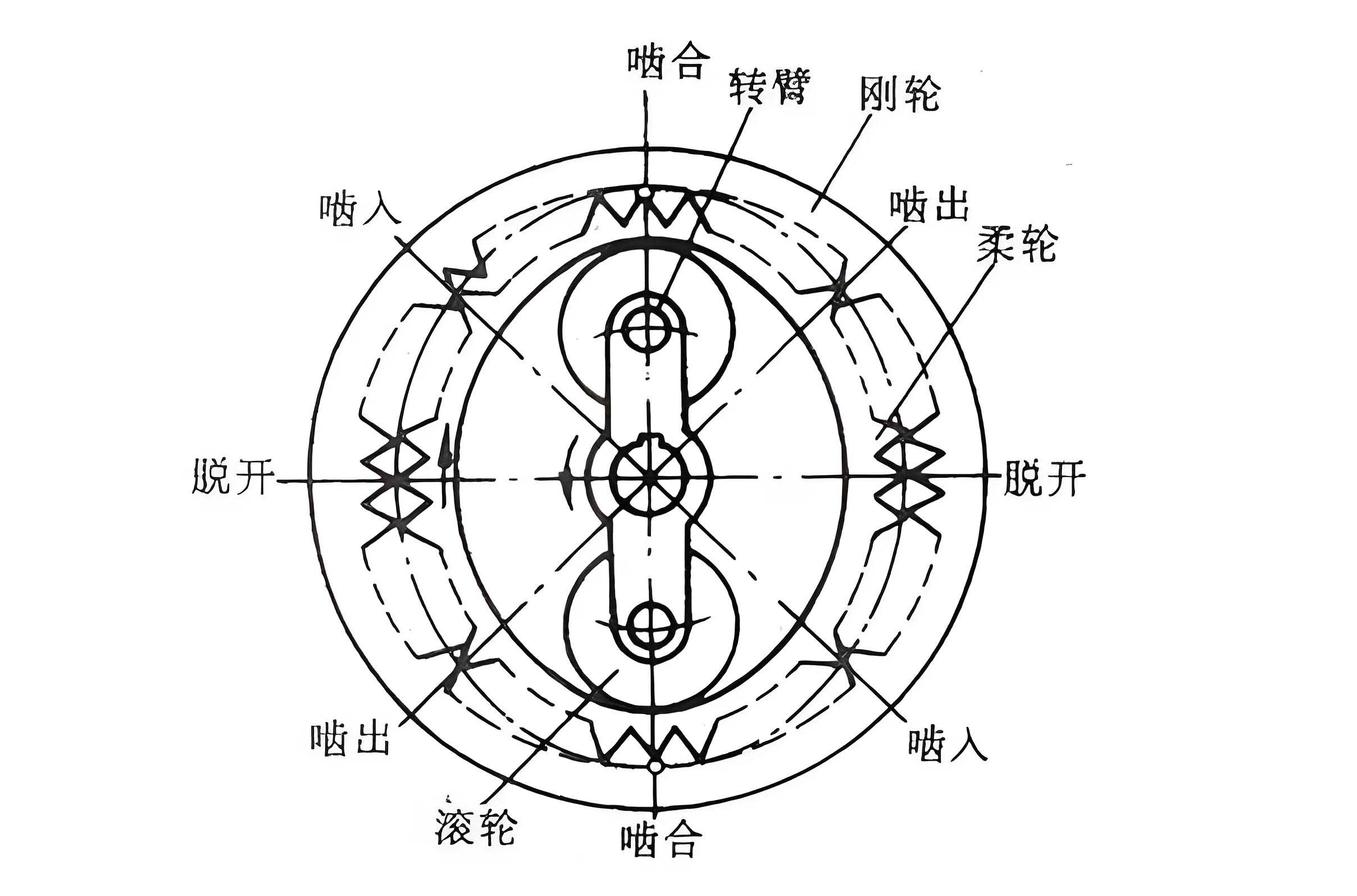
To lay the foundation for the analysis, I first consider the theoretical stress analysis of the flexible gear under no-load conditions, which corresponds to the pre-stress state induced during assembly by the wave generator. Utilizing cylindrical shell theory, the radial deformation of the flexible gear caused by a four-force type wave generator (approximating an elliptical cam) can be described. The radial displacement, \( w \), at any angular position \( \phi \) (measured from the major axis) is given by:
$$ w = w_0 \cos(2\phi) $$
Here, \( w_0 \) is the maximum radial deformation. The resulting bending stresses along the axial and circumferential directions, as well as the torsional shear stress due to deformation, are derived from shell theory. The axial bending stress \( \sigma_x \), circumferential bending stress \( \sigma_\phi \), and torsional shear stress \( \tau_{\phi} \) are expressed as:
$$ \sigma_x = \frac{E s_1 v}{2 r_m^2} \left( \frac{\partial^2 w}{\partial \phi^2} + w \right) $$
$$ \sigma_\phi = \frac{E s_1}{2 r_m^2} \left( \frac{\partial^2 w}{\partial \phi^2} + w \right) $$
$$ \tau_{\phi} = \frac{E s_1}{2 r_m L} \frac{\partial w}{\partial \phi} $$
In these equations, \( E \) represents the Young’s modulus of the flexible gear material, \( s_1 \) is the wall thickness at the tooth ring section, \( v \) is Poisson’s ratio, \( r_m \) is the mean radius of the gear midline, and \( L \) is the length of the cylindrical barrel. For the specific strain wave gear model under study, the key geometric and material parameters are summarized in Table 1. The flexible gear material is 40CrNiMoA alloy steel, known for its high strength and fatigue resistance, commonly used in demanding strain wave gear applications.
| Parameter | Symbol | Value | Unit |
|---|---|---|---|
| Maximum radial deformation | \( w_0 \) | 0.372 | mm |
| Tooth ring wall thickness | \( s_1 \) | 1.376 | mm |
| Cylinder length | \( L \) | 34 | mm |
| Mean radius | \( r_m \) | 31.35 | mm |
| Young’s modulus | \( E \) | 209 | GPa |
| Poisson’s ratio | \( v \) | 0.3 | – |
| Material | – | 40CrNiMoA | – |
Substituting these values into the stress equations, the peak stress under no-load conditions is calculated. For instance, evaluating at \( \phi = 0 \) (major axis) yields the maximum circumferential stress. The theoretical calculation results in a peak stress of approximately 166.98 MPa. This pre-stress is critical as it sets the baseline for additional stresses when the strain wave gear transmission is under load.
To verify the theoretical stress prediction, I employed finite element analysis (FEA) using a detailed 3D model. The flexible gear was modeled in Inventor software without simplifying the tooth geometry to ensure accuracy. The model was then imported into ANSYS Workbench for structural static analysis. The gear was segmented into four parts for efficient meshing: the tooth ring, the cylindrical barrel, the transition zone between the tooth ring and barrel, and the flange region. Boundary conditions were applied to mimic the actual assembly: four small rectangular areas on the inner surface of the tooth ring (corresponding to the wave generator contact points) were subjected to pressure to simulate the elliptical deformation, and the bottom flange holes were fixed to represent bolt connections to the housing. The mesh was refined in high-stress regions to capture gradients effectively.
The FEA results for no-load condition are presented in terms of equivalent (von Mises) stress and total deformation contours. The maximum equivalent stress was found to be around 165.09 MPa, located primarily at the mid-section of the tooth ring (along the major axis) and at the transition between the tooth ring and the cylinder. This shows excellent agreement with the theoretical value of 166.98 MPa, with a discrepancy of less than 1.2%, validating the reliability of the cylindrical shell theory for preliminary stress estimation in strain wave gear flexible gears. The deformation contour revealed a maximum radial displacement of 0.37396 mm, closely matching the specified \( w_0 = 0.372 \) mm. The deformation pattern confirmed the expected elliptical shape, with peaks along the major and minor axes.
Moving to loaded conditions, the stress state becomes more complex due to the superposition of deformation-induced stresses and those from torque transmission. When the strain wave gear transmission is under load, the teeth of the flexible gear mesh with those of the circular spline, generating tangential forces. To analyze this, I applied tangential forces on nodes along the pitch circle of the flexible gear teeth in the major axis regions to simulate the torque input. The relationship between the applied torque \( T \) and the tangential force \( F \) on each node is:
$$ F = \frac{T}{R \times N} $$
where \( R \) is the pitch radius of the flexible gear, and \( N \) is the number of nodes where the force is applied (taken as 11 in this study to distribute the load realistically). A series of torque values from 20 N·m to 140 N·m were considered to investigate the stress and deformation response under varying loads. The corresponding tangential forces are listed in Table 2.
| Torque, \( T \) (N·m) | Tangential Force per Node, \( F \) (N) |
|---|---|
| 20 | 49.6 |
| 40 | 117.3 |
| 60 | 176.0 |
| 80 | 234.5 |
| 100 | 293.0 |
| 120 | 351.8 |
| 140 | 410.0 |
For each torque case, a static structural analysis was performed. The resulting stress and deformation contours for \( T = 60 \) N·m are representative. The maximum equivalent stress increased compared to the no-load case, and additional stress concentrations appeared at the junction between the cylinder and the flange. The deformation contour maintained an elliptical shape but with slightly increased magnitude. To systematically study the impact of load, I extracted the maximum equivalent stress and the deformation profile along a cross-section at the tooth-ring-to-cylinder transition (axial position \( x = 13.67 \) mm) for all torque values. The trends are summarized in Figure 1 and Figure 2, represented here via derived equations and tables.
The variation of maximum equivalent stress with torque is nearly linear initially but exhibits a steeper increase beyond 100 N·m. This can be approximated by a piecewise function. Let \( \sigma_{\text{max}} \) denote the maximum equivalent stress in MPa and \( T \) the torque in N·m. From the FEA data, a fitting yields:
$$ \sigma_{\text{max}} \approx \begin{cases}
165 + 0.95T & \text{for } 0 \leq T \leq 100 \\
260 + 2.1(T – 100) & \text{for } T > 100
\end{cases} $$
This indicates that for the specific flexible gear geometry and material, the optimal working range—where stress growth is moderate—is for torques below 100 N·m. Exceeding this load leads to a rapid rise in stress, heightening the risk of yield or fatigue failure in the strain wave gear component.
The deformation behavior, however, shows different characteristics. The maximum radial displacement \( \delta_{\text{max}} \) (in mm) is largely dictated by the wave generator’s profile and remains relatively insensitive to torque. The FEA results show only a slight increase with load, which can be expressed as:
$$ \delta_{\text{max}} \approx 0.374 + 0.001T $$
Moreover, the deformation profile around the circumference at the fixed axial section follows a harmonic pattern described by:
$$ \delta(\phi) = \delta_0 \cos(2\phi) + \Delta(T) $$
where \( \delta_0 \) is the amplitude from the wave generator (about 0.372 mm) and \( \Delta(T) \) is a small load-dependent offset. At low torques (e.g., 20 N·m), the profile phase shifts slightly, but the overall shape remains consistent. This underscores that in strain wave gear transmissions, the deformation kinematics are primarily governed by the wave generator, while the stress state is strongly influenced by the transmitted torque.
Turning to fatigue strength analysis, the flexible gear in a strain wave gear system endures cyclic stresses due to the rotating wave generator and fluctuating loads, making fatigue a dominant failure mode. The theoretical assessment involves determining the stress amplitudes and mean stresses under combined loading. The stress components include the bending stresses from deformation (\( \sigma_\phi \) and \( \sigma_x \)) and the shear stresses from torque transmission (\( \tau_T \)) and deformation-induced torsion (\( \tau_\phi \)). For a torque \( T \), the shear stress due to torsion is:
$$ \tau_T = \frac{T}{2\pi r_m^2 s_1} $$
The total shear stress amplitude is then a combination of \( \tau_T \) and \( \tau_\phi \). Assuming the stress varies synchronously with the wave generator rotation, the alternating stress amplitudes for normal and shear stresses can be derived. Let \( C_\sigma \) and \( C_\tau \) be coefficients dependent on the force application angle \( \beta \) (relative to the major axis). For \( \beta = 25^\circ \), typical in this strain wave gear model, \( C_\sigma = 1.510 \) and \( C_\tau = 0.506 \). The stress amplitudes are:
$$ \sigma_a = \sigma_\phi = C_\sigma \frac{w_0 E s_1}{r_m^2}, \quad \sigma_m = 0 $$
$$ \tau_a = \tau_m = 0.5 (\tau_T + \tau_\phi) = 0.5 \left( \frac{T}{2\pi r_m^2 s_1} + C_\tau \frac{w_0 E s_1}{r_m L} \right) $$
With these, the fatigue safety factors for pure normal stress (\( S_\sigma \)) and pure shear stress (\( S_\tau \)) are calculated using the material endurance limits and stress concentration factors. For 40CrNiMoA, the bending fatigue limit \( \sigma_{-1} = 800 \) MPa and torsional fatigue limit \( \tau_{-1} = 320 \) MPa. The stress concentration factors are taken as \( K_\sigma = 2.4 \) for bending and \( K_\tau = 0.8K_\sigma = 1.92 \) for torsion. The safety factors are:
$$ S_\sigma = \frac{\sigma_{-1}}{K_\sigma \sigma_a} $$
$$ S_\tau = \frac{\tau_{-1}}{K_\tau \tau_a + 0.2 \tau_m} $$
Since the stress state is biaxial, the combined safety factor \( S \) according to the von Mises criterion in fatigue context is:
$$ S = \frac{S_\sigma S_\tau}{\sqrt{S_\sigma^2 + K_z S_\tau^2}} $$
where \( K_z \) is an interaction coefficient, typically 0.7 when the axial to circumferential stress ratio is around 0.3. For a torque of 100 N·m, inserting the numerical values yields \( S_\sigma \approx 1.94 \), \( S_\tau \approx 2.23 \), and thus \( S \approx 1.607 \). Since the allowable safety factor for reliable strain wave gear operation is usually 1.5 or higher, this value indicates the design is safe at 100 N·m.
To corroborate the theoretical fatigue assessment, I performed a fatigue analysis within ANSYS Workbench by importing the material’s S-N curve (stress amplitude versus cycles to failure) for 40CrNiMoA. The analysis settings included fully reversed loading (R = -1) to simulate the cyclic nature of the strain wave gear operation. The fatigue life contours and safety factor contours for \( T = 100 \) N·m were generated. The results showed a minimum life exceeding \( 10^6 \) cycles at critical locations, and a minimum safety factor of 1.6154, which aligns remarkably well with the theoretical 1.607 (error ~0.46%). This confirms the validity of both approaches for fatigue evaluation in strain wave gear flexible gears.
Extending the fatigue analysis across the torque range, the safety factor decreases with increasing load. The relationship can be approximated by an inverse function. Let \( S_{\text{min}} \) denote the minimum fatigue safety factor. From FEA-derived data:
$$ S_{\text{min}} \approx \frac{3.5}{1 + 0.02T} \quad \text{for } T \text{ in N·m} $$
The critical torque where \( S_{\text{min}} \) falls below 1.5 is around 110 N·m, indicating that beyond this point, the flexible gear is prone to fatigue fracture. This threshold is vital for defining the operational limits of the strain wave gear transmission. Table 3 summarizes the fatigue safety factors for selected torques, illustrating the declining margin with load.
| Torque, \( T \) (N·m) | Theoretical Safety Factor, \( S \) | FEA Safety Factor (Min) | Remark |
|---|---|---|---|
| 20 | 4.12 | 4.08 | Very Safe |
| 60 | 2.45 | 2.48 | Safe |
| 100 | 1.607 | 1.615 | Marginally Safe |
| 110 | 1.48 | 1.49 | Near Limit |
| 140 | 1.18 | 1.20 | Unsafe |
In discussing these results, several key insights emerge for strain wave gear design. First, the stress concentration regions—the tooth ring mid-section, the tooth-ring-to-cylinder transition, and the cylinder-to-flange transition—are consistent across load conditions. These are critical zones where material improvements or geometric optimizations (e.g., fillet radii adjustments) could enhance fatigue life. Second, the deformation of the flexible gear is predominantly elastic and controlled by the wave generator, implying that for a given strain wave gear size, the deformation amplitude is fixed, and stress management must focus on wall thickness and material selection. Third, the nonlinear stress increase beyond 100 N·m suggests that for high-torque applications, a robust strain wave gear design may require thicker walls or higher-strength alloys, albeit at the cost of increased stiffness which might affect the transmission compliance.
Furthermore, the fatigue analysis underscores the importance of accurate S-N data for the specific material and surface treatment used in flexible gears. In real-world strain wave gear transmissions, factors like lubrication, temperature, and manufacturing imperfections (e.g., machining marks) can alter the fatigue performance. Therefore, the FEA-based approach, coupled with experimental validation, is recommended for final design verification. The methodologies presented here—combining cylindrical shell theory for quick estimates and detailed FEA for comprehensive assessment—provide a solid framework for engineers working on advanced strain wave gear systems.
In conclusion, through this detailed investigation of stress and fatigue strength in the flexible gear of a strain wave gear transmission, I have demonstrated that the maximum deformation occurs at the major and minor axes, largely independent of load, while the maximum stress resides at the tooth ring and transition regions, escalating with torque. The optimal working range for this particular flexible gear design is up to 100 N·m, beyond which stress rises sharply and the fatigue safety margin drops below 1.5, indicating increased risk of failure at around 110 N·m. These findings, supported by theoretical calculations and finite element simulations, offer valuable guidelines for optimizing the flexible gear geometry and material to extend service life and reliability in strain wave gear applications. Future work could explore dynamic loading effects, thermal stresses, and the impact of tooth profile modifications on the stress distribution in strain wave gear transmissions.