
In modern mechanical transmission systems, particularly in aerospace and advanced automotive applications, the demand for high power density and efficiency necessitates operation at increasingly high rotational speeds. Helical gear pairs are favored in such applications due to their smoother engagement characteristics and higher load-carrying capacity compared to spur gears. However, as operational speeds enter a wide, transient range—such as during rapid acceleration or deceleration of helicopter drivetrains or electric vehicle reduction gears—the system can exhibit complex nonlinear dynamic behaviors. A prominent, yet often inadequately modeled, phenomenon under these conditions is the separation of meshing teeth and subsequent impact on the non-driving flank, known as back-side contact. This paper delves into a comprehensive analysis of the transient vibration characteristics of high-speed helical gear systems, with a focused investigation on the influence of dynamic mesh stiffness that accounts for actual back-side contact mechanics.
The vibration and noise emanating from gear transmission systems under transient conditions are critical concerns for system reliability and environmental comfort. Traditional dynamic models of helical gear pairs often simplify the mesh stiffness as a periodic function dependent only on the mesh cycle, derived from the load distribution along the path of contact for normal driving-side engagement. While these models capture essential dynamics, they fall short when the system experiences severe vibrations leading to tooth separation. In high-speed scenarios, due to the presence of manufacturing backlash and dynamic excitations, the relative vibration displacement between mating teeth can exceed the backlash threshold. This results in the loss of contact (rattle) or, more critically, an impact on the opposite, non-working flank of the tooth. This back-side contact fundamentally alters the force transmission path, instantaneously reversing the driver-driven relationship and introducing a distinct mesh stiffness profile.
Most existing research either neglects this state or simplistically assumes the back-side stiffness is identical to the driving-side stiffness. This assumption is physically inaccurate. The contact geometry, load distribution, and consequently the effective mesh stiffness differ significantly when contact occurs on the tooth back. Therefore, to accurately predict transient vibration amplification when crossing critical speeds (e.g., system resonances), it is imperative to develop a dynamic model that incorporates a more realistic, state-dependent mesh stiffness function. This stiffness must be coupled not only with time (or mesh phase) but also with the instantaneous dynamic transmission error, forming a strong nonlinear feedback loop within the system’s equations of motion.
Dynamic Mesh Stiffness Formulation for Helical Gears with Back-Side Contact
The cornerstone of an accurate dynamic model is the formulation of the mesh stiffness $k(\lambda, t)$. For a helical gear pair, this stiffness is not a constant but varies during the mesh cycle due to the changing number of tooth pairs in contact and the shift in the contact line position along the face width. Under dynamic conditions leading to large vibratory displacements, the stiffness becomes a function of both time and the dynamic transmission error $\lambda(t)$.
The dynamic transmission error (DTE) along the line of action is defined as:
$$\lambda(t) = \cos\beta (y_p – y_g + R_p\theta_p – R_g\theta_g) + \sin\beta (z_p – z_g)$$
where $y$ and $z$ represent translational displacements in the plane of action and axial directions, $\theta$ represents torsional displacement, subscripts $p$ and $g$ denote the pinion and gear, $R$ is the base circle radius, and $\beta$ is the helix angle.
Considering a nominal backlash of $2b$, the contact state can be determined by comparing $\lambda(t)$ to $\pm b$:
- Normal Driving-Side Contact ($\lambda > b$): The pinion drives the gear. The mesh stiffness $k_1(t)$ is computed via loaded tooth contact analysis (LTCA) for the designed contact surfaces under deceleration (normal) torque.
- Loss of Contact ($-b \le \lambda \le b$): Teeth are separated, and the mesh force is zero. The effective mesh stiffness in the force formulation is zero.
- Back-Side Contact ($\lambda < -b$): The gear drives the pinion, implying an instantaneous overrunning condition. The mesh stiffness $k_2(t)$ must be computed via a separate LTCA, where the contact occurs on the opposite flanks and the load is applied in the reverse direction (simulating acceleration).
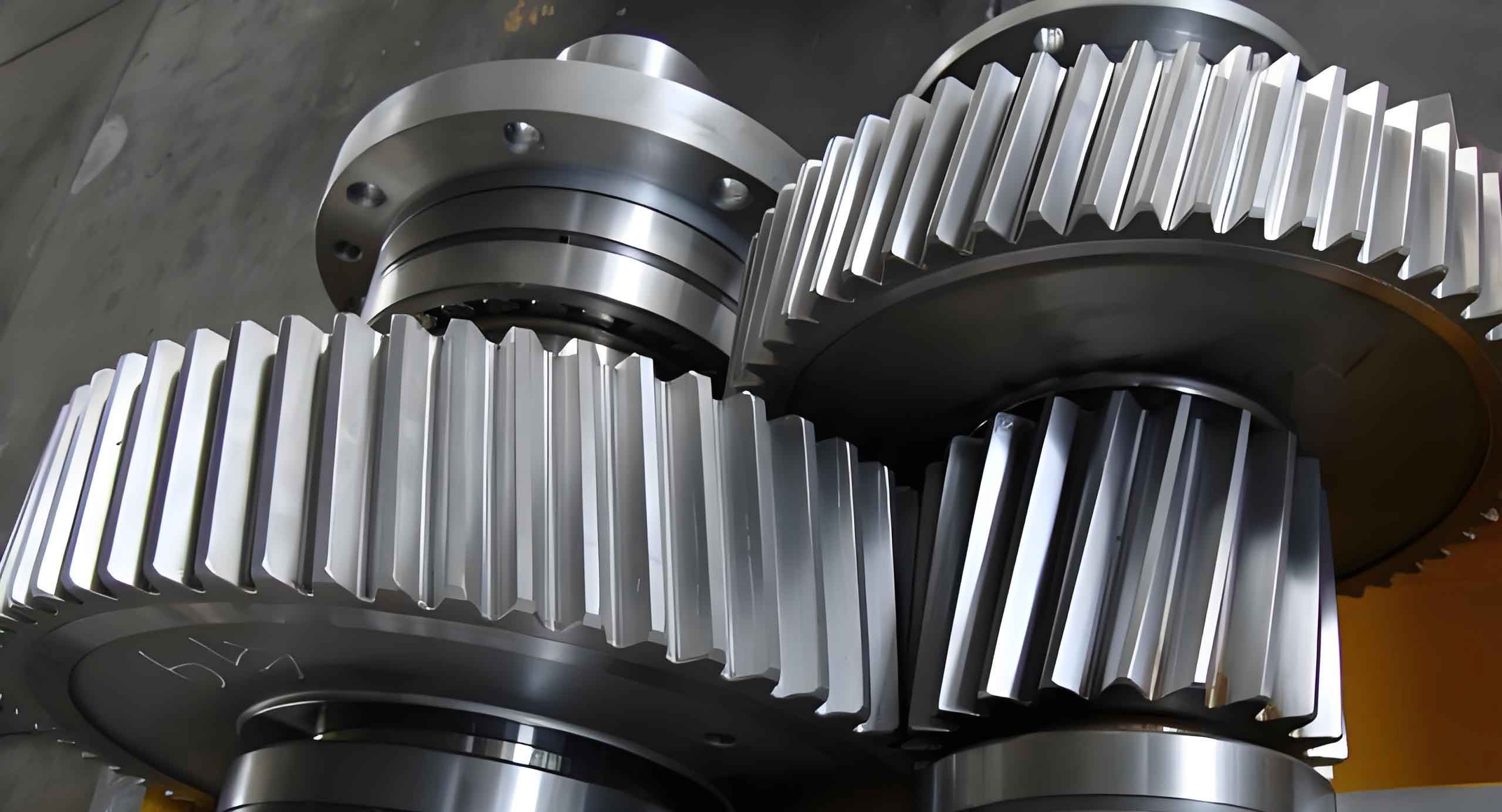
The calculation of these stiffness functions $k_1(t)$ and $k_2(t)$ requires a detailed elastostatic analysis. A robust approach involves using a finite element-based or analytical LTCA solver. The key steps are:
- Tooth Profile Generation: Define the exact geometry of both the driving and non-driving flanks, including any modifications (tip relief, lead crowning).
- Load Application: For $k_1(t)$, apply the nominal load to the driving flanks in the direction of power flow. For $k_2(t)$, apply the load to the back-side flanks in the reverse direction.
- Deformation Calculation: Solve for the contact pattern and the total deflection $\delta(t)$ of the gear bodies under load at successive mesh positions.
- Stiffness Derivation: The mesh stiffness is the ratio of the applied load to the calculated deflection: $k(t) = F / \delta(t)$.
The resulting time-varying stiffness curves $k_1(t)$ and $k_2(t)$ for a single mesh period $T_m$ will have similar average values but different fluctuation patterns and transition points due to the altered contact conditions. They are periodic and can be expanded into Fourier series:
$$k_1(t) = k_{1m} + \sum_{n=1}^{N} [k_{1a_n} \sin(n z_1 \omega_m t + \phi_{1n})]$$
$$k_2(t) = k_{2m} + \sum_{n=1}^{N} [k_{2a_n} \sin(n z_1 \omega_m t + \phi_{2n})]$$
where $k_{m}$ is the mean stiffness, $k_{a_n}$ are harmonic amplitudes, $z_1$ is the pinion tooth number, $\omega_m$ is the mesh frequency, and $\phi_n$ are phase angles.
The overall dynamic mesh stiffness function is thus a piecewise, state-dependent function:
$$k(\lambda, t) =
\begin{cases}
k_1(t), & \lambda > b \\[0.5em]
0, & -b \le \lambda \le b \\[0.5em]
k_2(t), & \lambda < -b
\end{cases}
$$
This formulation captures the essential nonlinearity arising from backlash and the distinct stiffness characteristics of back-side contact in a helical gear system.
Six-Degree-of-Freedom Transient Vibration Model
To analyze the system’s response under transient operating conditions, a lumped-parameter model with six degrees of freedom (DOF) for the gear pair is established. The model considers the torsional, lateral (in the plane of action), and axial vibrations of both the pinion and the gear, coupled through the nonlinear mesh interface described above.
The equations of motion for the pinion (subscript $p$) and gear (subscript $g$) are derived using Newton’s second law:
For the Pinion:
$$
\begin{aligned}
m_p \ddot{y}_p + (c_{py1} + c_{py2})\dot{y}_p + (k_{py1} + k_{py2})y_p &= -F_y \\
m_p \ddot{z}_p + c_{pz}\dot{z}_p + k_{pz}z_p &= -F_z \\
I_p \ddot{\theta}_p &= -F_y R_p + T_p(t)
\end{aligned}
$$
For the Gear:
$$
\begin{aligned}
m_g \ddot{y}_g + (c_{gy1} + c_{gy2})\dot{y}_g + (k_{gy1} + k_{gy2})y_g &= F_y \\
m_g \ddot{z}_g + c_{gz}\dot{z}_g + k_{gz}z_g &= F_z \\
I_g \ddot{\theta}_g &= F_y R_g – T_g
\end{aligned}
$$
Here, $m$, $I$, and $R$ represent mass, mass moment of inertia, and base radius. $k_{ij}$ and $c_{ij}$ denote the supporting bearing stiffnesses and damping coefficients in the $y$ (transverse) and $z$ (axial) directions. $T_p(t)$ is the input torque, which can be time-varying or constant, and $T_g$ is the output load torque.
The gear mesh interaction forces $F_y$ and $F_z$, projected along the plane of action and axial direction, are given by:
$$
\begin{aligned}
F_y &= \cos\beta \, f(\lambda) \, k(\lambda, t) + \cos\beta \, c_m \dot{\lambda} \\
F_z &= \sin\beta \, f(\lambda) \, k(\lambda, t) + \sin\beta \, c_m \dot{\lambda}
\end{aligned}
$$
where $c_m$ is the mesh damping coefficient, and $f(\lambda)$ is a backlash function that defines the displacement-dependent force:
$$f(\lambda) =
\begin{cases}
\lambda – b, & \lambda > b \\
0, & -b \le \lambda \le b \\
\lambda + b, & \lambda < -b
\end{cases}
$$
For transient analysis, the input speed is no longer constant. Consider a linear run-up condition where the pinion rotational speed $\Omega_p(t)$ increases with a constant acceleration $\alpha$:
$$\Omega_p(t) = \Omega_0 + \alpha t$$
where $\Omega_0$ is the initial speed. Consequently, the mesh frequency becomes time-dependent: $\omega_m(t) = z_1 \Omega_p(t)$. This necessitates that the Fourier series for the mesh stiffness $k_1(t)$ and $k_2(t)$ be expressed with a time-varying argument:
$$k_{1,2}(t) = k_{m} + \sum_{n=1}^{N} \left[ k_{a_n} \sin\left( n \int_0^t \omega_m(\tau) d\tau + \phi_n \right) \right] = k_{m} + \sum_{n=1}^{N} \left[ k_{a_n} \sin\left( n z_1 (\Omega_0 t + \frac{1}{2}\alpha t^2) + \phi_n \right) \right]$$
This formulation integrates the transient excitation due to the speeding mesh frequency into the system’s parametric excitation.
The system of equations is a set of coupled, nonlinear ordinary differential equations with piecewise-defined stiffness and forcing. Numerical integration methods, such as the Runge-Kutta family of solvers, are typically employed to obtain the time-domain response $\mathbf{q}(t) = [y_p, z_p, \theta_p, y_g, z_g, \theta_g]^T$.
Parameter Study: Influence of Backlash and Back-Side Stiffness
To isolate the effects of key nonlinear parameters, a parametric study is conducted using the model described above. The base parameters for the example helical gear pair and system are summarized in the following tables.
| Parameter | Pinion | Gear |
|---|---|---|
| Number of Teeth, $z$ | 19 | 47 |
| Normal Module, $m_n$ (mm) | 6 | 6 |
| Normal Pressure Angle, $\alpha_n$ (°) | 20 | 20 |
| Helix Angle, $\beta$ (°) | +9.9 | -9.9 |
| Face Width (mm) | 55 | 50 |
| Material Density (g/cm³) | 7.80 | 7.80 |
| Parameter | Symbol | Value |
|---|---|---|
| Mean Load Torque on Gear (Nm) | $T_{gm}$ | 2000 |
| Radial Bearing Stiffness (N/m) | $k_{y}$ | $1.0 \times 10^8$ |
| Axial Bearing Stiffness (N/m) | $k_{z}$ | $5.0 \times 10^7$ |
| Mesh Damping Ratio | $\zeta_m$ | 0.03 |
| Initial Rotational Speed (rpm) | $\Omega_0$ | 0 |
| Rotational Acceleration (rad/s²) | $\alpha$ | 500 |
| Final Speed (rpm) | $\Omega_{max}$ | 10,000 |
The primary natural frequency of the system corresponding to the dominant torsional mode is identified as $f_n$, corresponding to a pinion rotational speed of $\omega_{0} = 7500$ rpm.
Effect of Backlash Magnitude
The magnitude of gear backlash $b$ is a critical design parameter influencing the nonlinear jump phenomena. Simulations are performed for four different backlash values: $b = 4, 8, 10,$ and $12 \mu m$. The system is subjected to the linear run-up from 0 to 10,000 rpm, and the dynamic transmission error acceleration $\ddot{\lambda}(t)$ is monitored.
The results reveal a significant trend:
- For a small backlash ($b=4 \mu m$), the system behaves largely linearly. Transient vibration amplification is observed primarily when the time-varying mesh frequency passes through the system resonance $\omega_{0}$ and its one-third subharmonic ($\omega_{0}/3$). The response envelope is relatively contained.
- As backlash increases to $b=8 \mu m$, the resonant amplification region around $\omega_{0}$ broadens (approximately from $0.91\omega_{0}$ to $1.10\omega_{0}$). The peak amplitude also increases.
- At $b=10 \mu m$ and $b=12 \mu m$, the nonlinear effects become severe. The resonance region widens further ($0.79\omega_{0}$ to $1.28\omega_{0}$ for $10 \mu m$, and $0.75\omega_{0}$ to $1.38\omega_{0}$ for $12 \mu m$). Furthermore, for $b=12 \mu m$, a distinct nonlinear jump phenomenon and significant subharmonic activity appear around the $\omega_{0}/3$ region, indicating chaotic or period-doubling bifurcations.
This analysis underscores that while some backlash is necessary for lubrication and thermal expansion, excessive backlash in a high-speed helical gear system can drastically exacerbate transient vibration levels and induce unstable dynamic regimes during acceleration or deceleration through resonances.
Effect of Distinct Back-Side Contact Stiffness
To quantify the importance of accurately modeling back-side contact, a comparative study is performed. Two models are run for the same system with $b=8 \mu m$:
- Model A (Proposed): Uses the full piecewise stiffness $k(\lambda, t)$ with distinct $k_1(t)$ for drive-side and $k_2(t)$ for back-side contact.
- Model B (Conventional): Uses a simplified piecewise stiffness where the back-side contact is assigned the same stiffness function as the drive-side, i.e., $k_2(t) = k_1(t)$.
The results are strikingly different. Model B, with symmetric stiffness, predicts a transient response that, while nonlinear due to backlash, shows a resonance amplification pattern that is relatively symmetric and confined. In contrast, Model A predicts a much more pronounced and broader amplification peak when crossing the primary resonance. The distinct shape and magnitude of $k_2(t)$, particularly its different harmonic content and phase relative to $k_1(t)$, introduces additional parametric excitation and energy transfer when the system enters the back-side contact state during large vibrations. This leads to a stronger and more sustained nonlinear resonance condition.
The force-displacement hysteresis loops for one mesh cycle during resonant vibration further illustrate the difference. The loop for Model A shows a larger area and a distinct “kink” during the transition from drive-side to back-side contact, indicating higher energy dissipation and a more complex force interaction, which is not captured by Model B.
This comparison conclusively demonstrates that neglecting the unique stiffness characteristics of back-side contact can lead to a significant underestimation of the transient vibration amplification in high-speed helical gear systems. An accurate prediction of noise and dynamic loads, especially for designing passage through critical speeds, necessitates the incorporation of a properly calculated back-side mesh stiffness.
Experimental Validation via Transient Torsional Vibration Measurement
To validate the theoretical findings, a dedicated test rig was constructed. The core of the rig is a closed-loop power circulation system, which allows for applying high loads with relatively low input motor power, ideal for studying dynamics under realistic torque conditions.
Test Rig Configuration:
- Prime Mover: A servo-motor drive system capable of precise speed and torque control, programmed to execute the linear speed ramp $\Omega_p(t) = \alpha t$.
- Test Gearbox: Houses the test helical gear pair mounted on shafts supported by rolling element bearings.
- Power Circulation Loop: Includes a companion (reaction) gearbox identical to the test gearbox, connected via flexible couplings and a torque shaft.
- Load Application: A hydraulic or mechanical torque loader integrated into the loop applies and maintains a static preload torque $T_g$.
- Measurement System: High-precision rotary optical encoders (e.g., Heidenhain) are installed on both the input (pinion) and output (gear) shafts close to the test gearbox. These encoders measure the instantaneous angular position with extreme accuracy.
Data Processing for Transient Torsional Vibration:
The raw data from the encoders are angular positions $\theta_p(t_i)$ and $\theta_g(t_i)$ sampled at a high frequency. The dynamic transmission error (DTE) is calculated as:
$$\lambda_{exp}(t) = R_p \theta_p(t) – R_g \theta_g(t)$$
This signal contains both the quasi-static transmission error (due to manufacturing inaccuracies) and the dynamic vibratory component. The dynamic component $\lambda_{dyn}(t)$ is extracted via high-pass filtering. Finally, the vibration acceleration of primary interest is obtained by double differentiation: $\ddot{\lambda}_{dyn}(t)$.
Test Procedure and Results:
Two sets of test helical gears with different, precisely measured backlash values ($b \approx 4 \mu m$ and $b \approx 8 \mu m$) were used. The motor was commanded to accelerate from standstill to 10,000 rpm with $\alpha = 500$ rad/s² under a constant load torque. The measured transient vibration acceleration for the gear pair with small backlash (4 $\mu m$) showed clear amplification peaks when passing through $\omega_{0}/3$ and $\omega_{0}$, matching the prediction from Model A. For the gear pair with larger backlash (8 $\mu m$), the measured response exhibited a significantly broader and more intense amplification region centered on $\omega_{0}$, precisely as predicted by the nonlinear model incorporating distinct back-side stiffness. The experimental envelope closely followed the theoretical prediction from Model A, while deviating substantially from the simpler Model B’s prediction.
The strong correlation between the experimental results and the proposed theoretical model validates the critical role of both backlash magnitude and the unique dynamics of back-side contact in governing the transient vibration behavior of high-speed helical gear systems.
Advanced Analysis: Frequency-Domain Characteristics and Sideband Formation
Beyond the time-domain amplitude amplification, the presence of back-side contact and nonlinear vibration leaves distinct signatures in the frequency domain. Analyzing the simulated and experimental data via Short-Time Fourier Transform (STFT) or Wavelet Transform provides a time-frequency representation.
During the resonant passage, the spectrum shows not only the primary mesh frequency $f_m(t)$ and its harmonics but also a rich structure of sidebands. The nonlinearities introduce modulation effects. The spacing of these sidebands is related to the system’s rotational frequencies and their modulations due to the time-varying parameters and impacts. The model with distinct back-side stiffness (Model A) predicts a more densely populated sideband structure with higher energy levels compared to Model B, indicating a more complex interaction process. This spectral signature is a valuable diagnostic tool. In practical condition monitoring of a helical gear transmission operating under variable speed, the emergence and growth of such specific nonlinear sidebands during transient events can be an early indicator of excessive backlash or developing nonlinearities leading to impacting behavior.
The power spectral density (PSD) of the steady-state vibration at a fixed high speed (post-resonance) also shows differences. The nonlinear model predicts higher energy at super-harmonics of the mesh frequency (e.g., $2f_m$, $3f_m$) and combination frequencies, which are a direct consequence of the nonsmooth nonlinearity from backlash and the piecewise stiffness function.
Design Implications and Mitigation Strategies
The insights gained from this analysis have direct implications for the design of low-noise, high-performance helical gear drives for transient applications.
1. Backlash Control: The study quantitatively shows the detrimental effect of large backlash on transient vibration amplification. Therefore, stringent control of gear manufacturing and assembly tolerances to minimize functional backlash is paramount. For ultra-high-speed applications, the use of gear designs with minimal or controlled backlash, or even pre-loaded designs (e.g., using flexing elements or temperature compensation), should be considered, balancing against thermal expansion and lubrication needs.
2. Tooth Flank Modification Optimization: Traditional tip and root relief are designed to smooth the entry and exit of contact for the driving flank. This analysis suggests that similar attention could be given to the non-driving flank. Strategic micro-geometry modifications (e.g., a small relief on the back-side tip) could potentially soften the impact during back-side contact, altering the $k_2(t)$ curve to reduce the impulsive excitation. This is a non-traditional but potentially beneficial design avenue for gears expected to frequently operate near or through critical speeds.
3. System Damping: Increasing system damping, particularly at the mesh interface or through shaft dampers, is a classic but effective method to reduce resonance amplification. The model shows that higher mesh damping $c_m$ directly reduces the peak amplitude and narrows the unstable region in the transient run-up curve. The use of high-damping gear materials or embedded damping layers could be explored.
4. Active Control Strategies: For systems with known and frequent transient events (e.g., an electric vehicle’s aggressive acceleration), active control of the input torque $T_p(t)$ can be employed to shape the passage through resonance. By slightly modulating the acceleration rate $\alpha$ or applying a compensating torque component based on real-time vibration feedback, the dynamic response can be smoothed, avoiding prolonged periods of large-amplitude vibration and back-side impacting.
5. Accurate Dynamic Simulation in Design Phase: The key takeaway is the necessity of using advanced, nonlinear dynamic models early in the design phase. Relying on linear or simplified nonlinear models may lead to designs that exhibit unexpected and severe transient vibrations. The modeling framework presented here, incorporating LTCA-derived, state-dependent stiffness, provides a powerful tool for predicting and optimizing the transient dynamics of helical gear systems.
Conclusion
This investigation has provided a detailed examination of the transient vibration characteristics inherent to high-speed helical gear pairs, with a specific emphasis on the often-overlooked phenomenon of back-side contact. By developing a dynamic mesh stiffness model that is explicitly dependent on both the mesh phase and the instantaneous dynamic transmission error, a more physically accurate representation of the gear interface under severe vibratory conditions is achieved. This stiffness model distinguishes between the normal driving-side contact and the distinct back-side contact, the latter arising when dynamic displacements exceed the backlash clearance.
The integration of this nonlinear, piecewise stiffness function into a six-degree-of-freedom lumped-parameter dynamic model allows for the simulation of complex transient events, such as linear acceleration through system resonances. Parametric studies conclusively demonstrate that the magnitude of gear backlash is a critical factor, where increased backlash leads to a significant broadening and intensification of the resonant vibration amplification region. Furthermore, the assumption of symmetric stiffness for back-side contact is shown to be inadequate; the unique stiffness characteristics of the non-driving flank contribute substantially to the nonlinear dynamic response, leading to stronger and more sustained vibrations than predicted by conventional models.
Experimental validation conducted on a closed-power-flow test rig, equipped with high-resolution angular encoders for direct torsional vibration measurement, confirmed the theoretical predictions. The measured transient vibration responses for gears with different backlash values aligned closely with the simulations from the proposed model, particularly in capturing the broadening of the resonance peak.
The implications of this work are significant for the design of advanced gear transmission systems in aerospace, automotive, and industrial applications where high-speed transient operation is common. It underscores the importance of minimizing and controlling backlash, suggests novel considerations for tooth flank modifications, and highlights the necessity of employing sophisticated nonlinear dynamic models during the design phase to accurately predict and mitigate undesirable transient vibration phenomena. By accounting for the full complexity of the helical gear mesh interaction, including back-side contact dynamics, engineers can develop quieter, more reliable, and higher-performance gear systems capable of operating smoothly across wide and demanding speed ranges.