
In this article, I will explore the tooth surface meshing analysis of hyperboloid gears, focusing on the modified method machining technique. Hyperboloid gears are widely used in automotive industries due to their smooth transmission and high load-bearing capacity. The processing of hyperboloid gears, particularly the pinion, often employs methods like the modified method, which can be implemented on four-axis CNC machines, offering advantages over more complex five-axis systems. I will establish mathematical models for gear cutting, derive the modified polynomial expressions, determine initial values for modification coefficients, and analyze the influence of these coefficients on meshing performance using tooth surface detection technology. Throughout this discussion, I will emphasize the role of hyperboloid gears in modern engineering and provide detailed formulas and tables to summarize key concepts.
The importance of hyperboloid gears cannot be overstated in applications requiring efficient power transmission with minimal noise and vibration. The modified method machining, as opposed to the tilt method, allows for simpler CNC implementations, making it a cost-effective solution for producing hyperboloid gears. However, theoretical studies on the modified method are limited, with most research focusing on replicating traditional mechanical machine tools on CNC systems. Therefore, I aim to fill this gap by developing a comprehensive mathematical framework and using tooth contact analysis (TCA) to optimize meshing performance. This work will provide theoretical guidance for CNC machining of hyperboloid gears using the modified method.
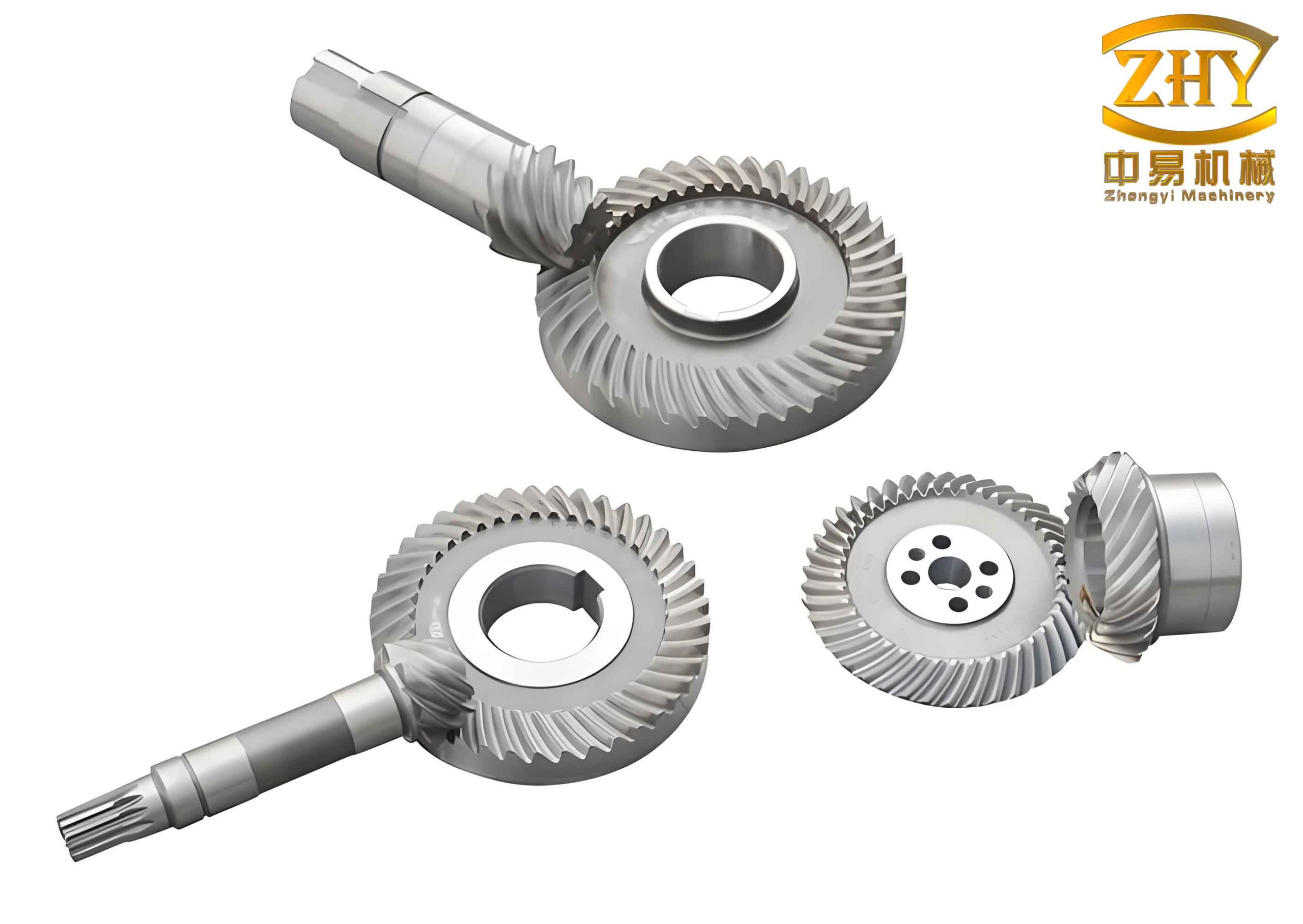
To begin, I will establish the mathematical models for cutting the gear wheel and pinion. The gear wheel is typically processed using a forming method, while the pinion uses the modified method. These models involve multiple coordinate systems to describe the relative motions between the tool, workpiece, and machine components. For the gear wheel, I define a machine coordinate system \(S_m\), a generating gear coordinate system \(S_g\), a tool coordinate system \(S_e\), and a workpiece coordinate system \(S_2\). The radial tool position \(S_p\) and angular tool position \(q_2\) are key parameters, along with the horizontal offset \(X_{G2}\) and workpiece installation angle \(\gamma_2\). The relationship can be expressed through transformation matrices, but for brevity, I will focus on the fundamental equations.
The cutting process for the hyperboloid gear wheel involves the tool rotating about its axis \(Z_e\) while the workpiece remains stationary. The position vector of a point on the tooth surface in the workpiece coordinate system can be derived from the tool geometry and machine motions. Let \(\mathbf{r}_e\) be the tool surface vector in \(S_e\), then in \(S_2\), it is transformed as:
$$\mathbf{r}_2 = \mathbf{M}_{2m} \mathbf{M}_{mg} \mathbf{M}_{ge} \mathbf{r}_e$$
where \(\mathbf{M}_{2m}\), \(\mathbf{M}_{mg}\), and \(\mathbf{M}_{ge}\) are transformation matrices accounting for translations and rotations. The specific forms depend on the machine setup, but generally, they include terms for \(S_p\), \(q_2\), \(X_{G2}\), and \(\gamma_2\). This model ensures accurate generation of the gear wheel tooth surface, which is crucial for subsequent meshing analysis with the pinion.
For the pinion, the modified method introduces a varying roll ratio during cutting. I define coordinate systems \(S_n\) (machine), \(S_p\) (cradle), \(S_f\) (tool), and \(S_1\) (workpiece). Key parameters include the cradle rotation angle \(\Phi_p\), pinion rotation angle \(\Phi_1\), radial tool position \(S_q\), angular tool position \(q_1\), bed position \(X_{B1}\), vertical offset \(E_{m1}\), and horizontal offset \(X_{G1}\). The tool rotates about \(Z_f\) and moves with the cradle, while the workpiece rotates about \(X_1\). The root cone angle \(\gamma_1\) is formed by rotating \(S_b\) about \(Y_b\). The modified motion is encapsulated in a polynomial relating \(\Phi_1\) and \(\Phi_p\), which I will derive in the next section.
The mathematical model for pinion cutting involves similar transformations. The tool surface vector \(\mathbf{r}_f\) in \(S_f\) is transformed to \(S_1\) as:
$$\mathbf{r}_1 = \mathbf{M}_{1n} \mathbf{M}_{np} \mathbf{M}_{pf} \mathbf{r}_f$$
Here, the matrices incorporate the modified motion, making the relationship nonlinear. This complexity is essential for achieving the desired tooth geometry in hyperboloid gears. By accurately modeling these processes, I can later analyze the meshing performance under various modification coefficients.
Next, I will derive the basic form of the modified polynomial expression. According to Gleason’s experience, the relationship between the workpiece rotation angle \(\Phi_1\) and the cradle rotation angle \(\Phi_p\) can be expressed as a fifth-order Taylor series. Assuming \(\Phi_1 = F(\Phi_p)\) with \(F \in C^K\) and \(K \geq 3\), and noting that at \(\Phi_p = 0\), \(\Phi_1 = 0\), I can expand using Taylor series:
$$\Phi_1 = F'(0) \Phi_p + \frac{1}{2!} F”(0) \Phi_p^2 + \frac{1}{3!} F”'(0) \Phi_p^3 + \frac{1}{4!} F^{(4)}(0) \Phi_p^4 + \frac{1}{5!} F^{(5)}(0) \Phi_p^5 + \cdots$$
From the derivative, I have:
$$\frac{d\Phi_1}{d\Phi_p} = F'(\Phi_p)$$
At \(\Phi_p = 0\), \(F'(0) = \frac{w^{(1)}}{w^{(p)}} = R_{ap}\), where \(R_{ap}\) is the roll ratio. Without loss of generality, I set the pinion speed \(w^{(1)} = 1\), so:
$$F'(\Phi_p) \frac{d\Phi_p}{dt} = 1$$
Differentiating this, I obtain:
$$F”(\Phi_p) \left( \frac{d\Phi_p}{dt} \right)^2 = F'(\Phi_p) \frac{d^2\Phi_p}{dt^2}$$
Let \(a_2 = \frac{d^2\Phi_p}{dt^2}\), the cradle angular acceleration, and \(w_f = \frac{d\Phi_p}{dt}\), the cradle angular velocity. Then:
$$\frac{a_2}{w_f^2} = -\frac{F”(\Phi_p)}{F'(\Phi_p)}$$
At \(\Phi_p = 0\), with \(F'(0) = R_{ap}\), this becomes:
$$2C = \frac{a_2}{w_f^2} = -\frac{1}{R_{ap}} F”(0)$$
Continuing the differentiation, I define higher-order terms. Let \(a_3 = \frac{d^3\Phi_p}{dt^3}\), \(a_4 = \frac{d^4\Phi_p}{dt^4}\), and \(a_5 = \frac{d^5\Phi_p}{dt^5}\). Then:
$$6C_X = \frac{a_3}{w_f^3}, \quad 24D_X = \frac{a_4}{w_f^4}, \quad 120E_X = \frac{a_5}{w_f^5}$$
By further differentiation and evaluating at \(\Phi_p = 0\), I derive the modified polynomial coefficients. The polynomial is expressed as:
$$\Phi_1 = R_{ap} \left( \Phi_p – C \Phi_p^2 – D \Phi_p^3 – E \Phi_p^4 – F \Phi_p^5 \right)$$
where:
$$2C = -\frac{1}{R_{ap}} F”(0), \quad 6D = -\frac{1}{R_{ap}} F”'(0), \quad 24E = -\frac{1}{R_{ap}} F^{(4)}(0), \quad 120F = -\frac{1}{R_{ap}} F^{(5)}(0)$$
However, since \(F(\Phi_p)\) cannot be precisely represented by the cutting machine, I use auxiliary expressions to relate the coefficients. For example:
$$6D = 6C_X – 3(2C)^2$$
This ensures practical implementation in CNC systems for hyperboloid gear machining.
To determine the initial values of the modification coefficients, I refer to the Gleason No. 463 grinding machine cam mechanism. The relationship between cam rotation angle and cradle rotation angle is given by:
$$\sin(\Phi_p + \alpha) – \sin \alpha + \frac{\Delta_T}{15} \sin(\Phi_p – \Phi_c) + \frac{\sin r_u}{15} (\Phi_p – \Phi_c) = 0$$
where \(\alpha\) is the cam offset angle, \(\Delta_T\) is the cam offset distance, and \(r_u\) is the cam radius. Differentiating this equation, I obtain:
$$R_{ac} = 1 + \frac{15 \cos \alpha}{r_u + \Delta_T}$$
Here, \(R_{ac}\) is the similar roll ratio gear. The modification coefficients are then:
$$2C = \frac{R_{ac} – 1}{R_{ac}} \tan \alpha$$
$$6C_X = \frac{1 + 3(2C) \tan \alpha + \frac{(1 – R_{ac})^3}{15 \cos \alpha} \left( \frac{r_u^3}{15^3} + \Delta_T \right)}{1 + \frac{r_u + \Delta_T}{15 \cos \alpha}}$$
Once \(2C\) and \(6C_X\) are determined, \(D\) can be calculated using \(6D = 6C_X – 3(2C)^2\). This approach provides a foundation for setting initial parameters in the modified method for hyperboloid gears.
Now, I will establish the mathematical model for tooth surface meshing analysis. This involves defining coordinate systems for the pinion and gear wheel during engagement. I introduce fixed coordinate systems \(S_h\) and \(S_d\), with their origins separated by the offset distance \(E\). The axes \(Y_h\) and \(Y_d\) coincide, while \(X_h\) and \(Z_d\) are parallel, and \(Z_h\) and \(Z_d\) are parallel but opposite in direction. The pinion coordinate system \(S_1\) has its origin coincident with \(S_h\), with axis \(X_1\) aligned with \(X_h\). During meshing, \(S_1\) rotates about \(X_1\) by angle \(\beta_1\). The gear wheel coordinate system \(S_2\) has its origin coincident with \(S_d\), with axis \(X_2\) aligned with \(X_d\). The angle between \(X_2\) and \(Z_d\) is the shaft angle \(\Gamma\), and \(S_2\) rotates about \(X_2\) by angle \(\beta_2\).
The meshing condition requires that the tooth surfaces of the hyperboloid gear pair are in continuous contact. The position vectors of a point on the pinion tooth surface in \(S_1\) and on the gear wheel tooth surface in \(S_2\) must satisfy the equation of meshing. Let \(\mathbf{r}_1\) and \(\mathbf{r}_2\) be these vectors, and \(\mathbf{n}_1\) and \(\mathbf{n}_2\) be their unit normals. The condition for contact is:
$$\mathbf{r}_2 = \mathbf{M}_{2d} \mathbf{M}_{dh} \mathbf{M}_{h1} \mathbf{r}_1$$
and the normals must align:
$$\mathbf{n}_2 = \mathbf{R}_{2d} \mathbf{R}_{dh} \mathbf{R}_{h1} \mathbf{n}_1$$
where \(\mathbf{M}\) and \(\mathbf{R}\) are transformation and rotation matrices, respectively. Additionally, the relative velocity at the contact point should be zero along the common normal, leading to:
$$(\mathbf{v}_{12} \cdot \mathbf{n}) = 0$$
where \(\mathbf{v}_{12}\) is the relative velocity between the pinion and gear wheel. This equation can be solved numerically to determine the contact path and transmission errors for hyperboloid gears.
To analyze the influence of modification coefficients on meshing performance, I will use a numerical example. Consider a hyperboloid gear pair with a pinion of 6 teeth and a gear wheel of 37 teeth. The geometric parameters are summarized in Table 1.
| Parameter | Pinion | Gear Wheel |
|---|---|---|
| Number of Teeth | 6 | 37 |
| Module | 11.732 | |
| Face Width (mm) | 67.547 | 62 |
| Face Cone Angle (°) | 14.816 | 78.937 |
| Pitch Cone Angle (°) | 11.311 | 78.497 |
| Root Cone Angle (°) | 10.878 | 74.934 |
| Offset Distance (mm) | 35 | |
| Spiral Angle (°) | 45 | 34.446 |
| Addendum (mm) | 12.956 | 1.601 |
| Whole Depth (mm) | 16.791 | 16.791 |
The cutting parameters for the gear wheel are shown in Table 2.
| Parameter | Value |
|---|---|
| Radial Tool Position (mm) | 162.3350 |
| Angular Tool Position (°) | 48.3605 |
| Horizontal Offset (mm) | -2.2224 |
| Workpiece Installation Angle (°) | 75.3413 |
For the pinion, the cutting parameters for concave and convex sides are given in Table 3.
| Parameter | Concave Side | Convex Side |
|---|---|---|
| Cutter Radius (mm) | 139.4384 | 160.9053 |
| Tool Pressure Angle (°) | 21 | 25 |
| Workpiece Installation Angle (°) | 10.878 | 10.878 |
| Radial Tool Position (mm) | 188.6833 | 145.4782 |
| Angular Tool Position (°) | -61.6111 | -59.0783 |
| Vertical Offset (mm) | 61.3670 | 19.1900 |
| Horizontal Offset (mm) | 41.0634 | -11.7830 |
| Bed Position (mm) | -6.4456 | -1.5680 |
| Roll Ratio | 7.46666 | 5.4720 |
| 2nd-Order Coefficient | 0.2635 | -0.1755 |
| 3rd-Order Coefficient | -0.13 | 0 |
Using tooth contact analysis (TCA), I will investigate the effects of roll ratio, second-order modification coefficient, and third-order modification coefficient on meshing performance. The fourth and fifth-order coefficients have minimal impact, so I will focus on the first three. For hyperboloid gears, these coefficients significantly influence transmission error, contact path, and contact area.
First, consider the effect of roll ratio. In Case A, the roll ratio is 7.46666, and in Case B, it is increased by 0.01 to 7.47666. The transmission error in Case B shows reduced symmetry compared to Case A, with a larger amplitude. Asymmetric transmission error curves can lead to edge contact under load and generate ineffective tooth surfaces. Increased amplitude may raise noise levels in light-load conditions. However, the contact path and contact length remain relatively unchanged. This indicates that the roll ratio primarily affects the symmetry and amplitude of the transmission error curve in hyperboloid gears.
Mathematically, the transmission error \(\Delta \phi\) can be expressed as a function of the roll ratio \(R_{ap}\) and modification coefficients. For small changes, a linear approximation can be used:
$$\Delta \phi \approx \frac{\partial \Delta \phi}{\partial R_{ap}} \delta R_{ap}$$
where \(\delta R_{ap}\) is the variation in roll ratio. Through TCA simulations, I can quantify this relationship to optimize the roll ratio for minimal transmission error.
Next, analyze the second-order modification coefficient. In Case C, the coefficient is 0.2635, and in Case D, it is reduced to 0.2435. The contact path in Case C is slightly curved, while in Case D, it becomes nearly straight. The transmission error curve in Case C is symmetric, but in Case D, it becomes asymmetric. The contact length and transmission error amplitude are similar in both cases. Using tooth surface deviation analysis, I observe that reducing the second-order coefficient removes more material from the pinion toe and less from the heel, shifting the contact area toward the heel. Therefore, the second-order coefficient mainly influences the contact path shape and transmission error symmetry for hyperboloid gears.
The relationship can be modeled by considering the tooth surface deviation \(\delta s\) as a function of the second-order coefficient \(C\):
$$\delta s = k_1 C + k_2 C^2$$
where \(k_1\) and \(k_2\) are constants determined from gear geometry. This quadratic term explains the curvature changes in the contact path.
Now, examine the third-order modification coefficient. In Case E, the coefficient is -0.13, and in Case F, it is increased to -0.10. The transmission error curve in Case E is symmetric, but in Case F, it becomes asymmetric. The contact path, contact length, and transmission error amplitude show little variation. Tooth surface deviation analysis reveals that increasing the third-order coefficient removes less material from the toe and more from the heel. Thus, the third-order coefficient primarily affects the symmetry of the transmission error curve in hyperboloid gears.
A polynomial representation of the transmission error \(\Delta \phi\) in terms of modification coefficients is:
$$\Delta \phi = a_0 + a_1 C + a_2 D + a_3 C^2 + a_4 D^2 + a_5 CD + \cdots$$
where \(a_i\) are coefficients derived from TCA. For hyperboloid gears, optimizing \(C\) and \(D\) can minimize \(\Delta \phi\) and improve meshing performance.
To further illustrate, I will provide additional tables summarizing the TCA results. Table 4 shows the impact of modification coefficients on key meshing parameters for hyperboloid gears.
| Coefficient Variation | Effect on Contact Path | Effect on Transmission Error Symmetry | Effect on Transmission Error Amplitude |
|---|---|---|---|
| Roll Ratio Increase | Negligible | Reduced | Increased |
| 2nd-Order Coefficient Decrease | Straightened | Reduced | Negligible |
| 3rd-Order Coefficient Increase | Negligible | Reduced | Negligible |
Another aspect to consider is the load distribution on hyperboloid gear teeth. The contact pressure \(p\) can be estimated using Hertzian contact theory, modified for gear geometry. For a point contact, the maximum pressure is:
$$p_{\text{max}} = \frac{3F}{2\pi a b}$$
where \(F\) is the normal load, and \(a\) and \(b\) are the semi-axes of the contact ellipse. For hyperboloid gears, \(a\) and \(b\) depend on the local curvatures, which are influenced by modification coefficients. By adjusting these coefficients, I can optimize the contact ellipse size and orientation to reduce stress concentrations.
Moreover, the transmission error spectrum is crucial for noise analysis. The Fourier transform of the transmission error \(\Delta \phi(t)\) reveals harmonic components:
$$\Delta \phi(f) = \int_{-\infty}^{\infty} \Delta \phi(t) e^{-i2\pi ft} dt$$
Lower harmonics often dominate gear noise. By minimizing the amplitude of these harmonics through coefficient adjustment, I can enhance the acoustic performance of hyperboloid gears.
In practice, the modified method machining of hyperboloid gears involves iterative optimization. I propose a step-by-step approach: first, determine the second-order coefficient to achieve a straight contact path; second, use the third-order coefficient to adjust transmission error symmetry; and third, fine-tune the roll ratio for minimal amplitude. This sequence leverages the distinct influences of each coefficient, as summarized in Table 5.
| Step | Coefficient Adjusted | Primary Goal | Secondary Goal |
|---|---|---|---|
| 1 | 2nd-Order | Straight Contact Path | Minimize Curvature |
| 2 | 3rd-Order | Symmetric Transmission Error | Reduce Asymmetry |
| 3 | Roll Ratio | Minimize Amplitude | Maintain Symmetry |
To validate this approach, I can use computational simulations or experimental tests on hyperboloid gear prototypes. The mathematical models I developed allow for efficient TCA, reducing the need for physical trials. For instance, the tooth surface equation for the pinion can be numerically solved to generate point clouds, which are then compared with ideal surfaces to compute deviations.
The deviation \(\delta\) at a point on the tooth surface is given by:
$$\delta = |\mathbf{r}_{\text{actual}} – \mathbf{r}_{\text{ideal}}|$$
where \(\mathbf{r}_{\text{actual}}\) is from the modified method machining, and \(\mathbf{r}_{\text{ideal}}\) is from design specifications. By minimizing the root-mean-square deviation over the entire surface, I can optimize the modification coefficients.
Furthermore, the meshing performance of hyperboloid gears under load can be analyzed using loaded tooth contact analysis (LTCA). This involves solving the elasticity equations for gear teeth in contact, considering deflections. The total deformation \(\delta_{\text{total}}\) includes bending, shear, and contact deformations:
$$\delta_{\text{total}} = \delta_b + \delta_s + \delta_c$$
where \(\delta_b\) is bending deflection, \(\delta_s\) is shear deflection, and \(\delta_c\) is contact deformation. These depend on gear geometry and material properties. By integrating LTCA with the modified method, I can predict performance under operational conditions, ensuring durability for hyperboloid gears.
In terms of manufacturing, CNC programming for hyperboloid gears requires precise control of tool paths. The tool position vector \(\mathbf{P}(t)\) as a function of time \(t\) can be derived from the kinematic model. For example, in pinion cutting:
$$\mathbf{P}(t) = \mathbf{T}(q_1, S_q) + \mathbf{R}(\Phi_p(t)) \mathbf{r}_f$$
where \(\mathbf{T}\) accounts for radial and angular tool positions, and \(\mathbf{R}\) is the rotation matrix due to cradle motion. The modified polynomial governs \(\Phi_p(t)\), making the tool path nonlinear. This complexity necessitates advanced CNC algorithms, but the benefits in terms of gear quality justify the effort.
Additionally, the surface finish of hyperboloid gears affects meshing noise and efficiency. The roughness \(R_a\) can be related to cutting parameters through empirical formulas. For instance, in gear machining:
$$R_a = k V^m f^n$$
where \(V\) is cutting speed, \(f\) is feed rate, and \(k, m, n\) are constants. By optimizing these parameters along with modification coefficients, I can achieve both geometric accuracy and good surface quality for hyperboloid gears.
In conclusion, the modified method machining is a viable technique for producing high-quality hyperboloid gears on four-axis CNC machines. I have established comprehensive mathematical models for cutting and meshing, derived the modified polynomial expressions, and determined initial coefficient values. Through TCA, I analyzed the effects of roll ratio, second-order coefficient, and third-order coefficient on meshing performance, showing that each parameter has distinct influences. The second-order coefficient primarily affects contact path shape and transmission error symmetry, the third-order coefficient influences transmission error symmetry, and the roll ratio impacts transmission error symmetry and amplitude. By strategically adjusting these coefficients, I can optimize tooth contact and reduce noise in hyperboloid gears. This research provides theoretical guidance for CNC machining and contributes to the advancement of hyperboloid gear technology in automotive and other industries. Future work may include experimental validation, extension to higher-order coefficients, and integration with real-time adaptive control systems for further improvement.
To summarize the key equations for hyperboloid gears, I list them below:
1. Pinion rotation angle in modified method: $$\Phi_1 = R_{ap} \left( \Phi_p – C \Phi_p^2 – D \Phi_p^3 – E \Phi_p^4 – F \Phi_p^5 \right)$$
2. Second-order coefficient: $$2C = -\frac{1}{R_{ap}} F”(0)$$
3. Third-order coefficient: $$6D = -\frac{1}{R_{ap}} F”'(0)$$
4. Meshing condition: $$(\mathbf{v}_{12} \cdot \mathbf{n}) = 0$$
5. Transmission error approximation: $$\Delta \phi \approx \frac{\partial \Delta \phi}{\partial R_{ap}} \delta R_{ap}$$
6. Contact pressure: $$p_{\text{max}} = \frac{3F}{2\pi a b}$$
7. Tool path in CNC: $$\mathbf{P}(t) = \mathbf{T}(q_1, S_q) + \mathbf{R}(\Phi_p(t)) \mathbf{r}_f$$
These formulas, along with the tables provided, offer a solid foundation for understanding and optimizing hyperboloid gear design and manufacturing using the modified method.