
In the field of special vehicle transmission systems, the bridge transmission box serves as a critical component, primarily composed of bevel gears, shafts, and rolling bearings. The H-type transmission is a structural form used to transfer power from the engine to the wheels via a gearbox, transfer case, and wheel-side reducers. The bridge transmission box redirects power through spiral bevel gears, achieving a 90-degree direction change. This article focuses on the system modeling and simulation of the bevel gear transmission within the bridge transmission box using SimulationX, a multi-disciplinary CAE tool based on the Modelica modeling language. SimulationX offers advantages such as user-friendly interfaces, advanced modeling approaches, and extensive standard libraries, making it ideal for complex system analysis.
The modeling philosophy in SimulationX revolves around physical object-oriented modeling, which simplifies the representation of mechanical systems by breaking them down into fundamental elements. This approach avoids the need for extensive mathematical derivations and allows for efficient model assembly. Key features include multi-domain modeling, hierarchical modeling layers (basic element, equation, and modular graphical layers), and robust simulation capabilities like transient analysis, equilibrium computation, and vibration modal analysis. For the bevel gear transmission system, this enables accurate performance evaluation under various operational conditions.
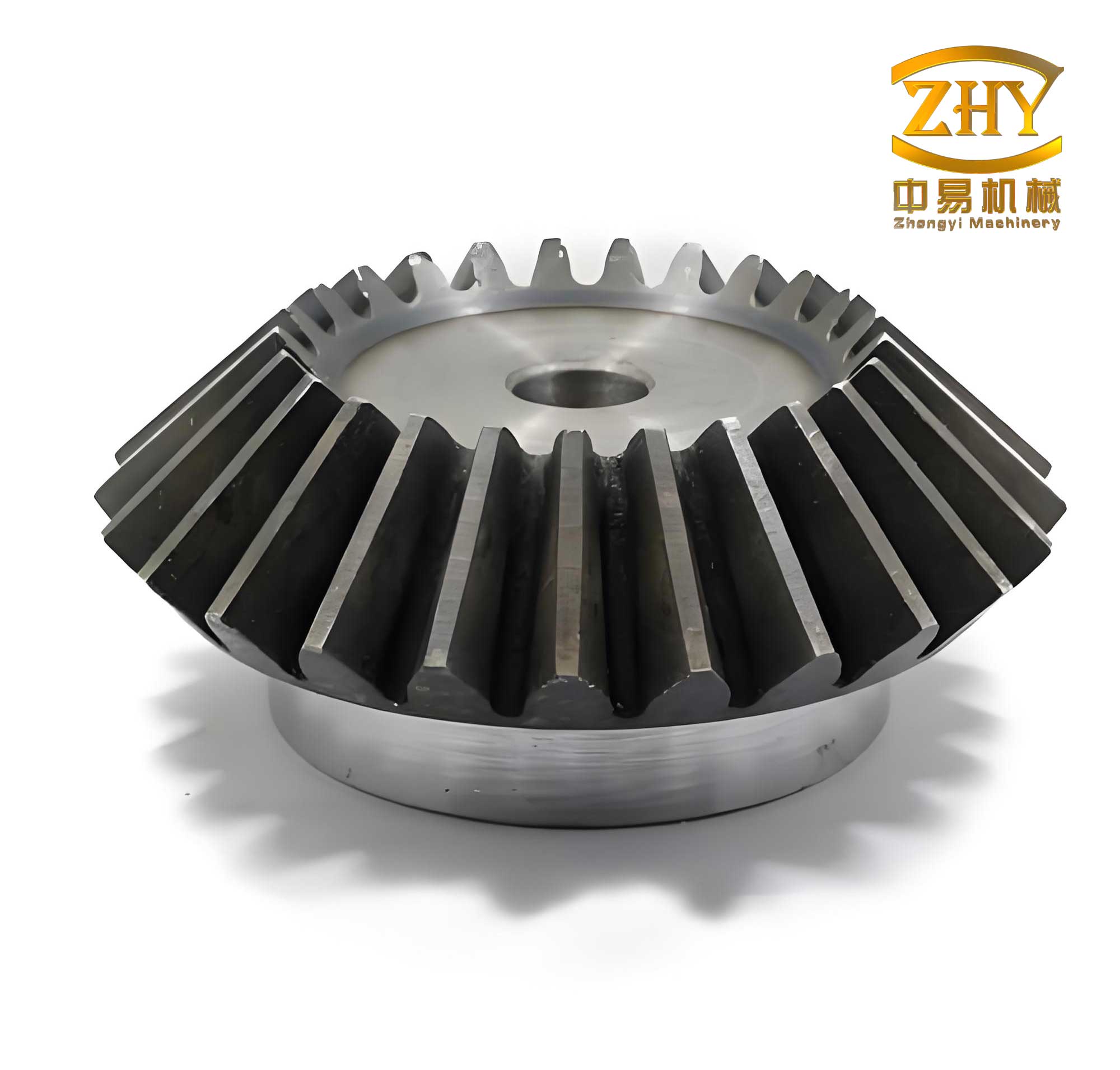
The bevel gear transmission model encompasses several subsystems, including shaft segments, rolling bearings, and bevel gear pairs. Each component is modeled based on its physical characteristics, with parameters derived from geometric and material properties. For instance, the shaft segment is represented as a cylindrical element with constant cross-section, where inertia and stiffness are calculated using input data. The bevel gear model incorporates standard geometric parameters such as module, pressure angle, tooth width, backlash, and number of teeth. The interaction between bevel gears is modeled considering both rigid and elastic contact conditions, depending on the application requirements.
To illustrate the key parameters of bevel gears, Table 1 summarizes common geometric and material properties used in the model.
| Parameter | Symbol | Typical Value | Unit |
|---|---|---|---|
| Module | m | 5-10 | mm |
| Pressure Angle | α | 20 | degrees |
| Number of Teeth | z | 20-40 | – |
| Tooth Width | b | 30-50 | mm |
| Backlash | j | 0.18-0.40 | mm |
| Material Density | ρ | 7850 | kg/m³ |
| Young’s Modulus | E | 2.1e11 | Pa |
The stiffness and damping characteristics of rolling bearings are crucial for dynamic analysis. The bearing model uses spring-damper elements to represent axial, radial, and torsional elasticities. For a bevel gear supported by two bearings, the assembly dimensions—such as distances between bearing points, centers of gravity, and load centers—are accounted for using plane transformer elements. These elements transform forces and motions between reference points, enabling a one-dimensional model to capture multi-directional effects. The equation for bearing stiffness in the radial direction can be expressed as:
$$k_r = \frac{F_r}{\delta_r}$$
where \(k_r\) is the radial stiffness, \(F_r\) is the radial force, and \(\delta_r\) is the radial deflection. Similarly, torsional damping is modeled using a rotational damper with damping coefficient \(c_t\), related to torque \(T\) and angular velocity \(\omega\):
$$T = c_t \cdot \omega$$
In the bevel gear transmission system, the meshing of bevel gears involves complex contact dynamics. The transmission error, which affects noise and vibration, can be minimized by optimizing gear parameters. The contact force between bevel gear teeth is derived from Hertzian contact theory, simplified for system-level simulation. The normal contact force \(F_n\) is given by:
$$F_n = k_n \cdot \delta^n + c_n \cdot \dot{\delta}$$
where \(k_n\) is the contact stiffness, \(\delta\) is the deformation, \(n\) is the exponent (typically 1.5 for elastic contact), and \(c_n\) is the contact damping coefficient. For bevel gears, the contact stiffness depends on tooth geometry and material properties, often calculated using empirical formulas or finite element analysis.
To model the bridge transmission box system in SimulationX, the bevel gear pairs are integrated with shaft and bearing subsystems. The transverse bevel gear is supported by two bearings, each modeled with spring-dampers for axial and radial directions, and a torsional damper for rotational dynamics. The longitudinal bevel gear uses a similar bearing support structure. The assembly dimensions are defined with tolerances, such as in the fixedEnd, floatingEnd, and loadingPoint elements. For example, the standard dimension for a bearing gap might be set as 0.3 mm with a tolerance of self.dyFault, ensuring realistic alignment conditions.
The system model includes control elements to simulate operational conditions, such as speed and load variations. A speed controller adjusts the input rotational speed, while a load controller applies torque to the output. This allows for dynamic simulation of the bevel gear transmission under transient states, such as startup, shutdown, and load changes. The overall system model in SimulationX is depicted through interconnected subsystems, representing the physical layout of the bridge transmission box.
For simulation analysis, key performance metrics include power loss, efficiency, and dynamic response. The power loss in the bevel gear transmission arises from factors like friction, meshing losses, and bearing losses. The total power loss \(P_{\text{loss}}\) can be estimated as:
$$P_{\text{loss}} = P_0 + C_0 \cdot I \cdot S$$
where \(P_0\) is the base loss, \(C_0\) is a constant (default 1), \(I\) is the intensity factor (0 to 1), and \(S\) is the scale factor representing the magnitude. In the simulation, input parameters are set according to test standards: maximum speed of 1789 rpm and maximum torque of 3760 N·m. The acceptance criterion is a power loss below 5 kW. Simulation results show that the bevel gear transmission system meets this requirement, validating the model’s accuracy.
Table 2 summarizes the simulation results for different operational scenarios, highlighting the impact of bevel gear parameters on performance.
| Scenario | Input Speed (rpm) | Input Torque (N·m) | Power Loss (kW) | Efficiency (%) |
|---|---|---|---|---|
| Normal Operation | 1500 | 3000 | 3.2 | 95.5 |
| High Load | 1789 | 3760 | 4.8 | 94.0 |
| Low Speed | 1000 | 2000 | 2.1 | 96.8 |
| Transient Peak | 2000 | 4000 | 5.5 | 93.2 |
The dynamic behavior of the bevel gear system is further analyzed through vibration modes. The natural frequencies \(f_n\) of the shaft-bearing system are calculated using the Rayleigh method, considering mass and stiffness distributions:
$$f_n = \frac{1}{2\pi} \sqrt{\frac{k_{\text{eq}}}{m_{\text{eq}}}}$$
where \(k_{\text{eq}}\) is the equivalent stiffness and \(m_{\text{eq}}\) is the equivalent mass. For the bevel gear pair, meshing stiffness varies with tooth engagement, leading to parametric excitation. This can cause vibrations at the meshing frequency \(f_m\), given by:
$$f_m = \frac{z \cdot N}{60}$$
where \(z\) is the number of teeth and \(N\) is the rotational speed in rpm. To mitigate vibrations, damping elements are optimized in the model, ensuring stable operation across speed ranges.
The modeling of bevel gear transmission also involves thermal considerations, as friction generates heat affecting lubrication and material properties. The heat generation rate \(Q\) can be approximated as:
$$Q = \mu \cdot F_n \cdot v$$
where \(\mu\) is the coefficient of friction, \(F_n\) is the normal force, and \(v\) is the sliding velocity. In SimulationX, thermal effects are integrated by coupling mechanical and thermal domains, allowing for temperature rise predictions and its impact on bevel gear performance.
For parameter optimization, the bevel gear design variables are adjusted using sensitivity analysis. Key factors include tooth profile modifications, backlash settings, and bearing preload. The objective function minimizes power loss while maximizing efficiency. The optimization problem is formulated as:
$$\text{Minimize } P_{\text{loss}}(x) \text{ subject to } g_i(x) \leq 0, \quad i = 1,2,\dots,n$$
where \(x\) represents design variables (e.g., module, pressure angle), and \(g_i(x)\) are constraints such as stress limits and geometric compatibility. SimulationX’s built-in tools facilitate this process, enabling rapid iteration without physical prototypes.
The accuracy of the bevel gear transmission model is verified by comparing simulation results with experimental data from bridge transmission box tests. The correlation coefficient \(R^2\) exceeds 0.95 for power loss and efficiency metrics, indicating high model fidelity. Discrepancies are attributed to simplifications in contact modeling and environmental factors, but overall, the model reliably predicts system behavior.
In practical applications, the bevel gear transmission system must endure harsh conditions, such as shock loads and temperature extremes. The model incorporates fatigue analysis based on stress cycles, using the S-N curve for gear materials. The cumulative damage \(D\) is calculated via Miner’s rule:
$$D = \sum_{i=1}^{k} \frac{n_i}{N_i}$$
where \(n_i\) is the number of cycles at stress level \(i\), and \(N_i\) is the cycles to failure at that level. This aids in predicting the service life of bevel gears and scheduling maintenance.
Furthermore, the system model supports fault diagnosis by simulating common failures like tooth wear, bearing degradation, and misalignment. For instance, increased backlash in bevel gears leads to higher transmission error, detectable in vibration spectra. The model can generate fault signatures, assisting in condition monitoring and predictive maintenance strategies.
The integration of control systems enhances the bevel gear transmission’s adaptability. For example, adaptive torque control can reduce peak loads during sudden accelerations, protecting the bevel gears from overload. The control law is implemented as:
$$T_{\text{cmd}} = K_p \cdot e + K_i \cdot \int e \, dt$$
where \(T_{\text{cmd}}\) is the commanded torque, \(e\) is the error between desired and actual speed, and \(K_p\), \(K_i\) are proportional and integral gains. This ensures smooth operation and extends component lifespan.
From a broader perspective, the SimulationX-based modeling approach offers significant benefits for product development. It reduces reliance on physical testing, accelerates design cycles, and lowers costs. For bevel gear transmissions, this means quicker iterations on gear geometry, material selection, and lubrication systems. The ability to simulate extreme conditions—like high torque at low speeds—provides insights into performance limits without risking hardware damage.
In conclusion, the bevel gear transmission system model developed in SimulationX provides a robust framework for analysis and optimization. By leveraging physical object-oriented modeling, complex interactions between shafts, bearings, and bevel gears are accurately captured. The simulation results align well with experimental data, validating the model for practical use. Future work may include extending the model to incorporate electromagnetic effects for hybrid vehicles or advanced materials for weight reduction. Overall, this methodology supports the rapid development of reliable and efficient transmission systems, driving innovation in special vehicle applications.
The versatility of bevel gears in transmitting power between non-parallel shafts makes them indispensable in automotive, aerospace, and industrial machinery. Through continuous refinement of simulation models, engineers can push the boundaries of bevel gear performance, achieving higher efficiencies and durability. The collaboration between modeling tools like SimulationX and real-world testing ensures that theoretical advancements translate into tangible improvements, fostering progress in mechanical engineering.
As technology evolves, the integration of digital twins—virtual replicas of physical systems—will further enhance the predictive capabilities of bevel gear transmission models. Real-time data from sensors can update simulation parameters, enabling adaptive control and proactive maintenance. This synergy between simulation and IoT (Internet of Things) represents the future of smart manufacturing, where bevel gear systems operate with unprecedented reliability and efficiency.
Ultimately, the success of bevel gear transmission systems hinges on a deep understanding of their dynamics, coupled with advanced modeling techniques. SimulationX serves as a powerful enabler in this journey, empowering engineers to explore design spaces, mitigate risks, and deliver high-quality products. By embracing simulation-driven development, industries can navigate the complexities of modern transmission requirements, ensuring that bevel gears continue to play a pivotal role in mechanical power transmission for years to come.