
As a researcher focused on mechanical dynamics, I have extensively studied the vibration behavior of spur gears, which are critical components in many industrial transmission systems due to their stable instantaneous transmission ratio, high efficiency, and long service life. However, spur gears are prone to failures such as tooth root cracks, which can significantly impact performance, increase vibration and noise, and even lead to catastrophic failure. In practical applications, spur gears often operate under variable conditions, including speed fluctuations and load changes, making vibration analysis challenging. This article delves into the vibration characteristics of spur gears with crack faults under both stable and variable working conditions, utilizing analytical models, numerical simulations, and experimental validation. Throughout this work, the term “spur gears” will be emphasized to highlight their importance in mechanical systems.
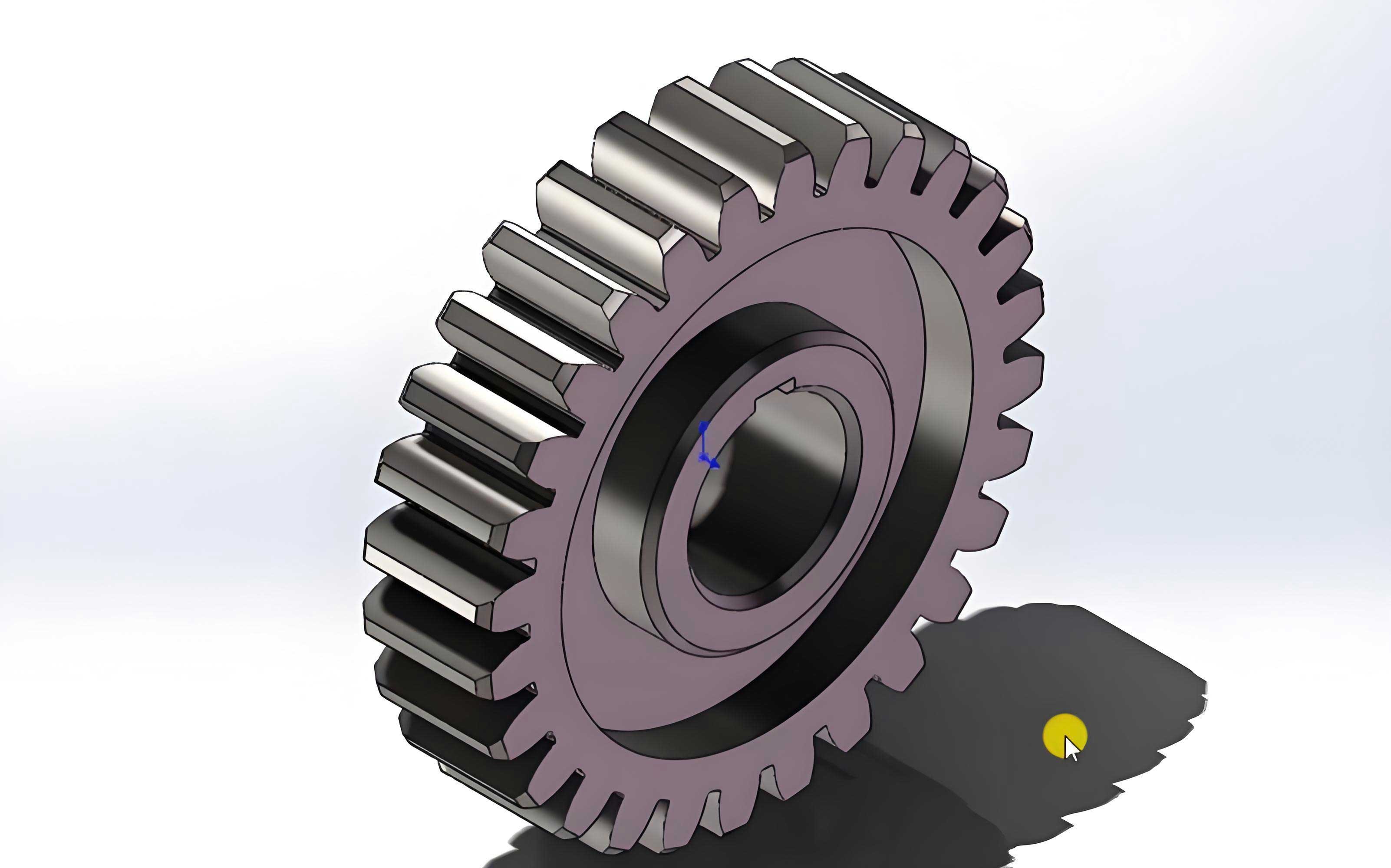
In my analysis, I consider spur gears with a tooth root crack fault. The time-varying meshing stiffness is a key dynamic excitation source for spur gears, and its calculation is essential for understanding vibration patterns. Based on the potential energy method, I derive analytical expressions for the time-varying meshing stiffness when a local crack fault is present. The stiffness components include bending stiffness, shear stiffness, axial compressive stiffness, Hertzian contact stiffness, and fillet foundation stiffness. For a spur gear pair with a crack in the driving gear, the stiffness reduction primarily affects the bending, shear, and axial compressive stiffnesses due to changes in the tooth’s moment of inertia and cross-sectional area. The crack is modeled as a straight line with depth \(q_1\) and angle \(\gamma\) relative to the tooth centerline.
The bending stiffness \(k_b\) for a cracked tooth can be expressed as:
$$
\frac{1}{k_b} = \int_{-\alpha_g}^{-\alpha_1} \frac{3\{1 + \cos \alpha_1[(\alpha_2 – \alpha) \sin \alpha – \cos \alpha]\}^2 (\alpha_2 – \alpha) \cos \alpha}{E L \{[\sin \alpha + (\alpha_2 – \alpha) \cos \alpha]^3 + [\sin \alpha_2 – (q_1 / R_b) \sin \gamma]^3\}} d\alpha + \int_{-\alpha_g}^{\alpha_2} \frac{3\{1 + \cos \alpha_1[(\alpha_2 – \alpha) \sin \alpha – \cos \alpha]\}^2 (\alpha_2 – \alpha) \cos \alpha}{2E L [\sin \alpha + (\alpha_2 – \alpha) \cos \alpha]^3} d\alpha
$$
where \(E\) is the elastic modulus, \(L\) is the tooth width, \(R_b\) is the base circle radius, \(\alpha_1\) and \(\alpha_2\) are angles defining the tooth profile, and \(\alpha_g\) is the contact angle. Similarly, the shear stiffness \(k_s\) and axial compressive stiffness \(k_a\) are given by:
$$
\frac{1}{k_s} = \int_{-\alpha_g}^{-\alpha_1} \frac{1.2(1 + \nu) (\cos \alpha_1)^2 (\alpha_2 – \alpha) \cos \alpha}{E L \left[ \sin \alpha_2 – (q_1 / R_b) \sin \gamma + \sin \alpha + (\alpha_2 – \alpha) \cos \alpha \right]} d\alpha + \int_{-\alpha_g}^{\alpha_2} \frac{1.2(1 + \nu) (\cos \alpha_1)^2 (\alpha_2 – \alpha) \cos \alpha}{E L [\sin \alpha + (\alpha_2 – \alpha) \cos \alpha]} d\alpha
$$
and
$$
\frac{1}{k_a} = \int_{-\alpha_g}^{-\alpha_1} \frac{(\alpha_2 – \alpha) (\sin \alpha_1)^2}{E L \left[ \sin \alpha_2 – (q_1 / R_b) \sin \gamma + \sin \alpha + (\alpha_2 – \alpha) \cos \alpha \right]} d\alpha + \int_{-\alpha_g}^{\alpha_2} \frac{(\alpha_2 – \alpha) (\sin \alpha_1)^2}{2E L [\sin \alpha + (\alpha_2 – \alpha) \cos \alpha]} d\alpha
$$
with \(\nu\) as Poisson’s ratio. The total time-varying meshing stiffness \(k_t\) for the spur gear pair is the sum of these components, along with the Hertzian contact stiffness and fillet foundation stiffness, which remain largely unaffected by the crack. For a spur gear pair with parameters as listed in Table 1, the calculated stiffness shows a periodic variation, with reductions in both single- and double-tooth contact regions when the cracked tooth engages.
| Parameter | Driving Gear | Driven Gear |
|---|---|---|
| Module \(m\) (mm) | 1.5 | 1.5 |
| Number of Teeth \(z\) | 23 | 81 |
| Pressure Angle \(\alpha_0\) (°) | 20 | 20 |
| Tooth Width \(L\) (mm) | 26 | 26 |
| Elastic Modulus \(E\) (GPa) | 206 | 206 |
| Poisson’s Ratio \(\nu\) | 0.3 | 0.3 |
| Bore Diameter \(D\) (mm) | 19.5 | 32.5 |
To analyze the vibration response, I develop an 8-degree-of-freedom dynamic model for the spur gear transmission system using Lagrange’s equations. The model includes translational and rotational motions for both gears, as well as the input and output shafts. The dynamic equations are:
Input shaft equation:
$$
I_m \ddot{\theta}_m + c_p (\dot{\theta}_m – \dot{\theta}_1) + k_p (\theta_m – \theta_1) = M_1
$$
Output shaft equation:
$$
I_b \ddot{\theta}_b + c_g (\dot{\theta}_b – \dot{\theta}_2) + k_g (\theta_b – \theta_2) = -M_2
$$
Driving gear equations:
$$
I_1 \ddot{\theta}_1 – c_p (\dot{\theta}_m – \dot{\theta}_1) – k_p (\theta_m – \theta_1) = -R_{b1} F_M, \quad m_1 \ddot{x}_1 + c_{x1} \dot{x}_1 + k_{x1} x_1 = 0, \quad m_1 \ddot{y}_1 + c_1 \dot{y}_1 + k_1 y_1 = F_M
$$
Driven gear equations:
$$
I_2 \ddot{\theta}_2 – c_g (\dot{\theta}_b – \dot{\theta}_2) – k_g (\theta_b – \theta_2) = R_{b2} F_M, \quad m_2 \ddot{x}_2 + c_{x2} \dot{x}_2 + k_{x2} x_2 = 0, \quad m_2 \ddot{y}_2 + c_2 \dot{y}_2 + k_2 y_2 = -F_M
$$
where \(F_M\) is the dynamic meshing force, given by:
$$
F_M = F_k + F_c, \quad F_k = k_t (R_{b1} \theta_1 – R_{b2} \theta_2 – y_1 + y_2 – \tilde{e}(t)), \quad F_c = c_t (R_{b1} \dot{\theta}_1 – R_{b2} \dot{\theta}_2 – \dot{y}_1 + \dot{y}_2 – \dot{\tilde{e}}(t))
$$
Here, \(\tilde{e}(t) = e_0 + e_m \sin(2\pi f_m t + \phi)\) is the transmission error, with \(e_0\) as the mean and \(e_m\) as the amplitude. The parameters for the dynamic model are summarized in Table 2. I solve these equations numerically using the Runge-Kutta method to obtain the vibration signals, focusing on the acceleration \(\ddot{y}_1\) in the meshing direction.
| Parameter | Value |
|---|---|
| Driving gear mass \(m_1\) (kg) | 0.96 |
| Driven gear mass \(m_2\) (kg) | 2.88 |
| Driving gear moment of inertia \(I_1\) (kg·m²) | 4.3659 × 10⁻⁴ |
| Driven gear moment of inertia \(I_2\) (kg·m²) | 8.3620 × 10⁻⁴ |
| Motor moment of inertia \(I_m\) (kg·m²) | 0.0021 |
| Load moment of inertia \(I_b\) (kg·m²) | 0.0105 |
| Shaft torsional stiffness \(k_p, k_g\) (Nm/rad) | 4.4 × 10⁴ |
| Shaft torsional damping \(c_p, c_g\) (Nms/rad) | 5.0 × 10⁵ |
| Bearing support stiffness \(k_1, k_2\) (N/m) | 6.56 × 10⁷ |
| Bearing support damping \(c_1, c_2\) (Ns/m) | 1.8 × 10⁵ |
| Mean transmission error \(e_0\) (m) | 2 × 10⁻⁵ |
| Transmission error amplitude \(e_m\) (m) | 3 × 10⁻⁵ |
Under stable working conditions, I investigate the vibration characteristics of spur gears with crack faults by varying the rotational speed and load torque. For a crack depth of 0.5 mm and angle of 70°, the vibration time-domain signals show periodic impulse impacts corresponding to the rotational frequency \(f_r\) of the driving gear. As the speed increases, both the normal vibration amplitude and impulse impact amplitude increase. The frequency-domain analysis via Fast Fourier Transform (FFT) reveals that the primary frequency components are the meshing frequency \(f_m\) and its harmonics, with sidebands generated by modulation between \(f_m\) and \(f_r\). The sideband spacing equals \(f_r\), and they are predominantly located in the low-frequency range, such as between \(f_m\) and \(4f_m\). Similarly, as the load torque increases, the vibration amplitudes grow, and the sideband magnitudes increase without significant distribution changes. This behavior is summarized in Table 3 for different speeds and loads.
| Condition | Effect on Vibration Amplitude | Sideband Characteristics |
|---|---|---|
| Increasing rotational speed | Amplitude increases | Sideband spacing = \(f_r\), magnitudes increase, located in low-frequency range |
| Increasing load torque | Amplitude increases | Sideband magnitudes increase, distribution remains similar |
Under variable working conditions, such as speed acceleration, speed fluctuations, and load changes, the vibration signals of spur gears become non-stationary. Traditional FFT analysis may lead to frequency smearing, making it difficult to identify characteristic frequencies. Therefore, I employ the Short-Time Fourier Transform (STFT) to process these signals. For acceleration from 20 Hz to 50 Hz over 2 seconds, the time-domain signal shows decreasing intervals between impulse impacts as speed rises, and the amplitude increases. The STFT time-frequency representation clearly depicts the increasing meshing frequency and its harmonics, along with impulse impacts whose intervals shorten over time. This allows for tracking speed variations and fault severity. In cases of speed fluctuations, where the actual rotational frequency \(f_{ir}\) is given by:
$$
f_{ir} = f_r + f_{ro} \sin(2\pi f_r t + \phi)
$$
with \(f_{ro}\) as the fluctuation amplitude, the vibration amplitude modulates with speed, and the STFT shows frequency variations and impulse interval changes. For variable load conditions, such as a ramp from 20 N·m to 50 N·m at constant speed, the vibration amplitude increases with load, and the STFT reflects this through rising magnitudes in the time-frequency plot. These findings highlight the effectiveness of STFT in analyzing non-stationary signals from spur gears under variable conditions.
To validate the theoretical models, I conduct experimental tests using a gearbox test bench with a spur gear pair matching the parameters in Table 1. The driving gear has a crack fault with a depth of 0.5 mm and angle of 70°. Accelerometers measure vibration signals in the vertical direction, close to the meshing line. Under stable conditions at 1200 rpm and 50 N·m load, the time-domain signal exhibits periodic impulses with intervals corresponding to \(f_r = 20\) Hz, and the frequency domain shows meshing frequency components and sidebands between \(f_m\) and \(2f_m\), consistent with simulations. Under variable conditions, such as acceleration from 1200 rpm to 2100 rpm, the vibration amplitude increases, and the STFT reveals rising meshing frequencies and shortening impulse intervals, confirming the speed change. For variable load tests, increasing torque from 20 N·m to 35 N·m results in higher vibration amplitudes, though minor speed fluctuations cause frequency jumps in high harmonics. The experimental results align well with the theoretical predictions, verifying the accuracy of the models and the utility of STFT for spur gear fault diagnosis under variable conditions.
In conclusion, my analysis demonstrates that spur gears with crack faults exhibit distinct vibration characteristics under both stable and variable working conditions. The time-varying meshing stiffness model effectively captures the stiffness reduction due to cracks, and the dynamic model predicts vibration responses accurately. Under stable conditions, vibration amplitudes increase with rotational speed and load torque, and sidebands in the frequency domain provide fault indicators. Under variable conditions, STFT proves valuable for analyzing non-stationary signals, revealing impulse impacts and frequency variations that reflect speed and load changes. Experimental tests corroborate these findings, underscoring the robustness of the approach. This work contributes to the fault detection and health assessment of spur gears in practical applications, where variable conditions are common. Future studies could explore deeper crack propagation effects or integrate advanced signal processing techniques for real-time monitoring of spur gears.