
Gears are fundamental components in mechanical transmission systems, widely utilized across various industries such as automotive, aerospace, and robotics. The continuous advancement of high-end manufacturing has spurred significant demand for high-precision, hard-faced gears. Internal gear power honing is a prevalent finishing process for hard gear surfaces. It offers distinct advantages, including the generation of a special “herringbone” texture on the machined tooth surface, which effectively suppresses transmission noise, lower processing temperatures compared to gear grinding, and the induction of beneficial residual compressive stresses. However, the honing force fluctuates during the process due to varying engagement conditions. This fluctuation can easily excite self-excited vibrations in the machine tool, adversely affecting the surface quality and dimensional accuracy of the workpiece gear, reducing machining efficiency, and potentially leading to premature tool failure. Therefore, establishing a mathematical model for the gear honing force and a dynamic model of the honing wheel-workpiece system is crucial. Analyzing the influence of different process parameters on machining accuracy holds significant theoretical and engineering value for studying chatter mechanisms and enhancing process stability in gear honing.
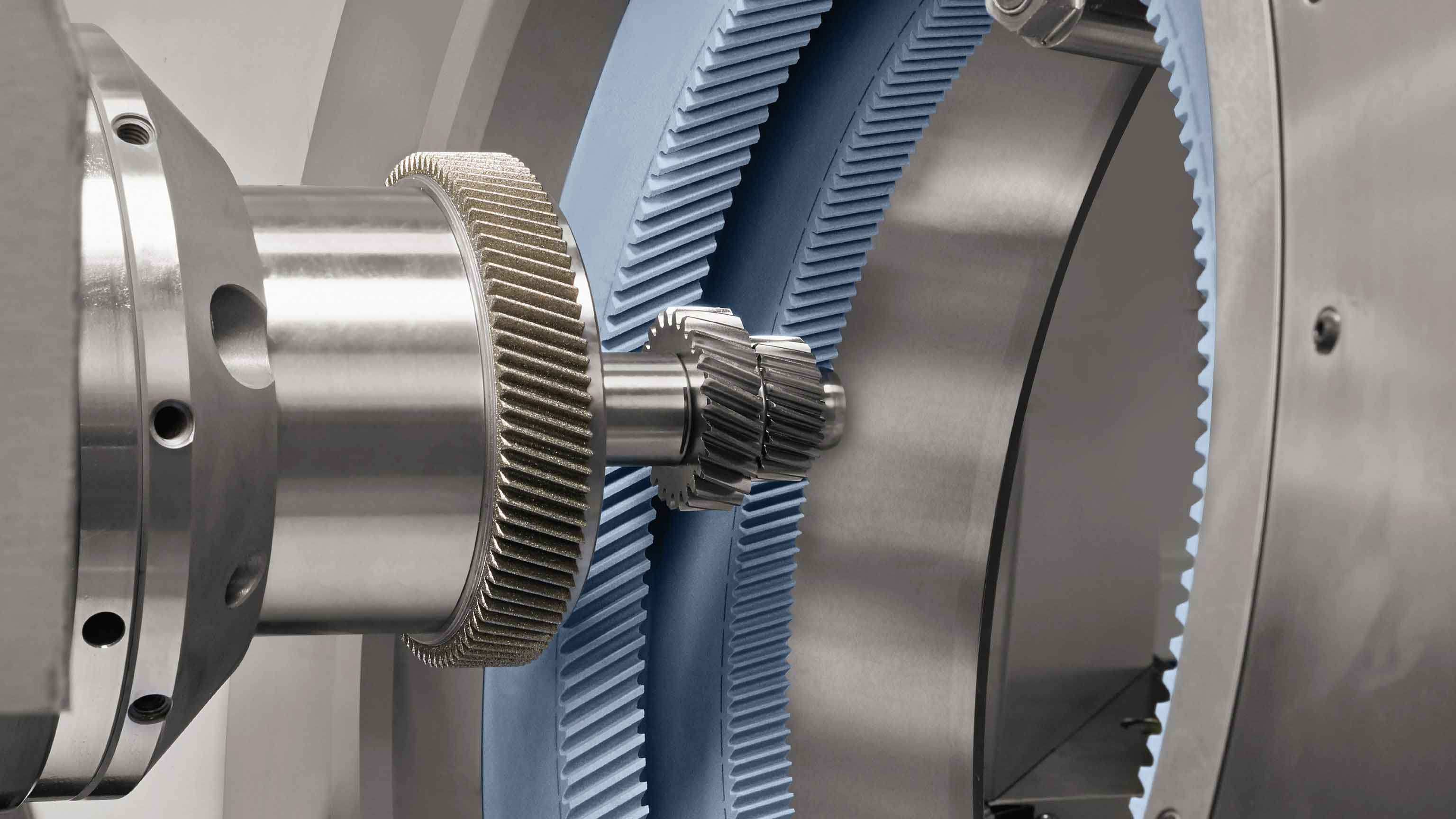
The internal gear power gear honing process is essentially a generating machining method where the relative motion between the tool and workpiece resembles that of crossed helical gears. The honing wheel, shaped like an internal gear with abrasive grains bonded to its base, and the workpiece gear have intersecting axes at a shaft angle Σ, determined by their helical angles:
$$ \Sigma = \beta_2 – \beta_1 $$
where $\beta_1$ is the workpiece helix angle (negative for left-hand, positive for right-hand) and $\beta_2$ is the honing wheel helix angle. During operation, the workpiece spindle (C2) and the honing wheel spindle (C1) are synchronously driven via an electronic gearbox following the relationship:
$$ \frac{\omega_2}{\omega_1} = \frac{Z_1}{Z_2} \pm \frac{v_z \cdot 360 \cdot \sin \beta_1}{\pi \cdot m_n \cdot Z_2} $$
where $\omega_1$ and $\omega_2$ are angular velocities, $Z_1$ and $Z_2$ are tooth numbers, $v_z$ is the axial feed velocity, and $m_n$ is the normal module. Concurrently, a radial feed motion (X-axis) is applied to remove material. Common feed strategies include radial feed only, discontinuous radial-axial feed, and continuous radial-axial feed, each with specific applications concerning efficiency and accuracy.
To model the gear honing force, the geometric engagement must first be defined. Based on gear meshing theory, the mathematical model of the workpiece tooth surface, a standard involute helicoid, is established in its moving coordinate system $S_1(O_1-x_1y_1z_1)$:
$$ \begin{aligned}
x_1 &= r_{b1}[\cos(\sigma_0 + \theta + \lambda) + \lambda \sin(\sigma_0 + \theta + \lambda)] \\
y_1 &= r_{b1}[\sin(\sigma_0 + \theta + \lambda) – \lambda \cos(\sigma_0 + \theta + \lambda)] \\
z_1 &= p \cdot \theta
\end{aligned} $$
where $r_{b1}$ is the base radius, $\sigma_0$ is the half tooth angle on the base circle, $\theta$ is the helical parameter, $\lambda$ is the involute roll angle, and $p$ is the spiral parameter ($p = r_{b1} / \tan \beta_1$). The contact line between the honing wheel and the workpiece tooth surface must satisfy the conjugate condition that the relative velocity $\mathbf{v}_{12}$ is perpendicular to the common surface normal $\mathbf{n}$ at the contact point:
$$ \mathbf{v}_{12} \cdot \mathbf{n} = 0 $$
Solving this equation yields the contact line on the workpiece surface for a given rotation angle $\phi_1$. The honing wheel tooth surface can then be derived as the envelope of all contact lines transformed into the honing wheel coordinate system $S_2$, using the coordinate transformation matrix $\mathbf{M}_{21}$:
$$ \mathbf{r}_2 = \mathbf{M}_{21} \cdot \mathbf{r}_1 $$
This forms the theoretical basis for analyzing the contact geometry during gear honing.
The gear honing force arises from the interaction between abrasive grains on the honing wheel and the workpiece material, involving three stages: sliding, ploughing, and chip formation. To predict the honing force, the complex contact is discretized. The honing process is viewed as an aggregation of numerous micro-cutting edges on the honing wheel surface. The force model for each micro-edge is based on a generalized plane grinding model that considers chip formation, friction, and ploughing components. The tangential ($F_t’$) and normal ($F_n’$) grinding force per unit length are given by:
$$ F_n’ = K \frac{V_w}{V_c} a + \frac{K_1 V_w}{V_c} \sqrt{\frac{a}{d_e}} + K_4 d_e^{b_0} a^{c_0} C_s^{a_0} \left( \frac{V_w}{V_c} \right) (ad_e)^{1/2} $$
$$ F_t’ = K’ \frac{V_w}{V_c} a + \left( \frac{K_3 V_w}{V_c} \sqrt{\frac{a}{d_e}} + K_2 \right) a + K_5 d_e^{b_0} a^{c_0} C_s^{a_0} \left( \frac{V_w}{V_c} \right) (ad_e)^{1/2} $$
where $V_w$ is the workpiece speed, $V_c$ is the wheel speed, $a$ is the depth of cut, $d_e$ is the equivalent grinding wheel diameter, $C_s$ is the static cutting edge density, and $K, K’, K_1, K_2, K_3, K_4, K_5, a_0, b_0, c_0$ are constants related to the workpiece and wheel properties.
For gear honing, the parameters for each discrete segment of the contact line are calculated: the local relative speed $\mathbf{v}_{12}$, the actual cutting depth $a$ (considering elastic deflection of the wheel and workpiece), and the local equivalent radius (curvature radius of the involute at that point, $\rho = r_{b1} \cdot \lambda$). The force on a micro-segment $dl$ is:
$$ d\mathbf{F}(k,i) = (F_n’ \mathbf{n} + F_t’ \mathbf{v}_{12}^0) dl $$
where $\mathbf{n}$ is the unit normal vector and $\mathbf{v}_{12}^0$ is the unit vector of relative velocity. The total honing force on the wheel is obtained by summing the vector forces from all active micro-segments across all contacting tooth pairs:
$$ \mathbf{F} = \sum_{k=1}^{m} \sum_{i=1}^{n} d\mathbf{F}(k,i) $$
The model predicts that honing force increases linearly with radial feed and decreases with increasing workpiece rotational speed. Experimental validation on a Fassler HMX-400 CNC gear honing machine showed good agreement between predicted and measured radial force trends, confirming the model’s accuracy.
| Process Parameter | Effect on Honing Force | Underlying Reason |
|---|---|---|
| Increase in Workpiece Speed ($n_2$) | Force decreases | More grains engaged per unit time, reducing uncut chip thickness. |
| Increase in Radial Feed ($f_x$) | Force increases linearly | Increased depth of cut and engaged contact area. |
The dynamic characteristics of the gear honing machine significantly influence process stability. Modal analysis of a Y4830CNC honing machine reveals its natural frequencies and mode shapes. The first six natural frequencies of the complete machine are listed below.
| Mode Order | Natural Frequency (Hz) | Mode Shape Description |
|---|---|---|
| 1 | 108.26 | Vertical swinging of the honing wheel headstock. |
| 2 | 116.74 | Lateral swinging of the honing wheel headstock. |
| 3 | 167.02 | Symmetric swing of headstock and workpiece column about YOZ plane. |
| 4 | 194.49 | Lateral swing of headstock and column. |
| 5 | 219.17 | Vertical vibration of bed/column with headstock lateral swing. |
| 6 | 249.70 | Symmetric swing of the whole machine about its centerline. |
The primary excitation frequency during gear honing is related to the tooth-passing frequency: $f = n_2 \cdot Z_1 / 60$. To avoid resonance, spindle speeds that result in excitation frequencies near the machine’s natural frequencies should be avoided. Further analysis of the workpiece spindle and honing wheel headstock subsystems identified their weak directions (primarily X and Y translations) and confirmed that reducing overhang lengths and adding rib reinforcements can improve dynamic stiffness.
The vibration during gear honing directly affects machining accuracy. A 4-degree-of-freedom (4-DOF) lumped parameter dynamic model is established, considering the translational vibrations of the honing wheel and workpiece in the X and Y directions.
$$ \begin{aligned}
m_{x1}\ddot{x}_1 + c_{x1}\dot{x}_1 + k_{x1}x_1 &= F_x(t) \\
m_{y1}\ddot{y}_1 + c_{y1}\dot{y}_1 + k_{y1}y_1 &= F_y(t) \\
m_{x2}\ddot{x}_2 + c_{x2}\dot{x}_2 + k_{x2}x_2 &= -F_x(t) \\
m_{y2}\ddot{y}_2 + c_{y2}\dot{y}_2 + k_{y2}y_2 &= -F_y(t)
\end{aligned} $$
Here, $m$, $c$, $k$ represent equivalent mass, damping, and stiffness in respective directions, and $F_x(t)$, $F_y(t)$ are the time-varying honing force components from the prediction model. The relative dynamic displacement error between the wheel and workpiece is:
$$ \begin{aligned}
\epsilon_x(t) &= (x_1(t) – x_2(t)) – (\bar{x}_1 – \bar{x}_2) \\
\epsilon_y(t) &= (y_1(t) – y_2(t)) – (\bar{y}_1 – \bar{y}_2)
\end{aligned} $$
where $\bar{x}, \bar{y}$ are static deflections. This dynamic error modifies the instantaneous cutting depth and the generated tooth profile. The resulting single pitch error $F_{pt}$ on the workpiece gear can be derived from geometric relations:
$$ F_{pt} = 2\epsilon_y + \frac{2 \tan \alpha_n}{\cos \beta_1} \epsilon_x $$
where $\alpha_n$ is the normal pressure angle and $\beta_1$ is the workpiece helix angle. Solving the dynamic equations using the 4th-order Runge-Kutta method reveals the system’s response. Analysis shows that increasing the workpiece speed reduces the peak-to-peak dynamic displacement error and, consequently, the single pitch error. Conversely, increasing the radial feed increases both vibration amplitude and pitch error.
| Process Parameter Change | Effect on Dynamic Error ($\epsilon_{x}, \epsilon_{y}$) | Effect on Single Pitch Error ($F_{pt}$) |
|---|---|---|
| Increase Workpiece Speed | Peak-to-peak amplitude decreases. | Decreases. |
| Increase Radial Feed | Peak-to-peak amplitude increases. | Increases (approximately linear). |
In conclusion, this study systematically investigates the internal gear power gear honing process. A honing force prediction model was developed by discretizing the engagement geometry and applying a micro-scale grinding model, validated with experimental data. Dynamic analysis of the machine tool structure identified critical natural frequencies and weak stiffness directions, providing guidance for structural optimization and process parameter selection to avoid resonance. Furthermore, a 4-DOF dynamic model of the honing process was established, linking the dynamic relative vibration between the wheel and workpiece to the generated gear pitch error. The analysis quantified the influence of key process parameters: higher workpiece speeds and lower radial feeds generally lead to reduced vibration and improved gear accuracy. These findings provide a theoretical foundation for enhancing the stability, precision, and efficiency of the internal gear power gear honing process. Future work could focus on modeling force variations under non-uniform stock conditions, incorporating thermo-elastic effects and torsional dynamics into the vibration model, and conducting experimental validation of the machine tool’s dynamic characteristics and the process dynamics model.