
In the field of elevator inspection and maintenance, the balance coefficient is a critical parameter for traction-driven elevators. It represents the proportion of the counterweight mass that balances the rated load, effectively reducing the load on the drive motor. According to safety regulations such as TSG T7001-2009, the balance coefficient for traction elevators must be between 0.40 and 0.50, or conform to the manufacturer’s design value. An incorrect balance coefficient can lead to severe safety incidents: if too low, a fully loaded car descending may cause a bottoming accident; if too high, an empty car ascending may result in a top collision. Traditional methods for measuring the balance coefficient, such as the current-load curve method (often referred to as the current method), involve loading the car with various percentages of the rated load (e.g., 30%, 40%, 45%, 50%, 60%) and recording the motor current during full-travel runs. While reliable, this method is time-consuming and labor-intensive, increasing the cost and duration of elevator inspections. In this article, I explore a novel approach—the no-load power method (referred to as the power method)—and investigate its applicability to worm gear drive elevators through theoretical analysis and practical case studies.
The power method is based on the physical principle that power is the rate of doing work, equal to the product of force and velocity. For an elevator system, the motor power during no-load operation can be derived from force analysis. Let \( W \) be the counterweight mass (in kg), \( P \) be the mass of the empty car and car-supported components such as part of the traveling cable and compensation ropes or chains (if any), \( v \) be the car velocity (in m/s), \( g_n \) be the gravitational acceleration (taken as 9.81 m/s²), \( \eta \) be the transmission efficiency of the elevator system, \( q \) be the balance coefficient under no-load conditions, and \( Q \) be the rated load (in kg). The motor power \( N \) during no-load operation is given by:
$$ N = \frac{(W – P) v g_n}{\eta} = \frac{q Q v g_n}{\eta} $$
During no-load operation, the counterweight side is always heavier than the car side. When the elevator descends empty, the motor operates in motoring mode; when it ascends empty, the motor operates in regenerative braking mode. By analyzing the power at the same horizontal position of the car and counterweight, the motor power during no-load descent \( N_x \) and no-load ascent \( N_s \) can be expressed as:
$$ N_x = q Q g_n v_x + q Q g_n v_x (1 – \eta_x) $$
$$ N_s = q Q g_n v_s – q Q g_n v_s (1 – \eta_s) $$
Here, \( v_x \) and \( v_s \) are the car velocities during no-load descent and ascent, respectively, at the same horizontal position, while \( \eta_x \) and \( \eta_s \) are the transmission efficiencies during no-load descent and ascent. Adding these equations and rearranging terms yields:
$$ \frac{N_x}{v_x} + \frac{N_s}{v_s} = 2 q Q g_n + q Q g_n (\eta_s – \eta_x) $$
From this, the balance coefficient \( q \) can be derived:
$$ q = \frac{N_x v_s + N_s v_x}{(2 + \eta_s – \eta_x) Q g_n v_s v_x} $$
The key insight is that if the transmission efficiencies during no-load ascent and descent are equal, i.e., \( \eta_x = \eta_s \), the equation simplifies to:
$$ q = \frac{N_x v_s + N_s v_x}{2 Q g_n v_s v_x} $$
This simplified formula is the theoretical foundation of the power method. Its applicability hinges on the condition that the transmission efficiency remains the same for both directions of operation under no-load conditions. In the following sections, I will examine whether this condition holds for different types of elevator drives, with a focus on worm gear systems.
The transmission efficiency of an elevator drive system plays a crucial role in determining the validity of the power method. For permanent magnet synchronous gearless elevators, the absence of intermediate transmission mechanisms means that the efficiency is high, typically around 95%, and is identical for both forward and reverse rotation. Thus, \( \eta_x = \eta_s \), making the power method directly applicable. However, for worm gear drive elevators, the situation is more complex due to the inherent characteristics of worm gears.
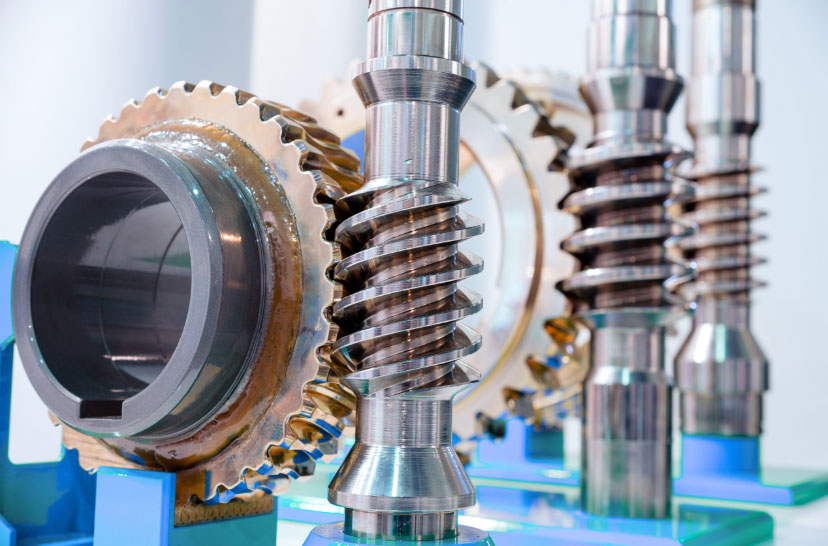
Worm gear drives are widely used in older elevator traction machines due to their large transmission ratio, smooth operation, compact structure, and self-locking properties. However, they suffer from relatively low transmission efficiency, typically around 70%. The efficiency of a worm gear drive \( \eta \) can be broken down into three components:
$$ \eta = \eta_1 \eta_2 \eta_3 $$
where \( \eta_1 \) is the meshing efficiency of the worm and worm wheel, \( \eta_2 \) is the bearing efficiency, and \( \eta_3 \) is the oil churning efficiency. The bearing and oil churning efficiencies are generally the same for both directions of rotation. The meshing efficiency \( \eta_1 \) depends primarily on the friction coefficient between the tooth surfaces of the worm and worm wheel during relative sliding. Under no-load conditions, regardless of whether the traction sheave is rotating forward or reverse, the counterweight side is always heavier than the car side. This means the torque on the sheave remains constant in magnitude and direction (excluding acceleration and deceleration phases). Due to the self-locking nature of worm gears, the worm always drives the worm wheel in both ascent and descent under no-load conditions. Consequently, the direction of force on the worm and worm wheel teeth remains unchanged, and the tooth surfaces in contact are consistent. Therefore, the friction coefficient for relative sliding between the tooth surfaces is the same for both operational directions, leading to identical meshing efficiency \( \eta_1 \). As a result, the overall transmission efficiency \( \eta \) is equal for no-load ascent and descent, i.e., \( \eta_x = \eta_s \). This theoretical analysis suggests that the power method is applicable to worm gear drive elevators as well.
To validate this theoretical conclusion, I conducted a practical case study involving four worm gear drive elevators in a residential complex. The elevators were of the same specification and model, installed in the same batch. Their parameters are summarized in the following table:
| Parameter | Value |
|---|---|
| Manufacturing Date | July 2002 |
| Equipment Type | Traction Passenger Elevator |
| Drive Type | Worm Gear Drive |
| Rated Load | 1000 kg |
| Rated Speed | 1.75 m/s |
| Number of Floors/Stops | 22/22 |
The elevators were labeled as Elevator A, Elevator B, Elevator C, and Elevator D. First, I used the traditional current method to measure their balance coefficients. The car was loaded with different percentages of the rated load, and the motor current was recorded during full-travel ascent and descent. The results are presented below:
| Elevator | Balance Coefficient (%) | Load Rate (%) | Actual Load (kg) | Ascent Current (A) | Descent Current (A) |
|---|---|---|---|---|---|
| A | 44.2 | 30 | 300 | 13.2 | 15.8 |
| 40 | 400 | 13.4 | 14.2 | ||
| 45 | 460 | 13.7 | 13.6 | ||
| 50 | 500 | 14.5 | 13.4 | ||
| 60 | 600 | 16.2 | 13.1 | ||
| B | 43.6 | 30 | 300 | 9.4 | 13.9 |
| 40 | 400 | 10.4 | 11.6 | ||
| 45 | 460 | 11.4 | 10.7 | ||
| 50 | 500 | 12.3 | 10.2 | ||
| 60 | 600 | 14.3 | 9.5 | ||
| C | 43.1 | 30 | 300 | 13.0 | 15.7 |
| 40 | 400 | 13.5 | 14.3 | ||
| 45 | 460 | 14.2 | 13.5 | ||
| 50 | 500 | 15.1 | 13.3 | ||
| 60 | 600 | 16.6 | 13.1 | ||
| D | 42.9 | 30 | 300 | 9.5 | 14.5 |
| 40 | 400 | 10.7 | 11.9 | ||
| 45 | 460 | 12.1 | 10.5 | ||
| 50 | 500 | 13.1 | 10.1 | ||
| 60 | 600 | 15.3 | 9.4 |
Next, I applied the power method using a specialized elevator balance coefficient detector. The instrument measures the motor power during no-load ascent and descent, along with the car velocities. The balance coefficient is calculated using the simplified formula assuming \( \eta_x = \eta_s \). The results are as follows:
| Elevator | Balance Coefficient (%) | Rated Load (kg) | Ascent Speed (m/s) | Descent Speed (m/s) | Operator Weight (kg) |
|---|---|---|---|---|---|
| A | 45.0 | 1000 | 1.64 | 1.63 | 60 |
| B | 44.5 | 1000 | 1.47 | 1.55 | 60 |
| C | 43.8 | 1000 | 1.61 | 1.60 | 60 |
| D | 43.1 | 1000 | 1.64 | 1.61 | 60 |
To assess the impact of worm gear wear on transmission efficiency and the power method’s accuracy, I inspected the tooth surface wear of the worm wheels in each elevator. Wear levels were categorized into three grades: Grade I (lightest wear), Grade II (moderate wear), and Grade III (severe wear). The wear conditions are visually documented, but per the instructions, I will not reference image numbers or descriptions. However, it is evident that the worm gears exhibited varying degrees of wear, which could potentially affect the friction coefficient and thus the transmission efficiency. The following table compares the balance coefficients obtained from both methods and includes the wear grade classification:
| Elevator | Balance Coefficient from Current Method (%) | Balance Coefficient from Power Method (%) | Worm Wheel Tooth Surface Wear Grade | Relative Deviation Between Methods (%) |
|---|---|---|---|---|
| A | 44.2 | 45.0 | I | 1.8 |
| B | 43.6 | 44.5 | I | 2.1 |
| C | 43.1 | 43.8 | III | 1.6 |
| D | 42.9 | 43.1 | II | 0.5 |
The data shows that the relative deviations between the current method and power method are small, ranging from 0.5% to 2.1%. Importantly, the wear grade of the worm gears does not appear to significantly influence the power method’s results. This supports the theoretical argument that for worm gear drive elevators under no-load conditions, the transmission efficiencies during ascent and descent are equal, i.e., \( \eta_x = \eta_s \), regardless of wear. Therefore, the power method is indeed applicable to worm gear drive elevators, providing a reliable alternative to the traditional current method.
The power method offers substantial advantages, particularly for the inspection of aging elevators. In many regions, elevators do not have a mandatory retirement age, leading to a significant number of old elevators (often defined as those over 15 years old) still in operation. These aging elevators, many of which utilize worm gear drives, often exhibit various safety hazards such as excessive wear of suspension ropes, traction sheave grooves, insufficient brake torque, and imbalanced balance coefficients. Moreover, replacement parts for these old models may no longer be available, complicating maintenance and resulting in elevators operating with latent defects. For such elevators, regular and efficient inspection of the balance coefficient is crucial.
Traditional current method inspections require loading and unloading heavy test weights multiple times, which typically takes about an hour per elevator under optimal conditions. In contrast, the power method requires only a single no-load ascent and descent run, taking approximately 10 minutes per elevator. This drastic reduction in time also translates to lower labor costs, as the power method can often be performed by a single technician. Some modern elevator manufacturers have integrated power method functionality directly into the control cabinet of new elevators, enabling real-time monitoring of the balance coefficient. However, for existing worm gear drive elevators, which constitute a large portion of the aging fleet, on-site measurement remains necessary. The power method’s efficiency makes it an ideal tool for large-scale inspections of older elevators, allowing inspectors to quickly identify balance coefficient issues before proceeding to other safety tests, such as traction ability verification.
In conclusion, the no-load power method for measuring elevator balance coefficient is not only theoretically sound but also practically applicable to worm gear drive elevators. Through rigorous analysis, I have demonstrated that the transmission efficiency for worm gears remains consistent during no-load ascent and descent, satisfying the key condition for the power method’s simplified formula. Case studies on four worm gear drive elevators confirmed that the power method yields results with minimal deviation from the traditional current method, irrespective of worm gear wear. The method’s efficiency, requiring only a single no-load run, significantly reduces inspection time and labor, making it particularly valuable for the growing number of aging elevators in service. As innovation in special equipment inspection technology is encouraged by regulatory authorities, the adoption of advanced methods like the power method represents a positive step toward enhancing safety and operational efficiency in the elevator industry. Future work could explore the method’s applicability to other drive types or under varying operational conditions, but for worm gear drives, the power method stands as a reliable and efficient alternative.