
In modern manufacturing, the longevity and performance of dies are critical, especially for complex components like bevel gears. As an engineer specializing in die technology, I have extensively studied surface treatment methods to enhance die life. Among these, Physical Vapor Deposition (PVD) has emerged as a pivotal technique for addressing common failure modes in bevel gear dies. This article delves into the principles, applications, and benefits of PVD technology, with a focus on its implementation in cold, warm, and hot forging processes for bevel gear production. Through detailed analysis, tables, and formulas, I aim to provide a comprehensive guide on how PVD coatings can significantly improve the durability and efficiency of bevel gear dies.
PVD, or Physical Vapor Deposition, is a vacuum-based process that involves the vaporization of target materials and their deposition onto substrate surfaces to form thin, adherent coatings. The core principle relies on physical mechanisms such as evaporation, sputtering, or ion plating to transfer atoms or molecules onto the die surface. This technology is renowned for producing coatings with high hardness, low friction coefficients, excellent wear resistance, and chemical stability. Importantly, PVD is environmentally friendly, aligning with green manufacturing trends. Over the years, PVD coatings have evolved from simple TiN layers to advanced multicomponent systems like TiCN, CrN, TiAlN, AlCrN, and diamond-like carbon (DLC), each tailored for specific industrial applications. In the context of bevel gear dies, PVD offers a solution to prevalent issues like wear, fatigue, and thermal degradation, thereby extending service life and reducing production costs.
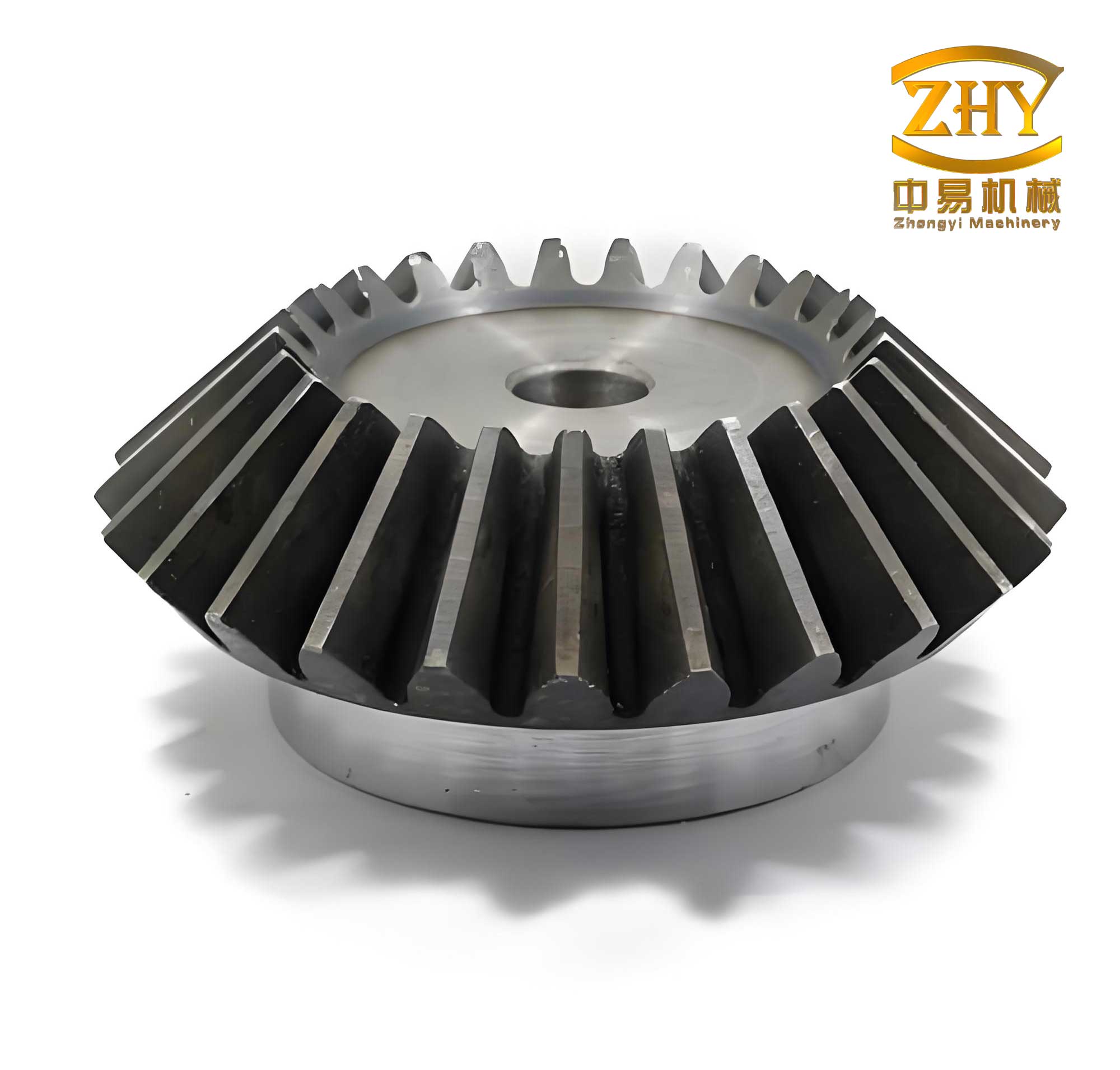
The importance of surface treatment in bevel gear dies cannot be overstated. Bevel gears are integral components in automotive, aerospace, and machinery sectors, requiring precise forming processes. Dies used in forging bevel gears are subjected to extreme mechanical and thermal stresses, leading to various failure modes. Traditional approaches to enhance die life include optimized design, material selection, and heat treatment, but surface engineering through PVD has proven to be a game-changer. By depositing ultra-hard coatings, PVD mitigates surface-related failures, ensuring consistent gear quality and higher productivity. In this discussion, I will explore the specific challenges faced by cold, warm, and hot forging bevel gear dies and how PVD technology effectively addresses them.
Cold forging of bevel gears involves plastic deformation of metal blanks at room temperature, imposing high frictional and cyclic loads on the die surfaces. Common failure modes in cold forging bevel gear dies include galling (or拉毛), which is adhesive wear caused by material transfer between the die and workpiece, and fatigue cracking, such as radial cracks in tooth slots or surface cracks at the tooth tips. These failures often lead to premature die报废, impacting production efficiency. To quantify wear, the Archard wear equation is often applied:
$$W = k \cdot \frac{P \cdot v}{H}$$
where \(W\) is the wear volume, \(k\) is the wear coefficient, \(P\) is the contact pressure, \(v\) is the sliding velocity, and \(H\) is the hardness of the material. For bevel gear dies, high \(P\) and \(v\) values exacerbate wear, necessitating surface enhancements. PVD coatings, with their superior hardness and low friction, reduce the effective wear coefficient \(k\), thereby extending die life. In my experience, materials like Cr12MoV and 6542 high-alloy steel are commonly used for cold forging bevel gear dies. However, these materials are susceptible to galling without proper surface treatment. Techniques like nitriding or CVD are less suitable due to high processing temperatures that can compromise dimensional accuracy post-electrical discharge machining (EDM) of the tooth profile.
PVD stands out as an ideal solution for cold forging bevel gear dies because of its low processing temperature (typically 450–550°C), which minimizes thermal distortion and preserves the precision of EDM-finished tooth shapes. Among PVD coatings, TiCN has been particularly effective due to its higher hardness (approximately 2800 HV) and lower friction coefficient compared to TiN. Through experimentation, we found that TiCN coatings reduce galling significantly, allowing dies to withstand over 50,000 forging cycles without noticeable surface degradation. The coating thickness ranges from 1.5 to 3.5 μm, providing a balance between wear resistance and adhesion. The improvement in die life can be modeled using a fatigue life formula:
$$N_f = \frac{C}{\sigma_a^m}$$
where \(N_f\) is the number of cycles to failure, \(C\) is a material constant, \(\sigma_a\) is the alternating stress amplitude, and \(m\) is the fatigue exponent. PVD coatings reduce \(\sigma_a\) by mitigating surface stresses, thereby increasing \(N_f\). For instance, in one case study, cold forging bevel gear dies with TiCN coatings exhibited a 5–10 fold increase in lifespan compared to uncoated dies, directly enhancing production throughput and gear accuracy.
To provide a broader perspective, Table 1 summarizes common surface treatment technologies for dies, highlighting their applications and limitations. This comparison underscores why PVD is preferred for high-precision bevel gear dies.
| Name | Application Objects | Processing Parameters | Coating Characteristics | Suitability for Bevel Gear Dies |
|---|---|---|---|---|
| Carburizing | Low-carbon steels | High temperature followed by quenching | High surface hardness, good toughness | Limited due to distortion risks |
| Nitriding (Gas/Ion) | Various steels, including high-alloy | Moderate temperatures (500–600°C) | High hardness, wear and corrosion resistance | Moderate, but may not suffice for severe wear |
| Boronizing | Wide range including tool steels | High temperatures (850–1000°C) | Extreme hardness (1300–2000 HV) | Poor due to high-temperature distortion |
| Electrospark Deposition | Most metallic materials | Room temperature pulse discharge | Thin layers, variable uniformity | Inadequate for precision bevel gear dies |
| Chemical Vapor Deposition (CVD) | Tool steels and carbides | High temperatures (>800°C) | Excellent adhesion, high hardness | Unsuitable due to thermal distortion |
| Physical Vapor Deposition (PVD) | Tool steels, carbides, and alloys | Low temperatures (450–550°C) | High hardness, low friction, environmental friendliness | Excellent for all bevel gear die types |
| TD Treatment | Tool steels and high-alloy steels | High temperatures (800–1200°C) | Very hard vanadium carbide layers | Poor due to high-temperature issues |
Moving to warm and hot forging of bevel gears, these processes involve higher temperatures—typically 850–950°C for warm forging and 1150–1230°C for hot forging—leading to additional thermal challenges. Dies used in these applications, often made from H13 or 012AL steels, face failure modes such as thermal fatigue cracking, plastic deformation at tooth tips, and coating剥落 (spalling). Thermal fatigue arises from cyclic heating and cooling, generating cracks that propagate under stress. The thermal stress can be estimated using:
$$\sigma_{th} = E \cdot \alpha \cdot \Delta T$$
where \(\sigma_{th}\) is the thermal stress, \(E\) is Young’s modulus, \(\alpha\) is the coefficient of thermal expansion, and \(\Delta T\) is the temperature gradient. For bevel gear dies, \(\Delta T\) can be substantial during forging cycles, leading to crack initiation. PVD coatings with high thermal stability, such as AlCrN or AlCrTiN, help mitigate this by providing a barrier that reduces heat transfer and surface oxidation. In warm forging bevel gear dies, we have successfully applied AlCrTiN coatings, which withstand temperatures up to 1000°C and exhibit hardness around 3300 HV. The coating thickness is optimized to 5–7 μm for enhanced durability, resulting in a marked reduction in thermal fatigue cracks and plastic deformation.
For hot forging bevel gear dies, the demands are even greater due to peak temperatures exceeding 1200°C. Standard PVD coatings like AlCrN may not suffice, necessitating advanced formulations such as NAlCr or nanocomposite coatings. These coatings offer improved oxidation resistance and thermal barrier properties, effectively preventing surface softening and material transfer. The wear mechanism in hot forging can be described by a modified version of the Archard equation that accounts for temperature effects:
$$W = k(T) \cdot \frac{P \cdot v}{H(T)}$$
where \(k(T)\) and \(H(T)\) are temperature-dependent wear coefficient and hardness, respectively. PVD coatings maintain high \(H(T)\) at elevated temperatures, thereby keeping \(W\) low. In practical terms, hot forging bevel gear dies with NAlCr coatings have demonstrated lifespan improvements of 8–10 times, significantly reducing downtime and maintenance costs.
To further elucidate the PVD coatings used for bevel gear dies, Table 2 details common coating types, their properties, and typical applications. This information is crucial for selecting the right coating based on forging conditions.
| Coating Material | Microhardness (HV) | Friction Coefficient (μ) | Maximum Application Temperature (°C) | Coating Thickness (μm) | Color | Preferred Use for Bevel Gear Dies |
|---|---|---|---|---|---|---|
| TiN | 2300 | 0.4 | 600 | 1.5–3.5 | Golden | Cold forging, moderate wear |
| TiCN | 2800 | 0.4 | 500 | 1.5–3.5 | Silver-gray | Cold forging, high wear resistance |
| AlTiN | 3300 | 0.4 | 900 | 1.5–3.5 | Blue-black | Warm forging, thermal stability |
| AlCrN | 3300 | <0.4 | 1000 | 1.5–3.5 | Deep gray | Warm forging, enhanced oxidation resistance |
| AlCrTiN | 3300 | <0.4 | 1000 | 1.5–3.5 | Deep pink | Warm forging, optimal for bevel gear dies |
| ZrSiN | 3400 | 0.5 | 850 | 1.5–3.5 | Purple-black | Specialized applications |
| TiSiN | 4300 | 0.5 | 1000 | 1.5–3.5 | Yellow-orange | High-temperature forging |
| NAlCr | 3500 | 0.3 | 1200 | 5–7 | Dark metallic | Hot forging bevel gear dies |
The application of PVD technology to bevel gear dies is not without challenges. Coating adhesion is paramount, especially for intricate tooth profiles where stress concentrations are high. Poor adhesion can lead to剥落, as observed in some warm forging dies with rough surface finishes. To address this, we employ surface pretreatment processes like polishing and ion cleaning to ensure optimal bonding. The adhesion strength can be evaluated using the scratch test, where a critical load \(L_c\) indicates coating failure:
$$L_c = \frac{2 \cdot \tau \cdot t}{r}$$
Here, \(\tau\) is the interfacial shear strength, \(t\) is the coating thickness, and \(r\) is the tip radius of the indenter. For bevel gear dies, we aim for high \(L_c\) values through tailored PVD parameters, such as bias voltage and deposition rate. Additionally, multilayer coatings, such as alternating layers of TiAlN and DLC, have been explored to combine hardness with lubricity, further reducing friction in cold forging bevel gear dies.
From a production standpoint, the economic benefits of PVD-coated bevel gear dies are substantial. By extending die life, we reduce the frequency of die replacements, which minimizes machine downtime and tooling costs. For instance, in a high-volume bevel gear manufacturing line, the implementation of PVD coatings increased overall equipment effectiveness (OEE) by 15–20%. The cost-effectiveness can be modeled using a simple return on investment (ROI) formula:
$$\text{ROI} = \frac{\text{Cost Savings from Extended Die Life} – \text{PVD Coating Cost}}{\text{PVD Coating Cost}} \times 100\%$$
In our calculations, ROI often exceeds 200% within the first year, making PVD a highly viable investment for bevel gear producers.
Looking ahead, ongoing research in PVD technology focuses on nanostructured and gradient coatings to push the boundaries of performance. For bevel gear dies, we are experimenting with coatings like TiAlSiN and CrAlN, which offer even higher thermal stability and wear resistance. Moreover, the integration of in-situ monitoring during PVD deposition allows for real-time control of coating properties, ensuring consistency across die batches. As additive manufacturing advances, we also explore the possibility of depositing PVD coatings on 3D-printed bevel gear dies, opening new avenues for customized gear production.
In conclusion, PVD technology has revolutionized the surface treatment of bevel gear dies, effectively combating failures like wear, fatigue, and thermal degradation. Through careful selection of coatings—such as TiCN for cold forging, AlCrTiN for warm forging, and NAlCr for hot forging—we have achieved remarkable improvements in die lifespan, often by factors of 5 to 10. The low processing temperature, environmental benefits, and versatility of PVD make it an indispensable tool in modern die manufacturing. As we continue to refine coatings and processes, the future holds even greater potential for enhancing the durability and efficiency of bevel gear dies, driving innovation in industries reliant on precision gears.
To summarize key points, I have presented detailed insights into PVD applications, supported by tables and formulas. The consistent theme is that bevel gear dies, regardless of forging temperature, benefit immensely from advanced surface engineering. By leveraging PVD technology, manufacturers can ensure higher productivity, better gear quality, and reduced environmental impact, solidifying its role as a cornerstone of sustainable manufacturing. The journey of optimizing bevel gear dies is ongoing, but with PVD, we are well-equipped to meet the evolving challenges of the industry.