
In the design of mechanical products, most components are treated as rigid bodies, where assembly models are formed by specifying geometric constraints between parts, and the structural shapes of components do not change before or after assembly. However, the harmonic drive gear operates on a fundamentally different principle: it relies on the elastic deformation of a flexible component, specifically the flexspline, to transmit motion or power. Before assembly, the flexspline has a circular cross-section; after assembly, a wave generator forces the flexspline into a non-circular shape, with teeth fully meshing at the long axis and completely disengaging at the short axis. When the wave generator rotates, it induces wave-like deformation in the flexspline, causing the teeth to cycle through engagement, disengagement, and re-engagement, thereby enabling the flexspline to rotate in the opposite direction to the wave generator. This unique mechanism makes the harmonic drive gear a compact, high-ratio transmission device widely used in robotics, aerospace, and precision machinery.
Traditional design and manufacturing of harmonic drive gears focus on the pre-assembly state, where the flexspline is modeled as a cylindrical cup feature. This approach prevents the direct establishment of assembly models in general Computer-Aided Design (CAD) systems through standard constraint specifications. Yet, for啮合 analysis, motion simulation, and performance validation, it is crucial to have an assembly model that reflects the deformed state of the flexspline under load. Such a model allows for直观 visualization of working conditions, tooth interference, and backlash distribution, thereby检验 design合理性 and transmission performance. Therefore, developing an assembly model for harmonic drive gears that accounts for flexible component deformation is essential. This article addresses this need by proposing a parametric method to generate the deformed flexspline model based on the neutral curve deformation, introducing an equal arc-length distribution algorithm to determine tooth positions post-assembly, and comparing it with traditional elastic ring deformation theories. The goal is to enable accurate representation of the harmonic drive gear in its operational state, facilitating better design and analysis.
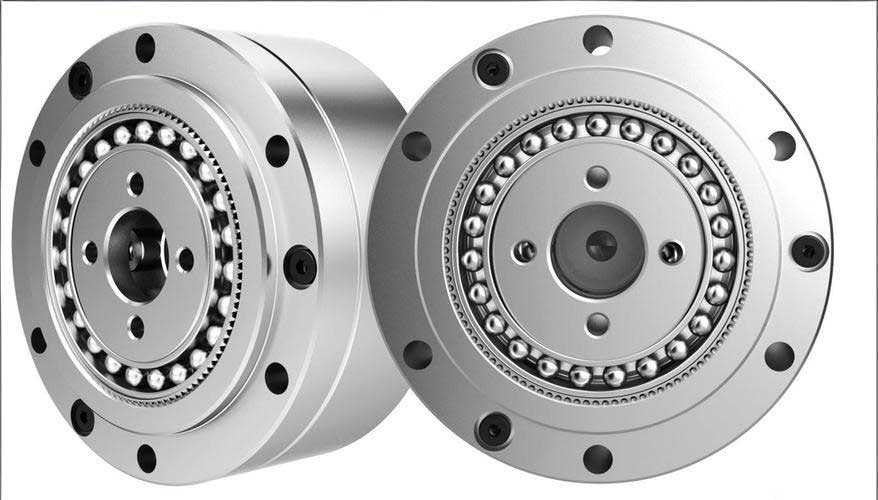
The core of modeling a harmonic drive gear lies in accurately representing the deformation of the flexspline, which is primarily dictated by the shape of the wave generator. In the assembled state, the wave generator forces the flexspline’s neutral curve—initially a circle with radius $r_m$—to deform into a non-circular curve. The radial displacement $w(\theta)$ describes this deformation, where $\theta$ is the angular coordinate. The deformed neutral curve can be expressed as:
$$Q(\theta) = r_m + w(\theta).$$
Different types of wave generators induce distinct radial displacement functions. Common wave generators include the dual-disk, four-roller, two-roller, cosine cam, and standard elliptical types. Each has a specific geometric configuration that affects the deformation profile and, consequently, the meshing behavior of the harmonic drive gear. Below, I detail the radial displacement equations for these wave generators, which form the basis for subsequent deformation analysis.
For a dual-disk wave generator, which uses two disks with an eccentricity $e$ to achieve a maximum deformation $w_0$, the radial displacement is given by:
$$w(\theta) =
\begin{cases}
\frac{w_0 (A_1 \cos \theta – B_1)}{A_1 – B_1}, & 0 \leq \theta \leq C, \\
\frac{w_0 \left[ (1 + \sin^2 C) \sin \theta + \left( \frac{\pi}{2} – \theta \right) \cos \theta – 2\sin C – B_1 \right]}{A_1 – B_1}, & C < \theta \leq \pi.
\end{cases}$$
Here, $A_1 = \frac{\pi}{2} – C – \sin C \cos C$ and $B_1 = \frac{4}{\pi} \cos C – \left( \frac{\pi}{2} – C \right) \sin C$, with $C$ being the wrap angle of the flexspline around the disk.
The four-roller wave generator employs four eccentric rollers positioned at an angle $\beta$ from the long axis, yielding:
$$w(\theta) =
\begin{cases}
\frac{w_0}{A – 4/\pi} \left( A \cos \theta + \theta \sin \beta \sin \theta – \frac{4}{\pi} \right), & 0 \leq \theta \leq \beta, \\
\frac{w_0}{A – 4/\pi} \left[ B \sin \theta + \left( \frac{\pi}{2} – \theta \right) \cos \beta \cos \theta – \frac{4}{\pi} \right], & \beta < \theta \leq \frac{\pi}{2}.
\end{cases}$$
where $A = \sin \beta + \left( \frac{\pi}{2} – \beta \right) \cos \beta$ and $B = \cos \beta + \beta \sin \beta$.
The two-roller wave generator is a special case of the four-roller type with $\beta = 0$, resulting in:
$$w(\theta) = \frac{w_0}{\pi/2 – 4/\pi} \left( \sin \theta + \left( \frac{\pi}{2} – \theta \right) \cos \theta – \frac{4}{\pi} \right).$$
For a cosine cam wave generator, the deformation follows a simple harmonic function:
$$w(\theta) = w_0 \cos 2\theta.$$
Lastly, the standard elliptical wave generator produces a deformation described by:
$$w(\theta) = \frac{(r_m + w_0)(r_m – w_0)}{\sqrt{(r_m + w_0)^2 \sin^2 \theta + (r_m – w_0)^2 \cos^2 \theta}} – r_m.$$
These equations are fundamental for calculating the deformed shape of the flexspline in a harmonic drive gear. The choice of wave generator impacts the neutral curve’s geometry, which in turn influences tooth engagement and backlash. In the following sections, I will use these expressions to develop an algorithm for determining tooth positions on the deformed flexspline.
To accurately model the harmonic drive gear in its assembled state, it is necessary to determine the positions and orientations of the flexspline teeth after deformation. Before deformation, the teeth are uniformly distributed along the circular neutral curve, with equal angular spacing. However, after deformation, the neutral curve becomes non-circular, and the teeth are no longer equally spaced angularly. According to the assumption that the neutral curve does not elongate during deformation—a common premise in elastic ring theory—the arc length between adjacent teeth remains constant. This leads to the equal arc-length distribution algorithm, which I propose for calculating post-deformation tooth locations.
The first step involves computing the perimeter of the deformed neutral curve. Since the curve is symmetric, the total perimeter $l$ is four times the arc length in the first quadrant:
$$l = 4 \int_0^{\pi/2} \sqrt{Q^2 + \left( \frac{dQ}{d\theta} \right)^2} d\theta,$$
where $Q(\theta) = r_m + w(\theta)$. This integral can be evaluated numerically for each wave generator type. Once the perimeter is known, the arc length $s$ between adjacent teeth on the deformed curve is:
$$s = \frac{l}{z_1},$$
with $z_1$ being the number of teeth on the flexspline. The algorithm then iteratively determines the angular positions $\theta_i$ on the deformed curve such that the cumulative arc length from the starting point equals $i \cdot s$ for the $i$-th tooth. For the first quadrant, this involves solving:
$$\int_0^{\theta_i} \sqrt{Q^2 + \left( \frac{dQ}{d\theta} \right)^2} d\theta = i \cdot s, \quad i = 1, 2, \ldots, \text{floor}\left(\frac{z_1}{4}\right).$$
The positions for teeth in other quadrants are obtained via symmetry. This method ensures that the teeth are equally spaced along the deformed neutral curve, adhering to the non-elongation condition.
In addition to positional changes, each tooth on the flexspline experiences a rotational displacement about its root point due to the deformation. The tooth symmetry line, initially aligned with the radial direction, rotates by an angle $\lambda$ relative to the radial vector. From differential geometry, this rotation angle is given by:
$$\lambda(\theta) = -\arctan\left( \frac{\frac{dQ}{d\theta}}{Q} \right) = -\arctan\left( \frac{\frac{dw}{d\theta}}{r_m + w(\theta)} \right).$$
Thus, to fully define the tooth profile in the assembled state, both the root position $(x_{O_1}, y_{O_1})$ on the deformed curve and the rotation angle $\lambda$ must be computed. The tooth profile coordinates in the local tooth coordinate system are then transformed to the global assembly coordinate system using a rotation matrix and translation. For an involute tooth profile, commonly used in harmonic drive gears, the parametric equations are:
$$x_1 = r_1 \left[ -\sin(u – \eta) + u \cos \alpha_0 \cos(u – \eta + \alpha_0) \right],$$
$$y_1 = r_1 \left[ \cos(u – \eta) + u \cos \alpha_0 \sin(u – \eta + \alpha_0) \right] – r_m,$$
where $u = \tan \alpha_k – \tan \alpha_0$, with $\alpha_k$ being the pressure angle at any point, $\alpha_0$ the standard pressure angle, $r_1$ the pitch radius of the flexspline, and $\eta = s/(2r_1)$ accounting for tooth thickness modification. The global coordinates $(X, Y)$ are obtained via:
$$\begin{bmatrix} X \\ Y \\ 1 \end{bmatrix} = \mathbf{R} \cdot \begin{bmatrix} x_1 \\ y_1 \\ 1 \end{bmatrix} + \mathbf{T},$$
with the rotation matrix $\mathbf{R}$ and translation vector $\mathbf{T}$ defined based on $\theta$ and $\lambda$. This parametric generation enables the creation of a three-dimensional flexspline model in the deformed state, which can be integrated into an assembly model of the harmonic drive gear.
To validate the equal arc-length distribution algorithm, I compare it with traditional methods based on elastic ring deformation theory. In this theory, the deformation of the flexspline’s neutral curve includes radial displacement $w(\theta)$, tangential displacement $v(\theta)$, and rotational displacement $\lambda(\theta)$. The tangential displacement is related to the radial displacement by:
$$v(\theta) = -\int_0^\theta w(\theta) d\theta,$$
and the non-elongation condition implies that the arc length on the deformed curve equals that on the initial circle. This leads to two approaches: an approximate algorithm and an exact algorithm.
In the approximate algorithm, simplifications are made by assuming $\lambda$ is small and $w(\theta)$ is much smaller than $r_m$, resulting in:
$$\lambda \approx \frac{1}{r_m} \frac{dw}{d\theta},$$
and the angular position $\theta_1$ on the deformed curve is approximated as:
$$\theta_1 \approx \theta + \frac{v(\theta)}{r_m}.$$
This method is computationally efficient but may introduce errors. In contrast, the exact algorithm avoids approximations, directly computing $\lambda$ as:
$$\lambda(\theta) = -\arctan\left( \frac{\frac{dw}{d\theta}}{r_m + w(\theta)} \right),$$
and determining $\theta_1$ through the integral relationship:
$$\theta = \int_0^{\theta_1} \sqrt{ \left(1 + \frac{w(\theta)}{r_m}\right)^2 + \left( \frac{1}{r_m} \frac{dw}{d\theta} \right)^2 } d\theta.$$
The exact algorithm is more accurate but requires numerical integration, increasing computational cost. The equal arc-length distribution algorithm proposed here aligns closely with the exact algorithm, as it directly enforces equal arc lengths without simplifying the geometry. To illustrate the differences, I computed the deviation in angular positions for a flexspline with 204 teeth and an involute profile, using parameters $r_m = 81 \, \text{mm}$ and $w_0 = 0.955 \, \text{mm}$. The results show that while the approximate algorithm exhibits significant deviations (up to 0.022° at 46.95°, leading to a circumferential error of 1.782 mm), the equal arc-length algorithm matches the exact algorithm closely. This demonstrates the accuracy of the proposed method for harmonic drive gear modeling.
Below is a table summarizing the perimeter changes for different wave generator types, highlighting the slight elongation of the neutral curve post-deformation—a factor considered in the equal arc-length algorithm.
| Wave Generator Type | Pre-deformation Perimeter (mm) | Post-deformation Perimeter (mm) | Relative Elongation (%) |
|---|---|---|---|
| Four-roller | 508.938 | 509.012 | 0.0146 |
| Two-roller | 508.938 | 509.002 | 0.0126 |
| Dual-disk | 508.938 | 509.006 | 0.0133 |
| Cosine cam | 508.938 | 509.009 | 0.0139 |
| Standard elliptical | 508.938 | 508.956 | 0.0035 |
The table reveals that all wave generators cause a small elongation of the neutral curve, with the standard elliptical type producing the least elongation (0.0035%). This minimal elongation supports the non-elongation assumption and justifies the use of the equal arc-length distribution algorithm for precise harmonic drive gear assembly modeling.
With the algorithm established, I now present application examples to demonstrate the generation of a three-dimensional assembly model for a harmonic drive gear. Consider a harmonic drive gear with parameters: flexspline teeth $z_1 = 204$, circular spline teeth $z_2 = 206$, module $m = 0.8 \, \text{mm}$, pressure angle $\alpha_0 = 20^\circ$, profile shift coefficient $x_1 = 1.01288$, wave generator angle $\beta = 30^\circ$, and maximum deformation $w_0 = 0.955 \, \text{mm}$. Using a four-roller wave generator, the pre-assembly models of the circular spline and flexspline are generated parametrically. After applying the equal arc-length distribution algorithm, the deformed flexspline is assembled with the circular spline to form the complete harmonic drive gear model. The assembly visually confirms that teeth are fully engaged at the long axis and disengaged at the short axis, as expected in a functioning harmonic drive gear.
To further analyze the meshing behavior, a two-dimensional projection of the tooth engagement in the long-axis region is created. This projection clearly shows the backlash distribution between the flexspline and circular spline teeth. Backlash, the clearance between mating teeth, is critical for smooth operation and load distribution. For the involute tooth profile, the minimum backlash typically occurs at the flexspline tooth tip. The backlash distribution under different wave generators is plotted, revealing that the four-roller wave generator offers the most uniform backlash distribution, while the two-roller type shows greater variation. Uniform backlash is desirable for enhancing load capacity and reducing wear in harmonic drive gears. However, for applications with lighter loads and smaller deformations, the two-roller wave generator may be sufficient due to its relatively even backlash in the long-axis region (0° to 7°).
The following table compares key characteristics of the wave generators in terms of backlash uniformity and computational complexity, aiding in the selection for specific harmonic drive gear designs.
| Wave Generator Type | Backlash Uniformity | Computational Cost | Suitable Applications |
|---|---|---|---|
| Dual-disk | Moderate | Medium | General-purpose transmissions |
| Four-roller | High | High | High-precision, high-load scenarios |
| Two-roller | Low | Low | Light-load, cost-sensitive designs |
| Cosine cam | Moderate | Medium | Simplified modeling and analysis |
| Standard elliptical | Very High | Medium | Ultra-precision harmonic drive gears |
These insights underscore the importance of wave generator selection in harmonic drive gear design. The assembly model, built using the equal arc-length distribution algorithm, enables designers to visualize and optimize these factors interactively.
In conclusion, this article presents a comprehensive method for building an assembly model of a harmonic drive gear based on flexible component deformation. The core contribution is the equal arc-length distribution algorithm, which accurately determines tooth positions and orientations on the deformed flexspline by enforcing the non-elongation condition of the neutral curve. Compared to traditional elastic ring deformation theories, this algorithm aligns closely with the exact solution while remaining computationally feasible. The implementation involves parametric generation of the flexspline model for various wave generator types, followed by assembly with the circular spline to visualize meshing and backlash. Application examples validate the method, showing that it effectively captures the deformed state of the harmonic drive gear, which is essential for啮合 analysis, interference checking, and performance evaluation.
Future work could explore the impact of different tooth profiles, such as double-arc or S-shaped teeth, on backlash and load distribution in harmonic drive gears. Additionally, integrating dynamic simulation capabilities into the assembly model would allow for real-time analysis of the harmonic drive gear under operating conditions, further enhancing design optimization. The proposed approach not only advances CAD modeling for harmonic drive gears but also provides a framework for other mechanical systems involving flexible components, contributing to the broader field of digital manufacturing and virtual prototyping.
Throughout this discussion, the term “harmonic drive gear” has been emphasized to highlight its centrality in the context of flexible deformation modeling. By leveraging algorithms like equal arc-length distribution, engineers can better design and analyze these sophisticated transmission systems, ensuring reliability and efficiency in advanced mechanical applications. The harmonic drive gear, with its unique reliance on elastic deformation, continues to be a critical component in modern machinery, and accurate assembly modeling is key to unlocking its full potential.