
In the field of mechanical transmission, the demand for high-speed and heavy-duty spur gear systems is continually increasing, particularly in aerospace applications. Under such severe operating conditions, effective lubrication is critical to prevent direct tooth contact, excessive heat generation, wear, and scuffing failures. Jet lubrication is commonly employed for high-speed spur gears, but the high rotational speeds induce strong air barrier effects around the gear meshing zone, which can impede the lubricant from reaching the tooth surfaces. Therefore, optimizing the nozzle layout parameters to overcome this air barrier and ensure efficient lubrication is essential. In this study, we employ computational fluid dynamics (CFD) transient simulation methods to investigate the airflow patterns and pressure distribution around spur gears at various linear speeds, and subsequently determine the optimal nozzle orientation parameters for effective lubrication.
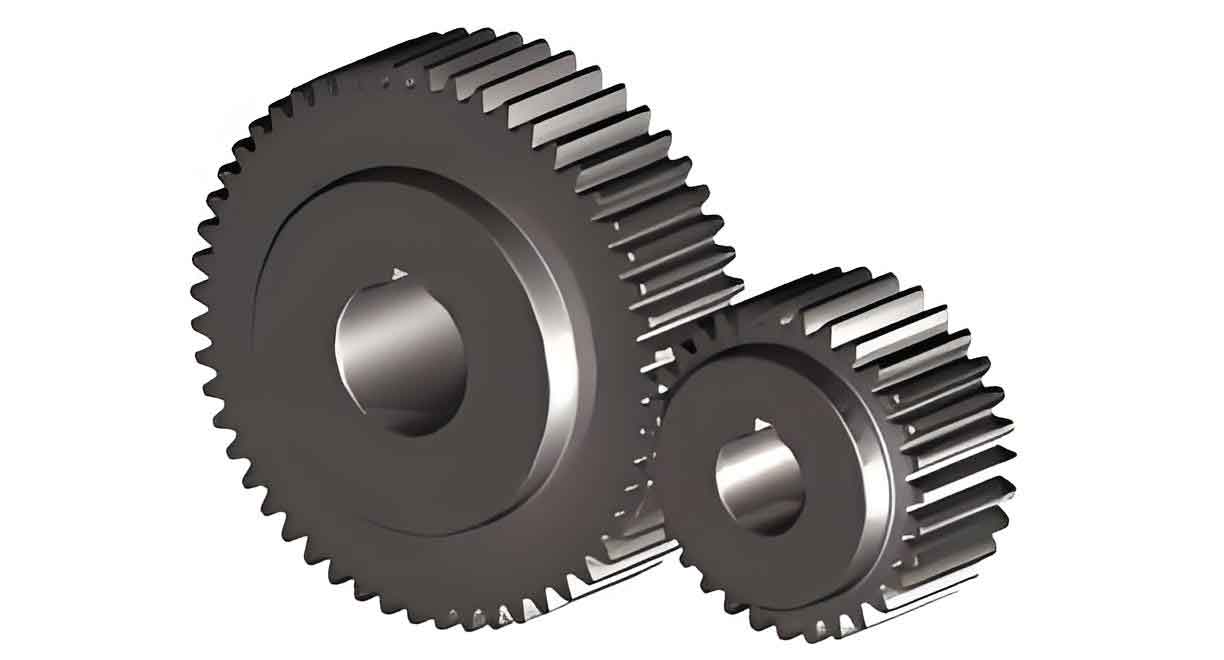
Our research focuses on spur gears operating at linear speeds of 40, 80, 120, and 160 m/s. We first conduct single-phase airflow field simulations to analyze the transient behavior of the gas around the gear pair. This allows us to reveal the pressure distribution and airflow motion laws in the meshing region and around the tooth profiles. Based on these findings, we propose a method to determine the optimal nozzle layout parameters, which is then validated through two-phase flow transient oil jet lubrication simulations. The results demonstrate that as the linear speed of the spur gears increases, the air barrier effect becomes more pronounced, and the airflow patterns shift, influencing the trajectory of the lubricant jet. By strategically positioning the nozzle according to the airflow characteristics, we can enhance lubrication efficiency for high-speed spur gears.
The theoretical foundation of our CFD simulations is based on fundamental conservation laws, including volume conservation, mass conservation, and momentum conservation. For single-phase airflow simulations, the fluid is air, while for two-phase oil jet simulations, the phases are air and lubricating oil. The volume conservation equation ensures that the sum of volume fractions of all phases in each control volume is unity. For a multiphase system with phase q, this is expressed as:
$$ \sum_{q=1}^{n} \alpha_q = 1 $$
Here, $\alpha_q$ represents the volume fraction of phase q. In single-phase simulations, $n=1$ and $\alpha_1=1$ for air. In two-phase simulations, $n=2$ for air and oil. The mass conservation, or continuity equation, for a fluid with density $\rho$ and velocity vector $\mathbf{v}$ is given by:
$$ \nabla \cdot (\rho \mathbf{v}) + \frac{\partial \rho}{\partial t} = 0 $$
The momentum conservation equation, derived from Newton’s second law, describes the change in fluid momentum due to forces. For a fluid element, it is written as:
$$ \rho \frac{d\mathbf{v}}{dt} = \rho \mathbf{F} + \nabla \cdot \mathbf{P} $$
where $\mathbf{F}$ is the body force per unit mass and $\mathbf{P}$ is the stress tensor. To model the turbulent flow generated by high-speed spur gears, we utilize the RNG k-$\epsilon$ turbulence model, which offers improved accuracy for complex flows by accounting for turbulence vorticity. The transport equations for turbulent kinetic energy k and its dissipation rate $\epsilon$ are:
$$ \rho \frac{dk}{dt} = \frac{\partial}{\partial x_i} \left( \alpha_k \mu_{\text{eff}} \frac{\partial k}{\partial x_i} \right) + G_k + G_b – \rho \epsilon – Y_m $$
$$ \rho \frac{d\epsilon}{dt} = \frac{\partial}{\partial x_i} \left( \alpha_\epsilon \mu_{\text{eff}} \frac{\partial \epsilon}{\partial x_i} \right) + C_{1\epsilon} \frac{\epsilon}{k} (G_k + C_{3\epsilon} G_b) – \rho C_{2\epsilon} \frac{\epsilon^2}{k} $$
In these equations, $\mu_{\text{eff}}$ is the effective turbulent viscosity, $\alpha_k$ and $\alpha_\epsilon$ are inverse effective turbulent Prandtl numbers, $G_k$ and $G_b$ represent turbulence generation due to mean velocity gradients and buoyancy, respectively, and $C_{1\epsilon}$, $C_{2\epsilon}$, $C_{3\epsilon}$ are constants. The dynamic mesh technique is employed to handle the motion of the spur gears. The spring-based smoothing and local remeshing models are used to update the mesh at each time step, governed by the integral form of the conservation equations for a moving control volume V:
$$ \frac{d}{dt} \int_V \rho \phi dV + \int_{\partial V} \rho \phi (\mathbf{u} – \mathbf{u}_s) \cdot d\mathbf{A} = \int_{\partial V} \Gamma \nabla \phi \cdot d\mathbf{A} + \int_V S_\phi dV $$
where $\phi$ is a general scalar, $\mathbf{u}$ is the fluid velocity, $\mathbf{u}_s$ is the mesh velocity, $\Gamma$ is the diffusion coefficient, and $S_\phi$ is the source term.
For our simulations, we model a pair of meshing spur gears enclosed in a housing. The geometric parameters of the spur gears are summarized in Table 1.
| Gear Parameter | Pinion (Driving) | Gear (Driven) |
|---|---|---|
| Number of Teeth | 25 | 33 |
| Module M (mm) | 4 | 4 |
| Pressure Angle $\beta$ (°) | 20 | 20 |
| Face Width B (mm) | 28 | 28 |
The three-dimensional fluid domain is discretized using tetrahedral cells. A mesh independence study was conducted, and a mesh size of 0.5 mm near the teeth and meshing zone, expanding to 4 mm away from the gears, was selected, resulting in approximately 1.24 million cells. The simulations are performed using a pressure-based solver with a time step of $1 \times 10^{-6}$ s and convergence residuals set to $1 \times 10^{-5}$. User-defined functions (UDFs) are applied to define the rotational motion of the spur gears.
We first analyze the single-phase airflow field at different linear speeds. Two observation planes are defined: Plane 1 is the mid-plane along the gear axes, and Plane 2 is tangent to the pitch circles of the spur gears. The pressure distribution on Plane 1 for various speeds is illustrated in Figure 5 (reference content). The results show that a positive high-pressure zone forms on the gear meshing-in side, while a negative low-pressure zone appears on the meshing-out side. As the linear speed of the spur gears increases, the pressure difference across the meshing region increases linearly. This can be expressed by a linear relationship:
$$ \Delta P = k \cdot v + c $$
where $\Delta P$ is the pressure difference, $v$ is the linear speed, and $k$ and $c$ are constants. This increasing pressure differential enhances the air barrier effect, making it more difficult for lubricant to penetrate the meshing zone. The airflow velocity contours reveal that the air moves in layers, with higher velocities near the tooth surfaces. At higher speeds, the airflow becomes more turbulent, and the symmetric pattern of airflow is disturbed. The velocity vectors indicate that on the meshing-in side, the airflow has a component directed toward the meshing point, while on the meshing-out side, it moves away. The two swirling airflows from the pinion and gear “meet” on the meshing-in side, creating a trace of weakest airflow. As speed increases, this trace gradually inclines toward the pinion due to the stronger airflow contributed by the larger gear. This phenomenon is critical for nozzle placement.
Based on the airflow patterns, we proceed to optimize the nozzle layout parameters for lubricating the high-speed spur gears. The nozzle orientation is defined by several parameters, as shown in Figure 9 (reference content). The coordinates are given by $(S, H, N)$, where $S$ is the offset from the common tangent of the pitch circles, $H$ is the vertical distance from the line connecting gear centers, and $N$ is the axial offset from the gear mid-plane. The injection angle $\alpha$ is the angle between the nozzle axis and the common tangent, and the end face angle $\gamma$ is the angle between the jet direction and the gear mid-plane. The injection distance $L$ is the distance from the nozzle to the pitch point $O$. By convention, positive values indicate direction toward the larger gear, and negative toward the pinion.
To determine the optimal nozzle placement, we consider the following steps. First, the nozzle should be positioned on the meshing-in side because the airflow there has a velocity component toward the meshing point, which can assist in carrying the lubricant into the meshing zone. In contrast, on the meshing-out side, the airflow opposes the lubricant jet, potentially causing the oil to be swept away. Second, the end face angle $\gamma$ should be zero, meaning the nozzle is placed on the gear mid-plane. This is because the airflow near the mid-plane is directed straight toward the meshing point, while airflow near the gear sides has lateral components that could deflect the oil jet. Third, we select candidate nozzle points on the meshing-in side with $\gamma=0$ and injection distances $L$ of 35, 40, 45, and 50 mm, ensuring no interference with the gear bodies. Eighteen candidate points are evaluated. By examining the airflow streamlines originating from each candidate point, we can predict whether the lubricant jet would follow a path into the meshing zone. The criterion is that the airflow streamline should enter the meshing region. Among the candidates, point number 7 (with $L=40$ mm) exhibits an airflow streamline that directly reaches the meshing zone, as shown in Figure 16 (reference content). Therefore, the optimal nozzle coordinates are $(S, H, N) = (1, 39.98, 0)$ mm. Finally, the injection angle $\alpha$ is set to align with the direction of the airflow streamline at this optimal point, which is found to be $\alpha = 21^\circ$. This alignment ensures that the initial lubricant velocity coincides with the local airflow, minimizing deflection and promoting entry into the meshing zone.
The optimal nozzle parameters are summarized in Table 2.
| Parameter | Value |
|---|---|
| Preferred Region | Meshing-in Side |
| Nozzle Coordinates $(S, H, N)$ (mm) | (1, 39.98, 0) |
| Injection Angle $\alpha$ (°) | 21 |
| End Face Angle $\gamma$ (°) | 0 |
To validate this optimization, we conduct a two-phase flow transient simulation of oil jet lubrication. The nozzle diameter is 2.4 mm, and the injection pressure is 0.25 MPa. The lubricant properties are density $\rho_{\text{oil}} = 904.27 \, \text{kg/m}^3$ and dynamic viscosity $\mu_{\text{oil}} = 0.00217 \, \text{Pa·s}$. The simulation results show that the oil jet trajectory closely follows the airflow streamline from the optimal nozzle point, confirming that the airflow pattern can reliably predict lubricant movement. The oil volume fraction on the tooth surfaces of the spur gears reaches above 0.8, indicating excellent lubrication coverage. This validates our method for determining nozzle orientation based on single-phase airflow analysis.
In conclusion, our study provides a comprehensive approach to optimizing nozzle layout parameters for high-speed spur gear lubrication. The key findings are as follows: The air barrier effect around spur gears intensifies with increasing linear speed, leading to a linear rise in pressure differential across the meshing zone and more turbulent airflow. The airflow on the meshing-in side favors lubricant entry, while the meshing-out side opposes it. The optimal nozzle should be placed on the meshing-in side with zero end face angle. The specific coordinates can be determined by analyzing airflow streamlines from candidate points; the point whose streamline enters the meshing zone is optimal. The injection angle should match the direction of this streamline. For the spur gears studied, the optimal parameters are coordinates (1, 39.98, 0) mm, injection angle $21^\circ$, and end face angle $0^\circ$. Validation via two-phase flow simulations confirms that this approach ensures effective lubrication for high-speed spur gears. This methodology can guide the design of lubrication systems in high-performance transmissions, particularly in aerospace applications where spur gears operate under extreme conditions.
Further research could explore the effects of different gear geometries, such as helical or bevel gears, or varying oil properties. Additionally, experimental validation could strengthen the practical applicability of these findings. Nonetheless, this work establishes a robust simulation-based framework for optimizing lubrication in high-speed spur gear systems.