
In my study of right-angle cylindrical worm gear drives, I have developed a method that transforms the complex spatial meshing problem into a simpler rack-and-pinion meshing problem. This approach leverages the special geometric relationships inherent in orthogonal-axis cylindrical worm gear pairs, where the worm axis is perpendicular to the worm gear axis. By doing so, I can simplify the design and calculation of worm gear transmissions significantly. Below, I present the detailed derivation, analysis of meshing conditions, first-type and second-type limit points, meshing axes, and other key characteristics, all within the context of worm gear systems.
1. Transformation of the Meshing Condition
To begin, I establish the coordinate systems as shown in the conceptual figure (a typical reference for worm gear analysis). Let $o_1-i_1,j_1,k_1$ be the worm coordinate system and $o_2-i_2,j_2,k_2$ be the worm gear coordinate system. The center distance is $A$, with $k_1$ coinciding with the angular velocity vector $\boldsymbol{\omega}^{(1)}$ of the worm, and $k_2$ coinciding with $\boldsymbol{\omega}^{(2)}$ of the worm gear. I set $i_2 = -i_1$, $j_2 = -k_1$, $k_2 = -j_1$. Assume $|\boldsymbol{\omega}^{(1)}| = 1$ and $|\boldsymbol{\omega}^{(2)}| = I$.
The worm spiral surface equation is given by:
$$ \mathbf{R}^{(1)} = \xi(u)\mathbf{e}(\lambda) + \eta(u)\mathbf{e}_1(\lambda) + (\zeta(u) + p\lambda)\mathbf{k}_1 $$
where $u$ and $\lambda$ are surface parameters, $p$ is the helical constant, and $\mathbf{e}(\lambda) = \cos\lambda\,\mathbf{i}_1 + \sin\lambda\,\mathbf{j}_1$, $\mathbf{e}_1(\lambda) = -\sin\lambda\,\mathbf{i}_1 + \cos\lambda\,\mathbf{j}_1$ are circular vector functions.
The family of worm helical surfaces after rotation is:
$$ \mathbf{r}^{(1)} = B_1(\varphi_1)\mathbf{R}^{(1)} = \xi(u)\mathbf{e}(\lambda+\varphi_1) + \eta(u)\mathbf{e}_1(\lambda+\varphi_1) + (\zeta(u)+p\lambda)\mathbf{k}_1 $$
Here $B_1(\varphi_1)$ is the rotation group, and $\varphi_1$ is the surface family parameter. Similarly, for the worm gear surface and its family, I have $\mathbf{R}^{(2)}$ and $\mathbf{r}^{(2)}$, with $\mathbf{r}^{(2)} = B_2(\varphi_2)\mathbf{R}^{(2)}$, and $B_2^{-1}(\varphi_2) = B_2(-\varphi_2)$.
The general meshing condition for spatial gear pairs is:
$$ f(u,\lambda,\varphi_1) = (\boldsymbol{\omega}^{(2)}\times \mathbf{r}^{(2)} – \boldsymbol{\omega}^{(1)}\times \mathbf{r}^{(1)}) \cdot \mathbf{n} = 0 $$
where $\mathbf{n}$ is the surface normal, $\mathbf{n} = \frac{\partial \mathbf{r}^{(1)}}{\partial u} \times \frac{\partial \mathbf{r}^{(1)}}{\partial \lambda}$. For a helical surface, the identity $ (p\boldsymbol{\omega}^{(1)} + \boldsymbol{\omega}^{(1)}\times \mathbf{r}^{(1)}) \cdot \mathbf{n} = 0$ always holds. Using this, I rewrite the condition as:
$$ f(u,\lambda,\varphi_1) = (\boldsymbol{\omega}^{(2)}\times \mathbf{r}^{(2)} – \boldsymbol{\omega}^{(1)}\times \mathbf{r}^{(1)} – p\boldsymbol{\omega}^{(1)} + p\boldsymbol{\omega}^{(1)}) \cdot \mathbf{n} = 0 $$
$$ \Rightarrow (\boldsymbol{\omega}^{(2)}\times \mathbf{r}^{(2)} – (-p\boldsymbol{\omega}^{(1)})) \cdot \mathbf{n} = 0 $$
This transformation shows that the relative rotary motion between the worm and worm gear can be replaced by the relative motion of a gear (worm gear) and a rack (worm). The term $ -p\boldsymbol{\omega}^{(1)}$ represents a translational velocity of the worm in the direction $-\mathbf{k}_1$ with magnitude $p$. Thus, the worm behaves like a rack moving linearly, and the worm gear rotates. The derived pitch circle radius of the worm gear is $R_{2j} = p/I$.
Further, let $\lambda + \varphi_1 = \psi$, then $\lambda = \psi – \varphi_1$. Substituting into $\mathbf{r}^{(1)}$ gives:
$$ \mathbf{r}^{(1)} = \xi\mathbf{e}(\psi) + \eta\mathbf{e}_1(\psi) + (\zeta + p\psi)\mathbf{k}_1 – p\varphi_1\mathbf{k}_1 $$
This represents a family of surfaces translating along $-\mathbf{k}_1$ at constant speed $p$, reflecting the inherent equivalence between rotation and translation in worm gear systems.
| Symbol | Description |
|---|---|
| $A$ | Center distance between worm and worm gear axes |
| $p$ | Helical constant of the worm |
| $I$ | Angular velocity ratio $|\boldsymbol{\omega}^{(2)}|$ (with $|\boldsymbol{\omega}^{(1)}|=1$) |
| $R_{2j}$ | Derived pitch radius of the worm gear, $R_{2j} = p/I$ |
| $R_{1j}$ | Derived pitch radius of the worm, $R_{1j} = A – R_{2j}$ |
| $\varphi_1, \varphi_2$ | Rotation parameters of worm and worm gear |
| $\mathbf{n}$ | Surface normal vector |
2. Equivalent Meshing Equation Derived from Rack-and-Pinion
By employing the rack-and-pinion analogy, I obtain a simpler meshing condition. Let $R_{1j} = A – R_{2j}$ be the derived pitch radius of the worm (acting as a rack). The instantaneous axis (pitch line) is given by:
$$ \mathbf{r}_j = R_{1j}\mathbf{i}_1 – Q\mathbf{j}_1 $$
where $Q$ is a parameter. According to the fundamental theorem of gearing, the common normal at the contact point must pass through this instantaneous axis. Therefore:
$$ \mathbf{r}^{(1)} + S_0\mathbf{n} = R_{1j}\mathbf{i}_1 – Q_0\mathbf{j}_1 $$
with $S_0 = -\frac{\mathbf{r}^{(1)}\cdot\mathbf{k}_1}{\mathbf{n}\cdot\mathbf{k}_1}$ and $Q_0 = -(\mathbf{r}^{(1)} + S_0\mathbf{n})\cdot\mathbf{j}_1$. By taking the dot product with $(\mathbf{j}_1 \times \mathbf{n})$, I eliminate $S_0$ and $Q_0$ to obtain:
$$ (\mathbf{r}^{(1)} \times \mathbf{j}_1 – R_{1j}\mathbf{k}_1) \cdot \mathbf{n} = 0 \tag{1} $$
This is the new meshing condition. One can verify its equivalence to the original spatial condition by substituting $\boldsymbol{\omega}^{(2)} = -I\mathbf{j}_1$ and $\mathbf{r}^{(2)} = \mathbf{r}^{(1)} – A\mathbf{i}_1$ into earlier expression.
To make the analysis more intuitive for engineering practice, I examine cross-sectional profiles. Cutting the worm and worm gear with a plane perpendicular to $\mathbf{k}_2$ yields a pair of conjugate profiles: the worm profile becomes a rack tooth curve, and the worm gear profile becomes the corresponding gear tooth within that plane. The meshing condition (1) is exactly the condition for these planar profiles. A useful geometric lemma states that for any non-singular point on a surface, the profile normal, surface normal, and plane normal are coplanar. Hence, I combine the meshing condition with the plane equation:
$$ \begin{cases}
(\mathbf{r}^{(1)} \times \mathbf{j}_1 – R_{1j}\mathbf{k}_1) \cdot \mathbf{n} = 0 \\
\mathbf{r}^{(1)} \cdot \mathbf{j}_1 = C
\end{cases} \tag{2} $$
where $C$ is a constant determined by the chosen cross-section. This system defines the meshing of a rack (worm profile) and a pinion (worm gear profile) in the plane. The conjugate worm gear profile equation is then:
$$ \mathbf{R}^{(2)} = B_2^{-1}(\varphi_2)(\mathbf{r}^{(1)} – A\mathbf{i}_1) $$
Thus, the spatial worm gear meshing problem is reduced to a planar gear meshing problem. The intersection of the cutting plane with the instantaneous axis is the pitch point; the intersection with the worm gear axis is the gear center; and the intersection with the meshing surface is the meshing line. This approach greatly simplifies the calculation for worm gear design.
3. First-Type Limit Points (Undercut Condition)
First-type limit points, also known as undercut points, are critical for worm gear tooth geometry. I derive these conditions using a geometrical property: for any given surface, at a first-type limit point on the conjugate surface, the normal to the meshing surface at the corresponding contact point passes through the axis of rotation of the conjugate member. Based on this, I obtain an equivalent planar property: for a planar curve, at the first-type limit point of its conjugate curve, the normal to the meshing line passes through the center of rotation of the conjugate curve.
Starting from the meshing condition (1), I solve for $\varphi_1 = \varphi_1(u,\lambda)$ and then substitute into $\mathbf{r}^{(2)} = \mathbf{r}^{(1)} – A\mathbf{i}_1$ to obtain the meshing surface equation:
$$ \mathbf{r}^{(2)} = \mathbf{r}^{(2)}(\varphi_1(u,\lambda), u, \lambda) $$
The normal to the meshing surface is:
$$ \mathbf{n}_p = \frac{\partial \mathbf{r}^{(2)}}{\partial u} \times \frac{\partial \mathbf{r}^{(2)}}{\partial \lambda} $$
The condition for a first-type limit point in the spatial domain is:
$$ (\mathbf{r}^{(2)}, \mathbf{n}_p, \mathbf{k}_2) = 0 \tag{3} $$
i.e., the triple scalar product of $\mathbf{r}^{(2)}$, $\mathbf{n}_p$, and $\mathbf{k}_2$ is zero. For the planar cross-section, I combine (3) with the plane condition:
$$ \begin{cases}
(\mathbf{r}^{(2)}, \mathbf{n}_p, \mathbf{k}_2) = 0 \\
\mathbf{r}^{(2)} \cdot \mathbf{k}_2 = C
\end{cases} \tag{4} $$
This yields the locations of first-type limit points on the worm gear tooth profile. These points represent the boundary of undercut-free region. In practice, avoiding undercut is essential for worm gear strength and smooth operation.
| Type | Spatial Condition | Planar Cross-Section Condition |
|---|---|---|
| First-type (undercut) | $(\mathbf{r}^{(2)}, \mathbf{n}_p, \mathbf{k}_2) = 0$ | $(\mathbf{r}^{(2)}, \mathbf{n}_p, \mathbf{k}_2) = 0$ and $\mathbf{r}^{(2)}\cdot\mathbf{k}_2 = C$ |
| Second-type (meshing boundary) | Instantaneous axis tangent to normal ruled surface | Derived from spatial condition using $s=S_0$ |
4. Second-Type Limit Points
Second-type limit points correspond to the boundary of the conjugate region, where the normal lines of the worm surface no longer intersect the instantaneous axis twice within one revolution. To analyze this, I consider the ruled surface formed by the normal lines at a given point on the worm surface as the worm rotates. This ruled surface, called the normal ruled surface, can be expressed as:
$$ \mathbf{r}_h(\lambda, u, \varphi_1, s) = \mathbf{r}^{(1)} + s\mathbf{n} $$
where $\varphi_1$ and $s$ are surface parameters, and $\lambda, u$ are the original surface parameters. Within the conjugate region, the instantaneous axis (pitch line) intersects this ruled surface twice for $|\varphi_1| < 2\pi$; outside the conjugate region, no intersection exists. At the boundary (second-type limit point), the instantaneous axis is tangent to the normal ruled surface. This means that at the specific $s = S_0$ corresponding to the contact point, the normal to the ruled surface is perpendicular to the direction of the instantaneous axis (the $\mathbf{j}_1$ direction). Mathematically:
$$ \begin{cases}
(\frac{\partial \mathbf{r}_h}{\partial \varphi_1}, \frac{\partial \mathbf{r}_h}{\partial s}, \mathbf{j}_1) = 0 \\
s = S_0
\end{cases} \tag{5} $$
Equation (5) provides a clear geometric interpretation: at the second-type limit point, the line of contact on the worm surface is such that the normal ruled surface is tangent to the instantaneous axis. This condition defines the extreme point of the usable tooth surface on the worm gear and is important for determining the effective face width of the worm gear.
5. Meshing Axes in Worm Gear Drives
For a pair of mutually enveloping surfaces, if at all points of an instantaneous line of contact the surface normals pass through a fixed line in space, that line is called a meshing axis. It is known that in crossed-axis gear drives where one member has a helical surface (as in worm gear pairs), meshing axes exist. In my method, the derived instantaneous axis itself is one meshing axis. I can find the second meshing axis by considering the decomposition of relative angular velocity. Let the second meshing axis be expressed as:
$$ \mathbf{r}_{2f} = R_{2f}\mathbf{i}_1 + v(-\cos\alpha\,\mathbf{k}_1 + \sin\alpha\,\mathbf{j}_1) $$
where $R_{2f}$ is the intercept on the $\mathbf{i}_1$ axis, $\alpha$ is the inclination angle with respect to $\mathbf{k}_1$, and $v$ is a parameter. The two component angular velocity vectors are $\boldsymbol{\omega}_1 = \omega_1\mathbf{j}_1$ and $\boldsymbol{\omega}_2 = \omega_2(-\cos\alpha\,\mathbf{k}_1 + \sin\alpha\,\mathbf{j}_1)$. They must satisfy:
$$ \boldsymbol{\omega}_1 + \boldsymbol{\omega}_2 = \boldsymbol{\omega}^{(2)} – \boldsymbol{\omega}^{(1)} $$
$$ R_{1j}\mathbf{i}_1 \times \boldsymbol{\omega}_1 + R_{2f}\mathbf{i}_1 \times \boldsymbol{\omega}_2 – A\mathbf{i}_1 \times \boldsymbol{\omega}^{(2)} = 0 $$
Solving these equations yields:
$$ R_{2f} = 0, \quad \tan\alpha = \frac{p}{R_{1j}} $$
Thus, the second meshing axis passes through the origin ($R_{2f}=0$) and is inclined at an angle $\alpha$, which is exactly the lead angle of the worm at the pitch circle. This confirms that the worm gear pair possesses two distinct meshing axes: one is the instantaneous axis (pitch line) and the other is the worm axis itself (after projection). This property is unique to cylindrical worm gear drives and simplifies the analysis of contact lines.
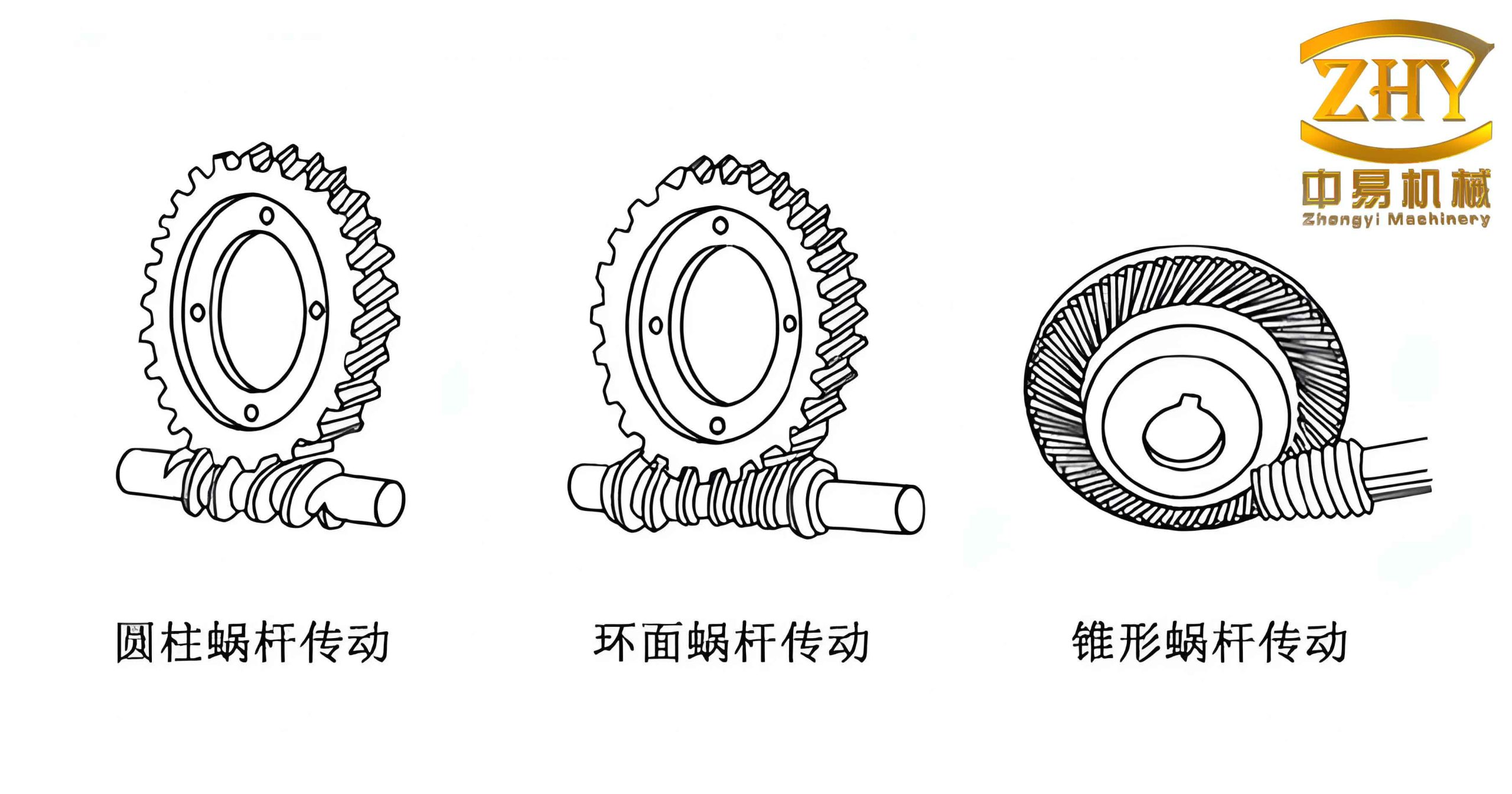
6. Conclusion
My method of transforming the spatial meshing of a right-angle cylindrical worm gear pair into a rack-and-pinion problem, and further into planar gear meshing by cross-sectional analysis, provides a powerful tool for the design and calculation of worm gear transmissions. By applying this approach, I derived the equivalent meshing condition, identified the conditions for first-type and second-type limit points with clear geometric interpretations, and determined the two meshing axes inherent in worm gear systems. The method is applicable to any straight-line or non-straight-line cylindrical worm gear drive that satisfies the orthogonal-axis and constant lead conditions. The extensive use of tables and formulas in this work helps systemize the knowledge required for robust worm gear engineering. Future work will extend these principles to non-orthogonal worm gear configurations and examine their impact on performance.
| Feature | Result |
|---|---|
| Derived pitch radius of worm gear | $R_{2j} = p/I$ |
| Derived pitch radius of worm (rack) | $R_{1j} = A – p/I$ |
| Equivalent meshing condition | $(\mathbf{r}^{(1)} \times \mathbf{j}_1 – R_{1j}\mathbf{k}_1) \cdot \mathbf{n} = 0$ |
| First-type limit point condition (spatial) | $(\mathbf{r}^{(2)}, \mathbf{n}_p, \mathbf{k}_2) = 0$ |
| Second-type limit point condition | $(\partial \mathbf{r}_h / \partial \varphi_1, \partial \mathbf{r}_h / \partial s, \mathbf{j}_1) = 0$ at $s=S_0$ |
| Second meshing axis | Through origin, inclined at lead angle $\alpha = \arctan(p / R_{1j})$ |