
In modern manufacturing, Computer-Aided Design and Computer-Aided Manufacturing (CAD/CAM) technologies have revolutionized the way we design and produce mechanical components, especially in the realm of gear systems such as spur and pinion gears. As an engineer immersed in this field, I have extensively utilized CAD/CAM tools to simulate and optimize the数控 machining processes for spur and pinion gears, which are critical in transmitting motion and power in various machinery. This article delves into my firsthand experience using CAXA software—a prominent CAD/CAM platform—to achieve precise modeling, trajectory generation, and simulation for spur and pinion gears, with a focus on enhancing efficiency and accuracy in digital manufacturing. The integration of CAD/CAM allows for seamless transition from design to production, reducing errors and saving time, which is particularly beneficial for complex components like spur and pinion gears that require high precision in their tooth profiles and meshing characteristics.
The application of CAD/CAM spans across multiple industries, from automotive to aerospace, where spur and pinion gears are employed for their simplicity and reliability in parallel轴 transmissions. In my work, I leverage CAXA Manufacturing Engineer, a comprehensive software that integrates data interfaces, geometric modeling, toolpath generation, simulation, and G-code output. This enables me to create detailed models of spur and pinion gears, simulate their machining under various conditions, and generate executable数控 code for实际 production. Throughout this process, I emphasize the importance of参数 optimization to ensure that the spur and pinion gears meet stringent performance standards, such as minimal noise and high load capacity. By sharing my methodology, I aim to highlight how CAD/CAM can be harnessed to tackle the challenges in gear manufacturing, ultimately contributing to advancements in mechanical engineering.
To begin, let’s explore the fundamental aspects of CAD/CAM technology. CAD/CAM systems facilitate a collaborative environment where designers and engineers can create, modify, and analyze digital models before physical prototyping. For spur and pinion gears, this involves defining geometric parameters, material properties, and manufacturing constraints. CAXA software, in particular, offers robust features like feature-based solid modeling, which simplifies the creation of complex shapes. For instance, when designing a spur gear, I can use predefined features such as holes, slots, and extrusions to build the gear body, followed by specialized tools for generating involute tooth profiles—a key element in spur and pinion gear design. The software supports high-speed machining strategies, which are essential for producing accurate spur and pinion gears with smooth surfaces and tight tolerances.
One of the core advantages of CAXA is its parametric trajectory editing capability. This allows me to adjust machining parameters—like cutting depth and feed rate—without recreating the entire toolpath, saving significant time in iterative design processes. Additionally, the batch processing function enables the generation of multiple toolpaths simultaneously, which is useful when producing batches of spur and pinion gears for large-scale applications. The simulation module provides a realistic preview of the machining process, helping me identify potential issues like collisions or inefficient tool movements before actual production. This is crucial for spur and pinion gears, as any deviation in tooth geometry can lead to performance failures in mechanical systems.
Now, diving into the design phase, I focus on the specific parameters for spur and pinion gears. These gears are characterized by straight teeth parallel to the axis, making them ideal for applications requiring straightforward motion transfer. In my projects, I often work with standard spur gears, but pinion gears—which are typically smaller gears in a pair—require similar design considerations. Below is a table summarizing the key parameters for a typical spur gear, which I use as a basis for modeling in CAXA:
| Parameter | Symbol | Value (Example) | Unit |
|---|---|---|---|
| Module | m | 3 | mm |
| Number of Teeth | Z | 32 | – |
| Pressure Angle | α | 20° | degrees |
| Pitch Diameter | D_p | 96 | mm |
| Base Diameter | D_b | 90.2 | mm |
| Addendum Diameter | D_a | 102 | mm |
| Face Width | B | 30 | mm |
These parameters are derived from standard gear equations. For example, the pitch diameter for a spur gear is calculated as $$ D_p = m \times Z $$, where m is the module and Z is the number of teeth. Similarly, the base diameter, crucial for defining the involute curve, is given by $$ D_b = D_p \times \cos(\alpha) $$. The addendum diameter approximates to $$ D_a \approx D_p + 2m $$, ensuring proper tooth engagement in spur and pinion gear pairs. Understanding these formulas is essential for accurate modeling, as even minor errors can affect the meshing of spur and pinion gears, leading to inefficiencies or failure in transmission systems.
The involute tooth profile is central to spur and pinion gear design, as it ensures smooth rolling contact and constant velocity ratio. In my CAXA workflow, I use the polar coordinate equation of the involute curve to generate the gear teeth. The equation is expressed as $$ \rho = D_b \times \tan(t) $$, where $$ \rho $$ is the radius vector, and $$ t $$ is the parameter ranging from 0 to 30 degrees for a full tooth flank. This mathematical representation allows me to create precise tooth shapes that are vital for the performance of spur and pinion gears. By inputting this equation into CAXA’s curve function, I can draw the involute profile accurately, which is then replicated around the gear circumference using array tools.
Moving to the modeling process, I start by launching CAXA Manufacturing Engineer and selecting the XOY plane for sketching. I draw the base circle and addendum circle based on the calculated diameters. Then, I invoke the equation-driven curve tool to plot the involute using the polar equation. To form a single tooth, I connect the involute endpoints to points on the base circle, ensuring symmetry by mirroring the curve across the X-axis. After trimming excess lines, I obtain a clean tooth轮廓线. This step is repeated via circular array to create the full set of teeth for the spur gear. Finally, I extrude the sketch to the desired face width, resulting in a solid 3D model of the spur gear. For pinion gears, the process is similar, but with smaller dimensions to match the specific application requirements.
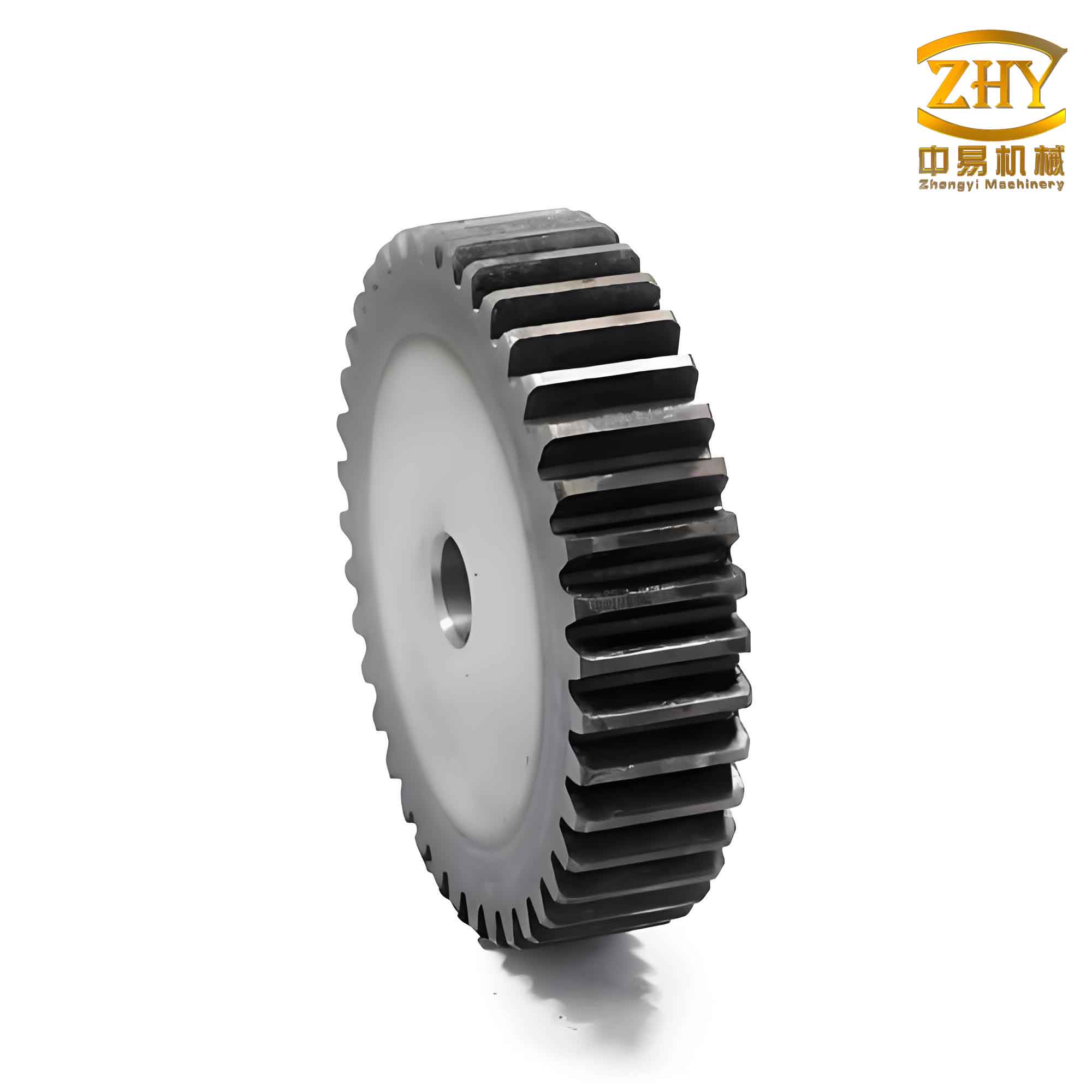
This image illustrates a typical spur gear model generated in CAXA, showcasing the intricate tooth profiles that are essential for reliable operation in spur and pinion gear systems. The visual representation helps in verifying the geometry before proceeding to machining simulation.
Once the model is ready, I proceed to the CAM phase for simulating the数控 machining. In CAXA, I use the plane contour machining function to generate toolpaths for milling the spur gear. I set parameters such as layer height (e.g., 5 mm per cut), machining tolerance (0.01 mm), and cutting conditions. For instance, I typically assign a spindle speed of 100 rpm and a feed rate of 80 mm/min to simulate realistic加工 conditions. The tool parameters include a milling cutter with a radius of 0.5 cm and a corner radius of 0.25 cm, chosen to achieve fine surface finishes on the spur and pinion gear teeth. The software automatically computes the toolpath, which appears as multiple layers around the gear轮廓, indicating the progressive material removal.
To optimize the process, I adjust the entry and exit points to minimize tool wear and avoid collisions. The simulation module allows me to visualize the entire machining sequence in real-time, revealing how the cutter engages with the spur gear material. This step is critical for identifying potential issues like overcuts or insufficient material removal, especially in the tight spaces between teeth of spur and pinion gears. By fine-tuning the parameters, I ensure that the toolpath conforms to the designed geometry, thereby enhancing the accuracy of the final product.
After simulation, I generate the G-code using CAXA’s post-processing功能. The software converts the toolpath into standard数控 instructions that can be directly fed into a CNC milling machine. For a spur gear, the G-code may comprise over 1500 lines, detailing every movement of the cutter. I save this code as a text file and validate it through software emulators or actual machine trials. This automated generation reduces human error and accelerates the production cycle for spur and pinion gears. Moreover, CAXA supports customizable post-processors, enabling compatibility with various数控 systems, which is advantageous when working with different manufacturing setups.
Throughout this workflow, I emphasize the integration of CAD and CAM for spur and pinion gear production. The table below summarizes the key steps and their benefits in the CAD/CAM pipeline:
| Step | Description | Benefits for Spur and Pinion Gears |
|---|---|---|
| Parameter Definition | Specify gear parameters (e.g., module, pressure angle) | Ensures accurate tooth geometry and meshing performance |
| 3D Modeling | Create digital model using involute equations | Provides visual verification and design flexibility |
| Toolpath Generation | Generate machining trajectories based on model | Optimizes material removal and reduces加工 time |
| Simulation | Preview machining process for errors | Prevents defects and enhances quality control |
| G-code Output | Export数控 instructions for production | Automates manufacturing and ensures repeatability |
In addition to the basic process, I often explore advanced techniques for spur and pinion gear machining. For example, high-speed machining (HSM) strategies can be implemented in CAXA to reduce cycle times and improve surface finish. HSM involves using higher spindle speeds and feed rates while maintaining precision, which is particularly useful for producing small pinion gears with fine teeth. The software’s ability to simulate HSM allows me to test different parameters without risking actual equipment. Furthermore, I utilize multi-axis machining capabilities for complex spur and pinion gear assemblies, where the tool can approach the workpiece from multiple angles to achieve undercuts or intricate features.
Another critical aspect is the validation of gear properties through analytical formulas. For spur and pinion gears, the bending stress and contact stress must be calculated to ensure durability. Using standard mechanical equations, I can integrate these calculations into the CAD/CAM workflow. For instance, the Lewis bending stress formula for spur gears is given by $$ \sigma_b = \frac{F_t}{b m Y} $$, where $$ F_t $$ is the tangential load, $$ b $$ is the face width, $$ m $$ is the module, and $$ Y $$ is the Lewis form factor. Similarly, the Hertz contact stress for meshing spur and pinion gears is expressed as $$ \sigma_c = \sqrt{\frac{F_t}{b} \cdot \frac{1}{\rho_1} + \frac{1}{\rho_2}} \cdot \frac{1}{\pi \left( \frac{1-\nu_1^2}{E_1} + \frac{1-\nu_2^2}{E_2} \right)} $$, where $$ \rho $$ are the radii of curvature, and $$ E $$ and $$ \nu $$ are material properties. By incorporating these formulas into my analysis, I can optimize the gear design for strength and longevity, which is essential for high-performance applications involving spur and pinion gears.
To further illustrate the importance of precision in spur and pinion gear manufacturing, I have compiled a comparison of different machining parameters and their effects on gear quality. This table highlights how variations in cutting conditions can influence the final product:
| Parameter | Low Setting | High Setting | Impact on Spur and Pinion Gears |
|---|---|---|---|
| Cutting Speed (rpm) | 50 | 200 | Higher speed reduces machining time but may increase tool wear; crucial for fine-toothed pinion gears |
| Feed Rate (mm/min) | 40 | 120 | Increased feed rate boosts productivity but can compromise surface finish on spur gear teeth |
| Depth of Cut (mm) | 2 | 10 | Deeper cuts shorten process but risk tool deflection, affecting accuracy of spur and pinion gear profiles |
| Tool Radius (cm) | 0.3 | 0.8 | Smaller tools allow detailed work on pinion gears but may break easily; larger tools are more stable for spur gears |
In my experience, balancing these parameters is key to achieving optimal results for spur and pinion gears. For instance, when machining a pinion gear with a small module, I prefer a higher cutting speed and lower depth of cut to maintain precision without sacrificing efficiency. CAXA’s simulation tools help me experiment with these settings virtually, reducing the need for physical prototypes and minimizing material waste.
Looking ahead, the future of CAD/CAM for spur and pinion gear manufacturing lies in the integration of artificial intelligence and IoT technologies. AI algorithms can predict tool wear and optimize toolpaths in real-time, further enhancing the production of spur and pinion gears. Additionally, cloud-based CAD/CAM platforms enable collaborative design and remote monitoring, allowing teams to work on complex gear systems from different locations. As I continue to explore these advancements, I am confident that CAD/CAM will play an even greater role in pushing the boundaries of precision engineering for spur and pinion gears.
In conclusion, the use of CAD/CAM software like CAXA has transformed the way we approach the design and machining of spur and pinion gears. From parametric modeling and involute curve generation to toolpath simulation and G-code output, the entire process is streamlined for accuracy and efficiency. By leveraging these tools, I can ensure that spur and pinion gears meet the demanding requirements of modern machinery, contributing to smoother operations and longer service life. The continuous evolution of CAD/CAM technology promises further innovations, making it an indispensable asset in the manufacturing of critical components like spur and pinion gears. Through firsthand application and ongoing learning, I aim to harness these capabilities to drive progress in mechanical design and production.