
In modern manufacturing engineering, the processing of hypoid gears is a critical task due to their complex geometry and high precision requirements. As a researcher in gear technology, I have extensively studied the shaving process for hypoid gears, which serves as an efficient alternative to grinding, especially when cost and equipment availability are constraints. This article delves into the computational aspects of shaving for hypoid gears, focusing on the changes in cutting principles induced by carbide shaving tools and the precise calculation of tool parameters. The goal is to provide a comprehensive guide for accurate shaving calculations, enhancing the quality and efficiency of hypoid gear production.
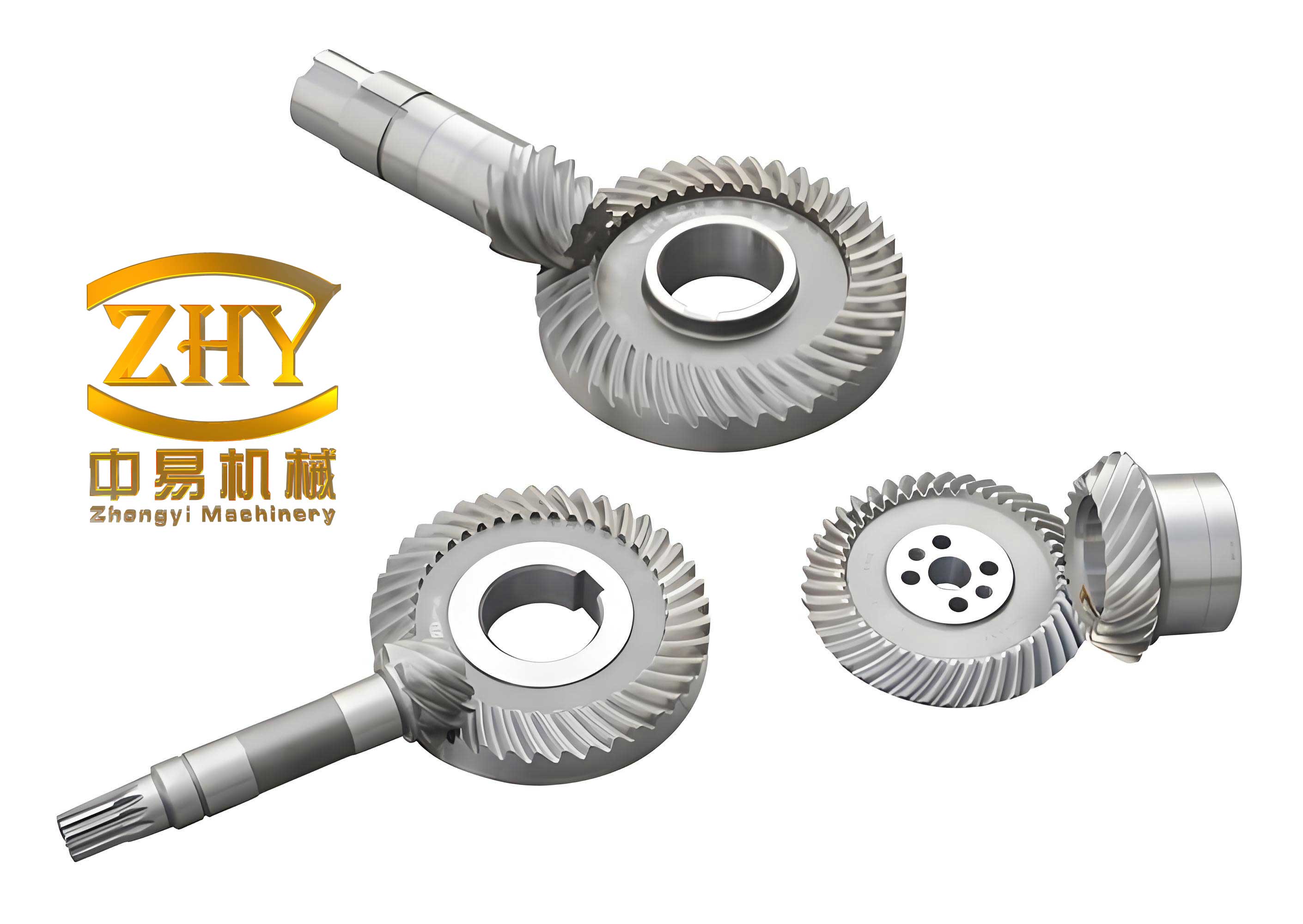
Hypoid gears are widely used in automotive and industrial applications for their ability to transmit motion between non-intersecting axes with high torque capacity. However, the final finishing of hypoid gear teeth, particularly for hard-faced gears, often involves expensive grinding processes. Shaving, which utilizes carbide tools with negative rake angles and straight cutting edges, offers a viable solution. This method alters the generating surface from a conical shape to a hyperboloid, necessitating a revised computational approach. In this analysis, I will explore the mathematical foundations of shaving for hypoid gears, starting from the tool’s generating surface equations and extending to the curvature parameters of the gear tooth surfaces.
The traditional high-speed steel milling cutter for hypoid gears has a generating surface that is a conical surface with a tool profile angle denoted as \(\alpha\). In contrast, the carbide shaving tool features a straight cutting edge that is inclined relative to this cone, with a negative rake angle \(\lambda_G\). This inclination transforms the generating surface into a one-sheet hyperboloid of revolution, fundamentally changing the cutting kinematics. To understand this, let’s establish coordinate systems and derive the equations step by step.
Consider a reference frame \(\Sigma\) where the \(k\)-axis aligns with the axis of the original conical surface, and the \(i\)-axis passes through the original tool tip point \(P\). In a secondary frame \(\Sigma_n\), the cutting edge equation for the shaving tool can be expressed as:
$$ \vec{r}^{(n)}_c = \begin{pmatrix} 0 \\ a \sin \lambda_G \\ -a \cos \lambda_G \end{pmatrix} $$
Here, \(a\) is a parameter along the cutting edge. Transforming this into the \(\Sigma\) frame, we obtain:
$$ \vec{r}_c = \begin{pmatrix} r_{cx} \\ r_{cy} \\ r_{cz} \end{pmatrix} = \begin{pmatrix} R_c – (b – a \cos \lambda) \sin \alpha \\ a \cos \lambda \\ (b – a \cos \lambda) \cos \alpha \end{pmatrix} $$
In this equation, \(R_c\) represents the tool tip radius, \(b = MP\) is derived from conventional cutting calculations for hypoid gears, and \(\alpha\) is the tool profile angle (positive for internal tools and negative for external tools). The parameter \(\lambda\) corresponds to the rake angle, which is negative for shaving tools.
Since the cutting edge is skew to the tool axis, the generating surface formed by rotating this edge around the axis becomes a hyperboloid. Let \(\theta\) be the initial rotation angle of the cutting edge around the tool axis. Then, the generating surface equation for the shaving tool is:
$$ \vec{r}_d = \vec{r}_d(a, \theta) = \begin{pmatrix} \sqrt{r_{cx}^2 + r_{cy}^2} \cdot \cos \theta \\ \sqrt{r_{cx}^2 + r_{cy}^2} \cdot \sin \theta \\ r_{cz} \end{pmatrix} $$
To simplify, define \(q = \sqrt{r_{cx}^2 + r_{cy}^2}\) and \(p = r_{cx} \frac{dr_{cx}}{da} + r_{cy} \frac{dr_{cy}}{da}\). The partial derivatives of \(\vec{r}_d\) with respect to \(a\) and \(\theta\) are:
$$ \vec{r}_{da} = \begin{pmatrix} \frac{p \cos \theta}{q} \\ \frac{p \sin \theta}{q} \\ -\cos \lambda \cos \alpha \end{pmatrix} $$
$$ \vec{r}_{d\theta} = \begin{pmatrix} -q \sin \theta \\ q \cos \theta \\ 0 \end{pmatrix} $$
The normal vector to the hyperboloid surface is given by the cross product:
$$ \vec{r}_{da} \times \vec{r}_{d\theta} = \begin{pmatrix} q \cos \lambda \cos \alpha \cos \theta \\ q \cos \lambda \cos \alpha \sin \theta \\ p \end{pmatrix} $$
At the conjugate contact point \(M\) on the hypoid gear tooth surface, where \(\theta = 0\) and \(a = 0\), the normal vector simplifies to:
$$ \vec{n}_M = \begin{pmatrix} (R_c – b \sin \alpha) \cos \lambda \cos \alpha \\ 0 \\ (R_c – b \sin \alpha) \cos \lambda \sin \alpha \end{pmatrix} $$
For the original conical generating surface, the normal vector at point \(M\) is:
$$ \vec{n} = \begin{pmatrix} \cos \alpha \\ 0 \\ \sin \alpha \end{pmatrix} $$
Comparing these, we see that the vectors are proportional, indicating that both surfaces share the same normal at \(M\), and the coordinate plane \(j_n M k_n\) is their common tangent plane. From differential geometry, the curvature lines of a hyperboloid are circles and hyperbolas, so the hyperboloid and cone have identical principal directions at \(M\). This allows us to use conical surface methods to compute the gear tooth surface normal and tangent vectors.
The first fundamental quantities of the shaving tool generating surface are:
$$ E = \vec{r}_{da}^2, \quad F = \vec{r}_{da} \cdot \vec{r}_{d\theta}, \quad G = \vec{r}_{d\theta}^2 $$
The surface normal vector is:
$$ \vec{n} = \frac{\vec{r}_{da} \times \vec{r}_{d\theta}}{\sqrt{EG – F^2}} $$
At point \(M\), this yields \(\vec{n}_M\) as above. Using Meusnier’s theorem, the principal curvature in the circular direction is:
$$ k_1 = -\frac{\cos \alpha}{R_c – b \sin \alpha} $$
Since the cutting edge direction is an asymptotic direction on the generating surface (where the normal curvature is zero), Euler’s formula gives the principal curvature in the hyperbolic direction:
$$ k_2 = \frac{\tan^2 \lambda \cos \alpha}{R_c – b \sin \alpha} $$
These curvature parameters are essential for subsequent gear tooth surface analysis. In shaving calculations for hypoid gears, we proceed by determining the first- and second-order parameters of the gear tooth surface at the calculation point \(M\). Based on the kinematic relationship between the tool and workpiece, Baxter’s formula can be applied to find the normal curvatures and geodesic torsions along the principal directions of the gear tooth surface.
For the driven gear (e.g., the larger hypoid gear), after obtaining the first-order parameters, the second-order parameters—specifically, the normal curvatures and geodesic torsion corresponding to the principal directions of the generating surface—are computed. Then, through the meshing relationship between the driven and driving gears (the smaller hypoid gear), we derive the first- and second-order parameters at the conjugate point on the theoretical tooth surface of the driving gear. If a modified tooth surface is required, these parameters are adjusted accordingly.
Let the modified driving gear tooth surface have normal curvatures \(k_{xc}\), \(k_{yc}\) and geodesic torsion \(G_c\) at the meshing point. According to the relationship between induced normal curvatures and induced geodesic torsion, we have:
$$ (k_{xc} – k_{xd})(k_{yc} – k_{yd}) = G_c^2 $$
Here, \(k_{xd}\) and \(k_{yd}\) are the first and second principal curvatures of the shaving tool generating surface for the driving gear. Similarly, for the driving gear tool, \(k_{yd} = -k_{xd} \tan^2 \lambda_p\), where \(\lambda_p\) is the rake angle of the driving gear shaving tool. Substituting this into the equation gives:
$$ k_{xd} = \frac{Q \pm \sqrt{Q^2 – 4 \tan^2 \lambda_p (G_c^2 – k_{xc} k_{yc})}}{2 \tan^2 \lambda_p} $$
where \(Q = k_{xc} \tan^2 \lambda_p – k_{yc}\). From Euler’s and Bertrand’s formulas in differential geometry, we relate these to the gear surface curvatures:
$$ k_{xc} = k_1 \cos^2 \phi + k_2 \sin^2 \phi, \quad k_{yc} = k_1 \sin^2 \phi + k_2 \cos^2 \phi, \quad G_c = (k_2 – k_1) \sin \phi \cos \phi $$
Here, \(\phi\) is an angle parameter related to the surface orientation. This leads to \(G_c^2 – k_{xc} k_{yc} = -k_1 k_2 = -K\), where \(K\) is the total curvature at that point on the gear tooth surface. Thus, the equation simplifies to:
$$ k_{xd} = \frac{-b \pm \sqrt{b^2 + 4 \tan^2 \lambda_p K}}{2a} $$
Considering the direction of the normal vector—pointing into the tooth solid for the convex side and outward for the concave side—we have \(k_{xd} > 0\). For the convex side of the driving hypoid gear, which is an elliptical point (\(K > 0\)), the positive root is selected. Therefore, for the convex side tool:
$$ k_{xd} = \frac{k_{xc} \tan^2 \lambda_p – k_{yc} + \sqrt{(k_{xc} \tan^2 \lambda_p – k_{yc})^2 + 4K \tan^2 \lambda_p}}{2 \tan^2 \lambda_p} $$
Using Meusnier’s theorem, the required tool tip radius for the driving gear shaving tool is:
$$ R_{cp} = \frac{\cos \alpha_{bp}}{k_{xd}} – b_p \sin \alpha_{bp} $$
Here, \(b_p\) is obtained from conventional calculations, and \(\alpha_{bp}\) is the tool profile angle for the driving gear. After computing \(R_{cp}\), it is rounded to a standard tool size. Other tool parameters and machine settings are determined similarly to conventional cutting calculations for hypoid gears.
To summarize the key parameters and formulas involved in shaving calculations for hypoid gears, I present the following tables. These tables encapsulate the essential variables, equations, and steps for practical implementation.
| Parameter | Symbol | Description |
|---|---|---|
| Tool Tip Radius | \(R_c\) | Radius at the tip of the shaving tool |
| Tool Profile Angle | \(\alpha\) | Angle of the tool’s cutting edge profile |
| Rake Angle | \(\lambda_G\) or \(\lambda_p\) | Negative angle for carbide shaving tools |
| Conjugate Point Distance | \(b\) or \(b_p\) | Distance from tool tip to contact point \(M\) |
| Principal Curvatures | \(k_1, k_2\) | Curvatures of the generating surface |
| Gear Surface Curvatures | \(k_{xc}, k_{yc}\) | Normal curvatures on the gear tooth surface |
| Geodesic Torsion | \(G_c\) | Torsion of the gear tooth surface |
| Total Curvature | \(K\) | Product of principal curvatures \(k_1 k_2\) |
| Step | Action | Equations/Notes |
|---|---|---|
| 1 | Define coordinate systems | Establish \(\Sigma\) and \(\Sigma_n\) frames |
| 2 | Derive cutting edge equation | \(\vec{r}^{(n)}_c = (0, a \sin \lambda_G, -a \cos \lambda_G)^T\) |
| 3 | Transform to tool frame | \(\vec{r}_c = (R_c – (b – a \cos \lambda) \sin \alpha, a \cos \lambda, (b – a \cos \lambda) \cos \alpha)^T\) |
| 4 | Formulate generating surface | \(\vec{r}_d = (\sqrt{r_{cx}^2 + r_{cy}^2} \cos \theta, \sqrt{r_{cx}^2 + r_{cy}^2} \sin \theta, r_{cz})^T\) |
| 5 | Compute partial derivatives | \(\vec{r}_{da}\) and \(\vec{r}_{d\theta}\) as above |
| 6 | Find normal vector at \(M\) | \(\vec{n}_M = ((R_c – b \sin \alpha) \cos \lambda \cos \alpha, 0, (R_c – b \sin \alpha) \cos \lambda \sin \alpha)^T\) |
| 7 | Calculate principal curvatures | \(k_1 = -\frac{\cos \alpha}{R_c – b \sin \alpha}\), \(k_2 = \frac{\tan^2 \lambda \cos \alpha}{R_c – b \sin \alpha}\) |
| 8 | Determine gear surface parameters | Use Baxter’s formula for second-order parameters |
| 9 | Solve for tool curvatures | \(k_{xd}\) from equation involving \(k_{xc}, k_{yc}, G_c\) |
| 10 | Compute tool tip radius | \(R_{cp} = \frac{\cos \alpha_{bp}}{k_{xd}} – b_p \sin \alpha_{bp}\) |
| 11 | Adjust to standard tool sizes | Round \(R_{cp}\) and select appropriate tool |
| 12 | Finalize machine settings | Similar to conventional hypoid gear cutting |
The application of shaving for hypoid gears offers significant advantages in terms of cost reduction and improved surface finish. By replacing grinding with shaving, manufacturers can achieve high precision without the need for expensive grinding machines, which are often scarce in many facilities. The use of carbide tools with negative rake angles enhances tool life and allows for efficient material removal from hard-faced hypoid gear teeth. Moreover, the computational framework outlined here ensures that the shaving process maintains the desired contact pattern and tooth geometry, critical for the performance of hypoid gears in demanding applications such as automotive differentials.
In practice, the success of hypoid gear shaving relies on accurate parameter selection and machine calibration. The tables above provide a concise reference for engineers, but it’s essential to iterate calculations based on specific gear designs. For instance, variations in hypoid gear parameters like offset, spiral angle, and pressure angle will influence the shaving tool geometry. Therefore, software tools that implement these equations can automate the process, reducing errors and speeding up production setup.
To further illustrate the relationships, consider the following formula that encapsulates the interdependence of key variables in hypoid gear shaving. The modified tool tip radius \(R_{cp}\) can be expressed as a function of multiple factors:
$$ R_{cp} = f(\alpha_{bp}, \lambda_p, k_{xc}, k_{yc}, K, b_p) $$
Where each variable contributes to the final tool dimension. This holistic approach underscores the complexity of hypoid gear machining and the need for precise calculations.
In conclusion, the shaving process for hypoid gears, facilitated by carbide tools, represents a sophisticated advancement in gear manufacturing. By analyzing the changes in the generating surface from a cone to a hyperboloid, we can derive accurate tool parameters that ensure optimal gear tooth surfaces. The calculations involve deriving the cutting edge equations, computing curvatures, and solving for tool geometry based on gear meshing principles. This method not only reduces costs but also enhances the accessibility of high-quality hypoid gear production. As technology evolves, further refinements in shaving algorithms and tool design will continue to improve the efficiency and accuracy of hypoid gear manufacturing, solidifying its role in modern engineering applications.
Throughout this discussion, the term “hypoid gear” has been emphasized to highlight its centrality in the topic. Hypoid gears are unique due to their hyperbolic pitch surfaces and non-intersecting axes, making their processing particularly challenging. The shaving technique addresses these challenges by adapting tool geometry to match the complex kinematics. As a result, manufacturers can achieve precise tooth modifications, such as crowning or bias, which are essential for noise reduction and load distribution in hypoid gear systems.
Finally, the integration of computational methods with practical machining insights enables the widespread adoption of shaving for hypoid gears. By following the steps and formulas detailed here, engineers can perform exact calculations for shaving tools, leading to improved gear performance and longevity. The ongoing research in this field promises further innovations, such as adaptive control systems and real-time monitoring, which will push the boundaries of hypoid gear technology even further.