
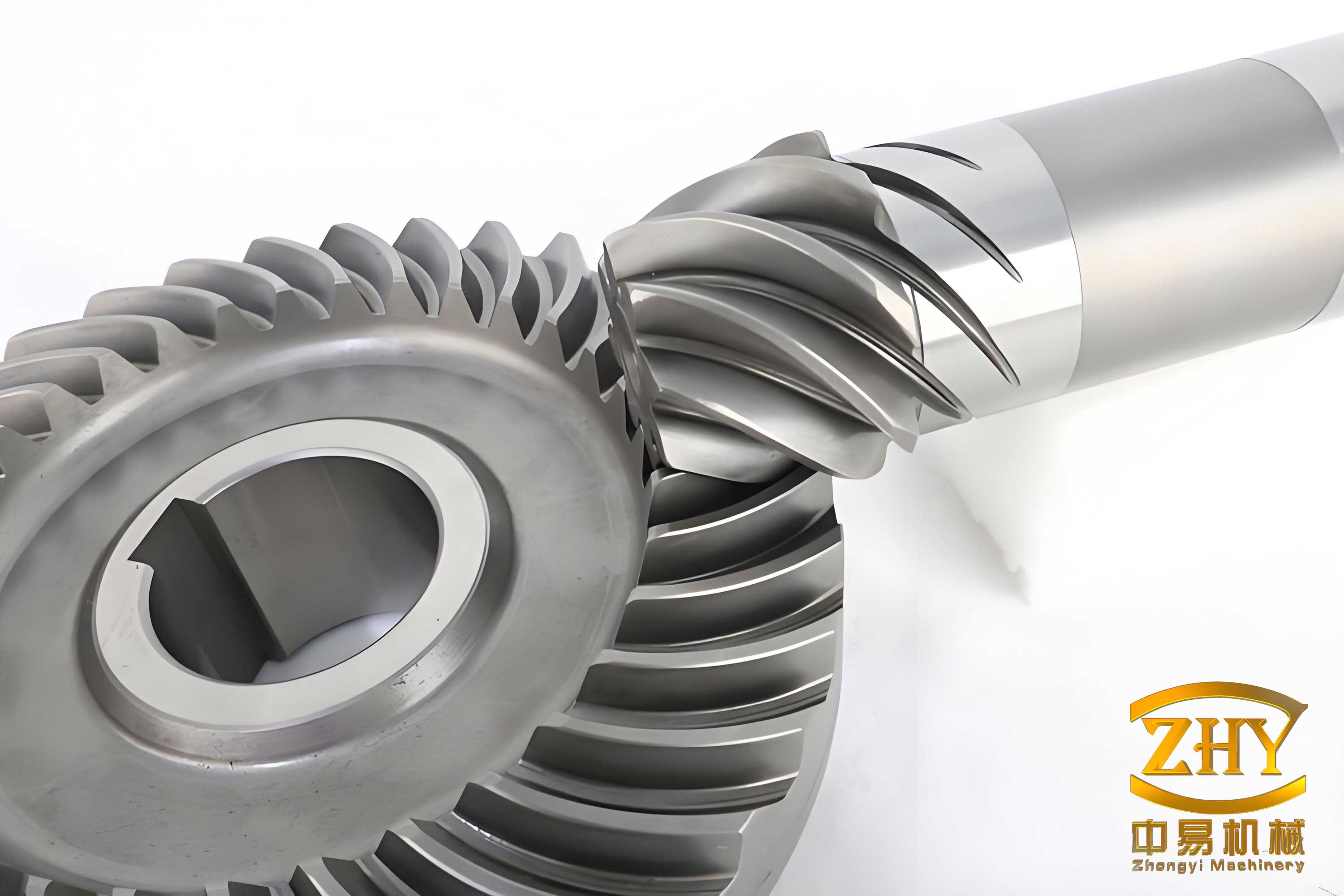
In the realm of heavy-duty engineering machinery, the reliability and longevity of critical transmission components are paramount. Among these, the spiral bevel gears employed in drive axles play a pivotal role in transferring torque and motion under severe operational conditions. These spiral bevel gears are subjected to substantial loads, shock, and abrasive environments, making their structural integrity, manufacturing precision, and performance durability a significant concern. Failure of these spiral bevel gears not only disrupts equipment functionality but also poses safety risks and impacts manufacturer reputation. Therefore, a thorough investigation into the failure mechanisms and enhancement of heat treatment processes for spiral bevel gears is essential. This article delves into an in-depth analysis of early failures observed in spiral bevel gears from drive axles of engineering machinery, examining metallurgical characteristics, heat treatment techniques, and proposing actionable measures to mitigate such issues and extend service life.
Early failure instances of spiral bevel gears often manifest as severe wear, pitting, spalling, or fracture. For instance, in a hydraulic vibratory roller drive axle, spiral bevel gears failed after approximately 500 hours of operation. The driving spiral bevel gear exhibited intense surface wear, with tooth tips sharpened to a knife-edge, and several teeth showed localized spalling where the hardened layer detached entirely. The driven spiral bevel gear demonstrated even more pronounced wear, with the hardened layer completely worn off in large areas, particularly on the concave side, leading to exposure of the core material and eventual fracture. These failures underscore the criticality of proper heat treatment and material science in spiral bevel gear manufacturing.
To understand the root causes, metallographic examination and microhardness testing were conducted on failed spiral bevel gears. For the driving gear, surface hardness averaged around 60 HRC, core hardness about 45–48 HRC, and effective case depth approximately 0.8–1.0 mm, all within specifications. The microstructure revealed a dense band of carbonitrides at the surface, followed by acicular martensite and minor retained austenite, indicating satisfactory heat treatment. However, the driven spiral bevel gear told a different story: surface hardness was about 60 HRC, but core hardness dropped to 38–40 HRC, below the required 42–46 HRC. The case depth was around 0.7 mm, but the microstructure showed piled-up carbonitrides extending over 0.5 mm, with underlying regions comprising fine martensite, non-martensitic transformations, and secondary carbides, suggesting inadequate carbon saturation. This led to a sharp hardness drop from the high-hardness surface layer, reducing load-bearing capacity and triggering early spalling and wear.
The microhardness distribution across the case depth of spiral bevel gears can be modeled using an exponential decay function, reflecting the diffusion of carbon and nitrogen during heat treatment. For a spiral bevel gear subjected to carburizing or carbonitriding, the hardness profile often follows:
$$ H(x) = H_s \cdot e^{-kx} + H_c $$
where \( H(x) \) is the hardness at depth \( x \) from the surface, \( H_s \) is the surface hardness, \( H_c \) is the core hardness, and \( k \) is a decay constant dependent on process parameters. In ideal spiral bevel gears, \( k \) should be moderate to ensure a gradual transition, but in failed driven gears, \( k \) was excessively high, causing abrupt hardness drops. This emphasizes the need for controlled diffusion cycles.
Table 1 summarizes the key findings from the failure analysis of these spiral bevel gears:
| Gear Type | Surface Hardness (HRC) | Core Hardness (HRC) | Effective Case Depth (mm) | Microstructural Observations | Failure Mode |
|---|---|---|---|---|---|
| Driving Spiral Bevel Gear | 60 | 45–48 | 0.8–1.0 | Carbonitride band, acicular martensite, minor retained austenite | Wear and localized spalling |
| Driven Spiral Bevel Gear | 60 | 38–40 | 0.7 | Piled-up carbonitrides, fine martensite, non-martensitic phases | Severe wear, spalling, fracture |
The heat treatment process for spiral bevel gears typically involves carbonitriding at moderate temperatures (e.g., 850–880°C) followed by quenching. For driving gears, direct quenching is often applied, which helps retain a fine microstructure with adequate case depth. The process can be described by the diffusion equation for carbon concentration \( C(x,t) \):
$$ \frac{\partial C}{\partial t} = D \frac{\partial^2 C}{\partial x^2} $$
where \( D \) is the diffusion coefficient, dependent on temperature and alloy composition. For spiral bevel gears, optimizing \( D \) through temperature control is crucial to achieve desired case depth without excessive carbonitride formation. In contrast, driven gears undergo reheat quenching, where lower temperatures (e.g., 820°C) are used to minimize distortion. However, this reduces carbon solubility in austenite, leading to carbonitride pile-up and decreased core hardness due to undissolved ferrite. The equilibrium carbon content \( C_{eq} \) in austenite at temperature \( T \) can be approximated by:
$$ C_{eq} = C_0 \cdot \exp\left(-\frac{Q}{RT}\right) $$
where \( C_0 \) is a constant, \( Q \) is activation energy, \( R \) is gas constant, and \( T \) is absolute temperature. Lower \( T \) during reheat quenching reduces \( C_{eq} \), explaining the poor carbon saturation in driven spiral bevel gears.
Further analysis reveals that the carbonitriding atmosphere, often using kerosene and ammonia, behaves suboptimally at lower temperatures. Kerosene decomposition is incomplete below 850°C, reducing gas generation and increasing soot, which hampers uniform carbon diffusion. The carbon potential \( CP \) in the furnace can be expressed as:
$$ CP = K \cdot \frac{P_{CO}^2}{P_{CO_2}} $$
where \( K \) is a temperature-dependent constant, and \( P_{CO} \) and \( P_{CO_2} \) are partial pressures. For spiral bevel gears, maintaining \( CP \) within 0.8–1.2% is ideal, but low temperatures cause \( CP \) to drop, leading to carbon black and erratic case formation. Additionally, decarburization during air cooling after carbonitriding further depletes surface carbon, exacerbating hardness issues upon requenching.
To address these challenges, several heat treatment modifications are proposed for spiral bevel gears. First, upgrading to controlled atmosphere furnaces enables precise regulation of temperature and carbon potential, minimizing oxidation and decarburization. Second, increasing carbonitriding and quenching temperatures by 10–20°C, while shortening holding times by 10–20%, can enhance carbon diffusion without significantly increasing distortion. The relationship between case depth \( d \) and time \( t \) at temperature \( T \) is given by:
$$ d = \sqrt{D \cdot t} $$
Thus, a slight temperature increase boosts \( D \), allowing shorter \( t \) to achieve the same \( d \), beneficial for spiral bevel gears. Third, optimizing media quality—e.g., using dry ammonia and low-sulfur kerosene—coupled with automated dosing systems ensures consistent carbon potential. Fourth, case depth should be tailored to gear module \( m_n \), typically:
$$ d \approx (0.15 \text{ to } 0.20) \cdot m_n $$
For spiral bevel gears with \( m_n = 5 \) mm, \( d \) should be 0.75–1.0 mm, balancing fatigue resistance and toughness. Deeper cases improve contact fatigue but may reduce residual compressive stress if excessive.
Table 2 compares conventional and improved heat treatment parameters for spiral bevel gears:
| Parameter | Conventional Process | Improved Process | Impact on Spiral Bevel Gear |
|---|---|---|---|
| Carbonitriding Temperature | 820–840°C | 850–860°C | Better carbon diffusion, reduced carbonitride pile-up |
| Quenching Temperature | 820°C | 840–850°C | Higher core hardness, less undissolved ferrite |
| Holding Time | 60–90 minutes | 50–70 minutes | Reduced distortion, maintained case depth |
| Atmosphere Control | Manual kerosene/ammonia | Automated, controlled carbon potential | Uniform case, minimal soot and decarburization |
| Cooling Method | Air cooling before requench | Direct quenching or rapid cooling | Preserved surface carbon, fewer non-martensitic phases |
Implementing these measures requires careful monitoring via hardness testing and microstructure analysis. For spiral bevel gears, regular inspection of case depth and core hardness is vital. The Vickers microhardness test, with loads of 0.5–1 kg, provides accurate profiles. Additionally, non-destructive techniques like eddy current testing can detect subsurface defects in spiral bevel gears before installation.
The mechanical performance of spiral bevel gears under load can be modeled using contact stress equations. The maximum Hertzian contact stress \( \sigma_H \) for gear teeth in mesh is:
$$ \sigma_H = \sqrt{\frac{F}{\pi b} \cdot \frac{1}{\frac{1-\nu_1^2}{E_1} + \frac{1-\nu_2^2}{E_2}} \cdot \frac{1}{\rho}} $$
where \( F \) is normal load, \( b \) is face width, \( \nu \) is Poisson’s ratio, \( E \) is Young’s modulus, and \( \rho \) is equivalent curvature radius. For spiral bevel gears, proper heat treatment reduces \( \sigma_H \) by increasing surface hardness and fatigue limits. The bending stress \( \sigma_b \) at the tooth root also matters:
$$ \sigma_b = \frac{F_t}{b m_n} \cdot Y_F \cdot Y_S $$
with \( F_t \) tangential force, \( Y_F \) form factor, and \( Y_S \) stress correction factor. Enhanced core hardness in spiral bevel gears via improved quenching boosts resistance to \( \sigma_b \), preventing tooth fracture.
Furthermore, residual stresses induced by heat treatment play a key role. Quenching generates compressive residual stresses at the surface, beneficial for fatigue life. For spiral bevel gears, the residual stress profile \( \sigma_r(x) \) can be estimated as:
$$ \sigma_r(x) = \sigma_0 \cdot \left(1 – \frac{x}{d}\right)^n $$
where \( \sigma_0 \) is surface stress, \( d \) case depth, and \( n \) an exponent. Optimizing heat treatment ensures \( \sigma_0 \) is highly compressive (e.g., -400 to -600 MPa), delaying crack initiation in spiral bevel gears.
In practice, simulation tools like finite element analysis (FEA) aid in designing heat treatment processes for spiral bevel gears. By modeling temperature distributions and phase transformations, manufacturers can predict case depths and distortion. For instance, the Koistinen-Marburger equation describes martensite formation during quenching:
$$ f_m = 1 – \exp(-\alpha (M_s – T)) $$
where \( f_m \) is martensite fraction, \( \alpha \) a constant, \( M_s \) martensite start temperature, and \( T \) current temperature. Applying this to spiral bevel gears helps tailor cooling rates for desired microstructures.
Environmental and operational factors also affect spiral bevel gear longevity. In engineering machinery, contaminants like dust and moisture accelerate wear. Therefore, alongside heat treatment, proper lubrication and sealing are essential. The wear rate \( W \) of spiral bevel gears can be expressed empirically:
$$ W = K_w \cdot P \cdot v \cdot t $$
where \( K_w \) is wear coefficient, \( P \) contact pressure, \( v \) sliding velocity, and \( t \) time. High-hardness cases from effective heat treatment reduce \( K_w \), extending life.
To summarize, the early failure of spiral bevel gears in drive axles often stems from suboptimal heat treatment, leading to poor case microstructure and hardness distribution. Through metallurgical analysis, we identified carbonitride pile-up, low core hardness, and decarburization as primary culprits. By elevating process temperatures, shortening cycles, using controlled atmospheres, and targeting appropriate case depths, these issues can be mitigated. Spiral bevel gears treated under improved conditions exhibit enhanced wear resistance, fatigue strength, and overall durability, crucial for heavy-duty applications. Continuous research into advanced materials and processes will further propel the reliability of spiral bevel gears in engineering machinery, ensuring safer and more efficient operations.
Future directions might explore laser hardening or cryogenic treatment for spiral bevel gears, offering precise case hardening and residual stress benefits. Additionally, real-time monitoring of heat treatment parameters via IoT sensors could enable adaptive control, minimizing variability. As the demand for robust engineering machinery grows, refining heat treatment strategies for spiral bevel gears remains a cornerstone of mechanical engineering excellence.