
In the field of automotive engineering, drive axles play a pivotal role in transmitting power from the engine to the wheels, with hyperboloid gears serving as a core component due to their ability to handle high torque and provide smooth motion transfer. These gears, often operating under heavy-load and high-speed conditions, are subject to significant system deformation arising from the complex interactions among gears, bearings, shafts, and housings. This deformation leads to misalignment in gear meshing, causing uneven load distribution on the tooth surfaces, which in turn affects meshing efficiency, noise, vibration, and overall durability. Accurately predicting the meshing efficiency of hyperboloid gears under real-world operating conditions is therefore crucial for optimizing drive axle performance. Traditional methods often overlook the impact of system deformation, focusing solely on idealized gear pairs, which can result in discrepancies between theoretical predictions and experimental outcomes. In this article, I propose a comprehensive approach to calculate the meshing efficiency of hyperboloid gears in drive axles by integrating system deformation effects, utilizing a friction-loaded tooth contact analysis (FLTCA) framework under mixed lubrication conditions. This method not only enhances accuracy but also provides a foundation for gear design improvements aimed at boosting efficiency and reliability.
The importance of hyperboloid gears in drive axles cannot be overstated; they are widely used in commercial vehicles, where efficiency losses directly translate to increased fuel consumption and operational costs. Under heavy loads, the deformation of the drive axle system—comprising the gearbox housing, support bearings, and shafts—induces misalignments that alter the contact pattern on the gear teeth. This misalignment can lead to edge loading, increased friction, and premature wear, all of which degrade meshing efficiency. Previous studies have explored gear efficiency through various lenses, such as elastohydrodynamic lubrication (EHL) models and thermal effects, but few have incorporated the holistic system deformation into their calculations. My approach addresses this gap by first modeling the drive axle as a multi-support shaft coupling system to compute deformation-induced misalignments. Then, based on actual machining parameters, the tooth surface geometry is generated, and FLTCA is employed to determine load distribution and friction coefficients under mixed lubrication. Finally, experimental validation is conducted using a drive axle test bench, comparing theoretical results with measured data for both contact patterns and efficiency. This integrated methodology ensures a more realistic assessment of hyperboloid gear performance, paving the way for enhanced design strategies in automotive applications.
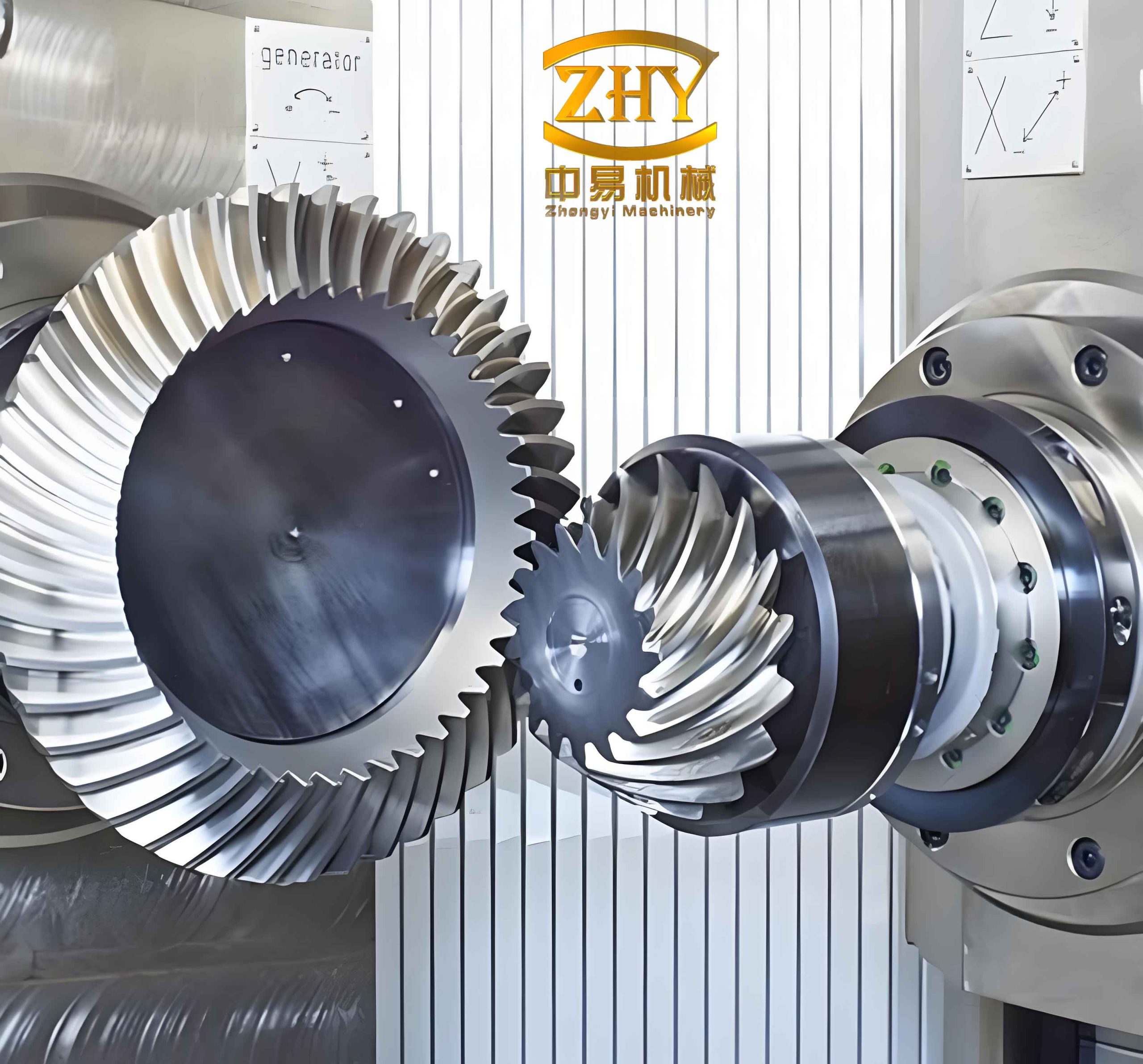
The calculation of hyperboloid gear meshing efficiency hinges on accurately modeling the tooth contact under load, which requires a deep understanding of the gear geometry, system stiffness, and lubrication regime. Hyperboloid gears, characterized by their offset axes and curved teeth, exhibit complex contact mechanics that are sensitive to alignment changes. When system deformation occurs—due to forces from torque transmission and bearing reactions—the relative position between the pinion and gear shifts, leading to misalignments quantified as displacements along and about the gear axes. These misalignments include variations in offset direction, axial shifts, and angular deviations, all of which distort the ideal contact ellipse and increase sliding velocities, thereby affecting friction losses. To capture this, I begin by establishing a stiffness matrix for the entire drive axle system, solving for nodal displacements under different load cases. The resulting misalignment values are then fed into the gear contact analysis, which simulates the actual tooth surfaces based on machine tool settings. This process involves mathematical formulations for surface generation, load distribution equations, and mixed-lubrication friction models, all of which are detailed in the following sections. By combining these elements, the proposed method offers a robust tool for predicting efficiency, with practical implications for reducing energy losses in vehicles.
System Deformation and Gear Misalignment Computation
The drive axle system is a complex assembly where hyperboloid gears interact with multiple components, each contributing to the overall stiffness and deformation behavior. Under operational loads, the system deflects, causing the hyperboloid gear pair to misalign from their nominal positions. This misalignment is a critical factor influencing tooth contact patterns and, consequently, meshing efficiency. To compute it, I model the drive axle using a multi-support shaft coupling approach, which treats the system as a network of interconnected elements—gears, bearings, shafts, and the housing—each with its own stiffness properties. The governing equation for static equilibrium is given by:
$$ \mathbf{K} \cdot \boldsymbol{\delta} = \mathbf{F} $$
where \(\mathbf{K}\) is the global stiffness matrix assembled from individual component stiffnesses, \(\boldsymbol{\delta}\) is the vector of nodal displacements, and \(\mathbf{F}\) is the vector of external forces. For a hyperboloid gear pair, the displacements at the pinion and gear centers are extracted, typically represented as:
$$ \boldsymbol{\delta}_p = (\delta_{px}, \delta_{py}, \delta_{pz}, \theta_{px}, \theta_{py}, \theta_{pz}) $$
$$ \boldsymbol{\delta}_g = (\delta_{gx}, \delta_{gy}, \delta_{gz}, \theta_{gx}, \theta_{gy}, \theta_{gz}) $$
Here, \(\delta\) terms denote linear displacements along the x, y, z axes, and \(\theta\) terms denote angular displacements about these axes, with subscripts \(p\) for pinion and \(g\) for gear. The misalignment between the hyperboloid gear pair is then derived by combining these displacements, considering the gear geometry parameters such as offset distance and shaft angles. The total misalignment components include:
$$ \Delta P = \Delta P_1 + \Delta P_2, \quad \Delta W = \Delta W_1 + \Delta W_2, \quad \Delta Y = \Delta Y_1 + \Delta Y_2, \quad \Delta \Sigma = \Delta \Sigma_1 + \Delta \Sigma_2 $$
where \(\Delta P\) is the relative displacement along the pinion axis, \(\Delta W\) along the gear axis, \(\Delta Y\) in the offset direction, and \(\Delta \Sigma\) the angular misalignment about the shaft intersection. These values vary with load, as demonstrated in the table below for different operating conditions of a commercial vehicle drive axle.
| Load Condition | \(\Delta P\) (μm) | \(\Delta W\) (μm) | \(\Delta Y\) (μm) | \(\Delta \Sigma\) (μrad) |
|---|---|---|---|---|
| Forward 20% Load | 101.6 | -17.8 | -128.6 | 0.22 |
| Forward 40% Load | 191.7 | -31.7 | -236.6 | 0.38 |
| Forward 60% Load | 279.8 | -44.9 | -341.3 | 0.51 |
| Forward 80% Load | 366.8 | -57.7 | -444.1 | 0.63 |
| Forward 100% Load | 453.2 | -70.3 | -545.9 | 0.75 |
| Reverse 20% Load | -173.9 | 231.1 | 173.7 | 0.21 |
| Reverse 40% Load | -326.6 | 411.4 | 312.2 | 0.49 |
| Reverse 60% Load | -475.7 | 583.5 | 445.9 | 0.75 |
As shown, misalignment increases with load, highlighting the necessity of incorporating system deformation into hyperboloid gear analysis. This data serves as input for subsequent tooth contact simulations, ensuring that the calculated load distribution reflects real-world conditions. The stiffness matrix \(\mathbf{K}\) is derived from finite element models or analytical expressions for bearings and shafts, capturing nonlinearities such as bearing clearance and housing flexibility. For hyperboloid gears, the contact point location relative to the gear centers also affects misalignment calculations, as described by:
$$ \Delta P_1 = \delta_{px}, \quad \Delta W_1 = -\delta_{py} + W_P \cos \alpha \sin \theta_{pz}, \quad \Delta Y_1 = -\delta_{pz} – W_P \cos \alpha \sin \theta_{py}, \quad \Delta \Sigma_1 = -\theta_{pz} $$
where \(W_P\) is the distance from the pinion center to the contact point, and \(\alpha\) is the offset angle. Similar expressions apply for the gear side. By solving these equations iteratively for different torque inputs, a comprehensive misalignment profile is obtained, which directly influences the hyperboloid gear meshing behavior.
Tooth Surface Generation of Hyperboloid Gears
The accurate representation of hyperboloid gear tooth surfaces is fundamental to any contact analysis. These surfaces are typically generated using face-hobbing or face-milling processes on specialized gear cutting machines, where the tool and workpiece undergo coordinated motions to produce the desired tooth geometry. In my approach, I simulate this machining process mathematically to derive the tooth surface coordinates based on machine tool settings. This involves defining multiple coordinate systems: the machine coordinate system \(O_m-i_m j_m k_m\), the cutter coordinate system \(O_c-i_c j_c k_c\), and the gear blank coordinate system \(O_{lp}-i_{lp} j_{lp} k_{lp}\). The transformation between these systems is governed by parameters such as radial distance, angular position, and tilt angles, which are specific to the hyperboloid gear design.
The tooth surface point coordinates in the gear blank system can be expressed as functions of machine parameters:
$$ \mathbf{r} = f_r(\theta_d, \phi_d, \boldsymbol{\xi}_c), \quad \mathbf{n} = f_n(\theta_d, \phi_d, \boldsymbol{\xi}_c) $$
where \(\mathbf{r}\) is the position vector, \(\mathbf{n}\) is the normal vector, \(\theta_d\) is the cutter rotation angle, \(\phi_d\) is the cradle rotation angle, and \(\boldsymbol{\xi}_c\) is a vector of machine settings including tool radius, feed rates, and alignment parameters. For hyperboloid gears, common parameters include the blade angle, cutter head radius, and machine root angle, which determine the tooth curvature and contact characteristics. Using Ferguson curve splines, these discrete points are interpolated to form a continuous surface, ready for contact analysis. The table below summarizes typical machining parameters for a hyperboloid gear pair in a drive axle application.
| Parameter | Pinion (Concave Side) | Pinion (Convex Side) | Gear (Convex Side) | Gear (Concave Side) |
|---|---|---|---|---|
| Angular Tool Position (°) | 56.03 | 56.03 | — | — |
| Radial Tool Distance (mm) | 162.08 | 162.08 | 113.74 | 113.74 |
| Vertical Workpiece Setting (mm) | 26.17 | 26.17 | 123.56 | 123.56 |
| Horizontal Workpiece Setting (mm) | -1.34 | -1.34 | 3.63 | 3.63 |
| Machine Root Angle (°) | -2.04 | -2.04 | 70.27 | 70.27 |
| Tool Blade Angle (°) | 26.26 | 18.80 | 20.40 | 24.60 |
| Reference Point Radius (mm) | 115.78 | 116.12 | 115.45 | 116.03 |
These parameters ensure that the hyperboloid gear teeth have the correct flank geometry for optimal meshing. Once the surface is generated, it is used in both unloaded and loaded contact analyses. The unloaded tooth contact analysis (TCA) determines the theoretical contact path and pattern without considering deformation, while the loaded analysis incorporates forces and misalignments. This step is crucial for hyperboloid gears because their offset design leads to sliding-dominated contact, making efficiency highly sensitive to surface accuracy. By deriving the tooth surface from actual machine data, I account for manufacturing imperfections that might affect performance, thereby enhancing the realism of the efficiency calculation.
Friction-Loaded Tooth Contact Analysis (FLTCA) for Hyperboloid Gears
With the tooth surface geometry and system misalignment known, the next step is to perform friction-loaded tooth contact analysis (FLTCA) to compute the load distribution and friction coefficients under operating conditions. This analysis solves for the contact forces on the tooth flanks by satisfying equilibrium equations that balance applied torque with contact reactions, while also accounting for tooth deformations. For hyperboloid gears, the contact is typically point-based or elliptical, and under load, the teeth undergo bending, shear, and contact deformations. The compatibility condition ensures that the total deformation matches the initial separation between teeth:
$$ \| \boldsymbol{\delta}_b + \boldsymbol{\delta}_s + \boldsymbol{\delta}_c – (\mathbf{Z} – \mathbf{d}_0) \| < \epsilon_1 $$
where \(\boldsymbol{\delta}_b\) is the bending deformation, \(\boldsymbol{\delta}_s\) is the shear deformation, \(\boldsymbol{\delta}_c\) is the contact deformation, \(\mathbf{Z}\) is the rigid body displacement, \(\mathbf{d}_0\) is the initial gap, and \(\epsilon_1\) is a convergence tolerance. Simultaneously, the force equilibrium must hold:
$$ \left\| \sum_{i=1}^{m} \sum_{j=1}^{n} (F_{fij} + F_{Nij}) \mathbf{r}_{ij} \times \mathbf{p} – T_{\text{load}} \right\| < \epsilon_2 $$
Here, \(F_{Nij}\) and \(F_{fij}\) are the normal and friction forces at discrete contact points, \(m\) is the number of simultaneously contacting tooth pairs, \(n\) is the number of points per contact ellipse, \(\mathbf{r}_{ij}\) is the position vector, \(\mathbf{p}\) is the direction vector of gear rotation, and \(T_{\text{load}}\) is the applied torque. The friction force depends on the friction coefficient, which in turn is derived from the lubrication regime. For hyperboloid gears operating in mixed lubrication, the coefficient \(\mu_{\text{ML}}\) is modeled as a weighted combination of boundary and fluid lubrication components:
$$ \mu_{\text{ML}} = \mu_{\text{FL}} f_K^{1.2} + \mu_{\text{DC}} (1 – f_K) $$
where \(\mu_{\text{FL}}\) is the fluid lubrication friction coefficient, \(\mu_{\text{DC}}\) is the boundary lubrication friction coefficient (typically around 0.115 for gear oils), and \(f_K\) is the load-sharing factor given by:
$$ f_K = \frac{1.21 \lambda^{0.64}}{1 + 0.37 \lambda^{1.26}} $$
The parameter \(\lambda\) is the film thickness ratio, defined as \(\lambda = h_0 / S\), with \(h_0\) being the central lubricant film thickness and \(S\) the composite surface roughness. The film thickness for hyperboloid gear contacts is calculated using Hamrock-Dowson type equations:
$$ h_0 = 2.69 W^{-0.067} U^{0.67} G^{0.53} (1 – 0.61 e^{-0.73 \ell}) $$
with dimensionless parameters:
$$ W = \frac{F_m}{E_{\text{eq}} R_x^2}, \quad U = \frac{V_e u_0}{E_{\text{eq}} R_x}, \quad G = \alpha E_{\text{eq}}, \quad \ell = 1.03 \left( \frac{R_x}{R_y} \right)^{0.64} $$
where \(F_m\) is the load per unit width, \(E_{\text{eq}}\) is the equivalent elastic modulus, \(R_x\) and \(R_y\) are the equivalent radii of curvature along the contact ellipse axes, \(V_e\) is the entrainment velocity, \(u_0\) is the dynamic viscosity, and \(\alpha\) is the pressure-viscosity coefficient. The fluid friction coefficient \(\mu_{\text{FL}}\) is often expressed via empirical regression models:
$$ \mu_{\text{FL}} = e^{f(S_R, P_h, u_0, S)} (P_h / \text{MPa})^{b_2} |S_R|^{b_3} (V_e / \text{m·s}^{-1})^{b_6} u_0^{b_7} R^{b_8} $$
with \(f(\cdot)\) being a function of slide-roll ratio \(S_R = 2V_s / V_r\), Hertzian pressure \(P_h\), viscosity, and roughness. The coefficients \(b_1\) to \(b_9\) are derived from experimental data, as listed below.
| Coefficient | Value | Coefficient | Value | Coefficient | Value |
|---|---|---|---|---|---|
| \(b_1\) | -8.916465 | \(b_4\) | -0.354068 | \(b_7\) | 0.752755 |
| \(b_2\) | 1.03303 | \(b_5\) | 2.812084 | \(b_8\) | -0.390958 |
| \(b_3\) | 1.036077 | \(b_6\) | -0.100601 | \(b_9\) | 0.620305 |
These equations are solved iteratively within the FLTCA framework to obtain the pressure distribution and friction forces at each meshing position. For hyperboloid gears, the contact ellipse size and orientation change along the tooth flank, requiring discretization into grids for numerical solution. The output includes the instantaneous power loss per mesh, which is integrated over the engagement cycle to compute total friction power loss. This detailed approach allows for a precise evaluation of hyperboloid gear efficiency, factoring in the unique geometry and system-induced misalignments.
Meshing Efficiency Calculation for Hyperboloid Gears
The meshing efficiency of hyperboloid gears is defined as the ratio of output power to the sum of output power and gear mesh friction losses. In drive axle testing, input speed and output torque are often controlled, making efficiency calculation straightforward. For a hyperboloid gear pair, the meshing efficiency \(\eta_{g,\text{fric}}\) is expressed as:
$$ \eta_{g,\text{fric}} = \frac{P_{\text{out}}}{P_{\text{out}} + P_{g,\text{fric}}} = \frac{|T_{\text{out}}| \omega_{\text{out}}}{|T_{\text{out}}| \omega_{\text{out}} + P_{g,\text{fric}}} $$
where \(P_{\text{out}}\) is the output power, \(T_{\text{out}}\) is the output torque, \(\omega_{\text{out}}\) is the output angular velocity, and \(P_{g,\text{fric}}\) is the total friction power loss of the hyperboloid gear pair over one mesh cycle. This loss is obtained by integrating the instantaneous power loss \(p_{\text{inst}}\) across the engagement interval from entry angle \(\theta_1\) to exit angle \(\theta_2\):
$$ P_{g,\text{fric}} = \frac{1}{\theta_2 – \theta_1} \int_{\theta_1}^{\theta_2} p_{\text{inst}} \, d\theta $$
The instantaneous loss depends on the friction forces and sliding velocities at each contact point:
$$ p_{\text{inst}} = \sum_{i=1}^{m} \sum_{j=1}^{n} F_{fij} V_{sij} $$
with \(V_{sij}\) being the sliding velocity. For hyperboloid gears, sliding velocities are significant due to the offset axes, leading to higher friction losses compared to parallel-axis gears. The calculation of \(p_{\text{inst}}\) relies on the FLTCA results, which provide \(F_{fij}\) and \(V_{sij}\) at discrete time steps. To account for system deformation, the misalignment values from Table 1 are incorporated, altering the contact path and sliding velocities. This integration ensures that the efficiency prediction reflects real operating conditions, not just ideal geometry.
In practice, the overall drive axle efficiency includes other losses such as bearing friction and churning losses from oil agitation. However, focusing on hyperboloid gear meshing efficiency allows for targeted improvements. The relationship between system efficiency \(\eta\) and gear efficiency is given by:
$$ \eta = 1 – \frac{P_{g,\text{drag}} + P_{b,\text{drag}} + P_{g,\text{fric}} + P_{b,\text{fric}}}{P_{\text{in}}} = \eta_{\text{drag}} – (1 – \eta_{g,\text{fric}}) – \frac{P_{b,\text{fric}}}{P_{\text{in}}} $$
where \(\eta_{\text{drag}}\) is the efficiency corresponding to no-load losses, and \(P_{b,\text{fric}}\) is the bearing friction loss computed using methods like the SKF model. Rearranging, the hyperboloid gear meshing efficiency can be isolated:
$$ \eta_{g,\text{fric}} = 1 + \eta – \eta_{\text{drag}} + \frac{P_{b,\text{fric}}}{P_{\text{in}}} $$
This formula is used in experimental validation to extract gear efficiency from whole-system measurements. By combining analytical predictions with test data, the accuracy of the proposed method is verified, as discussed in the next section.
Experimental Validation and Results Discussion
To validate the proposed calculation method for hyperboloid gear meshing efficiency, a series of experiments were conducted on a drive axle test bench. The setup involved a commercial vehicle rear axle equipped with hyperboloid gears, connected to a dynamometer that controlled input speed and output torque. Tests covered a range of operating conditions: speeds from 10 to 80 km/h and loads from 10 to 100 kW, with lubricant temperature maintained at 80±5°C using an oil cooling system. The lubricant was a standard gear oil (85W90 grade) with properties: dynamic viscosity \(u_0 = 27 \, \text{Pa·s}\) and pressure-viscosity coefficient \(\alpha = 2.2 \times 10^{10} \, \text{Pa}^{-1}\). Two identical axle units were tested to ensure repeatability, and average results were taken.
First, contact pattern tests were performed under no-load and loaded conditions to compare with FLTCA predictions. For no-load cases, the gear contact impressions showed good agreement between theoretical and experimental patterns, confirming the accuracy of tooth surface generation and TCA. Under load, system deformation caused the contact to shift toward the toe on the drive side and toward the heel on the coast side, as predicted by the misalignment calculations. The table below summarizes the contact pattern characteristics for forward full-load and reverse 60% load conditions, demonstrating the effect of deformation on hyperboloid gear contact.
| Condition | Theoretical Pattern (Without Misalignment) | Theoretical Pattern (With Misalignment) | Experimental Pattern |
|---|---|---|---|
| Forward Full Load | Centered on tooth flank | Shifted toward toe, near tooth top | Shifted toward toe, similar to misalignment prediction |
| Reverse 60% Load | Even distribution | Shifted toward heel, slight edge contact | Shifted toward heel, matching misalignment prediction |
These results underscore that ignoring system deformation leads to inaccurate contact predictions, which would affect efficiency calculations. Next, efficiency tests were carried out by measuring input and output power. No-load tests determined the drag losses \(P_{\text{drag}}\), while loaded tests gave the overall efficiency \(\eta\). Using the SKF model for bearing friction losses, the hyperboloid gear meshing efficiency \(\eta_{g,\text{fric}}\) was derived. The calculated efficiency from the FLTCA method was then compared against these experimental values across different speeds and loads.
The graphs below illustrate key findings. For a constant load power of 80 kW, the power loss composition varies with speed: at low speeds, hyperboloid gear friction is the dominant loss, but as speed increases, bearing friction and churning losses grow. This trend aligns with the increased entrainment velocity and lubricant film thickness at higher speeds, which reduce gear friction but raise viscous losses. The meshing efficiency of hyperboloid gears improves nonlinearly with speed, rising by about 1% from 10 to 80 km/h at 80 kW load. Similarly, under a constant torque of 1354 N·m, efficiency increases by approximately 1.5% over the same speed range. Load variation at fixed speed (60 km/h) shows minimal impact on efficiency, indicating that the mixed lubrication regime remains stable across loads for hyperboloid gears.
| Speed (km/h) | Load Power (kW) | Experimental \(\eta_{g,\text{fric}}\) (%) | Calculated \(\eta_{g,\text{fric}}\) Without Misalignment (%) | Calculated \(\eta_{g,\text{fric}}\) With Misalignment (%) |
|---|---|---|---|---|
| 10 | 80 | 97.2 | 97.5 | 97.3 |
| 40 | 80 | 97.8 | 98.1 | 97.9 |
| 80 | 80 | 98.3 | 98.6 | 98.4 |
| 60 | 10 | 98.0 | 98.2 | 98.1 |
| 60 | 50 | 97.9 | 98.1 | 98.0 |
| 60 | 100 | 97.8 | 98.0 | 97.9 |
The data shows that incorporating system misalignment yields calculated efficiencies closer to experimental values, especially at higher speeds and loads where deformation is more pronounced. For instance, at 80 km/h and 80 kW, the error reduces from 0.3% to 0.1% when misalignment is considered. This validates the proposed method’s ability to capture real-world effects on hyperboloid gear performance. Furthermore, the friction coefficient and film thickness analysis reveals that as speed rises, the average film thickness \(h_0\) increases, reducing the boundary lubrication share and thus the friction coefficient \(\mu_{\text{ML}}\). This explains the efficiency improvement with speed, as lower friction translates to lower power loss. The comprehensive approach, combining system deformation, accurate tooth modeling, and mixed lubrication friction, provides a reliable tool for hyperboloid gear efficiency prediction, useful for design optimization in drive axles.
Conclusion
In this article, I have presented a detailed method for calculating the meshing efficiency of hyperboloid gears in drive axles, with explicit consideration of system deformation. The approach integrates multi-support shaft coupling analysis to determine gear misalignment under load, tooth surface generation based on machining parameters, and friction-loaded tooth contact analysis under mixed lubrication conditions. By solving equilibrium and compatibility equations iteratively, the load distribution and friction forces are obtained, enabling precise computation of power losses and efficiency. Experimental validation using a drive axle test bench confirms that system deformation significantly affects contact patterns and efficiency, particularly under high-load and high-speed conditions. The results demonstrate that ignoring misalignment leads to overestimated efficiency, whereas the proposed method aligns closely with measured data, with errors within 0.2% in typical cases.
The implications of this work extend to automotive engineering, where improving drive axle efficiency can reduce fuel consumption and emissions. Hyperboloid gears, as key components, benefit from this accurate efficiency prediction, allowing designers to optimize tooth geometry, bearing arrangements, and housing stiffness to minimize deformation-induced losses. Future research could explore dynamic effects, thermal influences, and alternative lubrication models to further enhance accuracy. Overall, the methodology offers a robust framework for analyzing hyperboloid gear performance, contributing to the development of more efficient and reliable vehicle transmission systems. By embracing system-level insights, engineers can better tackle the challenges of heavy-duty applications, ensuring that hyperboloid gears operate at peak efficiency throughout their service life.