
In mechanical systems such as steering mechanisms, helical gears are commonly employed in conjunction with cylindrical racks to convert rotational motion into linear motion. The performance of these systems heavily relies on the precise design of helical gears, particularly regarding their effective length and run-out length. The effective length of a helical gear refers to the portion of the gear tooth that can properly engage with the rack without interference, while the run-out length denotes the non-functional tooth region resulting from the hobbling process’s withdrawal phase. Accurately calculating these lengths is crucial for avoiding interference, optimizing gear geometry, and ensuring the reliability of mechanical products involving helical gears. This paper presents detailed analytical expressions for both the effective length and run-out length of helical gears, derived through theoretical analysis involving Lagrange multiplier methods and quartic equations. The correctness of these expressions is verified using SolidWorks software, providing a robust foundation for design applications.
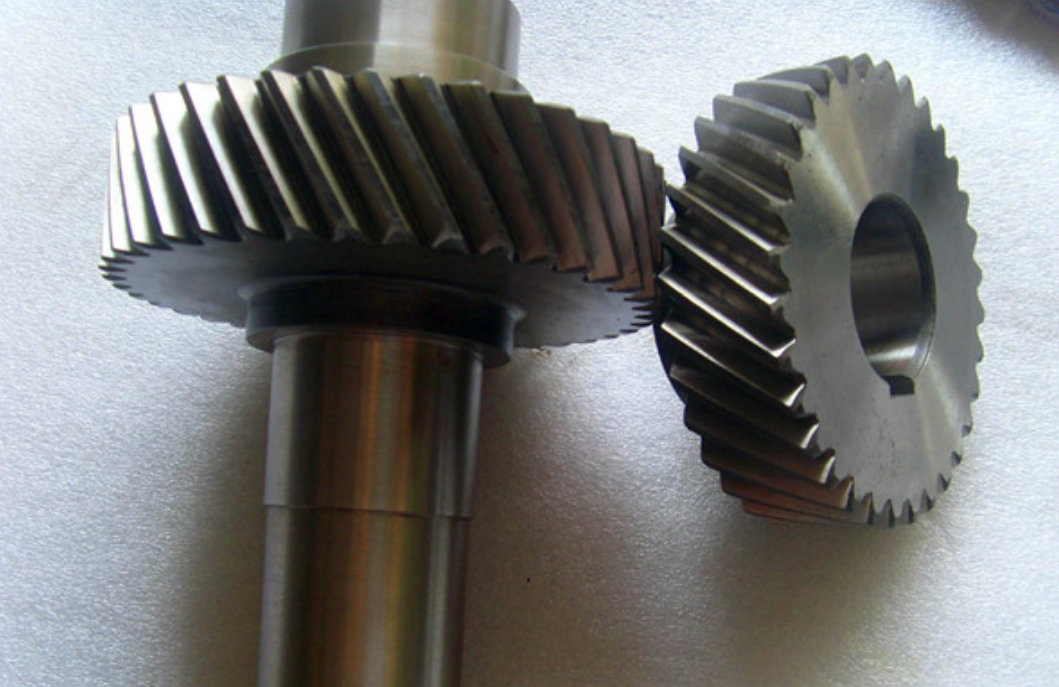
The interaction between helical gears and cylindrical racks occurs within the intersection of their respective cylindrical surfaces. For proper meshing without interference, the helical gear must have an effective length that covers this intersection region along its axis. This problem can be formulated mathematically as finding the extreme values of the axial coordinate within the intersection curve of the gear’s tip cylinder and the rack cylinder. Let’s define the key variables involved in this calculation for helical gears. The center distance, denoted as \(a\), is the shortest distance between the axes of the helical gear and the rack. The shaft angle, \(\Sigma\), is defined as the acute angle between the axes when viewed from the gear axis along the shortest distance line toward the rack axis; it is positive if the gear axis rotates clockwise to align with the rack axis, and negative otherwise. The radius of the helical gear’s tip cylinder is \(r_p\), and the radius of the cylindrical rack is \(r_r\). A coordinate system is established where the helical gear’s axis aligns with the z-axis, and the shortest distance line lies along the x-axis, as shown in the conceptual diagram.
The equations representing the surfaces of the helical gear’s tip cylinder and the rack cylinder are given by:
$$x^2 + y^2 – r_p^2 = 0 \quad \text{(Gear tip cylinder)}$$
$$(a – x)^2 + (y \cos \Sigma + z \sin \Sigma)^2 – r_r^2 = 0 \quad \text{(Rack cylinder)}$$
To find the effective length of the helical gear, we need to determine the extreme values of \(z\) that satisfy both equations simultaneously. This is a constrained optimization problem, which can be solved using the Lagrange multiplier method. We define the Lagrangian function:
$$L(x, y, z, \lambda, \mu) = z + \lambda (x^2 + y^2 – r_p^2) + \mu \left[(a – x)^2 + (y \cos \Sigma + z \sin \Sigma)^2 – r_r^2\right]$$
By taking partial derivatives and setting them to zero, we obtain the following system of equations:
$$\frac{\partial L}{\partial x} = 2\lambda x – 2\mu (a – x) = 0$$
$$\frac{\partial L}{\partial y} = 2\lambda y + 2\mu \cos \Sigma (y \cos \Sigma + z \sin \Sigma) = 0$$
$$\frac{\partial L}{\partial z} = 1 + 2\mu \sin \Sigma (y \cos \Sigma + z \sin \Sigma) = 0$$
$$\frac{\partial L}{\partial \lambda} = x^2 + y^2 – r_p^2 = 0$$
$$\frac{\partial L}{\partial \mu} = (a – x)^2 + (y \cos \Sigma + z \sin \Sigma)^2 – r_r^2 = 0$$
From these equations, we can derive relationships that simplify the problem. Combining the second and third equations yields:
$$\lambda y \tan \Sigma = \frac{1}{2}$$
Similarly, from the first and third equations:
$$\lambda = \frac{a – x}{x} \cdot \mu = \frac{a – x}{x} \cdot \frac{-1}{2 \sin \Sigma (y \cos \Sigma + z \sin \Sigma)}$$
Equating these expressions leads to:
$$\frac{a – x}{x} \cdot \frac{-y}{y \cos \Sigma + z \sin \Sigma} = \cos \Sigma$$
Squaring both sides and substituting the constraint equations results in a quartic equation in \(x\):
$$(1 – t)x^4 – 2a(1 – t)x^3 + (a^2 – r_p^2 – a^2 t + r_r^2 t)x^2 + 2a r_p^2 x – a^2 r_p^2 = 0$$
where \(t = \cos^2 \Sigma\). This quartic equation can be solved analytically. The four roots are:
$$x_1 = \frac{1}{2}(a – t_4 + t_5 + t_6)$$
$$x_2 = \frac{1}{2}(a – t_4 – t_5 + t_6)$$
$$x_3 = \frac{1}{2}(a + t_4 + t_5 – t_6)$$
$$x_4 = \frac{1}{2}(a + t_4 – t_5 – t_6)$$
with intermediate variables defined as:
$$t_1 = a^2 – r_p^2 – a^2 t + r_r^2 t$$
$$t_2 = 54 a^2 r_p^2 r_r^2 (1 – t) t + t_1^3$$
$$t_3 = \left( t_2 + \sqrt{t_2^2 – t_1^6} \right)^{1/3}$$
$$t_4 = \sqrt{ a^2 – \frac{2t_1}{3(1 – t)} + \frac{t_1^2}{3(1 – t) t_3} + \frac{t_3}{3(1 – t)} }$$
$$t_5 = \sqrt{ 2a^2 – \frac{4t_1}{3(1 – t)} – \frac{t_1^2}{3(1 – t) t_3} – \frac{t_3}{3(1 – t)} }$$
$$t_6 = \frac{2a (r_r^2 t + r_p^2)}{(1 – t) t_4}$$
Given that \(t_5 – t_6\) is negative, the roots \(x_3\) and \(x_4\) are imaginary and discarded. The root \(x_2\) is negative and also discarded for physical relevance. Thus, the valid root is \(x_1\). Once \(x\) is determined, \(y\) and \(z\) can be computed as:
$$y = -\text{sgn}(\Sigma) \sqrt{r_p^2 – x^2}$$
$$z = \frac{ \text{sgn}(\Sigma) \sqrt{r_r^2 – (a – x)^2} – y \cos \Sigma }{ \sin \Sigma }$$
where \(\text{sgn}(\Sigma)\) is the sign of \(\Sigma\). The extreme value of \(z\) represents the maximum axial extent of the intersection, and thus the required effective length for the helical gear must exceed this value to ensure proper engagement with the rack.
To illustrate this calculation, consider an example with the following parameters for helical gears: center distance \(a = 17.95 \, \text{mm}\), shaft angle \(\Sigma = 74^\circ 55’\), helical gear tip radius \(r_p = 11.175 \, \text{mm}\), and rack radius \(r_r = 13.5 \, \text{mm}\). Using the derived formulas, we compute the extreme \(z\) value as \(12.6929 \, \text{mm}\). This result can be verified using SolidWorks software by modeling the helical gear’s tip cylinder and the rack cylinder, intersecting them, and measuring the axial coordinate of the intersection curve. The verification confirms the correctness of the analytical expression for helical gears. The table below summarizes the variables and results for this example.
| Variable | Symbol | Value | Description |
|---|---|---|---|
| Center Distance | \(a\) | 17.95 mm | Shortest distance between gear and rack axes |
| Shaft Angle | \(\Sigma\) | 74°55′ | Angle between axes, positive as defined |
| Gear Tip Radius | \(r_p\) | 11.175 mm | Radius of helical gear’s tip cylinder |
| Rack Radius | \(r_r\) | 13.5 mm | Radius of cylindrical rack |
| Extreme \(z\) Value | \(z_{\text{max}}\) | 12.6929 mm | Calculated effective length requirement |
This expression for effective length is vital in designing helical gears for applications like steering systems, as it ensures that the gear teeth fully engage with the rack without interference, thereby optimizing performance and durability of mechanical products involving helical gears.
Now, let’s turn to the calculation of the run-out length for helical gears. During the hobbling process, helical gears are manufactured using a hob that simulates a helical gear in mesh with the workpiece. The run-out length arises when the hob is withdrawn after the feeding motion, leaving a non-functional tooth region at the end of the gear. This length must be accounted for in design to avoid interference and ensure proper gear geometry. The run-out length is defined as the distance from the farthest end of the hobbled run-out portion to the plane perpendicular to the workpiece axis that contains the shortest distance line between the hob axis and the workpiece axis during withdrawal.
For the analysis, we define the hobbling center distance as \(a\), the hobbling shaft angle as \(\Sigma\), the hob’s outer radius as \(r\), and the axial distance from the shortest distance line to a point on the workpiece as \(x\). The corresponding radius on the workpiece surface generated by the hob’s outer cylinder is \(y\). The relationship between \(x\) and \(y\) is derived from the geometry of the hob and workpiece axes. Consider the curve formed by rotating the hob axis around the workpiece axis with respect to the hobbling parameters. In a plane containing the workpiece axis, the curve is given by:
$$y = \sqrt{a^2 + (x \tan \Sigma)^2}$$
This curve represents the locus of points where the hob axis intersects a plane perpendicular to the workpiece axis at distance \(x\). The run-out tooth profile is obtained by offsetting this curve inward by the hob’s outer radius \(r\). Let \(\theta\) be the inclination angle of the tangent to the curve at point \((x, y)\). Then:
$$\tan \theta = \frac{d}{dx} \sqrt{a^2 + (x \tan \Sigma)^2} = \frac{x \tan^2 \Sigma}{\sqrt{a^2 + (x \tan \Sigma)^2}}$$
After offsetting by distance \(r\), the new coordinates \((x_r, y_r)\) are:
$$x_r = x + r \sin \theta = x + \frac{r x \tan^2 \Sigma}{\sqrt{a^2 + x^2 (\tan^2 \Sigma + \tan^4 \Sigma)}}$$
$$y_r = y – r \cos \theta = \sqrt{a^2 + (x \tan \Sigma)^2} – \frac{r \sqrt{a^2 + (x \tan \Sigma)^2}}{\sqrt{a^2 + x^2 (\tan^2 \Sigma + \tan^4 \Sigma)}}$$
To find the run-out length, we need to express \(y_r\) in terms of \(x_r\) or solve for \(x_r\) given \(y_r\). By substituting and simplifying, we obtain a quartic equation in \(y\):
$$(y – y_r)^2 (y^2 – a_t^2) = r_t^2 y^2$$
where \(a_t = \frac{a \tan \Sigma}{\sqrt{1 + \tan^2 \Sigma}}\) and \(r_t = \frac{r}{\sqrt{1 + \tan^2 \Sigma}}\). This quartic equation can be solved analytically for \(y\). The four roots are:
$$y_1 = \frac{1}{2} \left( y_r – t_4 + t_5 + t_6 \right)$$
$$y_2 = \frac{1}{2} \left( y_r – t_4 – t_5 + t_6 \right)$$
$$y_3 = \frac{1}{2} \left( y_r + t_4 + t_5 – t_6 \right)$$
$$y_4 = \frac{1}{2} \left( y_r + t_4 – t_5 – t_6 \right)$$
with intermediate variables defined as:
$$t_1 = -a_t^2 – r_t^2 + y_r^2$$
$$t_2 = -54 a_t^2 r_t^2 y_r^2 + t_1^3$$
$$t_3 = \left( t_2 + \sqrt{t_2^2 – t_1^6} \right)^{1/3}$$
$$t_4 = \sqrt{ a_t^2 + r_t^2 + \frac{t_1}{3} + \frac{t_1^2}{3 t_3} + \frac{t_3}{3} }$$
$$t_5 = \sqrt{ a_t^2 + r_t^2 + y_r^2 – \frac{t_1}{3} – \frac{t_1^2}{3 t_3} – \frac{t_3}{3} }$$
$$t_6 = \frac{2 y_r (a_t^2 – r_t^2)}{t_4}$$
Since \(t_5 – t_6\) is negative, the roots \(y_3\) and \(y_4\) are imaginary and discarded. The root \(y_2\) is negative and also discarded. Thus, the valid root is \(y_1\). Once \(y\) is known, \(x_r\) can be computed as:
$$x_r = x + \left(1 – \frac{y_r}{y}\right) x \tan^2 \Sigma$$
This \(x_r\) represents the axial distance from the shortest distance line plane to the farthest point of the run-out region on the helical gear. Therefore, the run-out length is given by \(x_r\).
Consider an example for helical gears with the following hobbling parameters: center distance \(a = 31.839994 \, \text{mm}\), shaft angle \(\Sigma = -120^\circ\), workpiece tip radius \(y_r = 11.175 \, \text{mm}\) (which corresponds to the helical gear’s tip radius), and hob outer radius \(r = 25 \, \text{mm}\). Using the derived formulas, we compute the run-out length \(x_r = 17.27264 \, \text{mm}\). This result can be verified in SolidWorks by modeling the helical gear’s tip cylinder and the hob’s outer cylinder, intersecting them under the given hobbling conditions, and measuring the axial extent of the intersection curve. The verification confirms the correctness of the analytical expression for the run-out length of helical gears. The table below summarizes the variables and results for this example.
| Variable | Symbol | Value | Description |
|---|---|---|---|
| Hobbling Center Distance | \(a\) | 31.839994 mm | Shortest distance between hob and workpiece axes |
| Hobbling Shaft Angle | \(\Sigma\) | -120° | Angle between axes during hobbling |
| Workpiece Tip Radius | \(y_r\) | 11.175 mm | Radius of helical gear’s tip cylinder |
| Hob Outer Radius | \(r\) | 25 mm | Radius of hob’s outer cylinder |
| Run-Out Length | \(x_r\) | 17.27264 mm | Calculated run-out length for helical gear |
The derivation of run-out length for helical gears is essential in manufacturing and design, as it helps determine the non-functional portion of the gear teeth, allowing for proper layout of gear geometry and avoidance of interference in mechanical assemblies. By accurately calculating this length, designers can optimize the overall dimensions and performance of systems involving helical gears.
In summary, this paper has presented comprehensive analytical methods for calculating both the effective length and run-out length of helical gears. The effective length calculation ensures that helical gears properly engage with cylindrical racks without interference, derived through Lagrange multiplier techniques and quartic equation solutions. The run-out length calculation addresses the manufacturing aspects of helical gears during hobbling, also derived via quartic equations. Both expressions have been validated using SolidWorks software, confirming their accuracy and reliability. These calculations are fundamental for the design of mechanical products that utilize helical gears, such as steering systems, where precise motion conversion and reliability are critical. By incorporating these analytical tools, engineers can enhance the performance, durability, and efficiency of helical gear applications, leading to improved mechanical designs and reduced development time. Future work could explore applications to other gear types or extend the methods to dynamic conditions, but the current formulations provide a solid foundation for static design considerations involving helical gears.
Furthermore, the use of helical gears in various industries underscores the importance of these calculations. For instance, in automotive steering, the interaction between helical gears and racks must be flawless to ensure smooth and responsive control. The effective length determination prevents premature wear or jamming, while the run-out length consideration aids in compact packaging and stress distribution. The mathematical rigor applied here, involving advanced calculus and algebra, demonstrates how theoretical principles can be directly applied to practical engineering problems for helical gears. The tables provided summarize key variables and results, offering a quick reference for designers working with helical gears. Ultimately, mastering these calculations contributes to the advancement of mechanical engineering and the optimization of systems reliant on helical gears.