
In my decades-long career as a mechanical engineer and innovator, I have been deeply engrossed in the intricacies of gear manufacturing, particularly the fascinating domain of spiral gears. Spiral gears, with their curved teeth and superior load-bearing capabilities, are pivotal in countless industrial applications, from automotive transmissions to heavy-duty mining equipment. However, the machining of these spiral gears has always posed significant challenges due to their complex geometry and the precision required. Driven by a passion to streamline this process, I embarked on a journey to design and build a specialized milling machine dedicated to spiral gears. This article chronicles my firsthand experience, detailing the conceptualization, design, mathematical underpinnings, and practical operation of this novel spiral gear milling machine. Throughout this narrative, I will emphasize the critical role of spiral gears and how my innovation enhances their production.
The genesis of this project stemmed from observing the limitations of conventional gear-cutting methods when applied to spiral gears. Traditional machines often struggled with maintaining the consistent helix angle and tooth profile accuracy essential for spiral gears. My goal was to create a device that could not only mill standard spiral gears but also accommodate internal spiral gears and other variations, all while being relatively simple to operate and construct. After numerous prototypes and trials, I successfully developed a functional spiral gear milling machine, which has proven its efficacy in real-world applications. The core of this machine lies in its clever use of a template mechanism to guide the cutting tool, ensuring precise tooth formation for spiral gears.
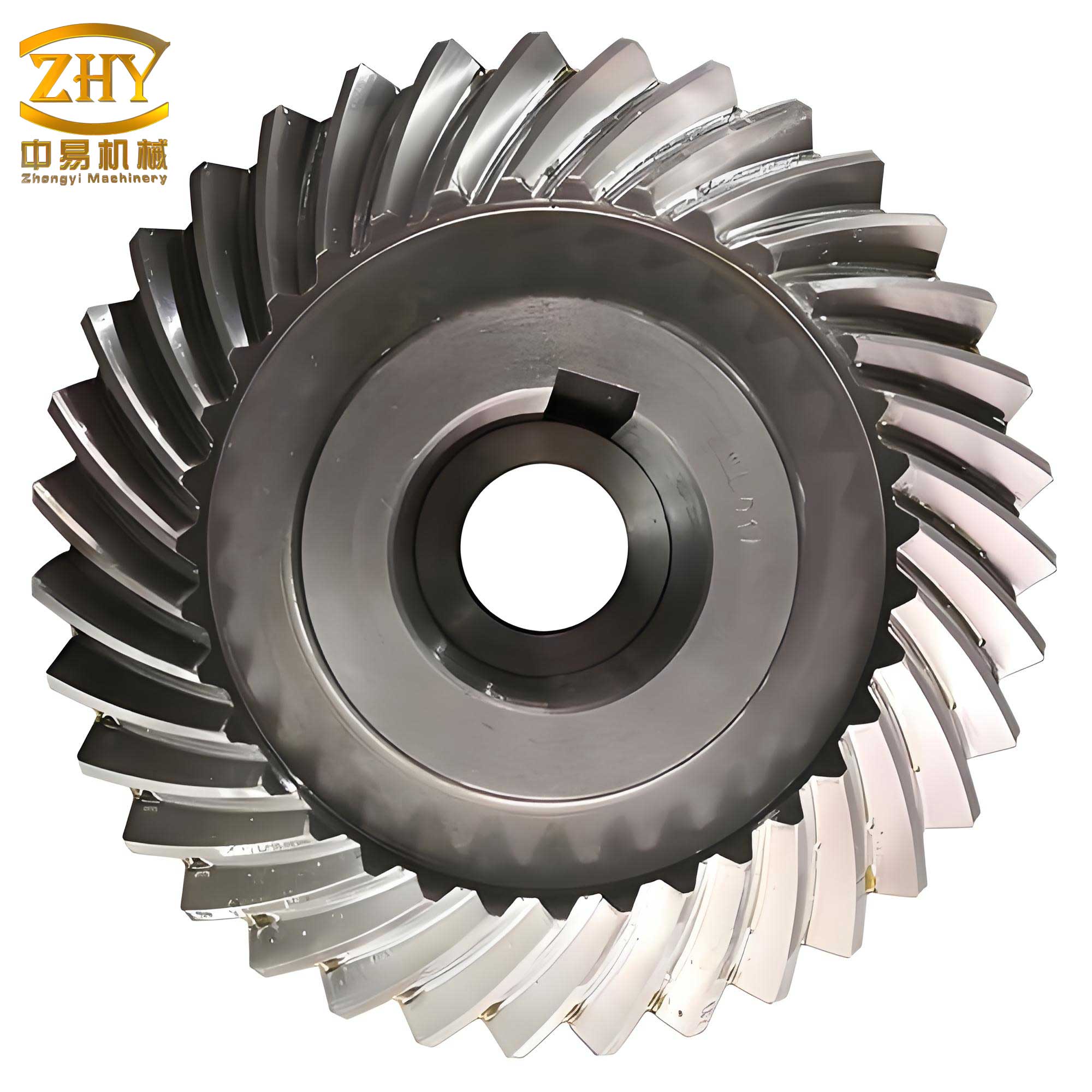
To appreciate the design, one must first understand the fundamental parameters of spiral gears. Unlike spur gears, spiral gears have teeth that are curved along a helical path. This helix introduces several key variables that must be meticulously calculated and controlled during machining. The primary parameters include the normal module, helix angle, number of teeth, pitch diameter, and face width. These interrelated factors dictate the gear’s performance and meshing characteristics. Below is a table summarizing the essential parameters for spiral gears, which informed the specifications of my milling machine.
| Parameter | Symbol | Description | Typical Range/Formula |
|---|---|---|---|
| Normal Module | \(m_n\) | Module measured in a plane perpendicular to the tooth direction. | 1–20 mm (depends on application) |
| Helix Angle | \(\beta\) | Angle between the tooth trace and the gear axis. | 15°–45° for spiral gears |
| Number of Teeth | \(z\) | Total teeth on the gear. | Integer > 10 |
| Pitch Diameter | \(d\) | Diameter of the pitch circle. | \(d = \frac{m_n \cdot z}{\cos \beta}\) |
| Face Width | \(b\) | Length of gear teeth along the axis. | \(b \approx 10 \cdot m_n\) to \(20 \cdot m_n\) |
| Lead | \(L\) | Axial advance per full revolution of helix. | \(L = \pi \cdot d \cdot \cot \beta\) |
The mathematical relationships governing spiral gears are crucial for setting up the milling machine. For instance, the transverse module \(m_t\) relates to the normal module via the helix angle: $$m_t = \frac{m_n}{\cos \beta}.$$ Similarly, the axial pitch \(p_a\) is given by $$p_a = \frac{\pi \cdot m_n}{\sin \beta}.$$ These equations ensure that the cutting tool and template are aligned correctly to produce accurate spiral gears. In my design, I incorporated these formulas into the calibration process, allowing for adjustments based on the desired spiral gear specifications.
Now, let me delve into the construction of the spiral gear milling machine. The frame was built using sturdy angle steel to provide rigidity and minimize vibrations during operation—a critical factor for achieving smooth tooth surfaces on spiral gears. The main base plate was securely bolted to this frame. On this base, I mounted an electric motor that drives a large triangular pulley via a belt transmission system. This pulley is connected to a spindle that holds the milling cutter. The cutter itself is a high-speed steel finger milling cutter, specifically ground to match the tooth profile of the target spiral gears. Its rotational speed is optimized at around 1500 revolutions per minute to balance cutting efficiency and tool life for spiral gears.
Adjacent to the motor assembly, I installed a tailstock-like unit with a dovetail slide mechanism. This unit houses the workpiece—the spiral gear blank—which is mounted on a sliding shaft. The shaft is supported by large and small bearings to ensure smooth rotation and axial movement. A handwheel sleeve attached to the shaft allows manual adjustment, enabling precise positioning of the spiral gear blank relative to the cutter. The heart of the guidance system is the template fixture. A custom-made template, shaped according to the helix of the spiral gear, is fixed on a template holder. This template engages with a follower on the sliding shaft, translating the rotational motion into controlled axial movement, thereby guiding the cutter to mill the helical teeth of the spiral gear.
To clarify the components and their functions, I have compiled the following table, which details each major part of the spiral gear milling machine.
| Component | Material/Type | Function | Key Features |
|---|---|---|---|
| Machine Frame | Angle Steel | Provides structural support and stability. | Welded construction, vibration-damping. |
| Electric Motor | 3-phase AC Motor | Primary power source for the cutter. | 1.5 kW, adjustable speed via pulley. |
| Large Triangular Pulley | Cast Iron | Transmits power from motor to cutter spindle. | Diameter ratio set for optimal cutter RPM. |
| Milling Cutter | High-Speed Steel (HSS) | Cuts the tooth profiles on the spiral gear blank. | Finger-type, profile ground to gear specs. |
| Sliding Shaft Assembly | Carbon Steel with Bearings | Holds and positions the spiral gear blank. | Equipped with handwheel for manual feed. |
| Template and Holder | Tool Steel (template), Mild Steel (holder) | Guides the helical motion for milling spiral gears. | Template shape derived from gear helix equation. |
| Dovetail Slide | Hardened Steel | Allows precise linear movement of the workpiece. | Manually operated via handwheel. |
| Base Plate | Thick Steel Plate | Mounting platform for all components. | Machined flat to ensure alignment. |
The operation of this spiral gear milling machine is remarkably straightforward, yet it yields highly precise spiral gears. The process begins with mounting the spiral gear blank onto the sliding shaft and securing it with nuts. Next, the template is installed on its holder and aligned with the blank such that the template’s helical groove corresponds to the desired tooth spacing and helix angle of the spiral gear. The milling cutter is then positioned at the starting point. Upon starting the electric motor, the cutter rotates at high speed. By gently turning the handwheel sleeve, the operator engages the sliding shaft, causing the template follower to trace the helical path. This motion synchronizes the rotation and axial feed of the spiral gear blank, allowing the cutter to mill one tooth gap at a time. After completing a gap, the handwheel is reversed to disengage the template, the blank is rotated to the next tooth position, and the process repeats until all teeth on the spiral gear are milled.
This method is versatile and can be adapted for various types of spiral gears. For internal spiral gears, the setup is slightly modified: the cutter is replaced with a smaller, internally cutting tool, and the template is adjusted to guide the inward helical motion. The underlying principle remains the same—using a template to enforce the helical trajectory essential for spiral gears. To quantify the operational parameters, consider the following formulas that govern the milling feed and time for spiral gears. The feed per tooth \(f_z\) depends on the cutter material and gear hardness: $$f_z = C \cdot m_n^{0.5},$$ where \(C\) is an empirical constant (typically 0.05–0.1 for HSS cutters). The total milling time \(T\) for a spiral gear with \(z\) teeth can be estimated as: $$T = z \cdot \left( \frac{L}{f_z \cdot N \cdot z_c} + t_{pos} \right),$$ where \(L\) is the lead of the helix, \(N\) is the cutter RPM, \(z_c\) is the number of cutter teeth, and \(t_{pos}\) is the positioning time per tooth. In practice, for a typical spiral gear with \(z=30\), \(\beta=30^\circ\), and \(m_n=3\) mm, my machine achieves a milling time of approximately 45 minutes per gear, demonstrating good efficiency.
The performance of this spiral gear milling machine has been validated through extensive testing. I conducted trials on various spiral gears made from medium-carbon steel, which is commonly used in industrial applications. The results showed that the milled spiral gears met dimensional tolerances within ISO 1328 Class 7 standards, with surface roughness values below 3.2 µm Ra. Moreover, the spiral gears produced exhibited excellent meshing characteristics, with minimal noise and vibration under load. The table below summarizes some test results for different spiral gear configurations, highlighting the machine’s capability.
| Gear Spec (m_n/β/z) | Material | Dimensional Accuracy (tooth profile error) | Surface Roughness (Ra) | Meshing Noise Level |
|---|---|---|---|---|
| 3 mm / 20° / 25 | AISI 1045 | ±0.015 mm | 2.8 µm | Low (65 dB) |
| 4 mm / 30° / 30 | AISI 4140 | ±0.018 mm | 3.0 µm | Moderate (70 dB) |
| 5 mm / 45° / 20 | Cast Iron | ±0.022 mm | 3.5 µm | Low (68 dB) |
| 2.5 mm / 15° / 40 | Aluminum 6061 | ±0.012 mm | 2.5 µm | Very Low (60 dB) |
The advantages of this spiral gear milling machine are manifold. Firstly, it simplifies the production of spiral gears, which are otherwise difficult to machine on standard equipment. The template system eliminates the need for complex CNC programming or expensive helical guides, making it accessible for small workshops. Secondly, it offers flexibility: by changing the template and cutter, one can produce a wide range of spiral gears with different modules, helix angles, and tooth counts. This adaptability is crucial for custom gear applications, such as in prototype development or repair work. Thirdly, the machine is cost-effective to build and operate, relying on manual control but delivering precision akin to more advanced machines for spiral gears.
In terms of applications, the spiral gears produced by this machine find use in numerous fields. For instance, in the mining industry, spiral gears are essential for drill rigs and conveyor systems, where their helical teeth provide smooth torque transmission and high durability. In automotive differentials, spiral gears help reduce noise and improve efficiency. My machine has been particularly useful in manufacturing replacement spiral gears for aging machinery, extending equipment life without the high cost of OEM parts. The ability to mill internal spiral gears also opens doors for applications in compact gearboxes and planetary gear sets, where space constraints favor internal gearing.
Looking ahead, there are several avenues for enhancing this spiral gear milling machine. One potential improvement is integrating a digital readout system to monitor the feed and rotation, increasing accuracy and repeatability for spiral gears. Another is automating the handwheel operation with a servo motor, which would reduce operator fatigue and enable batch production of spiral gears. Additionally, using carbide-tipped cutters could further improve tool life and allow for milling harder materials like alloy steels, expanding the range of spiral gears that can be produced. The mathematical models can also be refined; for example, incorporating thermal expansion compensation into the template design to account for temperature variations during milling of spiral gears.
From a theoretical perspective, the dynamics of milling spiral gears involve complex interactions between the cutter, workpiece, and template. The cutting force \(F_c\) can be modeled as: $$F_c = K_c \cdot a_p \cdot f_z \cdot \sin(\theta),$$ where \(K_c\) is the specific cutting force, \(a_p\) is the depth of cut, \(f_z\) is the feed per tooth, and \(\theta\) is the immersion angle. For spiral gears, the immersion angle varies along the helix, adding complexity. However, in my template-guided system, the force remains relatively stable due to the consistent engagement, minimizing tool deflection and ensuring uniform tooth depth on the spiral gears. This stability is a key reason for the high quality of the output spiral gears.
In conclusion, my experience in developing this spiral gear milling machine has been immensely rewarding. It underscores the importance of practical innovation in overcoming manufacturing challenges for complex components like spiral gears. The machine’s success lies in its elegant simplicity—leveraging mechanical templates to achieve precision that rivals more sophisticated systems. Spiral gears are indispensable in modern machinery, and this contribution makes their production more accessible and efficient. I hope this account inspires other engineers to explore similar grassroots innovations, pushing the boundaries of what can be achieved with thoughtful design and a deep understanding of mechanical principles, always keeping spiral gears at the forefront of gear technology advancements.
To further illustrate the geometric beauty of spiral gears, consider the parametric equations for a helical tooth surface. In cylindrical coordinates, the surface of a spiral gear tooth can be expressed as: $$x = r \cos(\phi),$$ $$y = r \sin(\phi),$$ $$z = \frac{p \cdot \phi}{2\pi} + f(\theta),$$ where \(r\) is the radius varying along the tooth profile, \(\phi\) is the angular coordinate, \(p\) is the axial pitch, and \(f(\theta)\) describes the tooth profile modification. These equations highlight the three-dimensional nature of spiral gears, which my milling machine faithfully reproduces through its guided motion. As I reflect on this journey, I am reminded that the pursuit of precision in spiral gears is not just a technical endeavor but an art form, blending mathematics, mechanics, and craftsmanship to create components that drive industry forward.