
In the manufacturing of miter gears, which are a type of bevel gears with shaft angles typically at 90 degrees, the milling cutter profile design is crucial for achieving accurate tooth forms. Traditionally, the design of milling cutters for miter gears relied on graphical methods or lookup tables, which often resulted in lower precision and inefficiencies, especially for single-piece production or repair work. These methods struggled with solving transcendental equations and handling the variability in tooth槽 shapes for gears of the same module but different tooth numbers. To address these challenges, I developed a computational approach using a microcomputer, which significantly enhances design accuracy and efficiency. This paper details the methodology, mathematical modeling, and implementation of this system, focusing on the calculation of the milling cutter profile for miter gears. The key innovation lies in applying numerical methods, such as Newton’s iteration, to solve complex equations, thereby overcoming the limitations of traditional techniques. Throughout this work, the term “miter gears” is emphasized as it represents the specific application domain, and the goal is to provide a robust solution for their machining.
The primary issue in miter gears cutter design is the need for high precision while managing economic constraints. In practice, miter gears are often produced using cutter sets where a single cutter handles gears with相近 tooth numbers to reduce tooling costs. For instance, with a module of 1 mm, gears having tooth numbers from 12 to 18 might be machined with one cutter, while for higher precision grades, the number of cutters may vary. However, this grouping introduces errors due to approximations in tooth profiles. My approach aims to compute the exact cutter profile based on the gear parameters, ensuring accuracy even for non-standard cases. The core of this method involves establishing a mathematical model for the tooth form, particularly at the small end of the miter gears, and then deriving the corresponding cutter coordinates. This process involves several steps: defining the coordinate systems, formulating equations for the gear tooth profile, and applying transformations to obtain the cutter profile. By leveraging microcomputer capabilities, we can perform these calculations rapidly, improving design efficiency by 1 to 2 times compared to manual methods.
To begin, let’s consider the milling process for miter gears. The common method involves rotating the gear blank around its axis using a dividing head while offsetting the worktable. After the first cut, the worktable is shifted by a distance Δ, and the gear blank is rotated slightly in the opposite direction to machine the tooth flank. This process is repeated for both sides of the tooth. The cutter itself is ground with a relief angle, requiring the tool to be tilted during sharpening. The geometry of this setup is critical for accurate profile generation. Below is a table summarizing key parameters used in the calculation for miter gears:
| Symbol | Description | Unit |
|---|---|---|
| m | Module at large end | mm |
| α | Pressure angle at pitch circle | degrees |
| z | Number of teeth | – |
| z_v | Virtual number of teeth (for equivalent spur gear) | – |
| δ | Pitch cone angle | degrees |
| R | Pitch cone distance | mm |
| b | Face width | mm |
| K | Compression ratio (for profile scaling) | – |
For miter gears, the tooth profile is based on an equivalent spur gear with virtual tooth number z_v, calculated as z_v = z / cos(δ). This simplification allows us to use standard gear equations while accounting for the conical shape. The cutter profile is then derived from this equivalent gear, but with adjustments for the milling process. The mathematical model starts with defining coordinate systems. Let’s denote the coordinate system for the gear as Oxy, where the origin is at the gear center, and the y-axis aligns with the tooth槽 centerline. For the cutter, we use a separate coordinate system O’x’y’, which is rotated and translated relative to the gear system. The key equations involve the tooth profile at the small end of the miter gears, as this region often determines the cutter shape due to the milling offset.
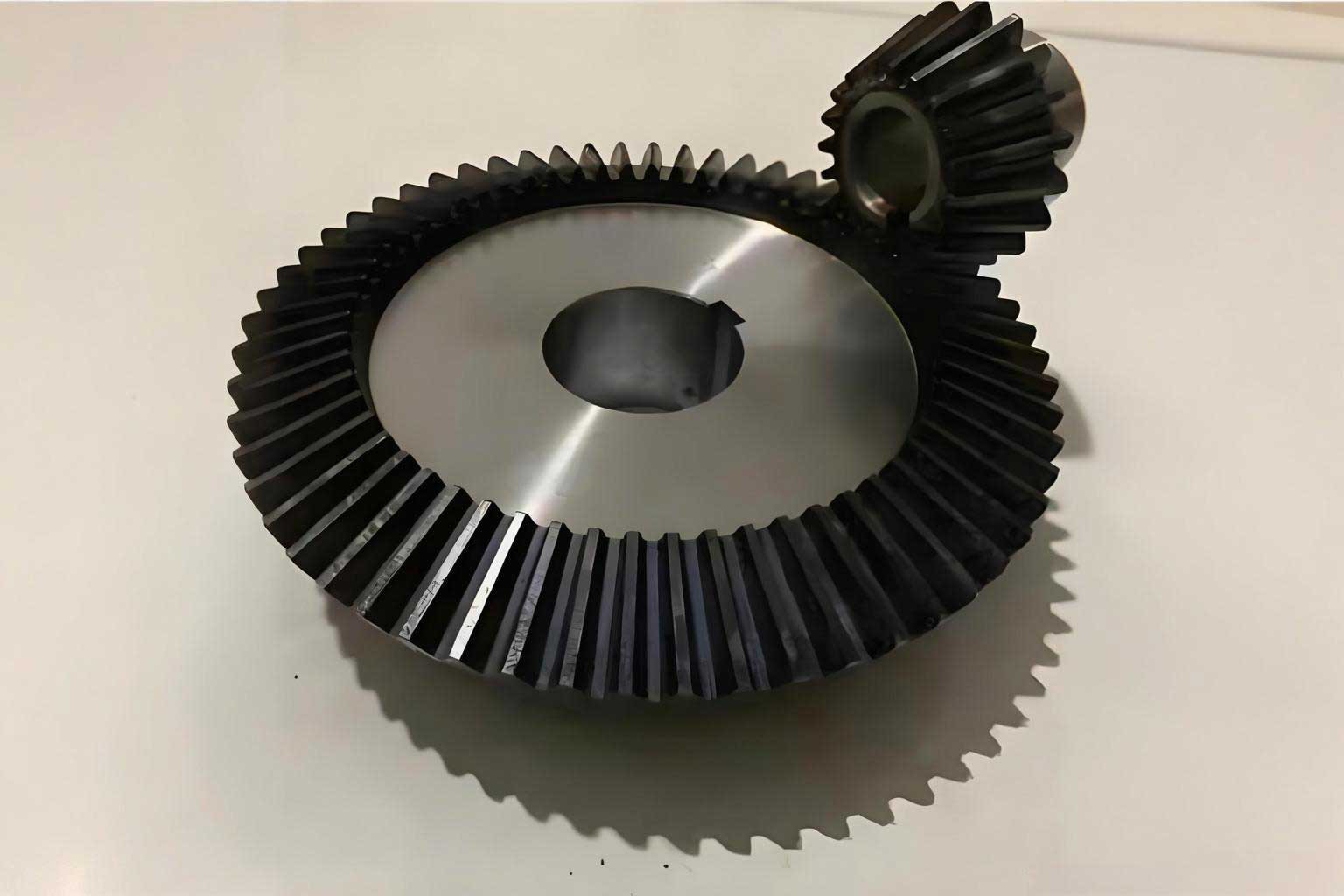
The tooth profile of miter gears can be described using involute equations for the large end and scaled versions for the small end. However, due to the milling offset Δ, the actual cut profile deviates from the ideal involute. To compute this, we first determine the coordinates of points on the small-end tooth form. Let r_s be the pitch radius at the small end, given by r_s = R – b/2, where R is the pitch cone distance. The pressure angle α_s at the small end can be derived from the large-end pressure angle using the compression ratio K. The involute equation in parametric form is: $$ x = r_b (\cos(\theta) + \theta \sin(\theta)), \quad y = r_b (\sin(\theta) – \theta \cos(\theta)) $$ where r_b is the base radius, and θ is the roll angle. For miter gears, we need to transform this to account for the cone angle. The base radius at the small end is r_{bs} = r_s \cos(\alpha_s). The tooth槽 width at the small end, denoted as s_s, is calculated from the large-end槽 width s using scaling: s_s = s \cdot (r_s / R).
Next, we consider the milling cutter profile. The cutter is essentially a form tool that replicates the tooth槽 shape. Its coordinates are obtained by offsetting the gear tooth profile by the cutter radius and applying a relief angle. The critical parameter is the tilt angle β of the cutter during sharpening, which ensures proper clearance. This angle β is determined from the geometry of the cutting process. For miter gears, β can be expressed as: $$ \beta = \tan^{-1}\left( \frac{\Delta}{R \sin(\delta)} \right) $$ where Δ is the worktable offset. The derivation of β involves analyzing the relative motion between the cutter and gear blank. Once β is known, the cutter coordinates in its own system can be computed from the gear coordinates via rotation and translation. Specifically, if (x_g, y_g) are coordinates in the gear system, the cutter coordinates (x_c, y_c) are: $$ x_c = x_g \cos(\beta) – y_g \sin(\beta), \quad y_c = x_g \sin(\beta) + y_g \cos(\beta) + r_c $$ where r_c is the cutter radius. This transformation accounts for the tilt and offset required for machining miter gears accurately.
A significant challenge in this calculation is solving transcendental equations that arise from the involute profile and intersection points. For example, finding the parameter θ for a given point on the tooth profile involves equations like: $$ f(\theta) = x – r_b (\cos(\theta) + \theta \sin(\theta)) = 0 $$ Traditional methods use trial-and-error, which is time-consuming. To overcome this, I employed Newton’s iteration method, which provides rapid convergence to high precision. The Newton iteration formula for a function f(θ) is: $$ \theta_{n+1} = \theta_n – \frac{f(\theta_n)}{f'(\theta_n)} $$ where f'(θ) is the derivative. For the involute equation, the derivative is: $$ f'(\theta) = -r_b (-\sin(\theta) + \sin(\theta) + \theta \cos(\theta)) = r_b \theta \cos(\theta) $$ By applying this iteratively, we can solve for θ efficiently. This approach is extended to other parameters, such as the angle φ for points on the extended involute used in root fillet calculations.
The root profile of miter gears is another critical aspect, as it affects tooth strength and machining. For gears with tooth numbers above the minimum for non-undercutting, the root is typically a smooth fillet. However, for gears with fewer teeth, undercutting occurs, and the root must be approximated with circular arcs or straight lines. The minimum tooth number z_min for spur gears is given by: $$ z_{\min} = \frac{2}{\sin^2(\alpha)} $$ For miter gears, this is adjusted using the virtual tooth number. Based on z_v, the root profile can be classified into three types, as shown in the table below:
| Case | Condition | Root Profile Description |
|---|---|---|
| I | z_v > z_{\min} + \Delta z | Smooth fillet with circular arc tangent to involute |
| II | z_{\min} < z_v \leq z_{\min} + \Delta z | Circular arc and straight line combination |
| III | z_v \leq z_{\min} | Straight line approximation due to undercutting |
Here, Δ z is a threshold based on gear geometry. For each case, mathematical equations are derived. For example, in Case I, the fillet radius ρ is calculated as: $$ \rho = \frac{r_f – r_{bs}}{2} $$ where r_f is the root radius. The coordinates of the fillet center and its intersection with the involute are determined using geometry. For miter gears, these calculations must account for the conical scaling. The equations involve solving for points where the fillet arc meets the involute, which again requires Newton’s iteration.
To illustrate the computational process, consider the derivation of the small-end tooth profile coordinates. Let P be a point on the small-end profile that intersects the large-end pitch circle. In the gear coordinate system Oxy, the large-end pitch circle equation is: $$ x^2 + y^2 = R^2 $$ The small-end profile, derived from the equivalent spur gear, has parametric equations based on the involute. The intersection point P satisfies both equations, leading to a system that can be solved for parameters like θ or φ. For instance, if we use the involute parameter θ, the coordinates are: $$ x = r_{bs} (\cos(\theta) + \theta \sin(\theta)), \quad y = r_{bs} (\sin(\theta) – \theta \cos(\theta)) $$ Substituting into the circle equation gives: $$ [r_{bs} (\cos(\theta) + \theta \sin(\theta))]^2 + [r_{bs} (\sin(\theta) – \theta \cos(\theta))]^2 = R^2 $$ Simplifying, we get: $$ r_{bs}^2 (1 + \theta^2) = R^2 $$ Thus, $$ \theta = \sqrt{ \left( \frac{R}{r_{bs}} \right)^2 – 1 } $$ This is a straightforward solution, but for more general points, iterative methods are needed.
For the cutter profile, after obtaining the gear tooth coordinates, we apply the transformation with angle β. Additionally, the worktable offset Δ is computed based on gear parameters. For miter gears, Δ is given by: $$ \Delta = \frac{s_s}{2} – \frac{s}{2} \cdot \frac{b}{R} $$ where s is the chordal tooth槽 width at the large end. This offset ensures proper tooth thickness after milling. The cutter coordinates are then adjusted for relief and sharpening. In practice, the cutter is ground with a back-off angle γ, which affects the profile. The final cutter coordinates (X, Y) in a machine coordinate system are: $$ X = x_c + r_c \cos(\gamma), \quad Y = y_c + r_c \sin(\gamma) $$ where γ is typically small (e.g., 5-10 degrees). These coordinates are used to manufacture the cutter via CNC grinding.
The entire calculation was implemented in a microcomputer using BASIC language, chosen for its accessibility and ease of use in industrial settings. The program flow is structured as follows: first, input gear parameters (module, tooth number, pressure angle, etc.); then compute derived values like virtual tooth number, pitch radii, and compression ratio; next, determine the root profile type based on z_v; and finally, calculate coordinates for both the gear and cutter profiles using iterative methods where needed. The program outputs a list of coordinates that can be used directly for cutter fabrication. To manage memory and speed, data is stored in arrays, and functions for Newton’s iteration are optimized. Below is a summary of key formulas used in the computation for miter gears:
| Formula Name | Equation | Application |
|---|---|---|
| Virtual Tooth Number | $$ z_v = \frac{z}{\cos(\delta)} $$ | Equivalent spur gear for miter gears |
| Pitch Radius at Small End | $$ r_s = R – \frac{b}{2} $$ | Small-end geometry |
| Base Radius at Small End | $$ r_{bs} = r_s \cos(\alpha_s) $$ | Involute generation |
| Tilt Angle β | $$ \beta = \tan^{-1}\left( \frac{\Delta}{R \sin(\delta)} \right) $$ | Cutter sharpening angle |
| Newton’s Iteration | $$ \theta_{n+1} = \theta_n – \frac{f(\theta_n)}{f'(\theta_n)} $$ | Solving transcendental equations |
| Worktable Offset Δ | $$ \Delta = \frac{s_s}{2} – \frac{s}{2} \cdot \frac{b}{R} $$ | Milling process adjustment |
In developing this system, special attention was paid to the handling of miter gears with varying tooth numbers. The program includes logic to switch between different root profile cases, ensuring accurate results across a range of gear designs. For instance, when z_v is less than z_min, the root is approximated by a straight line tangent to the extended involute. The equations for this line are derived by finding the tangent point on the extended involute. The extended involute equation is: $$ x_e = r_b (\cos(\phi) + \phi \sin(\phi)), \quad y_e = r_b (\sin(\phi) – \phi \cos(\phi)) $$ for ϕ > 0. The slope of the tangent at ϕ is: $$ \frac{dy_e}{dx_e} = \frac{\cos(\phi) – \cos(\phi) + \phi \sin(\phi)}{-\sin(\phi) – \sin(\phi) + \phi \cos(\phi)} = \frac{\phi \sin(\phi)}{\phi \cos(\phi) – 2\sin(\phi)} $$ By setting this equal to the slope of the desired line, we can solve for ϕ using Newton’s method. This level of detail ensures precision in cutter design for miter gears.
The computational efficiency of this approach is remarkable. By automating the design process, we reduced the time required for cutter profile calculation from several hours to minutes. In tests, the microcomputer system achieved a design efficiency improvement of 1 to 2 times compared to manual graphical methods. This is particularly beneficial for small-batch production of miter gears, where quick turnaround is essential. Moreover, the accuracy of the computed profiles leads to better gear quality, with tooth forms conforming closely to theoretical ideals. The use of numerical methods minimizes human error, and the program can be easily modified for different gear specifications.
In conclusion, the application of microcomputer technology to the calculation of miter gears milling cutter profiles represents a significant advancement in gear manufacturing. By establishing a comprehensive mathematical model and employing numerical techniques like Newton’s iteration, we have overcome the limitations of traditional design methods. This system not only enhances precision but also boosts productivity, making it a valuable tool for industries involved in miter gears production. Future work could involve extending this approach to other gear types or integrating it with CAD/CAM systems for seamless manufacturing. The success of this project underscores the importance of computational methods in modern engineering, especially for complex components like miter gears.
Throughout this paper, the focus on miter gears has been deliberate, as their unique geometry poses specific challenges. The methods described here are generalizable but tailored to the conical form of miter gears. By repeatedly emphasizing miter gears, we highlight the application context and ensure clarity for practitioners. The integration of tables and formulas provides a reference for implementation, and the computational framework serves as a foundation for further innovation in gear design and manufacturing.