
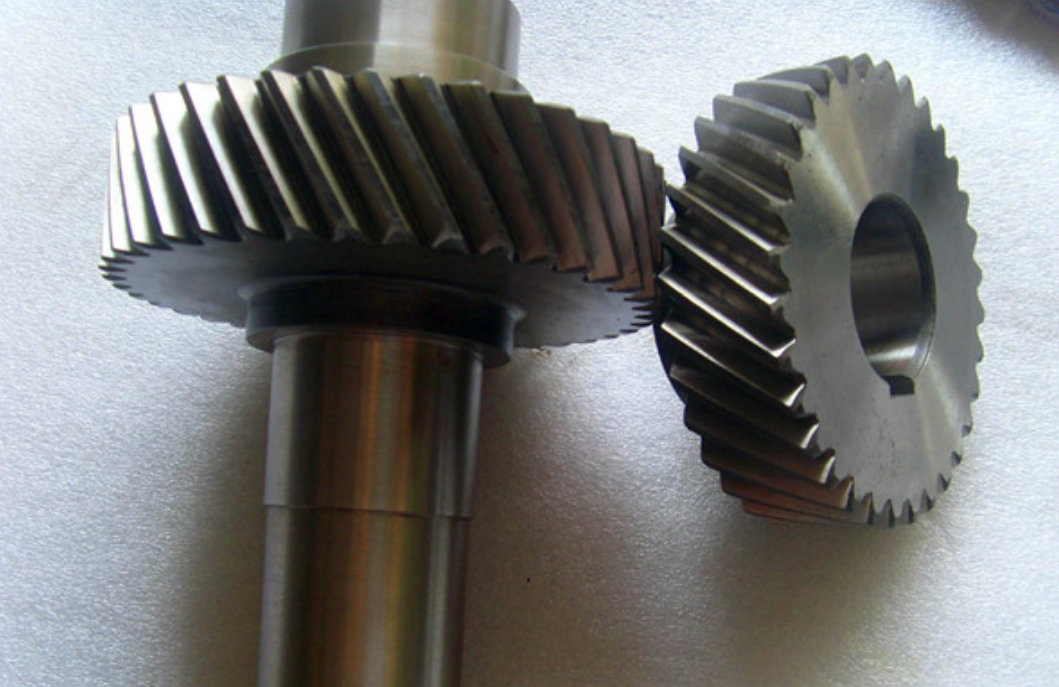
The relentless pursuit of higher performance in power transmission systems, particularly in demanding sectors like electric vehicles and aerospace, has exposed the limitations of the traditional, symmetric involute gear profile. While standard helical gears have served reliably for generations, their uniform pressure angle on both drive and coast flanks presents a fundamental compromise. The helical gear, with its inherent gradual engagement and higher load capacity compared to spur gears, forms an excellent foundation. However, to truly push the boundaries of power density, durability, and efficiency, we must move beyond symmetry. This necessity drives the exploration of asymmetric gear design, where the working (drive) flank and the non-working (coast) flank are deliberately designed with different pressure angles. This paper details, from a first-person engineering perspective, the comprehensive methodology for constructing precise mathematical and solid models of asymmetric modified helical gears and analyzes the profound influence of pressure angle selection on their contact stress performance.
The core advantage of an asymmetric helical gear lies in its ability to decouple design objectives. For the working flank, which bears the primary load during power transmission, a larger pressure angle can be employed. This increase in the working pressure angle reduces the radius of curvature at the point of contact, which, according to Hertzian theory, favorably impacts contact stress. Concurrently, it results in a thicker tooth root, potentially enhancing bending strength. For the non-working flank, which is primarily engaged during coasting or reversal under minimal load, a smaller, standard pressure angle can be retained. This smaller angle on the non-working side provides a more generous tooth tip, effectively mitigating the issue of tip pointing that often arises when a large pressure angle is applied symmetrically. The incorporation of profile shift (modification) further adds a layer of design freedom, allowing for center distance adjustment, undercut avoidance, and balanced specific sliding. Therefore, the asymmetric modified helical gear represents a sophisticated synthesis of helical geometry, asymmetric profiling, and modification, aimed at optimal performance for unidirectional, high-duty applications.
The journey toward a reliable analysis begins with an accurate geometric definition. We start by modeling the generating tool—a rack cutter with asymmetric profiles. The coordinate systems are established as follows: Systems \( S_1 \) and \( S_2 \) are rigidly attached to the left and right flank of the rack cutter, respectively. An auxiliary system \( S_3 \) is fixed to the rack. The key geometric parameters of the asymmetric rack cutter are defined in the table below.
| Symbol | Description |
|---|---|
| \( \alpha_{n1} \) | Normal pressure angle of the working flank (drive side) |
| \( \alpha_{n2} \) | Normal pressure angle of the non-working flank (coast side) |
| \( m_n \) | Normal module |
| \( h_{a}^* \) | Addendum coefficient |
| \( c^* \) | Dedendum clearance coefficient |
| \( \rho \) | Tip radius of the rack cutter |
| \( \beta \) | Helix angle of the target helical gear |
The position vector of a point on the straight-line segment of the rack flank (e.g., flank 1) in its local system \( S_1 \) is defined by parameters \( l_1 \) and \( u_1 \):
$$ \mathbf{R}_1(l_1, u_1) = [l_1, 0, u_1, 1]^T $$
This representation is then transformed into the main rack coordinate system \( S_3 \) via a homogeneous transformation matrix \( \mathbf{M}_{31} \), which accounts for the pressure angle \( \alpha_{n1} \) and the offset relative to the rack’s pitch line:
$$ \mathbf{R}_{3}^{(1)}(l_1, u_1) = \mathbf{M}_{31} \mathbf{R}_1(l_1, u_1) $$
where,
$$ \mathbf{M}_{31} = \mathbf{M}_{3f} \mathbf{M}_{f1} $$
$$ \mathbf{M}_{f1} =
\begin{bmatrix}
\cos \alpha_{n1} & \sin \alpha_{n1} & 0 & 0 \\
-\sin \alpha_{n1} & \cos \alpha_{n1} & 0 & 0.25p_n \\
0 & 0 & 1 & 0 \\
0 & 0 & 0 & 1
\end{bmatrix}, \quad \mathbf{M}_{3f} =
\begin{bmatrix}
1 & 0 & 0 & 0 \\
0 & \cos \beta & -\sin \beta & 0 \\
0 & \sin \beta & \cos \beta & 0 \\
0 & 0 & 0 & 1
\end{bmatrix} $$
Here, \( p_n = \pi m_n \) is the normal pitch. A similar set of equations, using \( \alpha_{n2} \) and appropriate offsets, defines the right flank profile in \( S_3 \). The unit normal vector \( \mathbf{n}_{3}^{(1)} \) to this surface in \( S_3 \) is derived from the cross product of partial derivatives.
The generation of the helical gear tooth surface is modeled as the envelope of the family of rack cutter surfaces in the gear coordinate system \( S_4 \). The coordinate transformation from \( S_3 \) to \( S_4 \) involves the rotation of the gear by an angle \( \theta \) and the corresponding translation of the rack by \( r_p \theta \), where \( r_p \) is the pitch radius of the gear. Crucially, it also incorporates the profile shift coefficient \( x_n \):
$$ \mathbf{R}_{4}^{(1)}(l_1, u_1, \theta, x_n) = \mathbf{M}_{43}(\theta, x_n) \mathbf{R}_{3}^{(1)}(l_1, u_1) $$
$$ \mathbf{M}_{43} =
\begin{bmatrix}
\cos \theta & \sin \theta & 0 & (r_p + x_n m_n)\cos \theta + r_p \theta \sin \theta \\
-\sin \theta & \cos \theta & 0 & -(r_p + x_n m_n)\sin \theta + r_p \theta \cos \theta \\
0 & 0 & 1 & 0 \\
0 & 0 & 0 & 1
\end{bmatrix} $$
The generated surface is not arbitrary; it must satisfy the equation of meshing (or contact condition), which states that the common normal vector at the point of contact must be perpendicular to the relative velocity vector. For the rack-and-pinion generation, this condition simplifies to:
$$ f_1(l_1, u_1, \theta, x_n) = \theta – \frac{n_{3y}^{(1)}(R_{3x}^{(1)} + x_n m_n) – n_{3x}^{(1)} R_{3y}^{(1)}}{r_p n_{3x}^{(1)}} = 0 $$
Thus, the mathematical model for the active involute flank of the asymmetric modified helical gear is defined by the system \( \mathbf{R}_{4}^{(1)}(l_1, u_1, \theta, x_n) \) and \( f_1 = 0 \). The unit normal in the gear system is \( \mathbf{n}_{4}^{(1)} = \mathbf{M}_{43} \mathbf{n}_{3}^{(1)} \).
The transition curve between the active involute flank and the root fillet is generated by the tip rounding of the rack cutter. The circular arc segment of the rack tip is parameterized by an angle \( \varphi_i \). Its position vector \( \mathbf{R}_{s}^{(i)}(\varphi_i, u_i) \) is transformed through the same kinematic chain. The equation of meshing for this generating process is derived from the scalar product of the surface normal and the relative velocity, leading to a condition \( f_{si}(\varphi_i, u_i, \theta, x_n)=0 \). Solving this system yields the precise coordinates of the transition curve on the gear tooth, ensuring a continuous and smooth profile from the root to the active flank. This comprehensive mathematical formulation allows for the calculation of discrete point clouds representing the entire tooth surface of the asymmetric modified helical gear, which is the prerequisite for accurate solid modeling and finite element analysis.
Possessing a precise mathematical model is one achievement; translating it into a usable, parameterized three-dimensional solid model for simulation and manufacturing is the next critical step. Manual modeling of such complex profiles is prohibitively time-consuming and error-prone. Therefore, we leverage the Application Programming Interface (API) of a mainstream CAD software, SolidWorks, using C# for secondary development to create a fully automated parametric modeling program.
The core logic of the program follows these steps:
1. Input Parameters: The user interface collects all necessary design parameters for the asymmetric modified helical gear: tooth numbers \( z \), normal module \( m_n \), pressure angles \( \alpha_{n1} \) and \( \alpha_{n2} \), helix angle \( \beta \), profile shift coefficient \( x_n \), face width \( b \), and tool tip radius \( \rho \).
2. Point Cloud Generation: The C# backend calls a computational kernel (or uses integrated algorithms) to solve the mathematical models derived in the previous section. For given ranges of parameters \( l, u, \varphi, \theta \), it calculates dense point clouds representing the left flank, right flank, and root fillets on two key cross-sections: one at each end of the gear face width.
3. Profile Construction and Extension: The points for each flank and fillet on an end-plane are fitted with a smooth spline to define the tooth groove profile. A critical practical step is extending the involute spline slightly beyond the theoretical addendum circle to ensure a clean cut during the solid Boolean operation. This is achieved using a Lagrange interpolation scheme on the last few calculated points.
4. Solid Modeling via API: The program uses SolidWorks API functions to:
a. Create a new part document.
b. Sketch and extrude a cylindrical blank based on the calculated addendum diameter and face width.
c. Import the constructed spline curves for a single tooth groove onto the end faces of the blank.
d. Use a lofted cut or a sweep cut (with the splines as guide curves) to remove the material of one tooth groove from the blank.
e. Apply a circular pattern feature to replicate the groove around the gear axis, completing the full set of teeth.
5. Output: The result is a precise, watertight 3D solid model of the specified asymmetric modified helical gear, generated within seconds. This model is ready for export to FEA or CAM software.
This parametric approach is transformative. It allows for rapid design iteration. Exploring the effect of changing the working pressure angle \( \alpha_{n1} \) from 15° to 25°, while keeping the non-working \( \alpha_{n2} \) at 20°, involves simply changing the input parameter and re-running the script. Dozens of valid gear geometries can be generated in the time it would take to manually model one. This capability is indispensable for systematic performance analysis.
With accurate solid models of a gear pair in hand, we proceed to the core performance investigation: contact stress analysis. The primary goal is to understand how the asymmetric pressure angle, particularly on the working flank, influences the maximum surface contact stress, which is a key driver for pitting fatigue life. We employ the Finite Element Method (FEM) for its ability to handle complex geometry and boundary conditions, and we validate/contrast its trends with the well-established analytical Hertzian formula for symmetric gears.
The gear pair model is imported into ANSYS Workbench. The material properties (Young’s modulus \( E \) and Poisson’s ratio \( \nu \)) are assigned to both the pinion and gear, typically using alloy steel values (\( E = 2.1 \times 10^5 \) MPa, \( \nu = 0.3 \)). A critical step is meshing. A fine, curvature-sensitive mesh is applied, particularly in the anticipated contact zone near the pitch line. Second-order tetrahedral elements are often preferred for their ability to conform to complex gear tooth geometry while providing good accuracy for contact stresses. A frictional contact definition is established between the mating tooth flanks. Boundary conditions simulate real operation: the hub of the driven gear is fixed, while a torque is applied to the driving pinion shaft. A static structural analysis is performed to obtain the contact pressure distribution.
Alongside FEA, the traditional Hertzian contact stress formula for cylindrical surfaces provides a benchmark. For a symmetric helical gear, the nominal contact stress \( \sigma_H \) at the pitch point is calculated as:
$$ \sigma_H = Z_H Z_E Z_{\epsilon} Z_{\beta} \sqrt{ \frac{F_t}{b d_1} \cdot \frac{u \pm 1}{u} } $$
Where:
– \( Z_H \) is the zone factor, accounting for the transforming of tangential load at the pitch cylinder to normal load on the tooth flank. It is a function of pressure angle and helix angle: \( Z_H = \sqrt{ \frac{2 \cos \beta_b}{\cos^2 \alpha_t \tan \alpha_{wt}} } \). For asymmetric gears, \( \alpha_t \) is based on the working flank pressure angle.
– \( Z_E \) is the elasticity factor: \( Z_E = \sqrt{ \frac{1}{\pi \left( \frac{1-\nu_1^2}{E_1} + \frac{1-\nu_2^2}{E_2} \right) } } \).
– \( Z_{\epsilon} \) is the contact ratio factor.
– \( Z_{\beta} \) is the helix angle factor.
– \( F_t \) is the nominal tangential load.
– \( b \) is the face width.
– \( d_1 \) is the pinion pitch diameter.
– \( u \) is the gear ratio \( z_2/z_1 \).
To conduct a meaningful analysis, we define a baseline gear set with parameters listed below. We analyze multiple configurations where the working flank pressure angle \( \alpha_{n1} \) varies, while all other parameters, including the non-working flank pressure angle \( \alpha_{n2} \), remain constant.
| Parameter | Pinion (Driver) | Gear (Driven) |
|---|---|---|
| Number of Teeth, \( z \) | 30 | 48 |
| Normal Module, \( m_n \) (mm) | 2 | |
| Working Flank Pressure Angle, \( \alpha_{n1} \) (°) | 15, 17.5, 20, 22.5, 25 | |
| Non-Working Flank Pressure Angle, \( \alpha_{n2} \) (°) | 20 (constant) | |
| Helix Angle, \( \beta \) (°) | 8 | |
| Profile Shift Coefficient, \( x_n \) | +0.1 | -0.1 |
| Face Width, \( b \) (mm) | 30 | |
| Young’s Modulus, \( E \) (GPa) | 210 | |
| Poisson’s Ratio, \( \nu \) | 0.3 | |
| Input Torque (N·m) | 95.5 (for ~25 kW at 2500 rpm) | – |
For each \( \alpha_{n1} \) configuration, a pair of asymmetric modified helical gears is generated using our parametric tool. The FEA is performed, and the maximum contact pressure on the working flank is extracted. Simultaneously, the Hertz formula is applied, using the corresponding \( \alpha_{n1} \) to calculate \( Z_H \), to compute the theoretical contact stress for an equivalent symmetric helical gear (where both flanks would have pressure angle \( \alpha_{n1} \)). The results are summarized below.
| Working Pressure Angle \( \alpha_{n1} \) (°) | Non-Working Pressure Angle \( \alpha_{n2} \) (°) | FEA Contact Stress (Asymmetric Gear) (MPa) | Formula Contact Stress (Equivalent Symmetric Gear) (MPa) | Deviation (%) | Stress Change Relative to 20° Baseline (%) |
|---|---|---|---|---|---|
| 15.0 | 20.0 | 712.8 | 676.6 | +5.1 | +8.8 |
| 17.5 | 20.0 | 680.5 | 657.8 | +3.3 | +3.8 |
| 20.0 | 20.0 | 655.5 | 643.0 | +1.9 | 0.0 (Baseline) |
| 22.5 | 20.0 | 632.6 | 631.1 | +0.2 | -3.5 |
| 25.0 | 20.0 | 612.0 | 621.4 | -1.5 | -6.6 |
The analysis of the results yields several significant insights. First, the contact stress on the working flank of the asymmetric modified helical gear, as predicted by FEA, shows a clear and consistent decreasing trend as the working pressure angle \( \alpha_{n1} \) increases. This aligns perfectly with fundamental gear theory—a larger pressure angle reduces the radius of curvature at the contact point, leading to lower Hertzian stress for the same load. Second, and more importantly, the FEA results for the asymmetric helical gear are in remarkably close agreement with the values calculated using the traditional symmetric gear formula. The deviation between the two methods is within ±6% across all cases, and for the more practical pressure angles (20°-25°), the deviation is less than 2%.
This close correlation is a pivotal finding. It demonstrates that the contact stress on the working flank of an asymmetric helical gear is dominated by the local geometry of that flank and its mating counterpart. The presence of a different pressure angle on the non-working flank (\( \alpha_{n2} = 20° \) in this study) has a negligible influence on the stress state of the loaded, working flank. Therefore, for the purpose of estimating the contact fatigue performance of the drive side, the well-understood and widely used Hertzian formula for symmetric helical gears remains a valid and effective approximation for asymmetric helical gears, provided the correct working flank pressure angle is used in the calculation of the zone factor \( Z_H \). This greatly simplifies the design process for asymmetric gears.
The study also reveals an asymmetry in the rate of change. Decreasing the working pressure angle from the baseline 20° to 15° causes a stress increase of about 8.8%, while increasing it from 20° to 25° yields a decrease of only 6.6%. This non-linearity suggests that while increasing the pressure angle is beneficial, the returns diminish at higher angles. The optimal selection must balance this stress reduction against other factors like increased bearing load (radial force) and potential mesh stiffness variations.
In conclusion, this first-person engineering journey from first principles to performance validation underscores the potential of asymmetric modified helical gears. We have established a robust, closed-loop methodology: starting with a rigorous mathematical model derived from gear generation theory, implementing it into a parametric CAD modeling tool via software automation, and employing high-fidelity FEA to analyze critical performance metrics. The key finding is that the contact stress behavior of the working flank in an asymmetric helical gear can be accurately approximated using traditional symmetric gear theory. This empowers designers to confidently adopt asymmetric profiles, leveraging a larger working flank pressure angle to significantly reduce contact stress and enhance load capacity, while using a smaller non-working flank pressure angle to maintain good meshing properties and avoid tip interference. The helical gear, thus enhanced by asymmetric profiling and strategic modification, stands as a superior solution for advancing the performance frontiers of modern power transmission systems.