
In the realm of mechanical engineering, the gear shaft is a critical component, often subjected to significant stresses and wear during operation. When localized damage occurs on a gear shaft, such as grooves or dimensional loss at sealing surfaces, complete replacement can be economically burdensome. This article delves into the application of cold welding technology for restoring a damaged gear shaft, focusing on a case where the sealing surface of a gear shaft made from 20CrMnTi material required repair. The damaged area involved grooves approximately 0.3–0.5 mm deep, 30–40 mm long, with intervals of 5–8 mm and widths of 0.8–1 mm on an Ø85f9 external cylindrical surface. The goal was to restore the gear shaft to meet original drawing specifications without affecting non-repaired areas. Through comparative analysis of various repair methods, cold welding emerged as the optimal choice due to its minimal heat input, which prevents distortion and preserves the integrity of the surrounding material. This process involves micro-electric instantaneous discharge to generate high heat, melting specialized filler wire onto the damaged gear shaft surface, achieving a metallurgical bond with the base material. The brief discharge intervals allow heat dissipation, keeping the workpiece near room temperature. This article elaborates on pre-repair preparations, in-process requirements, and post-repair inspections, culminating in a successful restoration methodology for gear shaft applications.
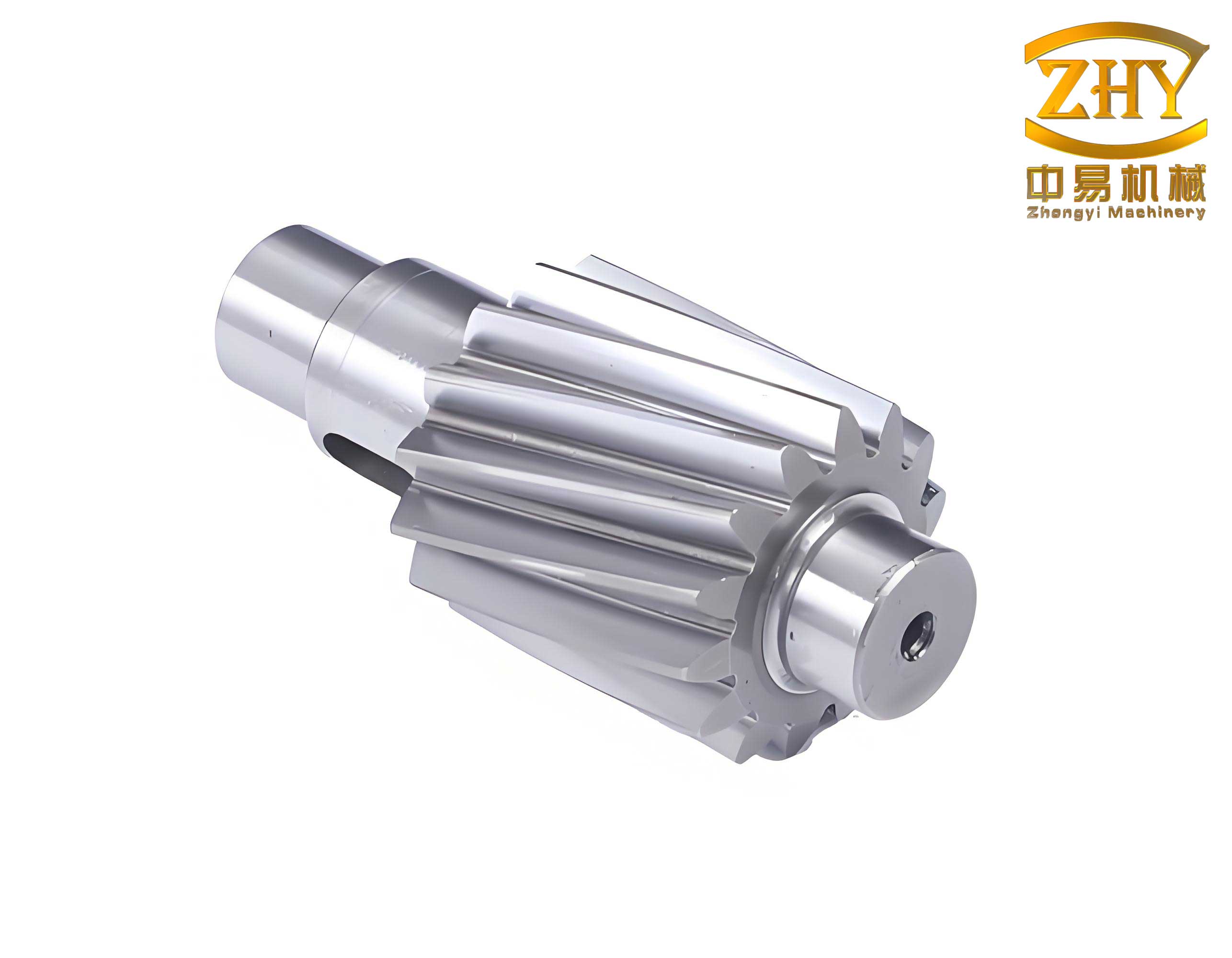
The foundation of any successful gear shaft repair lies in thorough pre-repair preparations. This phase ensures the gear shaft is viable for restoration and sets the stage for optimal cold welding outcomes. Internal quality assessment is paramount; used gear shaft components must be evaluated for hidden defects that could compromise repair integrity. Non-destructive testing (NDT) methods, such as ultrasonic testing and liquid penetrant inspection, are employed to scrutinize both internal and external conditions of the gear shaft. Only upon passing these tests should repair proceed, as undetected flaws could lead to failure post-restoration. Surface preparation is equally critical. Given the shallow groove damage spread across the gear shaft外圆, direct cold welding is impractical due to narrow groove widths. Therefore, machining is necessary to create a uniform surface for deposition. A single-side machining allowance of 0.5 mm is recommended, with a surface roughness of Ra ≤ 12.5 µm. This step ensures dimensional accuracy post-repair for the Ø85f9 specification. Additionally, cleanliness is vital to prevent defects; the repair area and a 10 mm surrounding zone on the gear shaft must be meticulously cleaned using isopropyl alcohol to remove oil and contaminants. Table 1 summarizes key pre-repair steps for a gear shaft.
| Step | Description | Technical Requirements |
|---|---|---|
| Internal Quality Check | Non-destructive testing of gear shaft | Ultrasonic and liquid penetrant inspection per standards |
| Surface Machining | Machining of damaged area on gear shaft | Single-side allowance 0.5 mm, Ra ≤ 12.5 µm |
| Cleaning | Removal of contaminants from gear shaft | Isopropyl alcohol cleaning over repair zone ±10 mm |
During the repair phase, specific requirements must be adhered to ensure the gear shaft is restored to its original functionality. Equipment selection is the first consideration; based on operational experience, an AXT-J300 precision repair welder is chosen for its reliability in cold welding applications on gear shaft components. The choice of filler material and parameters directly impacts the quality of the restored gear shaft. For the 20CrMnTi gear shaft, an imported P20 mold welding wire is selected due to its low crack sensitivity and ability to achieve a hardness of 30–34 HRC post-weld, matching typical gear shaft requirements. The wire diameter is set at 1.2 mm, balancing repair efficiency and heat input to prevent overheating of the gear shaft. Pulse current and time are critical parameters derived from empirical formulas. The pulse current (I) in amperes relates to wire diameter (d) in millimeters, often expressed as:
$$ I = k \cdot d^2 $$
where k is a material-dependent constant. For a 1.2 mm wire, a pulse current of 49 A is optimal. The pulse time (t) in milliseconds is typically 2–3 units higher than the current value, hence set at 52 ms. This relationship can be modeled as:
$$ t = I + \Delta $$
where Δ ranges from 2 to 3. Temperature control during the repair of the gear shaft is crucial to avoid thermal distortion. The gear shaft temperature must be maintained between 45°C and 60°C; exceeding 60°C necessitates cooling pauses. The heat dissipation can be approximated using Fourier’s law of heat conduction:
$$ q = -k \nabla T $$
where q is heat flux, k is thermal conductivity, and ∇T is temperature gradient. Table 2 outlines key in-process parameters for gear shaft cold welding.
| Parameter | Value | Rationale |
|---|---|---|
| Welding Wire Material | P20 Imported Mold Wire | Low crack sensitivity, hardness 30–34 HRC for gear shaft |
| Wire Diameter (d) | 1.2 mm | Optimizes deposition rate and heat input on gear shaft |
| Pulse Current (I) | 49 A | Derived from empirical formula for gear shaft repair |
| Pulse Time (t) | 52 ms | t = I + 3 for stable deposition on gear shaft |
| Temperature Range | 45°C – 60°C | Prevents distortion of non-repaired gear shaft areas |
Post-repair inspection is essential to validate the quality of the restored gear shaft. After cold welding, the gear shaft undergoes machining processes like turning and grinding to achieve final dimensions. Non-destructive testing methods, including ultrasonic, magnetic particle, and liquid penetrant inspections, are employed to detect potential defects such as porosity or pinholes in the repaired gear shaft. These tests adhere to standards like JB/T 6908-2002 and JB/T 12582-2015, with acceptance criteria set at Grade I. Dimensional accuracy is verified against the drawing specification for Ø85f9, with tolerances of -0.036 mm to -0.123 mm, and surface roughness is checked to ensure Ra 1.6 µm. The integrity of the gear shaft is confirmed through these comprehensive checks. The effectiveness of cold welding can be quantified using a quality index (Q) for the gear shaft:
$$ Q = \frac{1}{n} \sum_{i=1}^{n} \left( \frac{D_{\text{actual},i} – D_{\text{nominal}}}{T_i} \right)^2 $$
where D_actual is measured dimension, D_nominal is target dimension, T is tolerance, and n is number of measurements. A lower Q indicates better conformance. Table 3 presents a sample inspection record for a repaired gear shaft.
| Inspection Method | Standard | Acceptance Criteria | Result for Gear Shaft |
|---|---|---|---|
| Ultrasonic Testing | JB/T 6908-2002 | Grade I | Qualified |
| Magnetic Particle Testing | JB/T 6908-2002 | Grade I | Qualified |
| Liquid Penetrant Testing | JB/T 12582-2015 | Grade I | Qualified |
| Dimensional Accuracy | Drawing Ø85f9 | -0.036 to -0.123 mm | Qualified |
| Surface Roughness | Drawing Ra 1.6 | Ra ≤ 1.6 µm | Qualified |
The advantages of cold welding for gear shaft repair are multifaceted. Compared to traditional methods like thermal welding or replacement, cold welding minimizes thermal distortion, preserving the geometric accuracy of the gear shaft. The process efficiency can be expressed in terms of repair time (T_repair) versus new part production time (T_new):
$$ \text{Time Savings} = T_{\text{new}} – T_{\text{repair}} $$
For a typical gear shaft, T_repair is significantly lower, reducing downtime and costs. The economic benefit is quantified by cost ratio (CR):
$$ CR = \frac{C_{\text{repair}}}{C_{\text{new}}} $$
where C_repair is repair cost and C_new is new part cost; CR is often less than 0.5 for gear shaft repairs. Furthermore, the metallurgical bond achieved ensures durability, with the restored gear shaft performing equivalently to a new one. The hardness profile across the repaired gear shaft surface can be modeled using a diffusion equation:
$$ \frac{\partial H}{\partial t} = D \frac{\partial^2 H}{\partial x^2} $$
where H is hardness, D is diffusion coefficient, and x is depth from surface. This ensures uniform properties in the gear shaft. In practice, cold welding has proven effective for various gear shaft applications, from automotive to industrial machinery, offering a sustainable solution by extending component life.
In conclusion, cold welding technology presents a robust method for restoring damaged gear shaft components. By meticulously following pre-repair preparations, adhering to in-process parameters, and conducting thorough post-repair inspections, a gear shaft can be returned to service with minimal cost and time investment. The technique’s low heat input prevents distortion, making it ideal for precision parts like gear shaft where dimensional stability is paramount. As industries seek efficient maintenance strategies, cold welding for gear shaft repair stands out as a viable and reliable approach, ensuring operational continuity and resource conservation. Future advancements may involve automated cold welding systems for gear shaft restoration, further enhancing precision and repeatability in repair processes.