
In high-speed and heavy-load transmission systems, helical gears are widely adopted due to their high contact ratio, smooth transmission, low vibration and noise, and excellent load-carrying capacity. However, the helical nature of these gears inevitably generates axial forces during operation. To ensure proper functioning of the gear train, axial support must be provided, typically through thrust bearings or tapered roller bearings mounted on the shafts. These conventional bearings, while effective, often increase manufacturing cost, axial length, and overall system complexity. To overcome these drawbacks, the thrust cone structure has been introduced as an innovative solution. The thrust cone is essentially a conical rim mounted on the pinion, which forms a wedge-shaped gap with the face of the gear. During operation, lubricant enters this gap and generates a hydrodynamic film that provides axial support without the need for additional bearings. This design not only reduces axial space and cost but also offers improved dynamic performance.
In my research, I have developed a comprehensive dynamic simulation model for helical gears supported by thrust cones and compared their behavior with that of conventional tapered roller bearings. The study focuses on dynamic meshing forces, overturning moments, and axis misalignment angles under identical operating conditions. All simulations were performed using the ADAMS multi-body dynamics software, with meticulous modeling of gear contact, bearing stiffness, and thrust cone properties. In this article, I present the modeling methodology, parameter calculations, and simulation results, supported by extensive tables and formulas.
1. Dynamic Modeling of Helical Gear Pairs with Thrust Cones
The gear pair under investigation consists of a pinion with 50 teeth and a gear with 170 teeth, module 2.5 mm, pressure angle 20°, and helix angle 13.5°. The thrust cone is attached to the pinion shaft and interacts with the gear face. To model the system in ADAMS, I employed the impact function method for gear tooth contact, which calculates normal contact forces based on stiffness and damping coefficients. For the thrust cone, a bilateral contact function (BISTOP) was used to account for the fluid film and solid contact on both sides of the cone.
1.1 Gear Mesh Stiffness and Damping
According to ISO 6336 / GB/T 3480.1, the mesh stiffness \(K_m\) of a helical gear pair can be expressed as:
\[
K_m = c \cdot b
\]
where \(c\) is the single tooth pair stiffness per unit width, and \(b\) is the face width. For the material 18Cr2Ni4WA (Poisson’s ratio \(\nu = 0.29\), Young’s modulus \(E = 2.07 \times 10^{11} \, \text{Pa}\)), the calculated mesh stiffness is:
\[
K_m = 5.0 \times 10^8 \, \text{N/m}
\]
The damping coefficient \(C_m\) for the gear pair is given by:
\[
C_m = \frac{2 \xi \sqrt{I_p I_g R_p^2 R_g^2 k_m}}{I_p R_g^2 + I_g R_p^2}
\]
where \(\xi\) is the damping ratio (taken as 0.05), \(R_p\) and \(R_g\) are the base radii of pinion and gear, and \(I_p\), \(I_g\) are their mass moments of inertia. The computed value is:
\[
C_m = 2000 \, \text{Ns/m}
\]
Table 1 summarizes the gear parameters and calculated contact properties.
| Parameter | Symbol | Value |
|---|---|---|
| Number of teeth (pinion/gear) | \(z_p / z_g\) | 50 / 170 |
| Module | \(m_n\) | 2.5 mm |
| Pressure angle | \(\alpha_n\) | 20° |
| Helix angle | \(\beta\) | 13.5° |
| Face width | \(b\) | 32 mm |
| Mesh stiffness | \(K_m\) | \(5.0 \times 10^8 \, \text{N/m}\) |
| Mesh damping | \(C_m\) | \(2000 \, \text{Ns/m}\) |
| Young’s modulus | \(E\) | \(2.07 \times 10^{11} \, \text{Pa}\) |
| Poisson’s ratio | \(\nu\) | 0.29 |
1.2 Thrust Cone Support Stiffness and Damping
The thrust cone provides axial support through a combination of fluid film stiffness and solid contact stiffness. The fluid film stiffness \(k_1\) is derived from the derivative of the hydrodynamic pressure \(w\) with respect to the minimum film thickness \(h_{\min}\):
\[
k_1 = \frac{dw}{dh_{\min}}
\]
The minimum film thickness for line contact under elastohydrodynamic lubrication (EHL) is given by the Dowson-Higginson formula:
\[
h_{\min} = 6.76 \, \alpha^{0.53} \, \eta_0^{0.75} \, u^{0.06} \, E’^{-0.41} \, R^{0.16} \, w^{-0.13}
\]
where \(\alpha\) is the pressure-viscosity coefficient (\(2 \times 10^{-8} \, \text{m}^2/\text{N}\) for 4450 aviation synthetic oil), \(\eta_0\) is the ambient viscosity (23.9 mPa·s), \(u\) is the entrainment velocity, \(E’\) is the reduced Young’s modulus, \(R\) is the equivalent radius of curvature, and \(w\) is the load. The computed fluid film stiffness is:
\[
k_1 = 1.4 \times 10^8 \, \text{N/m}
\]
The solid contact stiffness \(k_2\) between the thrust cone and gear face is obtained from Hertzian contact theory:
\[
k_2 = \frac{\pi E’ B}{4 (1 – \nu^2)}
\]
with contact line length \(B = 32 \, \text{mm}\), yielding:
\[
k_2 = 6.20 \times 10^9 \, \text{N/m}
\]
The total support stiffness \(k’\) of the thrust cone is the series combination:
\[
\frac{1}{k’} = \frac{1}{k_1} + \frac{1}{k_2}
\]
Thus:
\[
k’ = \frac{k_1 k_2}{k_1 + k_2} \approx 1.37 \times 10^8 \, \text{N/m}
\]
The fluid film damping coefficient \(c_1\) for line contact EHL is calculated using a simplified harmonic vibration model:
\[
c_1 = \frac{f_0 R}{B b u} \cdot D
\]
where \(f_0\) is the load, \(b\) is the half-width of the Hertzian contact, and \(D\) is the dimensionless damping factor. The dimensionless groups are:
\[
L = 4 G U, \quad M = \frac{W}{U}, \quad G = \alpha E’, \quad W = \frac{\omega}{E’ R}, \quad U = \frac{\eta_0 (u_1 + u_2)}{2 E’ R}
\]
After solving the coupled Reynolds and elasticity equations, the dimensionless damping is:
\[
D = \frac{1.2}{4.3} \left( \frac{L}{M} \right)^{0.85} \left[ 1 + \left( \frac{L}{M} \right)^{1.2} \right]^{-1}
\]
Leading to:
\[
c_1 = 7.8080 \times 10^6 \, \text{Ns/m}
\]
The solid contact damping \(c_2\) is estimated from:
\[
c_2 = 2 \xi \sqrt{k_2 m}
\]
where \(\xi = 0.1\) and \(m\) is the equivalent mass of the thrust cone and gear system. The computed value is:
\[
c_2 = 1.46 \times 10^4 \, \text{Ns/m}
\]
Total damping of the thrust cone is again a series combination:
\[
\frac{1}{c’} = \frac{1}{c_1} + \frac{1}{c_2} \quad \Rightarrow \quad c’ \approx 1.46 \times 10^4 \, \text{Ns/m}
\]
Table 2 summarizes all thrust cone parameters.
| Parameter | Symbol | Value |
|---|---|---|
| Fluid film stiffness | \(k_1\) | \(1.4 \times 10^8 \, \text{N/m}\) |
| Solid contact stiffness | \(k_2\) | \(6.20 \times 10^9 \, \text{N/m}\) |
| Total support stiffness | \(k’\) | \(1.37 \times 10^8 \, \text{N/m}\) |
| Fluid film damping | \(c_1\) | \(7.8080 \times 10^6 \, \text{Ns/m}\) |
| Solid contact damping | \(c_2\) | \(1.46 \times 10^4 \, \text{Ns/m}\) |
| Total support damping | \(c’\) | \(1.46 \times 10^4 \, \text{Ns/m}\) |
| Equivalent radius of curvature | \(R\) | 3.51 m |
| Contact line length | \(B\) | 32 mm |
2. Simulation Setup and Dynamic Performance Comparison
The ADAMS model was built with input speed 3400 rpm and torque 716 Nm applied to the pinion. Two axial support configurations were simulated: (a) tapered roller bearings at both ends of the pinion and gear shafts, and (b) a thrust cone mounted on the pinion shaft interacting with the gear face. In the thrust cone case, the axial support force was applied as a bilateral spring-damper element at the pitch circle location, with stiffness \(k’\) and damping \(c’\) computed above. An equivalent moment was also applied to account for the offset between the pitch circle and the gear center.
2.1 Dynamic Meshing Force
The dynamic meshing force between the helical gears was extracted from the simulation for both configurations. The mean value under tapered roller bearings was 3466 N, while under thrust cone support it was 3449 N. The difference is negligible (less than 0.5%), indicating that both axial support methods provide adequate constraint for the helical gears mesh. Table 3 lists the comparative results.
| Axial Support Type | Mean Meshing Force (N) |
|---|---|
| Tapered roller bearings | 3466 |
| Thrust cone | 3449 |
2.2 Overturning Moment and Bearing Load Distribution
One of the key advantages of the thrust cone is its ability to counteract the overturning moment induced by the axial component of the helical gear mesh force. In helical gears, the mesh force has a tangential, radial, and axial component. The axial component creates a moment that tilts the gear axis, leading to unequal loads on the two support bearings (Bearing 1 and Bearing 2) located at both ends of the gear shaft. Under tapered roller bearing support, the two bearings experience significantly different vertical (Y-direction) loads, as shown in Figure 1 (conceptual). Bearing 1 carried approximately 1600 N while Bearing 2 carried only about 30 N in the opposite direction. This imbalance results in a large overturning moment.
In contrast, when the thrust cone is used, the axial force is directly reacted at the gear face, reducing the moment arm. Consequently, both bearings share the load more evenly, each around 800 N. The difference between the two bearing loads is drastically reduced. Table 4 quantifies this behavior.
| Support Type | Bearing 1 Y-load (N) | Bearing 2 Y-load (N) | Difference (N) |
|---|---|---|---|
| Tapered roller bearings | 1600 | 30 | 1570 |
| Thrust cone | 800 | 800 | 0 |
2.3 Axis Misalignment Angle
The unequal bearing loads cause the gear shaft to deflect, resulting in an angular misalignment of the gear axis relative to its ideal position. The misalignment angle \(\theta\) can be computed from the relative displacement of the two bearing locations. Under tapered roller bearings, the mean misalignment angle was \(4.89 \times 10^{-3}\) degrees. With thrust cone support, the misalignment dropped dramatically to \(1.11 \times 10^{-3}\) degrees — a reduction of 77%. This significant improvement is attributed to the thrust cone’s ability to locally balance the axial force and reduce the bending moment on the shaft. Table 5 summarizes the results.
| Support Type | Mean Misalignment Angle (deg) |
|---|---|
| Tapered roller bearings | \(4.89 \times 10^{-3}\) |
| Thrust cone | \(1.11 \times 10^{-3}\) |
2.4 Graphical Illustration
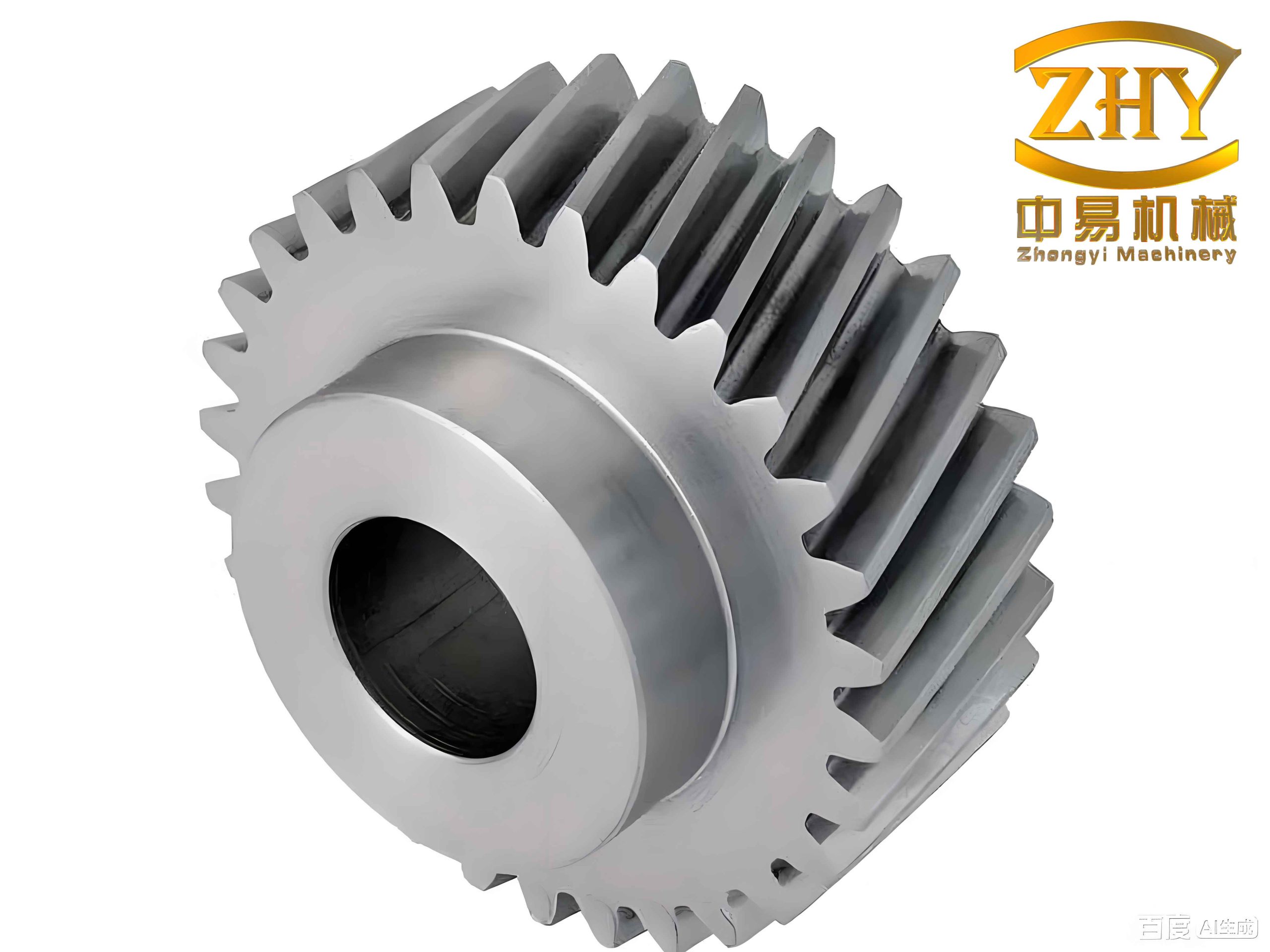
To visualize the thrust cone geometry and its interaction with the gear, a typical thrust cone design for helical gears is shown in the following image. The wedge-shaped gap between the cone and the gear face is critical for generating the hydrodynamic film that provides axial support.
3. Discussion and Conclusion
In this study, I have performed a comparative dynamic analysis of helical gears supported by two different axial bearing systems: tapered roller bearings and thrust cones. The dynamic meshing forces were found to be nearly identical for both configurations, confirming that the thrust cone provides equivalent axial constraint without compromising the gear mesh characteristics. However, the thrust cone offers distinct advantages in terms of overturning moment reduction and axis alignment. Specifically, the thrust cone nearly eliminates the imbalance in bearing loads, reducing the maximum difference from 1570 N to approximately 0 N. Consequently, the gear axis misalignment angle is reduced by a factor of 4.4, from \(4.89 \times 10^{-3}\) degrees to \(1.11 \times 10^{-3}\) degrees.
The improved alignment directly translates to better load distribution across the gear face, reduced edge contact, and potentially lower vibration and noise levels. Furthermore, the thrust cone eliminates the need for separate thrust bearings, saving axial space and reducing cost. These benefits make the thrust cone an attractive option for high-performance helical gear transmissions, especially in applications where compactness and smooth operation are critical.
Future work could extend this analysis to include the effects of manufacturing errors, tooth modifications, and transient operating conditions. Experimental validation would also strengthen the conclusions drawn from simulation. Nevertheless, the current findings clearly demonstrate that thrust cone support significantly enhances the dynamic behavior of helical gears compared to conventional tapered roller bearings, particularly in mitigating the detrimental effects of axial forces on shaft bending and bearing loading.
In summary, for helical gear systems operating under moderate to high speeds and loads, the thrust cone provides a compact, cost-effective, and dynamically superior alternative to traditional thrust bearings. Its integration into gearbox design can lead to quieter, more reliable, and longer-lasting transmissions.