
In gear transmission systems, the spur and pinion gear pair is one of the most fundamental and widely used components, especially in applications like wind turbines, industrial speed increasers, and specialized machinery. Traditionally, the design and modification of gears for speed-increasing drives have largely relied on experiences and standards developed for speed-reducing drives. However, due to the presence of sliding friction at the tooth contact interface, the meshing characteristics between speed-increasing and speed-reducing gear pairs exhibit significant differences. This discrepancy implies that the design principles for speed-reducing gears may not be directly applicable to speed-increasing gears, potentially leading to suboptimal performance or even failure. Therefore, a thorough comparative analysis of the tooth bending stress under these two operating conditions is essential for developing tailored design methodologies for speed-increasing gear systems.
This paper focuses on involute spur and pinion gear pairs, investigating the differences in root bending stress between speed-increasing and speed-reducing transmissions. We employ both analytical methods, such as the critical section approach, and numerical simulations using finite element analysis (FEA) to evaluate the stress distributions. The influence of sliding friction on the normal force and bending moment is rigorously analyzed, and the results are compared to highlight the distinct behaviors. Our findings indicate that, under the same transmitted power, the bending stress at the tooth root varies significantly depending on whether the gear is acting as the driving or driven element, particularly in the addendum and dedendum regions. This work aims to provide a theoretical foundation for the design and modification of speed-increasing spur and pinion gears, ensuring their reliability and efficiency in practical applications.
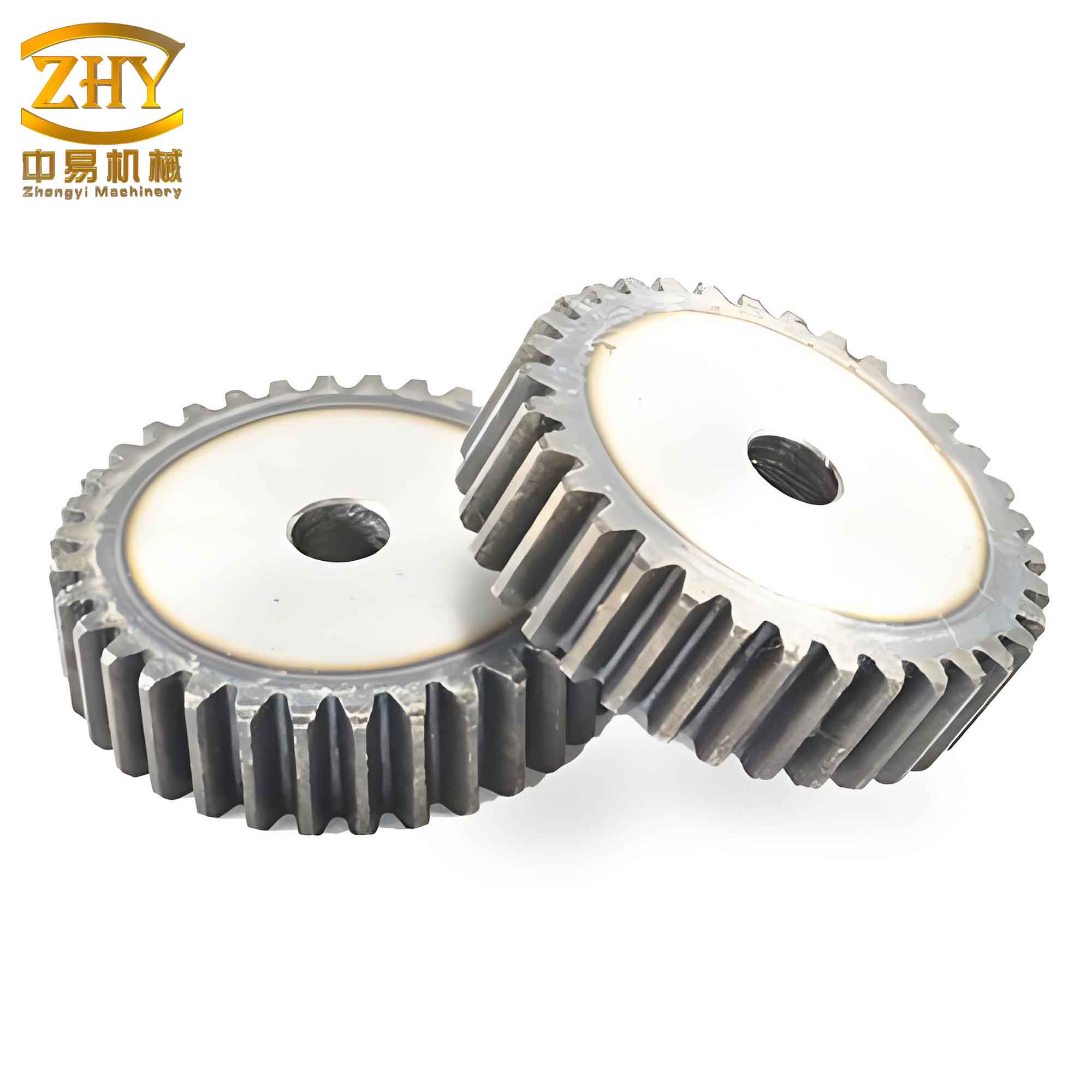
The meshing process of involute spur and pinion gears involves complex interactions between geometric profiles and dynamic forces. During engagement, the tooth surfaces experience both normal contact pressure and tangential sliding friction, except at the pitch point where pure rolling occurs. The direction of sliding friction reverses as the contact point moves from the dedendum to the addendum region, and this reversal is further influenced by whether the gear is driving or driven. In speed-increasing transmissions, the larger gear (often referred to as the gear) serves as the driver, while in speed-reducing transmissions, it acts as the driven element. This role reversal alters the friction direction relative to the tooth profile, thereby affecting the resultant forces and stresses. Understanding these nuances is crucial for accurate stress prediction and design optimization.
We begin by analyzing the meshing characteristics of spur and pinion gear pairs under both speed-increasing and speed-reducing conditions. The tooth surface is divided into two regions relative to the pitch circle: the dedendum region (from the root to the pitch circle) and the addendum region (from the pitch circle to the tip). For a given contact point A, the relative sliding velocity between the mating teeth determines the direction of friction. Let us consider a spur gear pair with pinion (small gear) and gear (large gear). The angular velocities are denoted as $\omega_1$ for the pinion and $\omega_2$ for the gear. The radii of the base circles are $r_{b1}$ and $r_{b2}$, respectively. At any contact point A, the relative sliding velocity $v_{12}$ is given by:
$$v_{12} = \omega_1 r_{b1} (\tan \alpha_1 – \tan \alpha_2)$$
where $\alpha_1$ and $\alpha_2$ are the pressure angles at point A for the pinion and gear, respectively. The sign of $v_{12}$ determines the friction direction. For instance, when point A is in the dedendum region of the gear, we have $\alpha_1 > \alpha_2$, so $v_{12} > 0$. In speed-increasing drives, where the gear is driving, the friction force on the gear tooth points toward the root circle, while in speed-reducing drives, it points toward the tip circle. Conversely, in the addendum region, the directions are reversed. This fundamental difference in friction direction leads to variations in the normal force and bending stress.
The normal force $F_n$ at the contact point is influenced by the friction force $F_f = \mu F_n$, where $\mu$ is the coefficient of sliding friction. Considering the equilibrium of moments, the normal force can be expressed as a function of the applied torque and friction. For the gear (large gear) under a torque $T_2$, the normal force when the contact point is in the addendum region (for speed-increasing) or dedendum region (for speed-reducing) is:
$$F_n = \frac{F_{n0}}{1 + \mu \tan \alpha_2}$$
where $F_{n0} = T_2 / r_{b2}$ is the nominal normal force without friction. When the contact point is in the dedendum region (for speed-increasing) or addendum region (for speed-reducing), the normal force becomes:
$$F_n = \frac{F_{n0}}{1 – \mu \tan \alpha_2}$$
Thus, the normal force is either reduced or increased due to friction, depending on the region and driving condition. This variation directly impacts the bending stress at the tooth root. To quantify the bending stress, we employ the critical section method, which identifies the most stressed section near the tooth root using the 30° tangent method. The critical section is defined by points Q and R, where tangents at 30° to the tooth centerline touch the root fillet. The distance from the gear center to the critical section center H is denoted as $l_i$, and the chordal thickness at the critical section is $s$. The bending moment $M$ at the critical section due to normal force and friction is:
$$M = F_n (l_1 \cos \alpha_A \pm \mu l_2 \sin \alpha_A)$$
where $\alpha_A$ is the angle between the normal force direction and the horizontal, $l_1$ and $l_2$ are moment arms for the normal and friction forces, respectively. The plus sign applies when the moments from both forces are in the same direction (e.g., speed-increasing in addendum region), and the minus sign when they oppose (e.g., speed-increasing in dedendum region). The bending stress $\sigma$ is then calculated as:
$$\sigma = \frac{M}{W} Y_s$$
where $W = b s^2 / 6$ is the section modulus (with $b$ as the face width), and $Y_s$ is a stress correction factor accounting for stress concentration. Combining these equations, the bending stress for the gear can be generalized as:
$$\sigma = \frac{6 F_{n0} (l_1 \cos \alpha_A \pm \mu l_2 \sin \alpha_A) Y_s}{b s^2 (1 \pm \mu \tan \alpha_2)}$$
The detailed derivation of $l_1$ and $l_2$ involves geometric relations based on the contact point position. In a coordinate system with origin at the gear center, the coordinates of point A are $(X_A, Y_A)$, where $X_A = r_A \sin \gamma_A$ and $Y_A = r_A \cos \gamma_A$, with $\gamma_A = \pi/2 + \text{inv} \alpha – \text{inv} \alpha_2$. Here, $r_A$ is the distance from the gear center to point A, and $\text{inv} \alpha = \tan \alpha – \alpha$ is the involute function. The pressure angle $\alpha_2$ is related to $r_A$ by $\alpha_2 = \arccos(r_{b2} / r_A)$. The moment arms are computed as:
$$l_1 = Y_A – l_i – X_A \tan \alpha_A$$
$$l_2 = l_1 + X_A \left( \tan \alpha_A + \frac{1}{\tan \alpha_A} \right)$$
where $\alpha_A = \alpha_2 – \gamma_A$. By varying $r_A$ along the line of action, we can evaluate the bending stress throughout the meshing cycle. For a spur and pinion gear pair, the contact starts at the tip of the driven tooth and ends at the tip of the driver tooth. In single-pair contact regions, the stress is higher due to full load carrying. The maximum bending stress typically occurs near the highest point of single tooth contact (HPSTC) for the driven gear in speed-reducing drives, but our analysis shows a shift for speed-increasing drives.
To validate the analytical results, we conduct finite element simulations using ABAQUS software. A three-dimensional model of the spur and pinion gear pair is created with parameters as listed in Table 1. The gears are modeled with five teeth to balance computational accuracy and time, and meshing is refined near the contact regions. The material properties are assigned, and friction is included with a coefficient of $\mu = 0.1$. Simulations are performed under various torque conditions, with the gear set as either driver or follower to emulate speed-increasing and speed-reducing scenarios, respectively. The root bending stress is extracted as the maximum principal stress at the critical section.
| Parameter | Pinion (Small Gear) | Gear (Large Gear) |
|---|---|---|
| Module (mm) | 2 | 2 |
| Number of Teeth | 20 | 63 |
| Pressure Angle (°) | 20 | 20 |
| Elastic Modulus (GPa) | 210 | 210 |
| Poisson’s Ratio | 0.3 | 0.3 |
| Face Width (mm) | 20 | 20 |
The simulation results for the maximum root bending stress under different torques are summarized in Table 2 for the gear and Table 3 for the pinion. In both tables, the stress values represent the peak observed during the entire meshing cycle.
| Torque at Gear (N·m) | Speed-increasing Stress (MPa) | Speed-reducing Stress (MPa) |
|---|---|---|
| 10 | 7.13 | 6.12 |
| 30 | 24.98 | 20.57 |
| 50 | 40.14 | 32.59 |
| 80 | 56.32 | 47.21 |
| 100 | 78.63 | 61.54 |
| 150 | 117.61 | 104.34 |
| Torque at Gear (N·m) | Speed-increasing Stress (MPa) | Speed-reducing Stress (MPa) |
|---|---|---|
| 10 | 8.21 | 8.85 |
| 30 | 25.82 | 29.48 |
| 50 | 43.14 | 48.66 |
| 80 | 69.05 | 79.58 |
| 100 | 88.21 | 94.21 |
| 150 | 137.09 | 150.06 |
The data clearly indicate that for the gear, the bending stress in speed-increasing drives is consistently higher than in speed-reducing drives, with an increase ranging from 12.7% to 27.8% depending on torque. For the pinion, however, the trend is opposite: speed-increasing results in lower stress compared to speed-reducing, with reductions between 6.4% and 13.2%. This asymmetry underscores the importance of considering the driving role in stress analysis for spur and pinion gear pairs. Furthermore, the stress variation over the meshing cycle is plotted for different contact points. As shown in Figure 1 (simulated data for 150 N·m torque), the bending stress for the gear peaks near the HPSTC in the addendum region under speed-increasing, while under speed-reducing, the peak occurs in the dedendum region. The pinion exhibits complementary behavior.
The finite element analysis also reveals dynamic effects such as engagement and disengagement impacts, which cause stress fluctuations, especially at the boundaries of single and double tooth contact. These transient effects are more pronounced at higher torques. Nonetheless, the overall trend confirms the analytical predictions: in the addendum region, the driving gear experiences higher bending stress than when driven, and vice versa for the dedendum region. This is directly attributable to the friction-induced changes in normal force and moment arm. For a spur and pinion gear set designed for speed-reducing applications, if used directly in speed-increasing mode, the gear (now driver) faces elevated stress in the addendum region, increasing the risk of root fracture. Conversely, the pinion benefits from reduced stress. Therefore, design adjustments, such as profile modification or material enhancement, may be necessary for speed-increasing gears.
To delve deeper, we analyze the sensitivity of bending stress to friction coefficient. The friction coefficient $\mu$ is typically between 0.05 and 0.2 for lubricated spur gear contacts. Using the analytical model, we compute the bending stress ratio (speed-increasing to speed-reducing) for different $\mu$ values. The results are tabulated in Table 4 for the gear at a fixed torque (150 N·m) and contact point at the HPSTC.
| Friction Coefficient ($\mu$) | Stress Ratio (Speed-increasing / Speed-reducing) | Percent Change (%) |
|---|---|---|
| 0.05 | 1.15 | +15 |
| 0.10 | 1.28 | +28 |
| 0.15 | 1.42 | +42 |
| 0.20 | 1.58 | +58 |
This table illustrates that as friction increases, the disparity between speed-increasing and speed-reducing stresses grows significantly. Hence, in high-friction environments, such as poorly lubricated or high-load conditions, the design of spur and pinion gears for speed-increasing drives must account for this amplification effect. Additionally, the impact of gear geometry parameters, like module, pressure angle, and number of teeth, on the stress difference can be explored. For instance, a higher pressure angle generally reduces the bending moment arm but also alters the friction contribution. We can derive a dimensionless parameter $\zeta = \mu \tan \alpha_2$ to characterize the friction influence. The normal force magnification factor is $1/(1 \pm \zeta)$, and the bending stress includes this factor linearly. Thus, optimizing $\alpha_2$ and $\mu$ through material selection or surface treatment can mitigate stress imbalances.
Another aspect is the effect of load distribution in spur and pinion gear pairs due to multiple tooth contact. In practice, gears operate with a contact ratio greater than one, meaning that for part of the meshing cycle, two or more tooth pairs share the load. This load sharing reduces the stress on individual teeth, particularly in the double-pair contact regions. However, the maximum bending stress still occurs in the single-pair contact zone, as confirmed by our simulations. The load distribution factor can be incorporated into the analytical model using ISO standards, but the relative trend between speed-increasing and speed-reducing remains consistent. We propose a modified bending stress formula that includes a load distribution factor $K_{L}$:
$$\sigma = K_{L} \cdot \frac{6 F_{n0} (l_1 \cos \alpha_A \pm \mu l_2 \sin \alpha_A) Y_s}{b s^2 (1 \pm \mu \tan \alpha_2)}$$
where $K_{L}$ varies along the path of contact, typically ranging from 0.5 in double-pair regions to 1.0 in single-pair regions. This refinement enhances accuracy but does not alter the fundamental conclusion regarding the role of friction in differentiating speed-increasing and speed-reducing conditions.
Furthermore, we examine the implications for gear design and modification. For speed-increasing spur and pinion gears, traditional design approaches based on speed-reducing assumptions may lead to over-sizing of the pinion and under-sizing of the gear. To achieve balanced strength, the gear tooth root thickness could be increased, or the addendum profile modified to reduce the moment arm in critical regions. Alternatively, asymmetric tooth profiles, where the drive side and coast side have different pressure angles, could be explored to optimize for unidirectional speed-increasing operation. Moreover, shot peening or other surface hardening techniques can be applied selectively to the gear addendum region to enhance fatigue resistance.
In terms of finite element modeling, we extend our simulations to include dynamic analysis with time-varying loads. The ABAQUS model is subjected to rotational motion with constant torque, and the transient stress history is recorded. The results show that the stress peaks coincide with mesh stiffness variations and impact events. The dynamic magnification factor for bending stress is found to be around 1.1-1.3 under the given conditions, but it is similar for both speed-increasing and speed-reducing cases. Therefore, the static analysis suffices for comparative purposes, though dynamic effects should be considered in high-speed applications.
To generalize our findings, we consider a range of spur and pinion gear configurations. Table 5 summarizes the maximum bending stress for different gear ratios (with pinion teeth fixed at 20 and gear teeth varying) under a torque of 100 N·m at the gear. The speed-increasing stress ratio (relative to speed-reducing) is computed for each case.
| Gear Teeth | Gear Ratio | Speed-increasing Stress (MPa) | Speed-reducing Stress (MPa) | Stress Ratio |
|---|---|---|---|---|
| 50 | 2.5 | 85.2 | 70.3 | 1.21 |
| 63 | 3.15 | 78.6 | 61.5 | 1.28 |
| 80 | 4.0 | 72.4 | 54.8 | 1.32 |
| 100 | 5.0 | 66.9 | 49.1 | 1.36 |
The table indicates that as the gear ratio increases, the stress ratio also increases slightly, suggesting that speed-increasing effects become more pronounced for larger gear differences. This is because the pressure angle variation along the line of action is more significant for gears with more teeth, amplifying the friction contribution. Therefore, in high-ratio speed-increasing spur and pinion gearboxes, such as those in wind turbines, special attention must be paid to the gear tooth design.
In conclusion, our comparative analysis of tooth bending strength for speed-increasing and speed-reducing involute spur gears reveals substantial differences driven by sliding friction. The analytical model based on the critical section method and the finite element simulations consistently show that, under identical power transmission, the gear in a speed-increasing drive experiences higher bending stress in the addendum region and lower stress in the dedendum region compared to a speed-reducing drive. The opposite holds for the pinion. These findings challenge the conventional practice of applying speed-reducing gear design rules to speed-increasing applications. We recommend developing dedicated design methodologies for speed-increasing spur and pinion gears, incorporating friction effects, load distribution, and dynamic factors. Future work could explore helical gears, lubricant effects on friction, and experimental validation to further refine the models. This study provides a foundational step toward optimizing gear systems for diverse operational modes, enhancing reliability and performance in critical engineering applications.
Throughout this paper, we have emphasized the importance of the spur and pinion gear pair in mechanical transmissions. The intricate interplay between geometry, friction, and load conditions dictates the stress state and ultimately the fatigue life. By recognizing the distinct behaviors in speed-increasing and speed-reducing scenarios, engineers can make informed decisions in gear design, selection, and maintenance. The insights gained here are particularly relevant for industries relying on high-efficiency gearboxes, where every percentage point in stress reduction translates to improved durability and cost savings. As technology advances, the demand for tailored solutions for spur and pinion gears will only grow, and this work aims to contribute to that evolving knowledge base.