
In the field of mechanical transmission, the reduction of vibration and noise in spur and pinion gear systems remains a critical challenge, especially as these systems evolve towards higher speeds, greater precision, and increased power density. Traditional methods, such as gear tooth profile modification, have been extensively studied, but they often face manufacturing limitations. Therefore, exploring alternative damping structures directly integrated into the gear body presents a promising and practical approach. This study introduces a novel slot-hole damping structure designed for cylindrical spur and pinion gears, aimed at mitigating meshing impacts and vibrations through a combination of flexibility and relaxation constraints. The effectiveness of this design is thoroughly investigated via dynamic simulation, orthogonal experimental optimization, and physical testing.
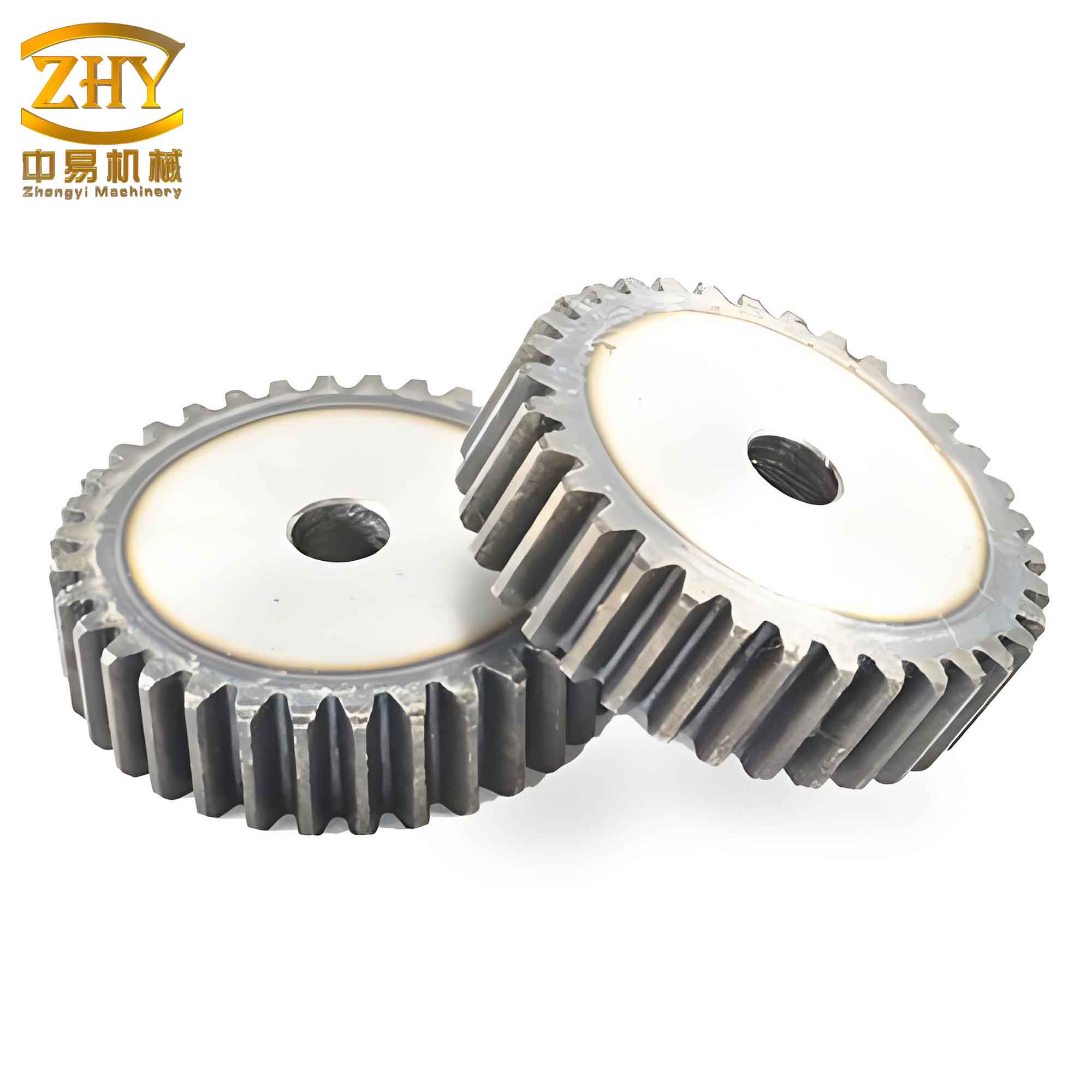
The proposed damping structure involves machining a longitudinal slot at the tooth tip, connected to a through-hole within the tooth body. This configuration imparts a coupled rigid-flexible characteristic to the spur and pinion gear teeth, which helps absorb impact energy during meshing engagement. Specifically, the slot reduces the coupled deformation effects between adjacent teeth and tooth flanks, allowing individual tooth deflection without significantly altering the pitch of neighboring teeth. Concurrently, the circular hole relaxes stress concentrations at the tooth root. For a spur and pinion gear pair with parameters such as module m=6 mm, tooth count z=34, pressure angle α=20°, and face width b=60 mm, this structure is implemented to evaluate its vibrational performance under various operational conditions.
To analyze the dynamic behavior, a multi-body dynamics simulation is conducted using Adams software. The spur and pinion gear pair is modeled as rigid bodies with material properties corresponding to 20CrMnTi steel. Contact between teeth is defined using an impact function, with meshing stiffness K and damping coefficient C calculated based on established formulas. The input spur and pinion gear is driven by a step function to reach a speed of 154 rad/s (1470 rpm) within 0.1 seconds, while the output gear bears a load torque of 150 N·m. The angular acceleration of the output spur and pinion gear is recorded over a simulation period of 0.5 seconds. The time-domain signal is then processed using Fourier transform to obtain the frequency spectrum, highlighting vibrations at the meshing frequency. Additionally, the power spectral density (PSD) is estimated via the correlation method (Wiener-Khinchin theorem) to assess the total vibrational energy. The meshing frequency f_m for the spur and pinion gear pair is given by:
$$ f_m = \frac{z \cdot n}{60} $$
where z is the number of teeth and n is the rotational speed in rpm. For n=1470 rpm, f_m ≈ 833 Hz. The original spur and pinion gear structure (without slots) exhibits an angular acceleration amplitude of 194 rad/s² at this frequency, with a total power of 2.515×10⁸ rad²/s⁴.
The dynamic response of the spur and pinion gear system can be further described by the equation of motion for a damped oscillator under meshing excitation:
$$ I \ddot{\theta} + C \dot{\theta} + K \theta = T_m \sin(2\pi f_m t) $$
where I is the mass moment of inertia, θ is the angular displacement, C is the damping coefficient, K is the stiffness, and T_m is the amplitude of the meshing torque excitation. However, for complex spur and pinion gear systems, numerical simulation provides more accurate insights.
To optimize the slot-hole parameters, a three-factor, three-level orthogonal experimental design is employed. The factors include slot width (A), backlash (B), and hole diameter (C), each at three levels as shown in Table 1. This design efficiently explores the parameter space with nine combinations, as outlined in Table 2. The evaluation metric is the angular acceleration amplitude at the meshing frequency, obtained from dynamic simulations for each spur and pinion gear configuration.
| Factor | Level 1 | Level 2 | Level 3 |
|---|---|---|---|
| A: Slot Width (mm) | 0.2 | 0.3 | 0.4 |
| B: Backlash (mm) | 0.2 | 0.07 | -0.03 |
| C: Hole Diameter (mm) | 4 | 6 | 8 |
| Test No. | A (mm) | B (mm) | C (mm) | Angular Acceleration (rad/s²) | Total Power (rad²/s⁴) |
|---|---|---|---|---|---|
| 1 | 0.2 | 0.2 | 4 | 201 | 2.683×10⁸ |
| 2 | 0.2 | 0.07 | 8 | 195 | 2.590×10⁸ |
| 3 | 0.2 | -0.03 | 6 | 162 | 1.984×10⁸ |
| 4 | 0.3 | 0.2 | 8 | 224 | 3.247×10⁸ |
| 5 | 0.3 | 0.07 | 6 | 184 | 2.338×10⁸ |
| 6 | 0.3 | -0.03 | 4 | 156 | 1.859×10⁸ |
| 7 | 0.4 | 0.2 | 6 | 211 | 2.921×10⁸ |
| 8 | 0.4 | 0.07 | 4 | 177 | 2.244×10⁸ |
| 9 | 0.4 | -0.03 | 8 | 173 | 2.185×10⁸ |
The results indicate that configurations with negative backlash (B3 = -0.03 mm) generally yield lower vibration levels. To analyze the influence of each factor, range analysis and signal-to-noise (S/N) ratio analysis are performed. The S/N ratio for smaller-the-better characteristics is computed as:
$$ \eta = -10 \log_{10} \left( \frac{1}{n} \sum_{i=1}^{n} y_i^2 \right) $$
where y_i are the angular acceleration values for each test. The average effects and S/N ratios for each factor level are summarized in Table 3 and Table 4, respectively.
| Factor | Average at Level 1 (rad/s²) | Average at Level 2 (rad/s²) | Average at Level 3 (rad/s²) | Range (rad/s²) | Order of Influence |
|---|---|---|---|---|---|
| A: Slot Width | 186 | 188 | 187 | 2 | B > C > A |
| B: Backlash | 212 | 185 | 164 | 48 | |
| C: Hole Diameter | 178 | 186 | 197 | 19 |
| Factor | S/N at Level 1 (dB) | S/N at Level 2 (dB) | S/N at Level 3 (dB) |
|---|---|---|---|
| A: Slot Width | -45.42 | -45.50 | -45.46 |
| B: Backlash | -46.56 | -45.37 | -44.32 |
| C: Hole Diameter | -45.01 | -45.31 | -46.06 |
The range analysis reveals that backlash (B) has the most significant impact on vibration reduction for the spur and pinion gear, followed by hole diameter (C), while slot width (A) shows minimal influence. The optimal parameter combination derived from S/N ratio analysis is A1B3C1: slot width 0.2 mm, backlash -0.03 mm, and hole diameter 4 mm. Analysis of variance (ANOVA) further quantifies the contributions, as shown in Table 5. Backlash accounts for approximately 85.84% of the variation in angular acceleration, confirming its dominance.
| Source | Degrees of Freedom | Sum of Squares | Mean Square | F-Value | Contribution (%) |
|---|---|---|---|---|---|
| A: Slot Width | 2 | 1.71×10⁴ | 8.55×10³ | 1.77 | 0.13 |
| B: Backlash | 2 | 1.15×10⁷ | 5.75×10⁶ | 1189.0 | 85.84 |
| C: Hole Diameter | 2 | 1.87×10⁶ | 9.35×10⁵ | 193.4 | 13.96 |
| Error | 2 | 9.67×10³ | 4.84×10³ | – | 0.07 |
| Total | 8 | 1.34×10⁷ | – | – | 100.00 |
Dynamic simulation of the optimal spur and pinion gear configuration (A1B3C1) shows a substantial reduction in vibration. The angular acceleration amplitude at the meshing frequency drops to 153 rad/s², which is 21.1% lower than the original spur and pinion gear structure. Similarly, the total vibrational power decreases by 20.4% to 2.002×10⁸ rad²/s⁴. The time-domain and frequency-domain responses demonstrate smoother operation, validating the damping effect of the slot-hole structure. The power spectral density estimation for the optimal spur and pinion gear is computed using the discrete Fourier transform of the autocorrelation function:
$$ S(\omega) = \sum_{m=-M}^{M} r(m) e^{-j\omega m} $$
where r(m) is the autocorrelation sequence of the angular acceleration signal u_N(n):
$$ r(m) = \frac{1}{N} \sum_{n=0}^{N-1} u_N(n) u_N^*(n-m) $$
with N being the number of data points and M the maximum lag.
To corroborate the simulation findings, experimental tests are conducted on a dedicated gear vibration test rig. The setup comprises a drive motor, a gearbox housing the test spur and pinion gear pair, a torque-speed sensor, and a magnetic powder brake for loading. Four accelerometers are mounted radially and axially on both the input and output shafts to capture vibration signals, which are processed using an M+P data acquisition system. Four spur and pinion gears with different measured base circle diameters are manufactured to achieve specific backlash values: Gear A and B (no slots, backlash 0.2 mm), Gear C (with slot-hole structure, backlash 0.07 mm relative to B), and Gear D (no slots, backlash -0.03 mm relative to C). This allows for three test pairs: A-B (original, 0.2 mm backlash), B-C (slot-hole, 0.07 mm backlash), and C-D (slot-hole, -0.03 mm backlash). Contact pattern checks ensure proper meshing alignment before vibration measurements.
Tests are performed at two speeds (780 rpm and 1470 rpm) under three load torques (20 N·m, 100 N·m, 150 N·m). The vibration acceleration spectra are analyzed, focusing on the fundamental meshing frequency and its harmonics. The results for key sensor locations (input shaft axial and output shaft axial) are summarized in Table 6 and Table 7. These tables clearly show that the spur and pinion gear pair with the optimal slot-hole structure (C-D, corresponding to A1B3C1) consistently exhibits the lowest vibration levels across various operating conditions.
| Gear Pair | Load (N·m) | Channel 2: Input Axial at 442 Hz | Channel 2: Input Axial at 884 Hz | Channel 4: Output Axial at 442 Hz | Channel 4: Output Axial at 884 Hz |
|---|---|---|---|---|---|
| A-B (Original) | 20 | 1.751 | 6.146 | 1.008 | 1.745 |
| 100 | 2.305 | 6.327 | 1.847 | 4.154 | |
| 150 | 3.277 | 4.776 | 0.483 | 4.352 | |
| B-C (Slot-hole) | 20 | 1.208 | 4.601 | 7.721 | 1.804 |
| 100 | 1.877 | 6.970 | 8.861 | 6.859 | |
| 150 | 3.792 | 2.625 | 3.591 | 5.197 | |
| C-D (Optimal) | 20 | 1.159 | 1.272 | 0.816 | 0.165 |
| 100 | 1.821 | 0.358 | 1.316 | 0.202 | |
| 150 | 2.491 | 0.777 | 0.387 | 0.575 |
| Gear Pair | Load (N·m) | Channel 2: Input Axial at 833 Hz | Channel 2: Input Axial at 1666 Hz | Channel 4: Output Axial at 833 Hz | Channel 4: Output Axial at 1666 Hz |
|---|---|---|---|---|---|
| A-B (Original) | 20 | 1.686 | 2.462 | 2.969 | 2.873 |
| 100 | 0.194 | 1.007 | 0.161 | 4.502 | |
| 150 | 0.254 | 0.874 | 0.256 | 2.442 | |
| B-C (Slot-hole) | 20 | 3.029 | 1.925 | 2.030 | 6.138 |
| 100 | 0.286 | 0.747 | 0.225 | 3.131 | |
| 150 | 0.231 | 0.850 | 0.228 | 5.419 | |
| C-D (Optimal) | 20 | 1.349 | 1.625 | 2.079 | 0.642 |
| 100 | 0.145 | 0.388 | 0.117 | 0.492 | |
| 150 | 0.196 | 0.470 | 0.180 | 0.469 |
The experimental data confirm that the slot-hole damping structure effectively reduces vibration in the spur and pinion gear system. Compared to the original spur and pinion gear pair, the optimal configuration achieves vibration acceleration reductions ranging from 19.2% to 33.8% at lower speeds and 19.9% to 29.9% at higher speeds, depending on the measurement location and load. Notably, under high-speed, high-load conditions (1470 rpm, 150 N·m), the vibration amplitudes align closely with simulation predictions, demonstrating the reliability of the dynamic model. The reduction trends are consistent across both simulation and experiment, emphasizing the robustness of the design.
In conclusion, this study presents a novel slot-hole damping structure for spur and pinion gears that significantly attenuates meshing vibrations. Through comprehensive dynamic simulation and orthogonal experimental optimization, the key design parameters are identified: backlash exerts the most substantial influence on vibration reduction, while slot width has negligible effect. The optimal combination—slot width 0.2 mm, negative backlash -0.03 mm, and hole diameter 4 mm—yields a vibration reduction exceeding 20% in both simulated and experimental spur and pinion gear systems. The mechanism relies on introducing controlled flexibility and relaxation constraints, which mitigate impact forces and decouple tooth deformations. This approach is particularly advantageous for high-precision, low-backlash applications where traditional profile modification may be impractical. Future work could explore the integration of this structure with different spur and pinion gear geometries or advanced materials to further enhance damping performance under extreme operating conditions.