
In my extensive experience working with straight bevel gears, I have consistently encountered the fundamental challenge that their tooth profile is not constant along the entire face width. The geometry varies significantly at different cross-sections and orientations, making the calculation of profile coordinates and the plotting of magnified standard tooth curves critical for accurate manufacturing and inspection. To achieve satisfactory meshing performance, it is not sufficient to only inspect the tooth form and dimensions at the large end; verification at the small end, the middle section, or even extended portions is equally vital. Furthermore, one must consider both the normal section and the transverse section profiles. For specialized applications like electrode gears, master gears, or precision-forged gears where the circular tooth thickness and pressure angle may be modified, separate calculations and profile drawings are required. Consequently, producing a single gear can necessitate dozens of sets of profile data and magnified drawings—a task virtually impossible or impractical through manual calculation and coordinate plotting. However, with the assistance of a microcomputer, this process becomes remarkably straightforward. I have developed and successfully implemented a universal program for calculating the tooth profiles of straight bevel gears at various sections and plotting magnified diagrams, which has proven invaluable in production. Utilizing a microcomputer and a plotter, the entire process from computation to graphical output takes merely minutes. This article will detail the derivation of formulas for profile coordinate calculation at different sections and outline the program’s workflow.
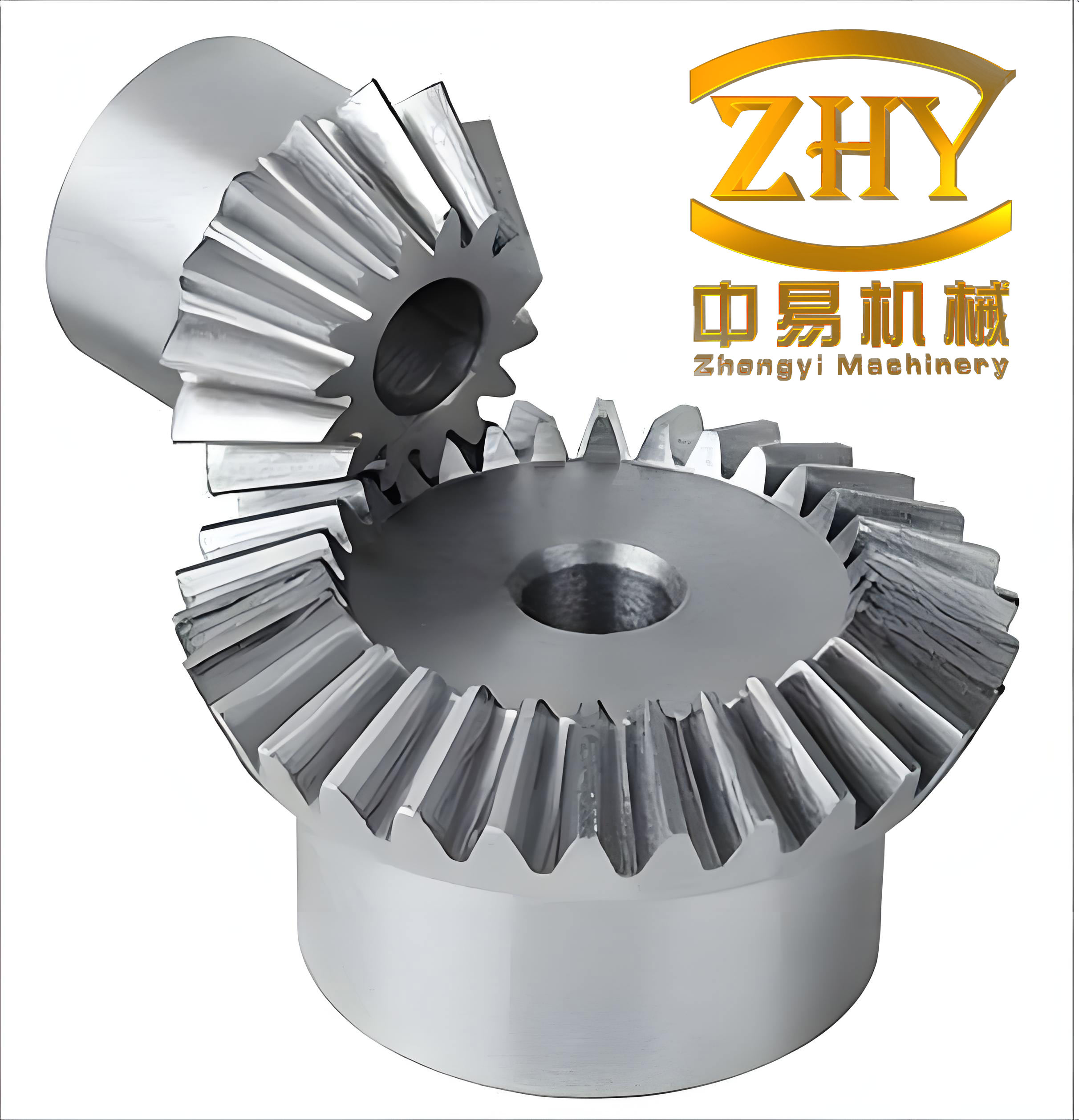
The visual representation above underscores the three-dimensional complexity inherent in straight bevel gear geometry, which our computational methods aim to unravel section by section.
The core of the analysis lies in systematic coordinate calculation. I will begin with the large end normal section, proceed to the small end, address special cases like backless gears, and finally handle arbitrary cross-sections.
Coordinate Calculation for the Large End Normal Section Profile
Consider the tooth profile on the developed back cone at the large end of a straight bevel gear. For inspection convenience, the theoretical outer diameter vertex O is taken as the coordinate origin. Let point M be an arbitrary point on the involute profile. Its coordinates (x, y) are to be determined based on its pressure angle \(\alpha_x\).
The fundamental geometric parameters of the straight bevel gear are defined as follows. First, the pitch diameter on the developed back cone is related to the actual gear dimensions. If \(d\) is the pitch diameter at the large end and \(\delta\) is the pitch cone angle, then the developed pitch circle diameter \(d_f\) is:
$$d_f = \frac{d}{\cos \delta}.$$
The theoretical outer diameter on the developed plane, \(D_{fe}\), considering the addendum \(h_a\), is:
$$D_{fe} = d_f + 2h_a \cdot \cos \delta.$$
The base circle radius \(r_{bf}\) on the developed plane is:
$$r_{bf} = \frac{d_f}{2} \cos \alpha_0,$$
where \(\alpha_0\) is the standard pressure angle. The arc tooth thickness on the developed pitch circle, \(s_f\), and the standard pressure angle \(\alpha_0\) are known.
For point M with pressure angle \(\alpha_x\), the radius vector \(r_x\) and the involute roll angle \(\theta_x\) are:
$$r_x = \frac{r_{bf}}{\cos \alpha_x},$$
$$\theta_x = \tan \alpha_x – \alpha_x \quad \text{(in radians)}.$$
The coordinate \(y_x\) relative to the tooth centerline can be expressed as:
$$y_x = r_x \sin(\psi_x),$$
where \(\psi_x\) is the angle encompassing half the tooth thickness and the involute development. The exact relationship is:
$$\psi_x = \frac{s_f}{d_f} + \text{inv} \alpha_0 – \text{inv} \alpha_x,$$
where \(\text{inv} \alpha = \tan \alpha – \alpha\). Therefore, the coordinates (x, y) of point M, with origin at O, are:
$$x = r_x \cos \psi_x – \frac{D_{fe}}{2},$$
$$y = r_x \sin \psi_x.$$
A significant computational challenge was ensuring that the y-coordinate values are calculated at regular, user-defined intervals (e.g., integer multiples of a step like 0.01 mm) rather than at irregular pressure angle intervals. Using manual methods, controlling this was difficult. I employed a bisection method within the microcomputer program to solve for \(\alpha_x\) corresponding to predefined y values, ensuring uniform spacing ideal for inspection and comparison.
It is crucial to note that at the tip vertex O (where y=0), the involute profile terminates. The pressure angle at the tip, \(\alpha_a\), is determined by the outer diameter:
$$r_a = \frac{D_{fe}}{2} = \frac{r_{bf}}{\cos \alpha_a} \Rightarrow \alpha_a = \arccos\left(\frac{r_{bf}}{r_a}\right).$$
Thus, the chordal tooth thickness at the tip can be calculated using \(\alpha_a\) in the above formulas.
Coordinate Calculation for Small End Normal and Transverse Sections
For straight bevel gears, the tooth dimensions vary linearly along the face width relative to the cone distance. Let \(R\) be the cone distance (pitch cone length). The small end is located at a distance \(\Delta R\) from the large end along the pitch cone. A proportionality factor \(K\) governs the scaling:
| Parameter | Large End (Normal) | Small End (Normal) | Relation |
|---|---|---|---|
| Cone Distance | \(R\) | \(R’ = R – \Delta R\) | – |
| Proportionality Factor | – | \(K = \frac{R’}{R}\) | – |
| Addendum | \(h_a\) | \(h_a’ = K \cdot h_a\) | Scaled linearly |
| Pitch Diameter (dev.) | \(d_f\) | \(d_f’ = K \cdot d_f\) | Scaled linearly |
| Arc Tooth Thickness (dev.) | \(s_f\) | \(s_f’ = K \cdot s_f\) | Scaled linearly |
Using \(h_a’\), \(d_f’\), and \(s_f’\), the profile coordinates for the small end normal section can be computed identically to the large end method, with the origin at the small end’s theoretical outer diameter vertex.
However, for physical inspection, the visible profile on the small end is often in the transverse (axial) plane, not the normal plane. While the transverse profile is not a true involute, its coordinates can be derived from the normal section profile via machining principles and geometric relationships. For a point P on the normal section with coordinates \((x_n, y_n)\), corresponding to a transverse section point with coordinates \((x_t, y_t)\), the transformation is:
$$x_t = x_n,$$
$$y_t = \frac{y_n}{\cos \delta’},$$
where \(\delta’\) is the pitch cone angle at the small end, approximately equal to \(\delta\) for straight bevel gears. To facilitate inspection, I ensure the transverse y-coordinates \(y_t\) are calculated at regular intervals. The program first determines the normal section y_n corresponding to a desired \(y_t\), then computes the associated \(x_n\), and finally derives \((x_t, y_t)\).
Coordinate Calculation for Backless Gears (Large End Transverse Section)
In practices such as manufacturing electrode gears for electrical discharge machining, it is economical to create elongated, backless gears. After each use, the small end can be machined off, and the teeth re-finished, allowing a single blank to be reused multiple times. For inspecting such backless electrode gears, the large end back cone profile is absent; instead, the large end transverse section or cylindrical section profile must be checked. The transverse section profile is preferred for measurement with gear tooth calipers.
To compute the large end transverse section profile, consider a fictitious normal section A-A that passes through the point of interest on the transverse plane. The geometry involves an incremental cone distance shift. Let \(\Delta L\) be the axial distance from the theoretical large end plane to the transverse inspection plane. The corresponding change in cone distance is \(\Delta R_t = \Delta L \sin \delta\). The scaling factor for this fictitious section is:
$$K_t = \frac{R – \Delta R_t}{R}.$$
The parameters for the fictitious normal section A-A are:
$$d_{f,t} = K_t \cdot d_f, \quad s_{f,t} = K_t \cdot s_f,$$
$$h_{a,t} = h_a + \Delta R_t \cos \delta,$$
$$D_{fe,t} = d_{f,t} + 2h_{a,t} \cos \delta.$$
Using these, the profile coordinates \((x_{n,t}, y_{n,t})\) for the fictitious normal section are calculated with its origin at its own theoretical outer diameter vertex. These are then transformed to the transverse section coordinates \((x_{T}, y_{T})\) with origin at the actual inspection plane’s outer point. The relationship is:
$$x_{T} = x_{n,t},$$
$$y_{T} = y_{n,t} \cos \delta + \left[ \left( \frac{D_{fe}}{2} – \frac{D_{fe,t}}{2} \cos \delta \right) – \Delta R_t \sin^2 \delta \right].$$
Again, to standardize inspection, the \(y_{T}\) values are computed at regular intervals using the bisection method to find corresponding normal section parameters.
Coordinate Calculation for Arbitrary Normal Section Positions
During first-article and in-process inspection of straight bevel gears, the actual large end outer diameter may deviate from its theoretical value. In such cases, it is necessary to compute the theoretical tooth profile on the normal section corresponding to the actual measured outer diameter for direct comparison with the manufactured gear, allowing quantification of profile error.
Suppose the theoretical large end normal section is at plane N-N, but the actual gear’s large end is at plane P-P with measured outer diameter \(D_a\). The face cone angle is \(\alpha_f\). The effective cone distance for this actual section, \(R_a\), can be derived from:
$$R_a = \frac{D_a / 2}{ \sin(\delta + \alpha_f) }.$$
Then, the parameters for the actual normal section P-P are:
$$d_{f,a} = \frac{2 R_a \cos \delta}{ \cos(\delta + \alpha_f) } \quad \text{(approximation for developed diameter)},$$
$$h_{a,a} = \frac{D_a – d_{f,a} \cos \delta}{2 \cos \delta}.$$
The arc tooth thickness scales proportionally: \(s_{f,a} = (R_a / R) \cdot s_f\). Using \(h_{a,a}\), \(d_{f,a}\), and \(s_{f,a}\), the profile coordinates for the actual normal section are computed, providing the reference for direct overlay comparison with the measured gear tooth.
Computational Program and Plotting Workflow
The entire methodology is implemented in a structured program using a high-level language. The program flow is designed for flexibility and accuracy in handling straight bevel gears. Below is a summary of the key computational steps and the plotting routine.
| Step | Action | Description |
|---|---|---|
| 1 | Input Master Parameters | Define gear basic data: number of teeth, module, pressure angle \(\alpha_0\), pitch cone angle \(\delta\), face width, addendum coefficient, etc. |
| 2 | Select Calculation Type | User chooses via keyboard input:
|
| 3 | Compute Section Parameters | Based on type, calculate effective addendum, pitch diameter, arc tooth thickness, and outer diameter for the target section using the formulas derived earlier. |
| 4 | Generate Profile Coordinates | For a sequence of y-coordinates (or corresponding roll angles) at regular intervals, use the bisection method to solve for the exact pressure angle \(\alpha_x\) and then compute the corresponding x-coordinate. This ensures evenly spaced points for precise plotting and inspection. |
| 5 | Plot Magnified Tooth Profile | Output the coordinates to a plotter or graphics display, drawing the magnified profile. The plot includes reference circles: tip circle, pitch circle, base circle, and lines indicating chordal tooth thickness at specified addendum heights (e.g., every 0.5 mm). |
The core coordinate calculation for any normal section profile is encapsulated in the following sequence, which is repeated for each point:
- Define target y-value \(y_{\text{target}}\) (regular increment).
- Solve for \(\alpha_x\) such that \(y(\alpha_x) = y_{\text{target}}\) using bisection on the equation:
$$y(\alpha_x) = \frac{r_{bf}}{\cos \alpha_x} \sin\left( \frac{s_f}{d_f} + \text{inv} \alpha_0 – \text{inv} \alpha_x \right).$$ - Compute \(r_x = r_{bf} / \cos \alpha_x\).
- Compute \(x = r_x \cos\left( \frac{s_f}{d_f} + \text{inv} \alpha_0 – \text{inv} \alpha_x \right) – \frac{D_{fe}}{2}\).
- Output (x, y).
For transverse sections, an additional transformation is applied as detailed earlier.
The program’s effectiveness is demonstrated by its ability to generate dozens of accurate profile diagrams for a single straight bevel gear design in minutes, a task that would be prohibitively time-consuming manually. The magnified plots, typically at scales like 50:1 or 100:1, allow for meticulous inspection using optical comparators or coordinate measuring machines. Key features such as tip circle, pitch circle, and base circle are clearly marked, and chordal thickness values at various heights are annotated, providing a complete inspection template.
Practical Applications and Benefits
The application of this computational system extends across the entire lifecycle of straight bevel gears. In design verification, it allows engineers to analyze the tooth form at non-standard sections, ensuring clearance and strength requirements are met. During manufacturing, it provides essential data for setting up gear cutting machines like planers or precision forging dies. For inspection and quality control, the plotted magnified profiles serve as masters for optical comparison, enabling rapid assessment of profile deviations, pitch errors, and tooth thickness variations. The ability to handle arbitrary sections is particularly valuable for troubleshooting meshing issues in assembled gearboxes, where wear or manufacturing errors might localize contact problems.
Moreover, the methodology underscores the importance of digital tools in modern gear engineering. By automating the complex trigonometric and iterative calculations, it minimizes human error and frees up skilled technicians for interpretive tasks. The program can be easily adapted for different gear standards (e.g., AGMA, ISO) by modifying the underlying parameter calculations.
Conclusion
In summary, the variable nature of straight bevel gear tooth profiles demands a rigorous and flexible computational approach. Through the derivation of specific geometric transformations for large end, small end, backless, and arbitrary normal sections, and the implementation of a bisection-based algorithm for uniform coordinate generation, I have established a comprehensive system for profile analysis. The integration of this system with a microcomputer and plotter translates complex mathematical models into practical, actionable engineering drawings. This not only enhances the accuracy and efficiency of straight bevel gear production but also elevates the standard of quality control, ultimately contributing to more reliable and durable gear drives in automotive, aerospace, and industrial machinery applications. The continued refinement of such computational techniques remains pivotal for advancing the design and manufacture of straight bevel gears.